



Reading Nook Ideas With Coffee Tray and Ceramic Mug: What to Compare
Reading time: about 11 minutes
The chair gets the credit. The tray is what makes the corner usable.
In our store we handle ceramic all day, and the return conversation is almost never about the glaze — it is about fit. Most reading nook ideas with coffee tray and ceramic mug pairings fail on a measurement: a tray two centimetres wider than the tabletop, a handle that catches the tray rail, a coaster nobody added into the clearance. People build the corner in the sensible order — lamp, armchair, cushion, throw — then discover there is nowhere to set the cup down except the floor. A week later the corner is where the laundry lands.
Which reading nook ideas with coffee tray and ceramic mug setups survive daily use?
Three things break a tray in a nook, and none of them are about style:
- Overhang. A tray wider than the usable tabletop tips the moment a full mug lands near the edge.
- Crowding. A tray that only fits the mug leaves no room for a coaster, a phone, or the book you set down mid-page.
- Soft ground. A tray balanced on an ottoman cushion or a blanket pile rocks. A rocking tray plus a hot drink is the wrong kind of cosy.
Measure four things before you shop, with the tray still out of the picture: the flat top of your side table in both width and depth, the distance from the table edge to the nearest wall, the table height above your seat, and how far your hand travels from a seated position to the middle of that surface. Those four numbers narrow the field faster than any style filter, and they are the ones buyers skip.
Two buyers, two opposite purchases. A renter with a slipper chair and a narrow drinks table needs a compact tray that leaves bare surface on every side. A reader in a deep wingback with a wide console behind it can run a deep-sided caddy with room for a second refill. That is why, in our store, the tabletop measurement comes before the mug recommendation.
Round, rectangular or deep-sided — which tray shape suits your chair and floor space?
Shape decides more than looks. This is how the common tray styles behave once a mug, a coaster and a book are actually on them:
| Tray type | What it does well in a nook | Trade-off to accept | Best for |
|---|---|---|---|
| Shallow round tray | Soft look; a round rim pairs predictably with round ceramics | Gives up the corners of a square table | One-mug nooks on round side tables |
| Rectangular tray with a low lip | Contains small spills; holds mug, coaster and phone in a row | The lip eats usable interior and can tilt a wide handle | E-reader and tablet readers who set things down often |
| Deep-sided caddy | Carries more and hides clutter between sessions | Tall walls crowd a tall mug, and it is heavier to lift | Long sessions with a second refill |
| Rigid floor tray | No table needed at all | Harder to reach from a deep chair | Low chairs, window corners, floor cushions |
In a studio or a narrow bedroom corner, the side table is usually the smallest object in the setup and the easiest to overbuild. A tabletop barely wider than a dinner plate cannot host a serving tray, and it should not try. Our rule of thumb when we talk to customers: leave a finger's width of bare table on every side of the tray, and never let the tray edge sit proud of the table edge where an elbow can catch it on the way past.
For a one-mug nook, a compact rectangular tray roughly the size of a hardback book holds the mug, a coaster and a phone without turning the table into a sideboard. If your floor space is genuinely tiny, a wall shelf at seat height or a narrow console tucked behind the chair does the same job with no footprint — just check shelf depth against tray depth, because an overhanging tray on a shelf is worse than no shelf at all.
Is a small apartment reading corner with a ceramic mug actually workable?
Yes, and the fix is vertical rather than horizontal. In a small apartment reading corner, the mug does not need a table of its own; it needs one flat, firm landing point within arm's reach of the seat. Four layouts that hold up in rentals where you cannot drill freely:
- Wall shelf at seat height. Zero floor footprint, but the tray must be narrower than the shelf by a clear margin on both sides.
- Narrow console behind the chair. Reaches over the shoulder rather than across the lap — good for deep chairs, awkward if the chair back is high.
- C-clamp side table. Slides over the chair base so the surface sits where your hand already rests. Check the clamp depth against your chair frame before ordering.
- Rigid floor tray beside a low chair. Works only when the seat is low enough that you are not bending to the floor mid-chapter.
Skip the stacked-cushion table. Anything that gives under a full mug is the wrong surface, however good it looks in a photograph.
Will the mug handle clear the tray rail without tilting the cup?
Tray rails are the quiet culprit. A lipped tray with a couple of centimetres of wall looks tidy and contains spills, but it also shrinks the flat interior you can actually use. Put a mug with a wide, chunky handle anywhere near that rail and one of two things happens: the handle rests on the lip and the base lifts, or the cup slides until it wedges. Either way, a full mug is now unstable.
Do the arithmetic before ordering:
- Note the tray's interior depth, rail to rail, and the rail height.
- Read the mug's overall height and handle span off the listing.
- Compare handle span against the gap between mug body and rail when the cup sits centred.
- Add the coaster — a thick cork or stone coaster raises the cup and pushes the handle closer to the lip.
Cup height matters as much as handle width. On a low side table beside a deep armchair, a tall mug puts the rim right at elbow level, where it gets knocked rather than reached for. A shorter, wider cup sits below the arm line and survives. That is also why tall mugs tend to suit narrow desks better than deep lounge chairs — different reach geometry entirely.
Which ceramic details should you confirm on the listing before you order?
Care claims are where generic advice goes wrong. The page for the exact mug you are buying is the only reliable source for whether it is dishwasher safe, microwave safe, or hand wash only. Do not infer it from the shape, the glaze colour, or the fact that a similar mug in the same collection is machine-safe — metallic lustres, hand-painted rims and gold detailing commonly are not, and one hot cycle can dull them permanently.
Four details worth reading off the listing and the reviews:
- Foot ring finish. An unglazed or slightly rough base acts like fine sandpaper on painted and lacquered trays. A felt pad fixes it for pennies.
- Glaze behaviour. Fine surface crazing — the spiderweb crackle some glazes are designed to show — is decorative. A crack you can feel with a fingernail is not, and that cup should be retired.
- Thermal shock. Pouring boiling water into a cold, thick-walled mug stresses the body. Warming it with tap water first costs five seconds.
- Weight when full. A heavy mug on a light tray on a soft surface is the classic tip-over. Heavier ceramics want a firmer, wider base underneath.
Where the round coffee tea mug fits a nook — and where a different shape is the better buy
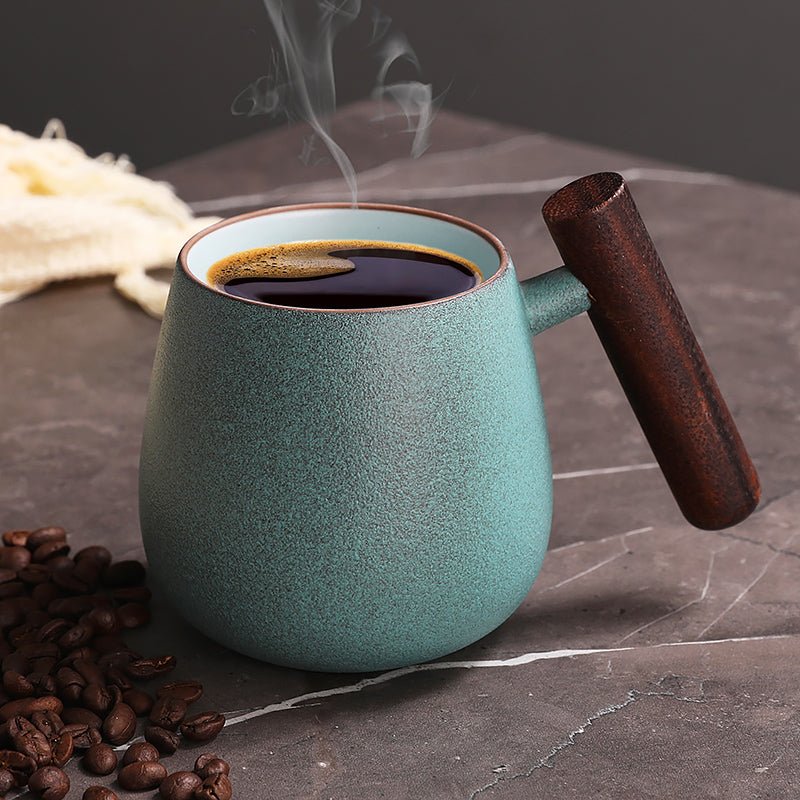
Our round coffee tea mug is the piece we point most nook builders toward first. The name tells you the body is round, and a round body sits predictably against a round tray rim; the curve also gives your hand somewhere to land in low lamp light when you do not want to hunt for the handle. We are not going to quote dimensions from memory — ceramic runs vary, and a few millimetres of handle span decides whether a cup sits flat on a lipped tray. Confirm three numbers on the current listing before you commit: overall height, rim diameter and stated capacity. Then read the care line for its exact dishwasher and microwave wording.
Where it is not the right pick: if your reading sessions run long enough that you refill two or three times, a larger vessel will serve you better and you will resent the extra trips. Same if you drink iced coffee in volume and need room for a lot of ice plus liquid. And if you read with the mug balanced on a chair arm rather than on a tray, a wide, low base is more forgiving there than a taller cup.
If the mug is meant to be the decorative element of the reading nook rather than a neutral supporting act, browse the unique coffee mugs collection — that is where we keep the shapes and finishes that hold a shelf on their own. Either way, the tray logic does not change: the more sculptural the mug, the more you want a plain tray under it.
One small trick from handling these setups daily: on a square tray, a round mug leaves triangular gaps at the corners. Drop a small dish or a tea bag rest into one and the tray stops looking half-empty.
How do lamp position, seat height and season change the tray setup?
Put the lamp on your non-dominant side. Otherwise you reach across a full mug every time you adjust the light, and that is how spills happen. The tray belongs on your dominant side, at or slightly below seat height, within one relaxed arm's length. If you have to lean out of the chair to reach it, you will stop using it and start balancing the mug on the armrest instead.
Season changes the kit more than most buyers expect:
- Cold months. A deeper tray with a raised rail contains a hot mug and a folded cloth; a lid or a saucer keeps the drink warm through a long chapter.
- Warm months. Iced drinks sweat. An absorbent coaster or a lipped tray keeps condensation off wood veneer and off whatever book jacket you set down beside it.
- Year round. Keep a dry cloth on the tray. Ceramic plus condensation plus a smooth tray equals a cup that slides.
If you are choosing between a taller cup for winter and a shorter one for iced drinks, keep the round ceramic mug listing open beside your measurements and check the stated height against the clearance between your tabletop and the chair arm.
Which measurements settle the tray-and-mug decision fastest?
Run this checklist before you add anything to a cart. It takes about four minutes with a tape measure and it saves a return:
- Tabletop width and depth, plus the clear space around it.
- Tray interior depth rail to rail, and rail height.
- Mug height, rim diameter and handle span as stated on the exact listing.
- Chair arm height versus table height — the mug rim should sit below the arm line, not level with it.
- Coaster thickness, added to mug height for the real clearance figure.
- Care wording on the listing, so you know whether the mug gets a dishwasher cycle or a hand wash.
If those numbers line up, the corner works; if they do not, no amount of styling rescues it. Start with the round coffee tea mug when you want a shape that sits predictably on a round tray rim, or shop the full unique coffee mugs collection when the mug is the focal point. Then measure the tray against the table before either one arrives.
Frequently asked questions
Do reading nook ideas with coffee tray and ceramic mug setups work in a studio apartment?
Yes, provided the tray lives on a vertical surface rather than a floor-standing table. A wall shelf or a narrow console behind the chair frees floor space and puts the mug at a comfortable reach. Measure shelf depth against tray depth first, because an overhanging tray on a shelf is a spill waiting to happen.
How big should the tray be for a single mug?
Big enough for the mug, a coaster and one more object — a phone, a teaspoon rest, or a folded cloth — with a finger's width to spare on each side. For most single-mug nooks that means a compact tray rather than a serving tray, sitting on a table visibly wider than the tray itself.
Is a ceramic mug safe to sit directly on a wooden tray?
It is, as long as the foot ring is smooth or you use a coaster. Unglazed or roughly finished bases leave a dull ring on oiled and lacquered woods over a few months. Check the base finish on the listing and add a felt pad if you are unsure.
Can the round coffee tea mug go in the dishwasher?
Only if that specific listing says so. Care instructions follow the glaze and decoration method, not the shape or the collection, so confirm the wording on the page for the exact mug you are buying. Hand washing is the safer default for anything with metallic or hand-applied detail.
What if my corner has no room for a table at all?
Use a firm, flat perch instead of a soft one: a narrow windowsill, a stable stool, or a floor tray with a rigid base beside a low chair. Avoid cushions and blanket piles — anything that gives under a full mug is the wrong surface, however good it looks.
Ready to pick your mug? Two ways to save on today's order:
Ordering 1–3 mugs? Get an extra 10% off your 1st order with code 10_OFF Apply 10% Off & Shop Wooden-Handle Mugs →
Gifting 4+ mugs? Buy 3, Get the 4th Free applies automatically at checkout (no code needed; offers do not stack) · Free standard shipping (Nov pre-Christmas delivery: 15–20 calendar days US) · Free replacement if chipped in transit.
Popular mug buying guides: Ceramic Tea Cups & Infuser Mugs · Ceramic Mugs with Lids Compared · Wooden-Handle Tea Infuser Mugs Compared · Christmas & Secret Santa Mugs 2026 · Espresso & Cortado Cups Guide · Cup & Saucer Gift Sets · All 25 Mugs Spec Table · Mug Size Guide · Shipping & Promo FAQ
FIRST ORDER 10% OFF (CODE: 10_OFF) · OR BUY 3, GET THE 4TH FREE


Read more

Ceramic Mugs for Table Styling Ideas: What Buyers Compare First
Two ceramic mugs can carry a whole table setting — if the heights, glazes, and rim shapes actually talk to each other. Here is what we compare before recommending a pair, the three setups we build ...
Read more
How to Choose Ceramic Mug for Daily Coffee Routine: 5 Counter Checks
Most daily mugs fail for reasons you can see before you buy: a thin rim, a pinching handle, a glaze that stains, or a capacity that doesn't match your pour. Here's the counter check we run in our s...
Read more
Leave a comment
This site is protected by hCaptcha and the hCaptcha Privacy Policy and Terms of Service apply.