



Ceramic Mugs for Table Styling Ideas: What Buyers Compare First
Reading time: about 9 minutes
Two mugs on a dining table look deliberate. Three usually look like you forgot to clear the dishes.
That gap between styled and cluttered is what shoppers are really asking about when they search for ceramic mugs for table styling ideas. The mug itself is rarely the problem — the count is, the height mix is, and the glaze usually is too. In our store we field the same handful of questions week after week: will these two read as a pair, will they scuff the table, will they survive a dishwasher cycle. Most of them come down to four comparisons you can make in about five minutes with nothing but the product listings in front of you.
Ceramic mugs for table styling ideas: how many actually belong on the table?
Fewer than most people think. A dining table is a working surface for most of the day, and every object on it has to earn its square footage.
- One mug reads as a place setting, not a display. Fine if you are photographing breakfast for one; weak as styling.
- Two mugs is the sweet spot. Identical pairs read as a matching set; two different silhouettes in the same glaze read as a decision someone made on purpose.
- Three or more only works when they are corralled — a tray, a wooden board, a runner. Left loose, they turn into clutter by the second morning.
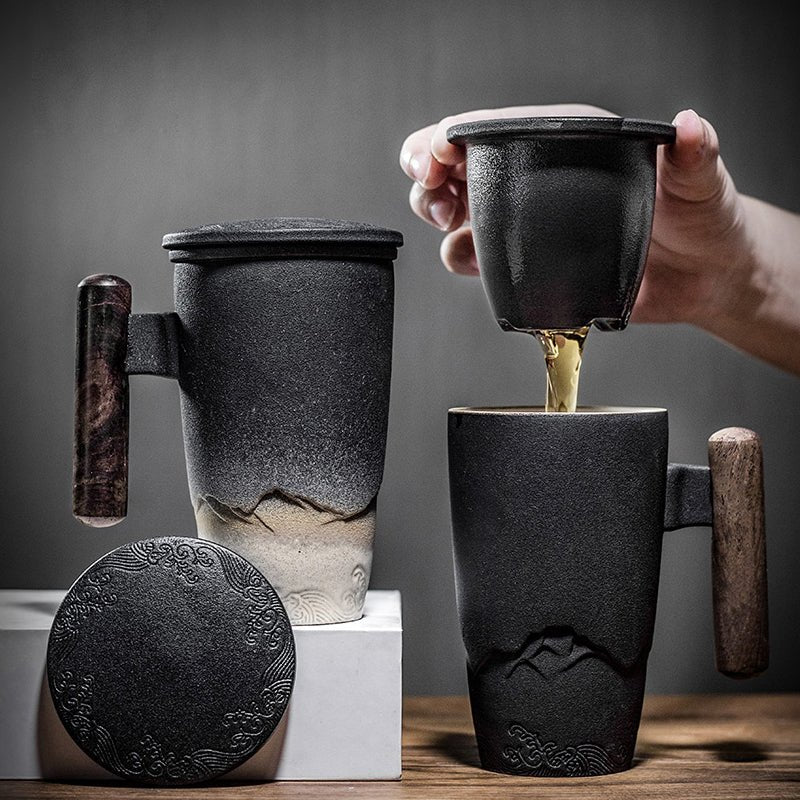
The practical version: style two, store the rest, rotate when the season changes. If you are starting from nothing, our unique coffee mugs collection is where we point shoppers who want two silhouettes that can sit together without looking like a matched set pulled from a box.
One distinction we draw early, because it changes the buying decision: a table set for guests is a different problem from a table styled for the room. Guests need four mugs that stack, wash, and match. The room needs two that look good doing nothing. Buying for the second scenario and then hosting for six is the most common mismatch we see.
Why a tall mug next to a round mug reads as a pair — and when the height gap breaks it
A pair reads as a pair when there is a visible step between the two heights from across the room. Not a staircase — one step. Two mugs of near-identical height and width look like duplicates, and duplicates on a table look like you are mid-chore.
This is where our two house silhouettes split, at least going by the listing names and photography. The Landscape Tall Coffee & Tea Mug is the vertical piece — the one you place behind a low bowl or beside a jug so the arrangement has a top edge. The Round Coffee & Tea Mug is the grounded, round counterweight that stops the taller mug from looking like it is standing alone.
Here is the caveat we always raise, and it matters: the exact height, rim diameter, and capacity are stated on each product page, and you should read those numbers before you commit rather than judging from photographs. Two listings shot separately can look far closer in scale than they are. A tall mug plus a low bowl on a narrow table crowds the sightline fast, and a mug that looks generous on screen can turn out to be a two-sip pour. We will not guess those measurements for you — check the current listing.
Rim width does quiet work too. A wider rim gives foam and crema somewhere to sit and makes the mug feel generous at breakfast; a narrower rim reads more formal, which is why it tends to look better after dinner than at 7 a.m. If your table is a low coffee table rather than a dining table, the height math changes completely — our coffee table styling guide covers that version of the problem.
Gloss, matte, or speckled: how the glaze reads at 7 a.m. and again at 8 p.m.
Glaze is where table styling quietly succeeds or fails, because it behaves completely differently under morning window light and an evening pendant lamp.
- Gloss bounces light. Under a warm bulb it punches above its weight and photographs beautifully — but it also mirrors every fingerprint and water spot.
- Matte absorbs light and looks calm. The trade-off is real: matte surfaces show coffee oils and lip marks sooner, so they need a wipe after use to keep the table looking styled rather than used.
- Speckled and clay-toned glazes hide water spots and hard-water rings better than either, which is why they suit kitchens with busy sinks and thirsty dishwashers.
The rule we give shoppers is to vary exactly one axis. Match the silhouette and contrast the glaze, or match the glaze and contrast the height. Vary both and the pair stops reading as a pair; vary neither and you have bought the same mug twice.
| Pairing | Silhouette | Glaze | What it reads as |
|---|---|---|---|
| Two shapes, one glaze | Contrast | Matched | A collected pair |
| Two glazes, one shape | Matched | Contrast | A deliberate set |
| Two shapes, two glazes | Contrast | Contrast | Accidental, unless a third piece ties them together |
| One shape, one glaze | Matched | Matched | Duplicates — reads as laundry, not styling |
There is a longer breakdown of colour and height combinations in our guide to pairing ceramic mugs by colour and height if you are deciding between two close options.
What survives daily table duty — crazing, thermal shock, and the unglazed foot ring
Styling is half the purchase. The mug then has to come off the table, get washed, and go back on without degrading, and that is where cheaper ceramics give themselves away.
- Crazing is the fine web of cracks that develops in a glaze over years. It is common on older ceramics and often cosmetic, but it is worth knowing what you are looking at before you assume a mug is damaged.
- Thermal shock is the real killer. Pouring boiling water into a cold, thick-walled mug is the classic way to crack one. Pre-warming with tap water takes ten seconds and prevents most of it.
- The unglazed foot ring — the rough band under the base — is rougher than it looks. On a waxed or oiled wood table it can scuff, so a felt pad or a tray under a styled pair is not just decorative.
- Dishwashers dull matte glazes over time through detergent and high heat. If the finish is the reason you bought the mug, hand-wash it.
As a category, thicker-walled stoneware holds heat longer and feels more substantial in the hand, which is why we like it for a slow morning. It also tires your wrist on a large pour-over, and a chipped rim is sharp. Whether either of our two mugs is stoneware or porcelain, and whether it is rated for the dishwasher, is a listing-level detail — read the material and care lines on the product page rather than inferring from the photo.
Three setups we actually recommend: weekday breakfast, dinner service, holiday drinks station
The mistake is building one permanent arrangement and expecting it to suit every meal. Build three small ones and swap them.
- Weekday breakfast. A short runner down the centre, two mugs a hand's width apart with handles turned the same direction, a small jar of jam, one folded napkin. Nothing else. Sixty seconds to reset, and it survives being cleared for lunch.
- Dinner service. Take the mugs off the table during the meal entirely, then bring them back with dessert. A mug sitting next to a dinner plate reads casual no matter how good the glaze is.
- Holiday and gifting season. Two mugs plus a bowl of cocoa or a small jug of cream becomes a drinks station guests can use without asking. If the pair is going to someone else rather than staying on your table, our notes on ceramic mugs as gifts cover the capacity, design, and care comparisons worth checking first.
Seasonal rotation is the cheapest styling upgrade there is, and it is mostly about colour temperature. Warm clay and sand tones sit easily next to autumn linens; deep glazes and heavier shapes hold their own against a winter tablecloth; pale glazes and lighter silhouettes recede in a good way once the days get long. Rotate the pair, not the whole table.
Where ceramic mugs are the wrong buy for a styled table
We talk people out of this purchase more often than you would expect. Here is when.
- Homes with toddlers and hard floors. Thick stoneware chips, and a chipped rim is sharp. Thin porcelain cracks instead. Neither makes a table you can relax around.
- Covered patios and sunrooms. Rapid temperature swings are the fastest route to a crazed glaze, and wind takes loose mugs off a table.
- Small kitchens where everything must stack. Two different silhouettes do not nest. If storage is tight, a matching four is the practical choice even though it styles less interestingly.
- Espresso drinkers. A tall mug holding a single shot looks absurd on a laid table. Scale the vessel to the pour, not to the photo you liked.
If the goal is a table you never think about, glass or stainless will always be easier. Ceramic earns its place through texture, weight, and the way it holds heat — not through convenience.
The five-point check we run before we recommend a pair
- Read the capacity on each listing and match it to what you actually drink. A mug that is too large for your usual pour sits half-full in every photo you take.
- Confirm the height difference using the numbers, not the product photos — visible but not comical.
- Picture the glaze against your table linen and your dining bulb warmth. Matte and gloss read very differently after dark.
- Plan for the foot ring — coaster, tray, or felt pad — if your table is finished wood.
- Find the care instructions on the listing before you buy, not after the first wash.
Then start with two silhouettes rather than four of one: the round mug low and forward, the tall mug behind and slightly offset, handles turned the same way. That is the arrangement we see work most often on real tables, not just in the photos customers send us. Browse the full range of unique coffee mugs to see both shapes side by side, and let the measurements on each listing settle the rest.
Frequently asked questions
Are ceramic mugs for table styling ideas worth buying in pairs rather than sets of four?
For styling, yes. Two mugs read as an arrangement; four read as a set waiting for guests. Buy the pair for the table and add more later only if you actually host.
Should a pair of ceramic mugs on a table match exactly?
Not exactly. Pick one thing to share — the glaze or the silhouette — and let the other differ. Matching both looks like a shop display; matching neither looks accidental.
Can ceramic mugs go in the dishwasher if they are part of a styled table?
Check the care note on the specific listing, because finishes vary. As a rule, matte glazes dull faster in a dishwasher, and any metallic trim should stay out until the listing says otherwise.
Do ceramic mugs scratch wood tables?
The unglazed ring under the base is rougher than it looks and can scuff a waxed or oiled finish. A felt pad or a tray under a styled pair solves it completely.
What is the fastest way to stop mugs looking cluttered on a dining table?
Cut the count to two and put them on something — a runner, a board, a tray. A boundary does more for a table than any amount of rearranging.
Ready to pick your mug? Two ways to save on today's order:
Ordering 1–3 mugs? Get an extra 10% off your 1st order with code 10_OFF Apply 10% Off & Shop Wooden-Handle Mugs →
Gifting 4+ mugs? Buy 3, Get the 4th Free applies automatically at checkout (no code needed; offers do not stack) · Free standard shipping (Nov pre-Christmas delivery: 15–20 calendar days US) · Free replacement if chipped in transit.
Popular mug buying guides: Ceramic Tea Cups & Infuser Mugs · Ceramic Mugs with Lids Compared · Wooden-Handle Tea Infuser Mugs Compared · Christmas & Secret Santa Mugs 2026 · Espresso & Cortado Cups Guide · Cup & Saucer Gift Sets · All 25 Mugs Spec Table · Mug Size Guide · Shipping & Promo FAQ
FIRST ORDER 10% OFF (CODE: 10_OFF) · OR BUY 3, GET THE 4TH FREE


Read more
Ceramic Coffee Mug by the Window: What to Compare Before Buying
A window sill asks different things of a mug than a desk does: a footprint that fits the ledge, a handle you can clear one-handed, and a glaze that holds up to direct sun. What to measure, what to ...
Read more
Reading Nook Ideas With Coffee Tray and Ceramic Mug: What to Compare
A tray-and-mug pairing is what turns a corner chair into a nook you actually use. Here are the measurements, handle-clearance checks and ceramic care details worth comparing before you buy.
Read more
Leave a comment
This site is protected by hCaptcha and the hCaptcha Privacy Policy and Terms of Service apply.