

Golden Waves Coffee Mug vs Tea Mug Difference: What to Check First
Reading time: about 9 minutes
Last month a customer emailed us a photo: her new gold-decorated mug sitting beside her espresso machine, looking oddly small, with a note asking whether we had shipped the wrong product. We hadn't. She had run into the most common mix-up in drinkware — coffee mugs and tea cups are sized, shaped, and finished for different jobs, and styling alone doesn't tell you which is which. If you're weighing the golden waves coffee mug vs tea mug difference before you order, the honest answer is that it comes down to five measurable things, and only one of them is looks.
The golden waves coffee mug vs tea mug difference in five points
Here's the comparison we give shoppers at our counter, condensed:
- Capacity: coffee mugs run larger because coffee is one long pour; tea cups stay smaller because refills come from the pot.
- Shape: mugs are taller and straighter; tea cups are wider and shallower, which brings tea to drinking temperature faster.
- Rim: tea cups usually carry a thinner, finer edge for delicate sipping; mugs favor a sturdier lip that survives daily handling.
- Handle and saucer: tea cups traditionally pair with a saucer; mugs stand alone on a desk or counter.
- Care: metallic gold decoration changes how you wash and reheat, no matter which drink you pour into it.
Side by side: typical coffee mug and tea cup dimensions
Treat the table below as drinkware convention, not law — individual designs vary widely. Use it as a starting point, then verify the actual numbers on any product listing before you buy.
| Feature | Classic coffee mug | Traditional tea cup |
|---|---|---|
| Typical capacity | Roughly 240–350 ml (8–12 oz) | Roughly 150–240 ml (5–8 oz) |
| Silhouette | Tall, straight sides | Wide, shallow bowl |
| Rim | Thicker, durable edge | Thin, fine edge |
| Wall | Heavier, holds heat | Lighter, shows tea color |
| Saucer | Rarely included | Commonly paired |
| Suits | Filter coffee, lattes, long sessions | Pot-brewed tea, guests, rituals |
One note from our own shelf: the Golden Waves Kio Coffee Tea Mug is named for both drinks, which tells you it's positioned as a crossover piece. What we won't do is guess its capacity, wall thickness, or care rules from a photo. The stated ml and oz on its listing are the numbers that matter — check them against the table above before deciding which camp it plays in.
Why is a tea cup smaller and wider than a coffee mug?
Tea is brewed in a pot and poured in rounds, so the cup's job is to present a small serving at drinking temperature — not to store heat for an hour. A wide, shallow bowl does that well: more surface area releases aroma, and the broader footprint sheds excess heat quickly so the first sip doesn't scald. The saucer underneath catches drips and lets you move a hot cup without juggling it.
"I thought I was buying a mug. It holds one good cup of tea and then it's done." — a note that stayed with us from a returned gift set last spring.
Coffee culture built the opposite vessel. Filter coffee and café milks get sipped slowly over an hour, so the mug needs volume and thermal mass: taller walls, thicker ceramic, a rim that survives repeated lifts. Two reference points are worth knowing here. The Specialty Coffee Association's standard cupping cup holds 150 ml — a small volume chosen for evaluating aroma and flavor. The FDA defines a household "cup" as 240 ml, the number nutrition labels are built on. Most everyday coffee mugs are designed to meet or beat that 240 ml line, while tea cups often sit closer to the tasting volume. Neither approach is better. They answer different questions.
How do rim shape and wall thickness change your drink?
Rim thickness is the detail most comparisons skip. A thin rim lets tea flow onto the palate with almost no head tilt, and you notice texture — that's why fine teaware feels quiet when you drink from it. A thicker, straighter rim is less refined but far more durable; it shrugs off being knocked beside a keyboard and washed daily in an office kitchen.
Wall thickness works the other lever. Heavy walls hold temperature and shield your hands, which suits a long black that needs to stay warm through a morning of emails. Thin porcelain or bone china cools faster and shows the liquor's color through the side — lovely for a weekend pot of darjeeling, less ideal for the person who nurses one drink until lunch. Mouth width matters too: a wide opening throws aroma up and away, while a taller, narrower mug gathers it toward your nose as you lean in to sip.
Is the gold on golden waves mugs real gold — and can it go in the microwave?
Decorative gold on ceramics is usually applied as a luster or overglaze — a metallic finish laid over the fired glaze, often in a separate firing pass. Some lusters contain real gold in the compound; others use metallic substitutes. Listings rarely spell this out, and we won't claim to know a finish we haven't seen documented. What we can tell you is how to live with one:
- Skip the microwave. USDA microwave guidance treats metal as a sparking hazard, and metallic decoration is exactly that. The safe habit for any gold-decorated mug is to reheat the drink in a plain vessel, not the decorated one.
- Hand wash gently. A soft cloth and mild detergent keep gold edges bright; abrasive scrubbers and hot dishwasher cycles slowly wear metallic detailing away.
- Read the listing's care line. The FDA publishes guidance on metals in ceramic foodware, which is why we think sellers should state materials plainly. If a listing doesn't say the finish is dishwasher-safe, assume it isn't.
That's the honest trade-off with gold-decorated pieces: they ask more of you than a plain glazed mug, and they reward you at the table. If that trade doesn't sound worth it, better to know before ordering than after.
When is a golden waves mug the wrong choice?
We'd rather lose a sale than set a customer up to resent their mug. A gold-decorated piece is the wrong call if any of these describe your kitchen:
- You microwave your coffee back to life two or three times a day. Buy plain ceramic with no metallic decoration.
- Everything you own goes through the dishwasher on a hot cycle, no exceptions.
- You drink 450 ml or more, travel-mug style, from one vessel. Decorative mugs often prioritize form over sheer volume — verify the stated capacity first.
- Your mug lives in a shared office kitchen with industrial equipment. Delicate rims and metallic finishes rarely survive that environment.
None of this is a criticism of the style. It's about matching the object to the life it will actually live on your counter.
Which mug suits your ritual — or the person you're buying for?
Three scenarios we see constantly in orders and gift notes:
- The one-long-coffee desk drinker. They need real capacity and a shape that survives a cluttered desk. Check the stated volume on the Golden Waves Kio Coffee Tea Mug listing first — if it matches their usual pour, the gold waves make an everyday mug feel deliberate. If they need bigger, browse our unique coffee mugs collection and compare silhouettes side by side.
- The weekend pot-of-tea host. Smaller servings, refills from the pot, a table that looks considered. A gold-styled crossover mug works here precisely because it presents well beside a teapot and pours a generous single serving.
- The gift buyer who doesn't know the recipient's drink. This is where the vessel difference matters least and presentation matters most. Gold wave detailing reads as special straight out of the box, and we always suggest tucking a care note inside — gentle wash, no microwave — so the finish survives the recipient's habits. For a committed tea purist, ask first whether they drink from saucers; some treat that as non-negotiable.
Still comparing volumes after all this? Our coffee mug vs tea mug size comparison breaks ounces and fit down drink by drink.
Frequently asked questions
Can I use a golden waves coffee mug for tea?
Yes — liquid doesn't care what the vessel is called. What changes is the experience: a larger mug holds heat longer, so tea sits hotter and can over-steep if leaves stay in the water. Use an infuser you can remove, or accept milder refills as you top up.
How many ml does a coffee mug hold compared to a tea cup?
There's no single standard, but two anchors help: the FDA's household cup is 240 ml, and most everyday coffee mugs are built to meet or exceed it, while traditional tea cups often land closer to 150–240 ml. The only number that matters for a specific mug is the capacity stated on its listing — check it in ml and oz before ordering.
Is the gold decoration on golden waves mugs real gold?
Usually it's a metallic luster or overglaze fired onto the surface rather than solid gold, though formulations vary by maker and listings rarely disclose details. Treat it as decoration either way: keep it out of the microwave, wash it gently, and it holds its look for years.
Are gold-rimmed mugs safe in the microwave?
The cautious answer is no. USDA microwave guidance warns that metal in a microwave can spark, and metallic decoration counts. If a specific listing states its finish is microwave-safe, follow that; when the listing is silent, reheat in a separate plain vessel.
For gift buyers, what is the golden waves coffee mug vs tea mug difference?
A coffee mug signals a daily workhorse; a tea cup signals ritual and presentation. The Kio mug sits deliberately between the two — it's named for both drinks, which makes it a safe pick when you don't know the recipient's habit. Confirm the capacity on its listing and add a care note to the box.
Before you order: a 60-second checklist
- Find the stated capacity in ml and oz on the product listing.
- Pour your usual morning drink into a measuring jug once — the number surprises almost everyone we walk through it.
- Be honest about your habits. Do you microwave? Dishwash everything? Buy accordingly.
- Check the material and whether a saucer is part of the set.
- Match the vessel to the drink you actually make most mornings, not the one you imagine hosting.
Run those five checks and the choice makes itself. You can verify the current capacity and care details on the Kio mug's listing, or compare shapes across the unique coffee mugs collection until one matches your counter.
More from our blog
Read more
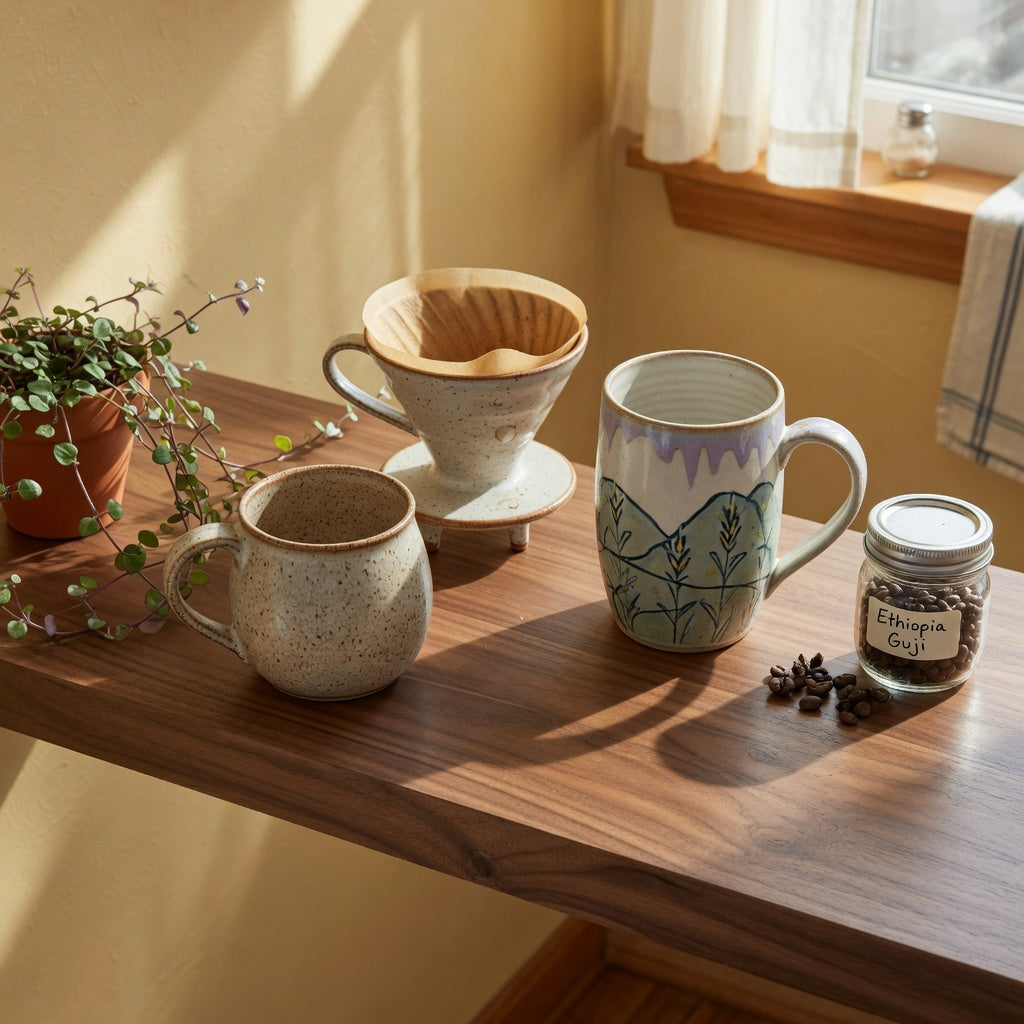
Ceramic Mug Pair Styling Ideas: What Buyers Should Compare
We pack and style ceramic mugs every working day. This guide covers the ceramic mug pair styling ideas that hold up in real kitchens — coffee bar, shelving, desk, guest tray — plus the size, glaze,...
Read more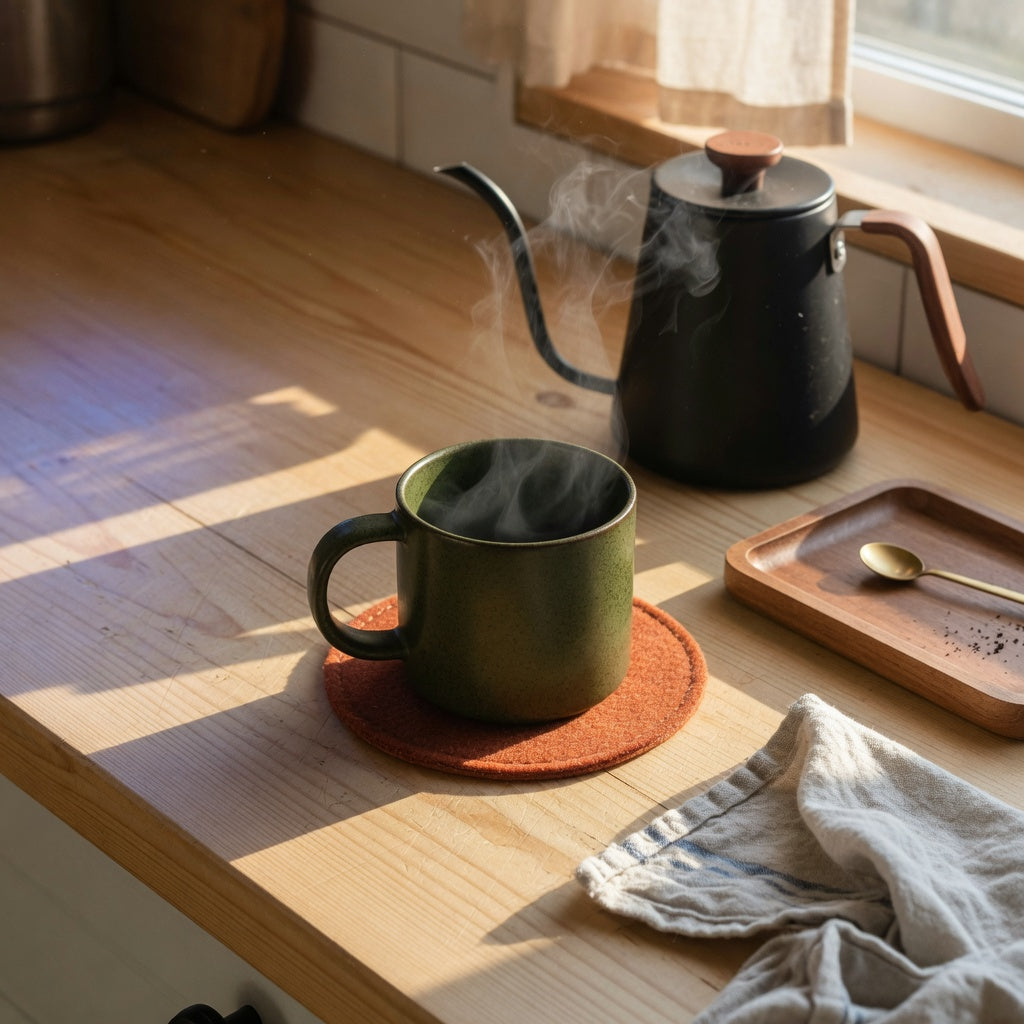
Quiet Coffee Routine Ceramic Mug: What Buyers Should Compare
Weight, wall thickness, rim shape, glaze safety, and honest heat behavior — what actually separates a calm-morning ceramic mug from an ordinary one, written by the team that checks these mugs befor...
Read more
Leave a comment
This site is protected by hCaptcha and the hCaptcha Privacy Policy and Terms of Service apply.