



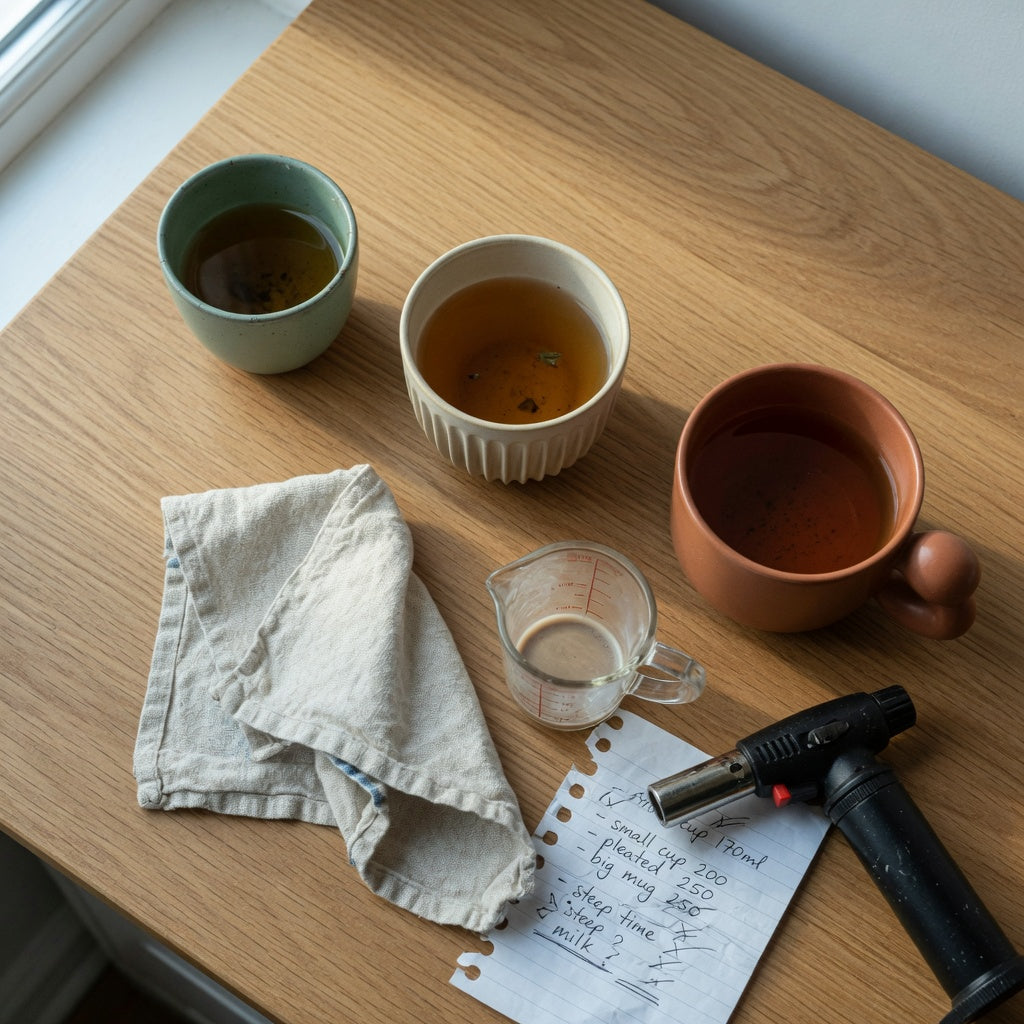
Pottery Tea Cups Shared Household Practical Purchase Checklist
Reading time: about 12 minutes
Four people share our office shelf, and none of them drinks tea the same way. Two pour small amounts and refill three times before lunch. One fills a mug to the brim and carries it to a desk two rooms away. The fourth only reaches for a cup when everything else is already in the sink. That is the real test of pottery tea cups in a shared household — not how they look lined up on day one, but whether anyone still reaches for them in week six.
We sell these cups one at a time rather than in matched sets, which means we hear the follow-up. A customer comes back for a second cup, or admits the one they bought sits untouched because it was too small for the way they actually drink, or too hot to hold without a towel. This pottery tea cups shared household practical purchase checklist is what we run before recommending anything to a house with more than one drinker in it.
Who drinks from the shelf, and how much do they actually pour?
Capacity is the first split, and it is the one households get wrong most often. A cup that feels perfect for a fast green tea refill feels stingy to the person who wants to carry tea to a desk and forget about it. Work backwards from the pour, not from the shelf photo.
| Pour habit in the house | Typical serving | Cup to start with | What you give up |
|---|---|---|---|
| Short, frequent pours — green tea, light oolong, tasting | Roughly 120–170 ml | Retro ceramic tea cup, 170 ml | More refills; not a desk-session cup |
| Everyday tea with a little headroom | Roughly 180–200 ml | Pleated ceramic tea cup, 200 ml | Little margin if someone pours to the brim |
| Mug-style serving, carried out of the kitchen | Roughly 230–250 ml | Ball Handle ceramic mug, 250 ml | Heavier when full; needs more shelf depth |
In our experience, the households that end up happy buy two capacities instead of four of the same thing. One small cup for the frequent pourers, one larger vessel for the carry-it-away drinker. The argument about who gets the good cup mostly disappears once there is no single good cup.
A 250 ml mug also leaves room for milk without pushing the tea up to the rim, which matters if anyone in the house takes their black tea strong and milky. The 170 ml cup does not — fill it three-quarters and you have a very short drink.
To see the full spread of shapes before narrowing down, the unique coffee mugs collection lays the forms out side by side.
What do 170 ml, 200 ml, and 250 ml look like next to a normal mug?
Numbers on a listing are hard to picture, so here is a scale to hang them on. The FDA describes cups and mugs as small ceramic hollowware used for hot drinks such as coffee or tea, normally holding about 240 ml (8 fl oz) and made with a handle. Compare our three sizes against that reference:
- 250 ml (Ball Handle) sits just above the 240 ml mark. It is the closest thing here to a standard mug pour, and the extra headroom leaves space for milk without threatening the rim.
- 200 ml (Pleated) lands roughly 40 ml below the reference — a moderate teacup. Comfortable for a single steep, tight if someone pours right to the edge.
- 170 ml (Retro) is around 70 ml below the reference and reads as a genuinely small cup. Excellent for short, hot pours; frustrating for anyone who likes a long, slow drink.
Two details worth knowing before you commit. First, listed capacity is measured to the rim; a comfortable pour sits lower, so leave 15–20 mm of headroom or you will be wiping the counter every morning. Second, do the jug test on the cup you use now — fill it with water, pour that into a measuring jug, then measure what you actually drink in one sitting. Most people are surprised by the gap between those two numbers, and that gap is the number to shop from.
There is also a guidance gap worth flagging. The FDA mug reference assumes a handled vessel around 240 ml and does not carve out handleless tea cups as a separate category. A small handleless cup sits partly outside that frame, which is one more reason to ask the seller directly rather than assume a generic food-safe badge covers it.
Glaze, lip contact, and what “food safe” should mean in a four-person house
Pottery deserves more scrutiny here than porcelain or glass. The FDA notes that lead can be present in the glazes or decorations on some traditional pottery, and that improperly fired ware can release lead into food and drink; when a piece is fired at the right temperature for the right time, essentially all the lead is bound into the glaze. The agency also lists the ceramicware it considers higher concern:
- Handmade pieces with a crude appearance or irregular shape
- Antique or vintage ware
- Damaged or heavily worn surfaces
- Items from flea markets, street vendors, or an unidentifiable maker
- Brightly decorated pieces in orange, red, or yellow
Everyday factory-made commercial pottery is treated as much less likely to have a lead problem. A shared household shelf, though, is exactly where a decorative market find ends up in rotation next to the everyday cups. Four boundaries we hold to:
- Washing will not fix it. The FDA is clear that no amount of washing, boiling, or other processing removes lead from pottery. If a cup is suspect, it becomes a pen holder.
- Decorative means decorative. Ornamental ceramicware that looks like it could hold food is generally treated as foodware unless it is permanently marked not for food use, carries the required warning, or has a hole bored through the food-contact surface.
- “Lead free” is a regulated claim. The FDA says ware with extractable lead under its test method should not be labeled lead free, and doing so may be considered misleading. Treat the phrase as meaningful only when it is tied to a finished-piece test.
- There are numeric limits. Under FDA guidance, cups and mugs are subject to a lead guideline of 0.5 micrograms per mL of leaching solution, and small hollowware under 1.1 liter carries a cadmium guideline of 0.5 micrograms per mL.
Where that leaves us: our Retro, Pleated, and Ball Handle listings state capacity and a ceramic body. We do not make leach-test claims for them on this page, and you should not read a general care article — ours included — as a substitute for a finished-piece report. If documented testing matters to you, and for a cup used daily by four people it reasonably might, ask before you order and we will tell you exactly what we have.
Crazing, pinholes, and chips — design feature or failure?
This is the part of the job photos cannot do for you, so do it the day the box arrives, in daylight, before the packaging goes out with the recycling. In our experience most disputes about pottery are not about the glaze recipe at all — they are about a hairline someone spotted in month three and could not date.
- Intentional crackle sits under a glossy surface, the lines are even, they were there on day one, and they do not darken with tea staining along the lines.
- Crazing that shows up later looks like a fine web you can just feel with a fingernail. It often appears after a dishwasher cycle or a sudden temperature change rather than on arrival.
- Pinholes are tiny craters in the glaze, most common on the inside base where tea sits. Shine a torch across the interior base at a low angle — that is the only reliable way to spot them, in a photo or in your hand. Small and isolated is one thing; clustered and gritty is worth a message to the seller.
- Bare clay on the drinking rim is the one to flag immediately. Ask what that surface is and whether it is intended for lip contact.
- A crack goes through the wall, not just the glaze. Tap the rim lightly — a clean ring is reassuring, a dull thud is not. When in doubt, retire it from drink duty.
Then run a finger slowly around the lip. A rolled or gently tapered rim drinks cleanly; a sharp edge makes you sip carefully, and careful sipping is the opposite of what a shared everyday cup should ask of you.
Handle or handleless — which survives a shared kitchen better?
A handle is not decoration in a house where cups get filled to the top. The Ball Handle mug is our obvious pick for the person who carries tea out of the kitchen — at 250 ml it is the largest of the three, and a handle is what keeps a full cup from becoming a two-handed operation.
For the Retro 170 ml and Pleated 200 ml cups, check the listing photos and judge the form for yourself: is there a handle, how much finger clearance does it give, and does the rim taper enough to sip without chasing tea around the edge? We would rather you ask us than have us guess on your behalf. Wall thickness matters here too — a thin wall warms faster in the hand, which is lovely for a 60-second pour and less lovely for a cup you hold for ten minutes.
The microwave question is separate. Metallic or overglaze decoration should stay out of the microwave regardless of what the body is made of, and appliance guidance for pottery is product-specific rather than universal. Confirm it per cup, per listing.
The pottery tea cups shared household practical purchase checklist we actually run
Ten minutes, one browser tab, and you will have a decision you can defend to the other three people in the house.
- Count the drinkers and their usual pour. Not the cup they admire — the amount they actually pour at 7 a.m.
- Decide whether the shelf needs one capacity or two. Two usually wins. Four identical cups usually does not.
- Compare listed capacity to your kettle and your habits. A 170 ml cup is a refill cup. A 250 ml cup is a carry-it-away cup.
- Read what the listing says about glaze — and notice what it does not say. Food safe with no detail is a starting point, not an answer.
- Confirm the surfaces that touch tea and lips are fully glazed, especially the inside base and the rim.
- Check handle clearance if the cup has one. Knuckles against a hot wall is the most common everyday complaint we hear.
- Ask about dishwasher and microwave in writing. No single public standard covers every pottery cup, so the maker's answer is the answer.
- Look at the returns window for transit chips. Ceramic and tile floors are not a good combination, and the claim window is short.
- Agree the retirement rule before the first chip. A chipped lip or a cracked wall means the cup leaves the drinking rotation, no debate.
Where pottery tea cups are the wrong buy
We would rather you skip a cup than resent it. These are the cases where we steer people elsewhere:
- Someone wants a 400 ml serving. Our largest cup here is 250 ml. A household that drinks in big mugs will spend the day refilling — look for a larger vessel instead.
- The house needs four identical cups. We sell these one at a time, not as a matched set. If uniformity matters more than character, buy multiples of a single style and confirm stock before you plan the shelf around it.
- Toddlers and tile floors are in the mix. Ceramic chips. That is not a defect, it is physics. Keep the pottery on the adult shelf.
- You need a documented appliance or safety claim. Ask us first. If we cannot answer for a specific cup, we will say so rather than let you assume.
- You are buying for flavour. Whether a particular clay changes how tea tastes is not something we can verify, and we will not pretend otherwise. Buy for capacity, comfort, and glaze condition — those you can actually check.
Washing, stacking, and the shelf itself
Most of the damage we see on returned pottery is not from drinking. It is from storage and temperature.
- Avoid thermal shock. Do not pour boiling water into a cup that has just come out of a cold cupboard or a chilly car, and never move a hot cup straight onto a cold stone counter.
- Stop stacking heavy mugs inside small cups. Rim chips come from stacking far more often than from drinking.
- Hand wash anything unconfirmed. If the listing does not state dishwasher suitability, treat hand washing as the default — thirty seconds and one less variable.
- Dry rim-down on a towel, not on bare metal. Small contact knocks add up over a year.
- Retire, do not repair, a cracked cup. A crack through the wall is a hygiene problem, not a cosmetic one.
Frequently asked questions
Can four people share one style of pottery tea cup, or do we need different sizes?
They can share one style, but the shelf works better with two capacities. Match the smaller cup to the people who refill often and the larger one to whoever carries tea away from the kitchen. Two sizes cover most shared households without anyone feeling stuck with the wrong cup.
Is a 170 ml pottery tea cup too small for everyday tea?
It is small next to a standard 240 ml mug, roughly 70 ml under. That makes it excellent for short, hot, frequent pours and tiring for anyone who wants a long drink. If the household mostly drinks black tea by the mug, start at 200 ml or 250 ml instead.
How do I check whether a pottery tea cup is food safe before ordering?
Ask specifically which surfaces touch the tea and your lips, whether they are fully glazed, and whether the seller has finished-piece leach testing for that exact cup rather than a general claim. Run that answer through the pottery tea cups shared household practical purchase checklist above before you check out — a vague reassurance is not the same as a specific one.
Will a handleless pottery cup be too hot to hold?
It depends on wall thickness and how full you pour, and neither is something we can settle from a photo. A thinner wall transfers heat faster, so a cup that is comfortable for a quick 170 ml pour can be uncomfortable at 250 ml. Ask about wall thickness and pour a little lower while you get used to it.
Should pottery tea cups go in the dishwasher?
Only if the maker or listing confirms it for that specific cup. Dishwasher guidance for pottery is product-specific rather than universal, and repeated cycles are often when late crazing first appears. Keep anything with metallic or overglaze decoration out of the microwave and, ideally, out of the dishwasher too.
If you are building a shelf for two or more drinkers, start with the unique coffee mugs collection and choose two capacities rather than four of the same. Then run the checklist against the individual listing before you buy — and if a question on it is not answered there, send it to us. We would rather answer it now than have a cup sit unused in the cupboard by spring.
More from our blog
Ready to pick your mug? Two ways to save on today's order:
Ordering 1–3 mugs? Get an extra 10% off your 1st order with code 10_OFF Apply 10% Off & Shop Wooden-Handle Mugs →
Gifting 4+ mugs? Buy 3, Get the 4th Free applies automatically at checkout (no code needed; offers do not stack) · Free standard shipping (Nov pre-Christmas delivery: 15–20 calendar days US) · Free replacement if chipped in transit.
Popular mug buying guides: Ceramic Tea Cups & Infuser Mugs · Ceramic Mugs with Lids Compared · Wooden-Handle Tea Infuser Mugs Compared · Christmas & Secret Santa Mugs 2026 · Espresso & Cortado Cups Guide · Cup & Saucer Gift Sets · All 25 Mugs Spec Table · Mug Size Guide · Shipping & Promo FAQ
FIRST ORDER 10% OFF (CODE: 10_OFF) · OR BUY 3, GET THE 4TH FREE


Read more
Large Round Coffee Mugs Shared Household Practical Purchase Checklist
A 400 ml round mug and a 440 ml round mug can behave nothing alike under a brewer or on a crowded shelf. Here is the capacity, clearance, handle and glaze-safety walkthrough our team runs with shar...
Read more
15 oz Ceramic Coffee Mugs Shared Household Practical Purchase Checklist
Shared households rarely need four identical mugs. We separate labeled capacity from usable fill, match our 400 ml, 440 ml, and 480 ml mugs to different drinkers, and flag the handle, care, glaze, ...
Read more
Leave a comment
This site is protected by hCaptcha and the hCaptcha Privacy Policy and Terms of Service apply.