
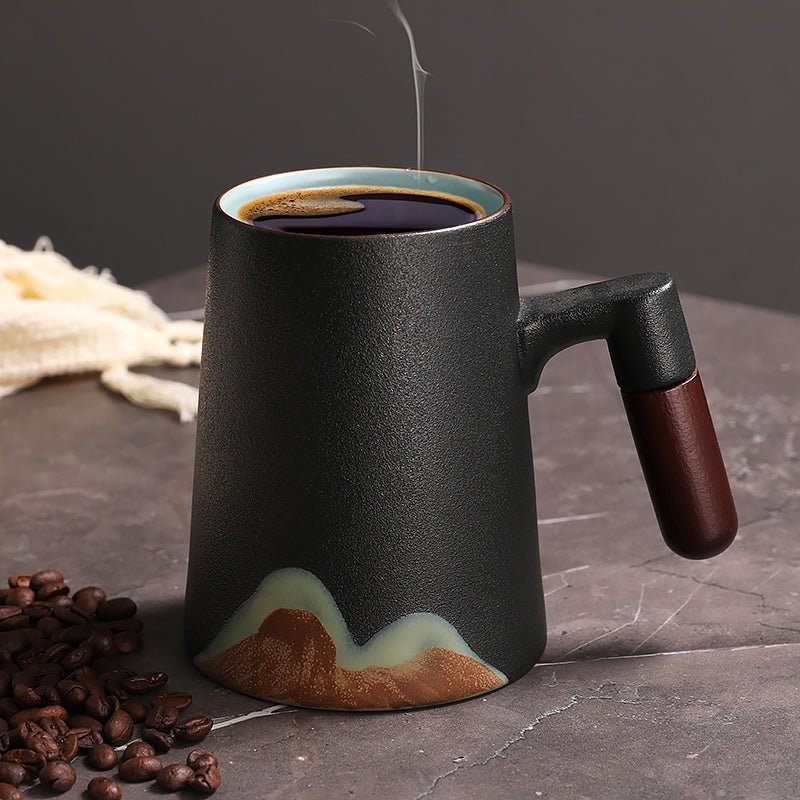
Chai Tea Mug Shared Household Practical Purchase Checklist: 400-480 ml
Reading time: about 10 minutes
A shared kitchen can have several clean mugs in the cupboard and still produce the same morning problem: one person takes the deeper mug for a short pour, while the person adding milk and leaving room to stir gets the smaller one. Our chai tea mug shared household practical purchase checklist starts with the finished drink, because a listed capacity only becomes useful after you know how much each household member actually pours.
The verified CoffeifyMug catalog comparison covers three tea-suitable choices: The Flow at 400 ml, Morning and Night at 440 ml, and The Rock at 480 ml. These are separate product choices, not a matched set. That matters in a shared home because two people rarely need identical volume, carrying weight, or cupboard placement.
Capacity is the verified comparison point in this guide. The source facts used here do not establish material, external dimensions, dishwasher or microwave compatibility, included accessories, or special temperature performance. If any of those details will decide your purchase, confirm the current product page and care information rather than inferring them from appearance or tea suitability.
How should you use a chai tea mug shared household practical purchase checklist?
At our store, we treat measurement as the first step and style as the second. A shopper may describe a favorite mug as large, but that word could mean a 350 ml finished drink with generous empty space or a 450 ml pour sitting close to the rim. The distinction affects stirring, carrying, and the amount of milk that can be added at the counter.
- Measure the finished drink. After using a favorite mug, refill it to the usual line with cool water and transfer that water to a marked measuring jug. Include the space normally occupied by milk, sweetener, foam, or a second pour.
- Account for headroom. Do not select a mug whose listed capacity merely equals the measured serving. Leave enough space below the rim for stirring and for walking from the kitchen counter to a table or desk without sloshing.
- Simulate the liquid weight. Put 400 ml, 440 ml, and 480 ml of cool water into a suitable vessel and lift each amount with one hand. This will not reproduce a product's handle geometry, but it does reveal how the extra liquid feels.
- Measure the storage route. Check cupboard shelf height and depth, the space between dishwasher rack tines if dishwasher use is confirmed, and the coaster or desk area where the mug will sit.
- Verify deal-breakers. Review current product information for material, overall dimensions, care instructions, and any included components. Tea suitability alone does not answer those questions.
Our working rule is simple: do not buy a 400 ml mug for a measured 400 ml serving. A practical household mug needs usable room below the rim, not just enough theoretical volume to contain the drink.
What do 400 ml, 440 ml, and 480 ml change in daily use?
The steps between these mugs are smaller than the product names may make them feel. Each neighboring option adds 40 ml, while the difference between The Flow and The Rock is 80 ml. Forty milliliters is roughly 2.7 US tablespoons, so one step can provide useful milk or stirring room without creating a dramatically larger serving.
| Listed capacity | Reader situation | Why it may fit | Product next step |
|---|---|---|---|
| 400 ml | The finished pour stays clearly below 400 ml, and the user wants the lowest liquid load of these three options. | It is the smallest verified capacity in this comparison and avoids moving directly to a deeper serving. | Review The Flow 400 ml coffee and tea mug. |
| 440 ml | A 400 ml option would sit close to the usual fill line after milk is added. | It adds 40 ml of listed capacity while remaining the middle choice. | Compare Morning and Night 440 ml coffee and tea mug. |
| 480 ml | The measured serving approaches 440 ml, or the user deliberately wants the largest listed volume in this group. | It offers 80 ml more listed capacity than The Flow and 40 ml more than Morning and Night. | See The Rock 480 ml coffee and tea mug. |
Do not treat the listed figure as a guaranteed comfortable fill line. If a person's finished chai lands near one of these capacities, move to the next option and verify the mug's current dimensions and design details. The 440 ml choice is especially useful as a comparison point: it shows whether the household really needs the largest option or simply a modest amount of additional room.
Which capacity fits each person in the household?
Shared households make better decisions when they assign a capacity to a person rather than choosing one size for the entire cupboard. We use three practical profiles when helping shoppers compare this range.
- The shorter-pour drinker: Their measured chai remains comfortably below 400 ml, they finish it quickly, and they do not want unnecessary liquid weight. The Flow is the relevant product to inspect.
- The at-the-counter adjuster: They brew first, then add milk or sweetener and need room to stir. If 400 ml leaves too little margin, Morning and Night provides the next 40 ml step.
- The long-serving drinker: Their measured drink is already near or above 440 ml, or they prefer one larger serving at a desk or on the sofa. The Rock is the capacity match, provided its full product details also suit their grip and storage space.
A household that also cares about color, shape, or use with coffee can browse the unique coffee mugs collection after establishing each person's capacity. Starting with volume prevents an attractive mug from becoming the one nobody reaches for.
How do the 40 ml steps affect hand and desk comfort?
Liquid weight is easy to overlook on a product page. Forty milliliters of a water-like drink weighs about 40 g, so the 80 ml capacity difference between the smallest and largest options can represent roughly 80 g of additional liquid when that extra space is used. Milk, sweetener, and the mug's own weight will change the final total, and product weight is not part of the verified facts in this comparison.
Before choosing the larger capacity by default, check four comfort variables:
- Handle clearance: Look for enough room for the intended user's preferred finger grip. Capacity does not reveal handle opening size.
- One-handed balance: Recreate the intended liquid amount with cool water and carry it from the kitchen to the usual chair or office desk.
- Lift frequency: A mug that stays beside a laptop creates a different demand than one carried upstairs several times a day.
- Desk footprint: Check the available space beside a keyboard, notebook, or coaster. A higher capacity does not automatically tell you the base diameter.
For someone with limited hand strength, the 400 ml option may reduce potential liquid weight, but it is not possible to promise the best grip without verified mug weight and handle dimensions. That is a product-detail check, not a conclusion capacity alone can support.
Will the mug fit the cabinet, dishwasher rack, and cleanup routine?
A 480 ml mug is not necessarily taller than every 400 ml mug; the additional capacity could come from height, width, or a combination of both. This is why our team does not translate volume into external dimensions. Measure the available space and compare it with current specifications if they are provided.
- Cabinet fit: Record shelf height, usable depth, and the side space required for a projecting handle. Do not assume the smallest capacity has the smallest outer footprint.
- Dishwasher placement: Confirm dishwasher compatibility first. Then check that the handle and rim can sit in the rack without contacting nearby items during a normal cycle.
- Microwave use: Do not infer microwave compatibility from tea use or visual appearance. Follow the current listing and care label.
- Chai residue: Rinse away milk, sweetener, or spice residue before it dries, then follow the stated cleaning instructions. Dried residue at the bottom usually takes more effort than a prompt rinse.
- Damage checks: Before serving a hot drink, inspect any frequently shared mug for rim chips, hairline cracks near the handle joint, or an unstable base. Stop using it for hot beverages if structural damage appears.
These are routine checks for drinkware used by several people, not a special durability claim for these products. If confirmed dishwasher or microwave use is non-negotiable and the current information does not answer the question, pause the purchase until it is clarified.
What should gift buyers learn before the unboxing?
A large mug can look generous in a gift box and still be wrong for the recipient's daily pour. Before buying for a partner, roommate, or housewarming, measure a mug they already use. Note the normal fill line, where they carry it, and whether it usually goes through a dishwasher or is washed by hand.
For two recipients, make two decisions. Choose The Flow for the person whose drink remains clearly below 400 ml, Morning and Night for someone who needs a modest step up, and The Rock only when the measured serving supports the larger capacity. These separate product choices should not be presented as an included or coordinated set.
Which needs point to a different mug style?
The three options in this comparison are not the right answer for every chai routine. Choose another category if the main requirement is:
- A lid, leak resistance, or compatibility with a car cup holder.
- A built-in infuser, strainer, brewing chamber, or included tea ingredients.
- Verified insulation or extended heat-retention performance.
- A much smaller serving that would leave even a 400 ml mug mostly empty.
- A particular material, certification, or professionally tested performance claim that has not been confirmed on the current product page.
This guide supports a capacity-and-comfort decision for home or desk use. It does not establish brewing accessories, cultural certification, special temperature behavior, or professional testing.
Five checks before a shared household adds mugs to the cart
This chai tea mug shared household practical purchase checklist works best when each person completes it separately:
- Measure the usual finished chai, including milk and other additions.
- Rule out any capacity that sits too close to that measured amount.
- Compare the remaining 400 ml, 440 ml, and 480 ml options by potential liquid weight.
- Confirm current dimensions, material, care instructions, and included components.
- Select each mug for its user instead of forcing one household-wide size.
Frequently asked questions
What belongs on a chai tea mug shared household practical purchase checklist?
Record each person's finished pour, required headroom, preferred carrying weight, cabinet space, and cleaning routine. Then compare those needs with the verified 400 ml, 440 ml, and 480 ml capacities. Confirm material, dimensions, care, and accessories separately because those details cannot be inferred from volume.
Is a 400 ml mug large enough for chai with milk?
It can be if the finished drink, including milk, remains clearly below 400 ml. If your measured serving approaches 400 ml, choose a larger capacity so there is practical room for stirring and carrying. The Flow is the 400 ml option; Morning and Night adds another 40 ml.
Should partners or roommates buy the same chai mug size?
Only if their measured pours and comfort preferences are genuinely similar. A person who drinks a shorter chai may prefer 400 ml, while another household member may need 440 ml or 480 ml. The products should be chosen individually rather than treated as a matched set.
Do The Flow, Morning and Night, or The Rock include an infuser or lid?
The verified facts used for this comparison establish capacity and support tea use, but they do not establish included brewing accessories. Do not assume an infuser, lid, strainer, or drink ingredients are included. Check the current product page before ordering if an accessory is required.
Are these chai mugs dishwasher-safe or microwave-safe?
Dishwasher and microwave compatibility are not among the verified facts used in this guide. Tea suitability does not establish either care property. Review the current product information and follow the care label supplied with the mug.
Measure one current favorite mug for each person, circle the first capacity that leaves realistic headroom, and open the corresponding product page above. Use the unique coffee mugs collection only after capacity, care, and storage requirements are settled.
More from our blog
Read more
Breakfast coffee cup shared household practical purchase checklist
Compare verified 170 ml, 200 ml, and 350 ml capacities, then check refill habits, table footprint, cupboard clearance, materials, and care before choosing individual cups for a shared breakfast table.
Read more
Lungo Coffee Cup Compact Kitchen Product Shortlist Guide: 3 Picks
Compare CoffeifyMug's 170 ml, 200 ml, and 270 ml cups using your actual pour, required headroom, cabinet opening, and counter workflow. Each pick includes a clear reason to choose it, skip it, or v...
Read more
Leave a comment
This site is protected by hCaptcha and the hCaptcha Privacy Policy and Terms of Service apply.