



15 oz Ceramic Coffee Mugs Shared Household Practical Purchase Checklist
Reading time: about 11 minutes
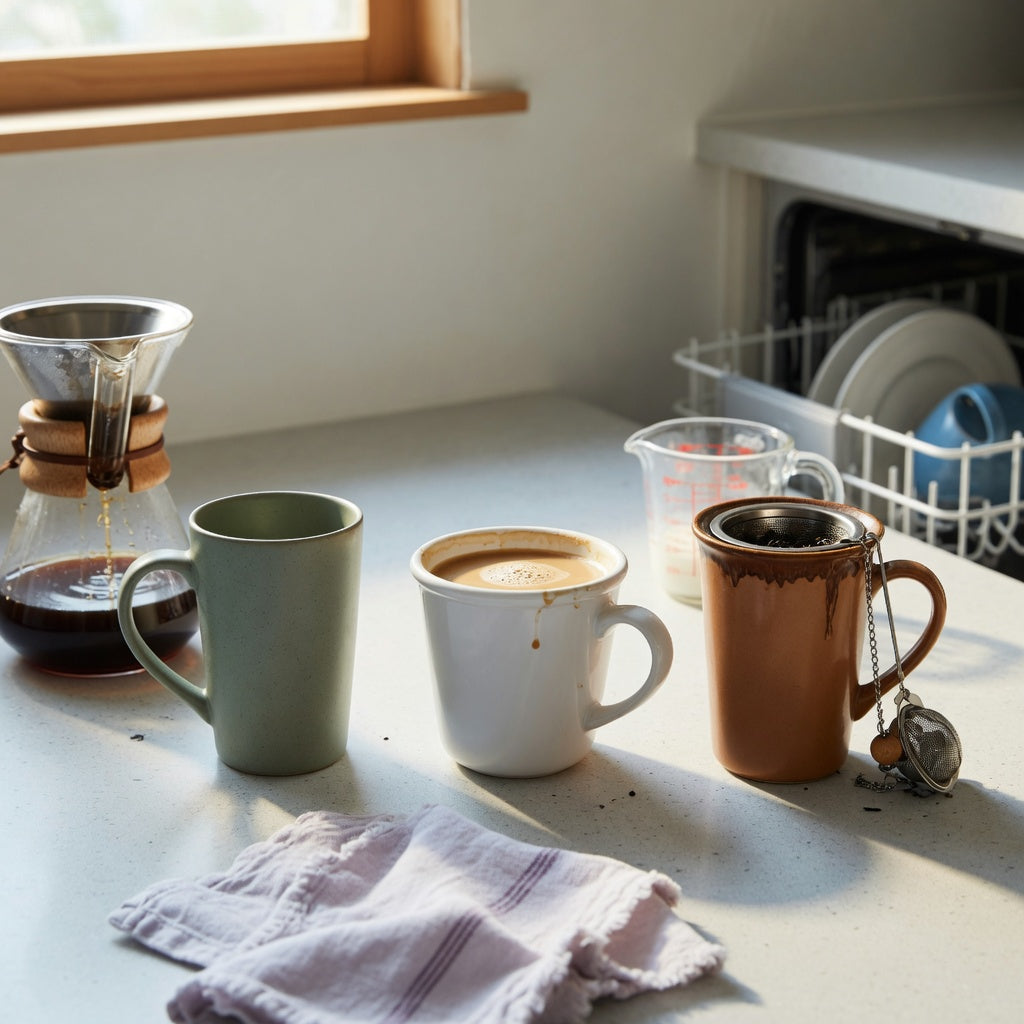
Three mugs sit in the drying rack, and the same one disappears first every morning. That is the shared-household problem in miniature: the mug that suits the person pouring a fast black coffee is not always the mug that suits the person building a milky latte or steeping tea at the same counter. The 15 oz ceramic coffee mugs shared household practical purchase checklist below treats that conflict as a design question, not a reason to buy four identical mugs.
In our store, we list each mug as an individual product rather than a matched set, because many households we talk to need two or three different pours instead of a cabinet full of clones. What follows is the sequence we walk through with shoppers: usable fill first, then capacity, balance, care, and the safety details that are easy to skip when a listing photo looks good.
Where the 15 oz ceramic coffee mugs shared household practical purchase checklist begins: usable fill
A fluid ounce is a volume measure, not a promise about the pour line. The FDA's own description of cups and mugs uses roughly 240 mL, or 8 fl oz, as a typical example, which shows how loosely the category is defined even at the regulatory level. No source we reviewed requires a set headspace below the rim of a 15 oz mug, and sellers do not all measure capacity the same way. Some figures are brim-full; others stop at a line you can actually use without spilling.
That gap matters most in a shared kitchen, where one mug may hold black coffee on Monday and a milk-heavy drink on Tuesday. Think through how each person actually drinks:
- Black coffee: uses more of the listed volume, but a brim-full mug is still a spill risk on a staircase or a crowded counter.
- Coffee with cream or milk: needs headroom for the added liquid plus stirring, so plan on a pour below the rim.
- Latte or cappuccino style: depends on interior shape and rim clearance as much as on ounces. If you want a 15 oz ceramic latte mug, the interior profile matters as much as the number on the listing.
- Tea: needs space for a bag, infuser, or spoon, and room to lift the bag out without overflow.
A measuring jug settles this faster than any product photo. Pour your normal serving into a jug, add the usual milk, and note the total. If that total lands close to the rim of the mug you are considering, a mug advertised at exactly 15 oz will feel tighter in daily use than expected. This is also the test to run when comparing 15 oz vs 12 oz ceramic coffee mugs and wondering whether the jump is worth the extra shelf space.
Which CoffeifyMug capacity fits each drinker at your counter?
Three of our mugs bracket the 15 oz mark closely enough to compare side by side. The capacities below are the verified figures for each product. Dimensions, empty weight, and handle measurements cannot be derived from capacity, so treat those as listing checks rather than assumptions.
| Option | Verified capacity | Reader situation it suits | Confirm on the listing |
|---|---|---|---|
| The Flow | 400 ml (about 13.5 fl oz) | A shorter coffee, a modest pour, or a tea drinker who leaves room for an infuser and does not fill to the rim. | Outside diameter, handle opening, empty weight, and care marks. |
| Morning and Night | 440 ml (about 14.9 fl oz) | The closest of the three to a nominal 15 oz serving; a practical daily mug for coffee with milk or a long tea. | Usable fill, height, full weight, and care claims. |
| The Rock | 480 ml (about 16.2 fl oz) | Someone who wants extra headroom for a large brew, a milky drink, or stirring without coming near the rim. | Footprint on shelf and drying rack, handle size, and full weight. |
These are separate listings, not a bundled set. A two-person kitchen might pair the 400 ml Flow mug for the tea drinker with the 440 ml Morning and Night mug for the coffee drinker, then add the 480 ml Rock mug only if someone genuinely wants a 16-ounce-class pour. If one person drinks a 12 oz brew with a splash of milk, the 400 ml Flow leaves little margin; the 440 ml Morning and Night is the safer daily pick. If someone regularly fills a 20 oz travel tumbler at home, none of these is a substitute for that tumbler. They are mugs, not travel vessels.
Once capacity is settled and style is the deciding factor, browse the CoffeifyMug unique coffee mugs collection to compare shapes rather than staring at one product page.
Will a full 15 oz ceramic mug feel steady on the walk to the desk?
Empty weight is half the story. Once you add 12 to 15 fl oz of coffee, the center of gravity moves up and out, and a wide body with a small handle asks more of your wrist. Two mugs can weigh the same empty and feel completely different full. In our experience, shoppers underestimate this when they buy the largest mug in the cabinet for everyone.
- Handle opening: look for a measurement or a clear photo with fingers through the handle. A two-finger handle is a different product from a four-finger handle, and a large handle on a 15 oz ceramic coffee mug is not automatically a comfortable handle.
- Handle attachment: a wide handle can still pinch if the upper attachment crowds your thumb or leaves a rough seam inside.
- Base diameter: a narrow base on a tall mug feels tippier on a soft drying mat or a lap tray.
- Full weight: if the listing gives empty grams, add the weight of your usual pour, using water as a fair stand-in, and compare that total with a mug you already lift comfortably.
- Grip strength: for anyone with reduced grip, arthritis, or a habit of carrying coffee up stairs, a smaller capacity or a lighter-walled mug is often the more honest choice.
A heavyweight 15 oz ceramic coffee mug can feel stable empty and tiring full. Thick walls also hold heat differently from thin walls, but none of the sources we reviewed provides a lab comparison for this size, and we will not pretend otherwise. If two-hour heat retention is the real requirement, an insulated tumbler is the better tool. A ceramic mug earns its place at the desk because it is pleasant to drink from and easy to wash, not because it outlasts a vacuum seal.
Do 11 oz, 12 oz, and 15 oz mugs each earn a job in one cabinet?
| Capacity | Typical job in a shared home | Main trade-off |
|---|---|---|
| 11 oz | Quick coffee, small desks, guests who drink less. | Little room for milk, foam, or a tea infuser. |
| 12 oz | A middle ground for mixed coffee and tea routines. | Can feel small to a large-brew drinker. |
| 15 oz | Large everyday pour, milky drinks, long tea. | Heavier when full and takes more shelf space. |
| 16 oz and up | Extra headroom, iced drinks, very generous pours. | Too much mug for small hands or tight cabinets. |
Households that argue over mugs usually have a size mismatch, not a mug-quality problem. One 12 oz mug for the short-black-coffee drinker and one 440 ml mug for the latte drinker is a more practical allocation than four identical large mugs. Gifting follows the same logic: a 15 oz mug reads as generous, but an 11 oz mug fits an office kitchen drawer with less fuss.
If someone brews single-serve pods, check the machine's largest cup setting against the mug's usable fill, not just its labeled capacity. A pod machine's large setting is not the same as a 15 oz pour. If you are considering stackable 15 oz ceramic coffee mugs, confirm stackability on the listing; capacity alone does not tell you whether rims nest.
Which care marks, glaze details, and chip risks need a second look?
Microwave safe and dishwasher safe are separate claims, and neither one tells you what the glaze contains. A mug can be fine for reheating coffee and still be a poor candidate for the bottom rack of a heavy cycle. The care line on the listing outranks the product photo.
- Metallic trim: gold or platinum rims and foil details generally should stay out of the microwave unless the maker explicitly says otherwise.
- Printed decoration: some prints are top-rack only or hand-wash only. Check the care line before the first wash.
- Chips: inspect the rim and the handle attachment on arrival. A chipped rim is a food-safety issue, not a cosmetic one.
- Crazing: a fine web of lines in the glaze is different from a coffee stain. Surface stain often lifts with a baking-soda paste; crazing is a glaze condition, and repeated dishwasher cycles can make it more visible.
- Rack contact: in a crowded dishwasher, handles knock against tines and other mugs. That is where many chips start.
- Staining: daily coffee and tea can leave a film. A mild abrasive paste is gentler than scraping with metal.
If a listing says “microwave safe 15 ounce ceramic coffee cups” but says nothing about the dishwasher, treat the two claims separately. When a listing is silent, hand wash and reheat in a separate container. That is conservative, but it is cheaper than replacing a mug that crazed in the bottom rack. Chip resistance is rarely published as a measured claim, so inspect the rim and handle seam rather than assuming a thicker mug is automatically chip resistant.
What does lead and cadmium guidance actually cover on a daily mug?
FDA guidance for cups and mugs sets a lead guideline of 0.5 micrograms per milliliter of leaching solution, judged on any one of six units, with test methods that include ASTM C738 and AOAC methods 973.32 and 973.82. For cadmium, the guidance sets 0.5 micrograms per milliliter for small hollowware and 0.25 for large hollowware, with the line drawn at 1.1 liters of capacity. A 15 oz mug sits well below that threshold.
Those figures describe regulatory test frameworks, not a certificate that a particular mug passed. California's Department of Public Health adds a detail worth knowing in a coffee household: coffee and tea are acidic, heat and microwaving can speed leaching from contaminated ware, and repeated dishwashing can damage a glaze that contains lead. CDPH also notes lead is rarely found in plain white dishes, one reason simple glazes are often the lower-risk pick for daily use.
Decorative ceramicware has its own rule under 21 CFR 109.16. A piece that looks food-safe but is ornamental needs a conspicuous warning plus a permanent warning on the base, or a hole through the potential food-contact surface. If a mug is sold mainly as decor, check before you pour coffee into it. Shoppers searching for lead free cadmium free ceramic coffee mugs often treat “microwave safe” as a proxy for glaze safety. It is not. Ask the seller for a food-contact statement and any published leach testing.
What should go on your pre-purchase checklist?
- Exact capacity in ml and fl oz. The Flow is 400 ml, Morning and Night is 440 ml, and The Rock is 480 ml — three different mugs.
- Whether that figure is brim-full or a usable fill.
- Height, widest diameter, and base diameter against your shelf and drying rack.
- Empty weight and handle opening, if the listing publishes them.
- Glaze and decoration type, plus any hand-wash or no-microwave note.
- Microwave and dishwasher claims, listed separately.
- Food-contact statement and any published leach testing.
- Who in the house will carry it full, and how far.
Frequently asked questions
What should the 15 oz ceramic coffee mugs shared household practical purchase checklist include before checkout?
Start with exact capacity in ml and fl oz, then ask whether that figure is brim-full or usable fill. Confirm height, widest diameter, base diameter, empty weight, handle opening, glaze and decoration care, microwave and dishwasher claims separately, and any published food-contact or leach testing. Finally, name who will carry the mug full and how far.
Is 15 oz enough for a large coffee with milk?
Usually yes, if you leave headroom. A mug filled to the brim has no room for cream, foam, or stirring, so the practical serving is smaller than the label. If you routinely pour a large brew plus a generous splash of milk, the 480 ml Rock mug gives more margin than a mug that measures exactly 15 oz.
Which CoffeifyMug mug is closest to 15 oz?
Morning and Night is 440 ml, about 14.9 fl oz, making it the closest of our three verified capacities to a nominal 15 oz. The Flow is 400 ml (about 13.5 fl oz) and The Rock is 480 ml (about 16.2 fl oz).
Can a 15 oz ceramic mug go in the dishwasher and microwave?
Only if the current listing says so, and check both claims separately. Microwave compatibility says nothing about dishwasher durability, and metallic trim or certain prints may rule out one or both. When a listing is silent, hand wash and reheat in a separate container.
Does a microwave-safe label mean the glaze is lead-free?
No. Microwave suitability and glaze leaching are unrelated questions. Ask the seller for a food-contact statement and any published lead or cadmium testing rather than treating microwave-safe wording as proof of glaze composition.
Ready to sort out your own cabinet? Start with the 440 ml Morning and Night mug if you want the closest thing to a 15 oz daily mug, choose the 400 ml Flow mug for a smaller pour or a tea routine, or size up to the 480 ml Rock mug for extra headroom. Then browse the full CoffeifyMug collection and confirm dimensions, weight, care marks, and safety details on each listing before checkout.
More from our blog
Ready to pick your mug? Two ways to save on today's order:
Ordering 1–3 mugs? Get an extra 10% off your 1st order with code 10_OFF Apply 10% Off & Shop Wooden-Handle Mugs →
Gifting 4+ mugs? Buy 3, Get the 4th Free applies automatically at checkout (no code needed; offers do not stack) · Free standard shipping (Nov pre-Christmas delivery: 15–20 calendar days US) · Free replacement if chipped in transit.
Popular mug buying guides: Ceramic Tea Cups & Infuser Mugs · Ceramic Mugs with Lids Compared · Wooden-Handle Tea Infuser Mugs Compared · Christmas & Secret Santa Mugs 2026 · Espresso & Cortado Cups Guide · Cup & Saucer Gift Sets · All 25 Mugs Spec Table · Mug Size Guide · Shipping & Promo FAQ
FIRST ORDER 10% OFF (CODE: 10_OFF) · OR BUY 3, GET THE 4TH FREE


Read more

Pottery Tea Cups Shared Household Practical Purchase Checklist
A shelf-level checklist for homes where more than one person pours from the same cupboard: matching capacity to real pour habits, checking glaze and lip contact, and knowing which questions to ask ...
Read more
Coffee Mugs With Big Handles Shared Household Product Shortlist Guide
In every shared kitchen there is one mug nobody reaches for. This scenario-based shortlist matches 250 ml, 400 ml and 480 ml mugs to the people who actually lift them, with an explicit reason to ch...
Read more
Leave a comment
This site is protected by hCaptcha and the hCaptcha Privacy Policy and Terms of Service apply.