



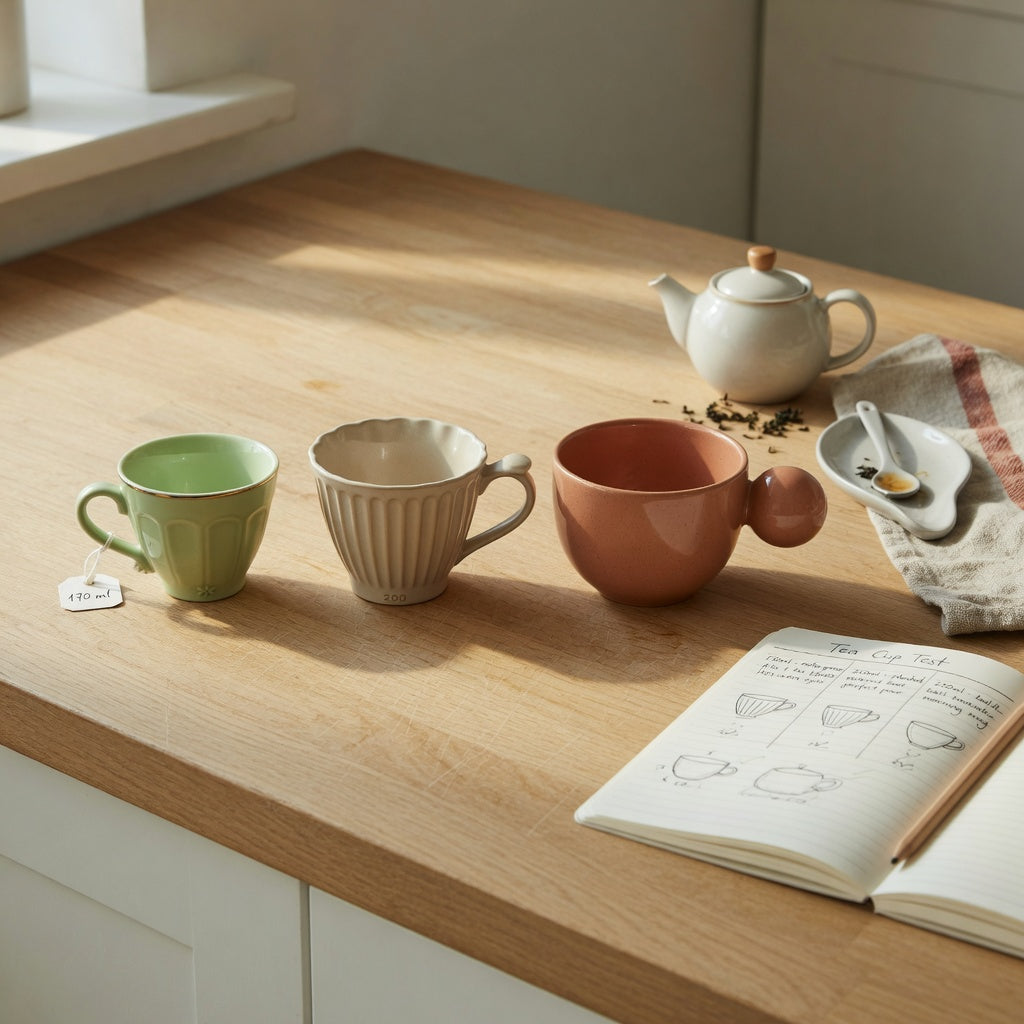
Pottery Tea Cups Daily Use Guide: 170, 200 or 250 ml?
Reading time: about 11 minutes
A cup that looks generous on a product page can feel cramped by your second refill, or too wide to grip comfortably while the tea is still hot. We sell ceramic drinkware and hear the same questions after delivery: why does this feel smaller than expected, why is the rim thicker than the photo suggested, and is the shiny surface the only part my lips touch? This pottery tea cups daily use guide is organized around those real moments — the desk, the kitchen counter, the gift box — and around what you can actually verify before ordering.
It is not a display guide. If the cup will sit on a shelf, appearance can carry the decision. If it will meet a kettle every morning, capacity, heat, rim comfort, and care instructions matter more than the pattern.
Pottery tea cups daily use guide: start with the pour, not the pattern
Capacity decides how a cup behaves in a real routine, and it is the first place buyers get surprised. All three CoffeifyMug cups compared here are ceramic with listed capacities. What those numbers do not tell you is how much headroom you need for carrying, how much ice displaces the tea, or whether you will want a second pour before the first one cools.
Treat listed capacity as a ceiling, not a target. A 170 ml cup filled to the rim is a spill waiting to happen on a sofa; a 250 ml cup filled halfway is a normal-sized tea. Match the number to how you actually drink.
| Tea cup | Listed capacity | Best daily fit | Main trade-off |
|---|---|---|---|
| Retro Coffee Tea Cup | 170 ml | Short pours, tasting portions, tight desk space | Needs refilling during a long work session |
| Pleated Coffee Tea Cup | 200 ml | A balanced everyday serving at a desk or breakfast table | Less generous than a mug-style portion |
| Ball Handled Coffee Tea Mug | 250 ml | Longer sessions and fewer refills | More footprint and less suited to small tasting pours |
The 170 ml Retro is the right starting point for short, concentrated pours and for anyone who likes tasting several teas in one sitting. The 200 ml Pleated is the adaptable middle: enough for a normal morning cup without the footprint of a mug. The 250 ml Ball Handled option suits a longer desk session and anyone who resents refilling.
One pattern we see in post-delivery questions: shoppers often choose the cup they like looking at rather than the one they finish. If you routinely leave half a mug of tea to go cold, a smaller cup will serve you better — more refills, but each pour is hot.
Is 240 ml the benchmark, and why does that matter for a handleless cup?
The FDA describes cups and mugs as small ceramic hollowware used for beverages such as coffee or tea above room temperature. It puts the normal capacity at about 240 ml and notes that a handle is typical. That benchmark reframes our three sizes: the 170 ml and 200 ml cups sit below a standard handled mug, and the 250 ml cup sits just above it.
It also explains a handling trade-off. A handle gives your fingers distance from the hot wall; a handleless cup makes the outside temperature part of the experience. The Ball Handled Coffee Tea Mug points to a handled form in its name, but the exact grip, handle opening, and heat behavior are details to confirm on the current listing rather than infer from a similar cup. If you drink very hot tea and dislike gripping a warm wall, treat handle shape as a priority rather than a detail.
Retro, Pleated, or Ball Handled: which shape fits your day?
170 ml Retro Coffee Tea Cup: short pours and tight spaces
Use it for a notebook-side tea break, a small breakfast tray, or a tasting lineup of two or three teas. It is a poor match for a two-hour meeting where you want one drink to last, and remember that ice takes up volume — a 170 ml cup with ice holds noticeably less tea. If your routine is mostly iced or large-volume, size up.
200 ml Pleated Coffee Tea Cup: the adaptable middle
The 200 ml Pleated is the safest choice for a gift, an office desk, or a kitchen shelf where the drinker's habits are not fully known. It is bigger than a tasting cup and smaller than a mug. The trade-off is real: it will not satisfy anyone who routinely pours 250 ml or more, and those buyers will refill it more often.
250 ml Ball Handled Coffee Tea Mug: fewer refills, more footprint
This is the pick for a generous morning tea, a desk drink meant to last, or a shopper who thinks in mug-sized portions. It is less suitable for small tasting pours, a crowded bedside table, or anyone who prefers a lighter cup in hand. Check the current listing for the exact handle shape and care instructions before committing to very hot drinks.
If none of the three matches your routine, browse the unique coffee mugs collection instead of forcing a size that fights how you drink.
What the ceramic body tells you, and what a photo cannot
Pottery is a style word, not a specification. Ceramic drinkware spans earthenware, stoneware, and porcelain, and those categories differ in porosity, firing maturity, and weight. A glossy photo can suggest a smooth glaze without showing whether the interior is fully covered, how thick the wall is, or how the rim was finished.
For the cups linked here, the verified facts are ceramic body, listed capacity, and visible form. Glaze type, firing temperature, and appliance care belong to the listing and the seller, not to a general rule about pottery. When a listing is silent, ask.
Details worth inspecting in person or in close-up photos:
- Interior glaze evenness — the surface that holds the tea should look continuous, with no rough patches.
- Rim thickness — a thick rolled edge feels sturdy; a thinner edge feels more precise against the lip. Neither is automatically better, but the cup should feel comfortable before the first hot pour.
- Foot ring — turn the cup over. A rough foot can scratch a desk or saucer, and an uneven base makes a small cup feel unstable.
- Pinholes — tiny openings in the glaze can trap residue; ask about them if the cup is meant for daily service.
Buyers also ask whether bare clay changes the taste of tea compared with glazed porcelain. We have not found a food-science or standards source that settles that question, so we treat flavor claims as preference, not verified fact. What you can judge is surface feel and how easy the interior is to clean.
Which food-contact questions should you settle before the first pour?
Safety is not the same as a glaze that looks fine. Lead can be present in some glazes and decorations, and pottery that is not properly made and fired can let lead leach into drink. Under the FDA lead guideline for cups and mugs, the threshold is 0.5 micrograms per mL of leaching solution in any one of six units. Cadmium has its own guideline and its own concerns for acid foods.
The FDA flags higher-concern ceramicware: handmade pieces with a crude appearance or irregular shape, antiques, damaged or heavily worn items, flea-market and street-vendor finds, pieces from an unidentifiable maker, and bright orange, red, or yellow decoration. Ordinary commercial factory pottery is described as much less likely to have lead problems, but that does not answer every individual listing.
Two points are worth keeping straight. Washing, boiling, or scrubbing cannot remove lead from pottery — the answer is to stop using the piece, not to clean it harder. And decorative ceramicware that looks like tableware is treated as foodware unless it is permanently identified as not for food use. A cup-shaped object with unclear status is not a safe assumption.
A CDC report described a family whose elevated blood lead levels were associated with traditional glazed ceramic ware used for cooking, storing meals, and making coffee; their levels declined after they stopped using it. That is the practical reason to ask before daily use rather than after.
Ask the seller, in writing:
- Is this finished piece intended for food and beverage contact?
- Are both the glaze and any lip or interior decoration suitable for the drinking surface?
- Does any test report apply to this finished cup or production batch, not just to a raw material?
- Is lead free backed by finished-piece testing? The FDA says ware with extractable lead should not carry that label.
- Does the product carry a not for food use warning or a decorative-only designation?
If the answer is vague, treat the cup as display-only. That rule is firmer than anything you can judge from a product photo, because glaze formulation and firing history are not visible on the surface.
How do chips, crazing, and bare clay change daily use?
Some variation is normal in ceramic; some is a reason to return the cup. The distinction matters most on surfaces that touch tea or your lips.
- Chips — check the rim and handle first. A chipped drinking edge is uncomfortable and can worsen with washing.
- Cracks — a structural crack through the body is different from a pattern in the glaze. Retire a cracked cup from drink service.
- Crazing — a network of fine lines in the glaze can be intentional crackle or can develop later. Ask the maker whether the finish is intended for food contact and how it should be cleaned.
- Bare clay — an unglazed exterior can be a design choice. Bare or porous clay on the drinking surface needs maker guidance, not a guess.
- Persistent staining — staining in an intact glaze is usually cosmetic; staining that settles into a rough or damaged area is a reason to stop using the cup.
Photograph anything questionable on arrival and compare it with the seller's return window. Handmade variation can explain a wavy rim or a color shift. It does not excuse a sharp chip or an unclear food-contact surface.
What care rules are safe to assume when the listing is silent?
Assume nothing about appliances. Dishwasher and microwave suitability depends on the body, glaze, and any metallic or overglaze decoration, and it is maker-specific. If the listing does not say, ask before the first cycle.
- Avoid sudden temperature swings — do not set a very hot cup straight onto a cold, wet counter.
- Keep metallic decoration out of the microwave; if you are unsure whether there is any, treat it as metal.
- Wash with a non-abrasive sponge, then check the rim and handle.
- At a desk, keep the cup away from the edge and out of the path of a keyboard arm.
- Retire any cup with a new crack, a sharp chip, or a defect on the lip.
For a gift, pass the care information along with the cup. A recipient who does not know whether it can go in a dishwasher will usually guess wrong and put it in anyway.
What should be on your pre-checkout list?
- Match the listed capacity to the pour you actually finish.
- Decide handled versus handleless based on how hot you drink.
- Confirm food-contact status and which surfaces touch tea and lips.
- Ask about dishwasher and microwave use if the listing is silent.
- Plan to inspect the rim, foot ring, and glaze as soon as it arrives.
Start with the size you will actually finish, then confirm the contact surface and care requirements. The full ceramic range shows the current options if you want to compare shapes side by side; the three cups above cover 170 ml, 200 ml, and 250 ml, which is most of what a daily tea routine needs.
Frequently asked questions
What size pottery tea cup works best for daily use?
For a single everyday cup, 200 ml is the most flexible middle ground: larger than a tasting cup, smaller than a mug. Choose 170 ml if you pour small amounts often, and 250 ml if fewer refills matter more than a compact footprint.
Are pottery tea cups safe for hot tea?
Only if the specific cup is intended for food and beverage contact and its glaze and decoration are suitable for the drinking surface. Confirm that with the seller rather than inferring it from a photo. Antique, damaged, heavily worn, or unknown-maker pieces deserve extra caution.
Can a pottery tea cup go in the dishwasher or microwave?
Follow the product's own instructions; there is no universal rule for ceramic. Metallic or overglaze decoration can rule out microwave use even when the body itself is fine. If the listing is silent, ask before the first cycle.
Is crazing on a pottery tea cup the same as a crack?
No. Crazing is a network of fine lines in the glaze; a crack runs through the ceramic body. The two can be hard to separate in a photo, so ask the maker whether the finish is intentional and food-contact appropriate, and stop using any cup with a sharp edge or through-crack.
Does this pottery tea cups daily use guide apply to a gift purchase?
Yes, with one adjustment: when you do not know the recipient's habits, choose the middle size rather than an extreme. The 200 ml Pleated is the safer gift, and passing the care information along prevents the guesswork that ruins a good cup.
More from our blog
Ready to pick your mug? Two ways to save on today's order:
Ordering 1–3 mugs? Get an extra 10% off your 1st order with code 10_OFF Apply 10% Off & Shop Wooden-Handle Mugs →
Gifting 4+ mugs? Buy 3, Get the 4th Free applies automatically at checkout (no code needed; offers do not stack) · Free standard shipping (Nov pre-Christmas delivery: 15–20 calendar days US) · Free replacement if chipped in transit.
Popular mug buying guides: Ceramic Mugs with Lids Compared · Wooden-Handle Tea Infuser Mugs Compared · Christmas & Secret Santa Mugs 2026 · Espresso & Cortado Cups Guide · Cup & Saucer Gift Sets · All 25 Mugs Spec Table · Mug Size Guide · Shipping & Promo FAQ
FIRST ORDER 10% OFF (CODE: 10_OFF) · OR BUY 3, GET THE 4TH FREE


Read more
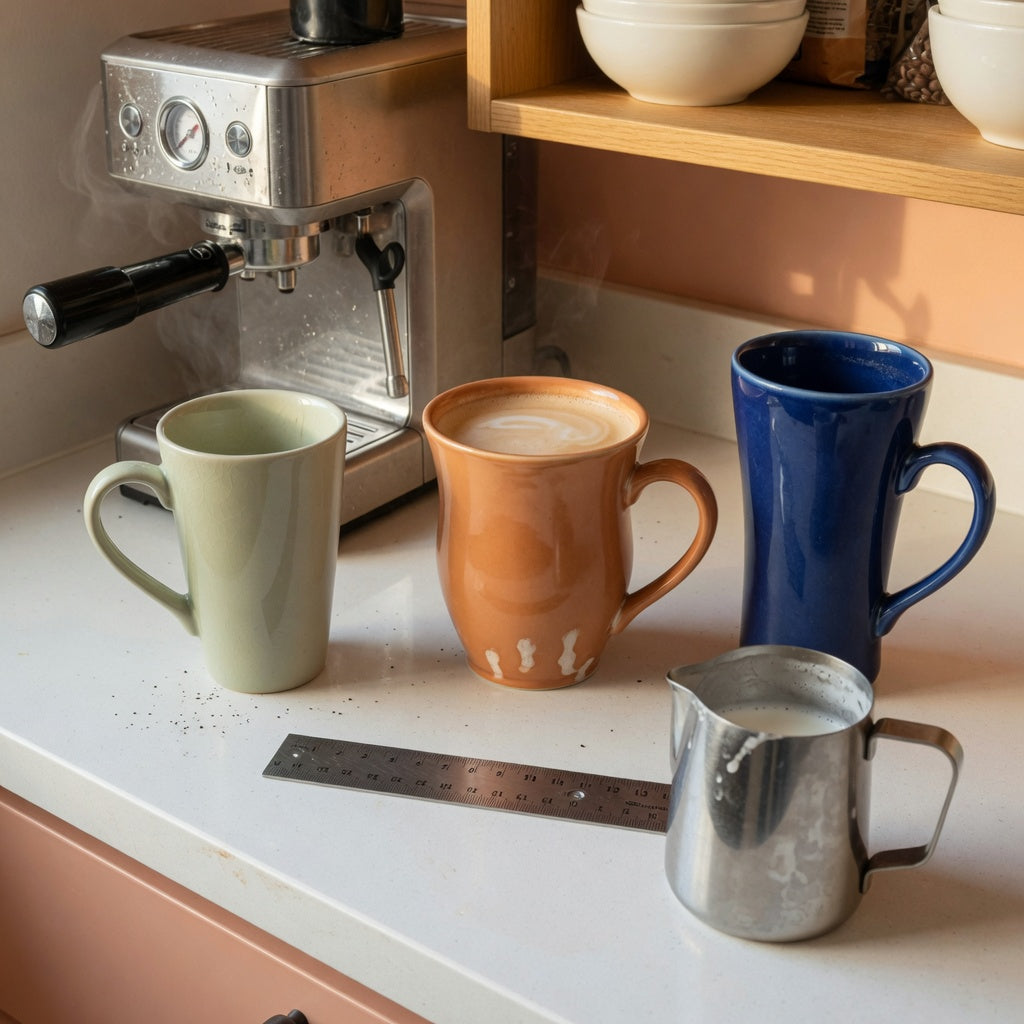
Latte Mugs Tall Daily Use Guide: 400, 440 or 480 ml?
A tall latte mug is a clearance test, a pour-size test and a care-label test — not just a capacity number. We compare our 400, 440 and 480 ml mugs by daily routine, latte-art shape and the dimensio...
Read more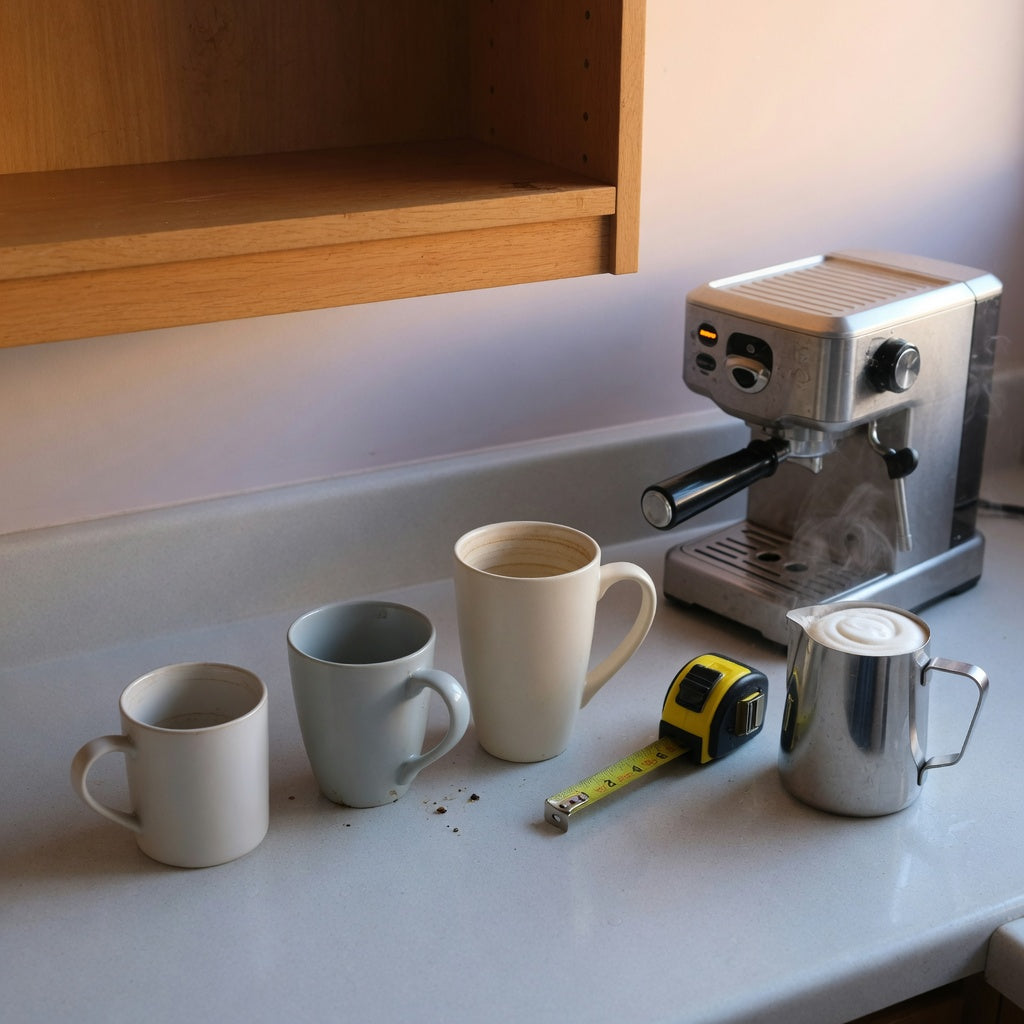
Latte Mugs Tall Morning Routine Practical Purchase Checklist
A tall latte mug usually fails at 7 a.m. for three reasons: no headroom, no spout clearance, no handle leverage. This is the eight-check version of our purchase checklist, mapped to 400, 440, and 4...
Read more
Leave a comment
This site is protected by hCaptcha and the hCaptcha Privacy Policy and Terms of Service apply.