
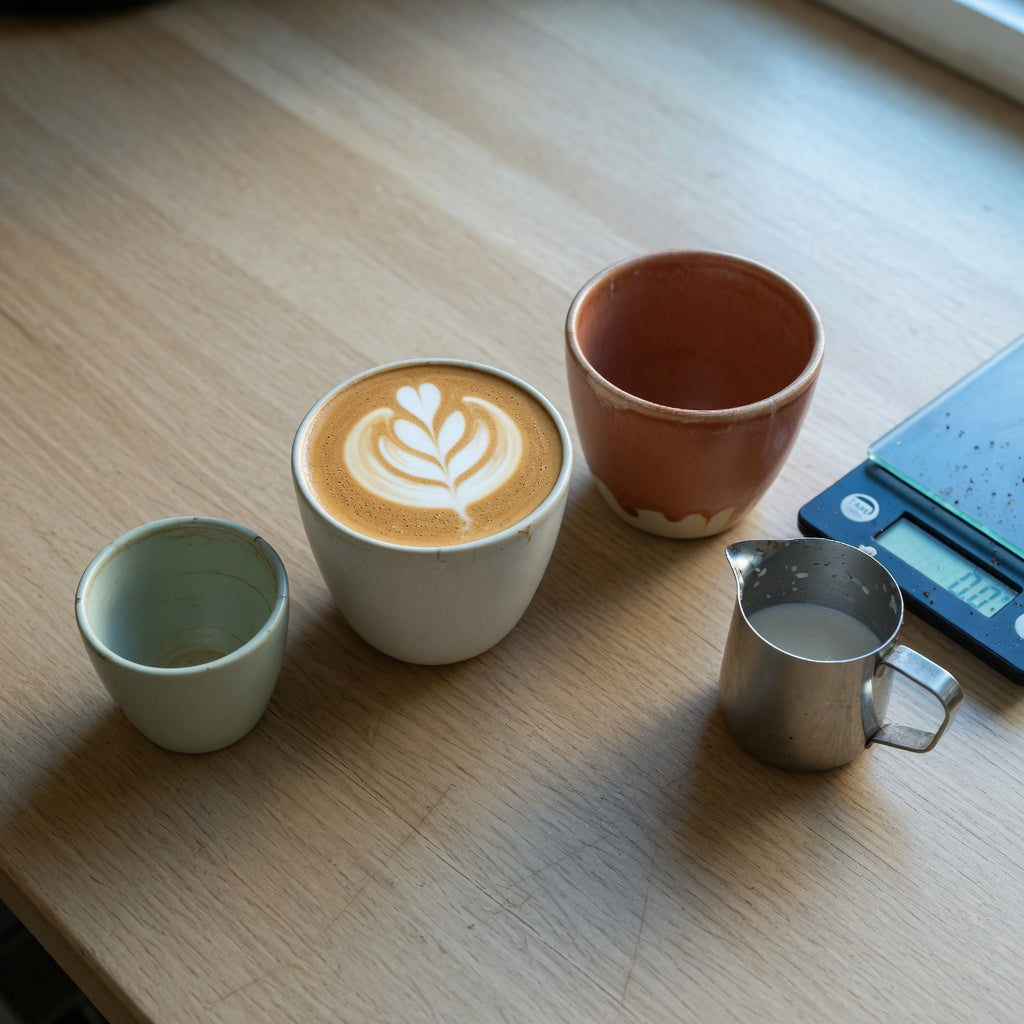
Ceramic Latte Cups Daily Use Guide: 250, 400 or 440 ml?
Reading time: about 12 minutes
A latte made at home usually shows its problems by the second sip. The foam ring collapses into a thin brown line, the handle presses into your middle finger, or the cup is still a third full when the coffee has gone lukewarm. This ceramic latte cups daily use guide starts there — with capacity, handle clearance and the fill line — because those are the things that decide whether a cup survives day 40, not how it looks on a shelf.
In our store we keep three ceramic latte cups between 250 ml and 440 ml. The emails we get about them are almost never about the glaze. They are about whether the cup fits a real morning: a rushed pour at 6:50 a.m., a desk that is already crowded, a dishwasher load that goes in every night. Capacity and handle fit do most of the deciding. Glaze and care come second — still important, just rarely the reason a cup gets pushed to the back of the cupboard.
What actually separates a latte cup from the mug already in your cupboard?
The FDA's plain-language description is a useful starting point because it is refreshingly practical. Ceramic cups and mugs are small hollowware meant for drinks such as coffee or tea served above room temperature, normally holding around 240 ml (8 fl oz), and normally made with a handle. The agency separates a cup — a base with curved sides — from a mug, which has cylindrical sides.
A latte cup adds three practical things to that baseline:
- A wider opening relative to its height. Milk and espresso meet across a bigger surface, which gives you room to pour a shape rather than a blob.
- A rounded interior instead of a hard corner where wall meets base. Milk folds and circulates instead of stalling in the angle.
- Capacity above the drink you intend to make. Not equal to it. Above it, so the foam has somewhere to sit.
Your current cylindrical 300 ml mug will still make a drinkable latte. It just gives you less margin at the rim and less surface to work with when you try to pour anything worth photographing.
How much does a 250 ml, 400 ml or 440 ml cup actually hold?
Listed capacity and usable capacity are two different numbers, and the gap between them is where most buyer disappointment lives. A cup measured to the brim holds less than that once you leave a sensible fill line, and less again once a 15–25 mm foam cap goes on top.
Run the arithmetic against your own drink before you fall for a shape:
- Espresso. A double shot is roughly 60 ml. A single is half that.
- Steamed milk. Most home setups use 120–200 ml of milk per latte, depending on how strong you like it.
- Headspace. Leave at least 15 mm at the top unless you enjoy wiping the counter.
Do that and a 250 ml cup is a tight fit for a 180–220 ml drink — workable, but you will be pouring close to the edge. A 400 ml cup takes the same drink with room to spare. A 440 ml cup starts nudging you toward more milk than you may want, which changes the taste as much as the volume.
Ceramic latte cups daily use guide: which of our three sizes suits which morning?
We keep three sizes, and each one is fairly honest about what it is for.
| Cup | Listed capacity | The morning it fits | Where it runs out of road |
|---|---|---|---|
| Ball Handle | 250 ml | Cortado, flat white, a short latte, or a proper cup of tea | Tight for a full 12 oz latte or a generous foam cap; not a desk-all-day cup |
| The Flow | 400 ml | The standard home latte, with headroom left for foam | Overkill if you drink 150 ml and nothing more |
| Morning and Night | 440 ml | Long milk drinks, iced coffee, tea, slow desk sipping | Heavy when full, and it wants more milk to taste balanced |
Ball Handle (250 ml). This is the small-drink cup. At 250 ml it makes a flat white or cortado feel intentional rather than under-filled, and it handles tea without the awkward half-empty look a big mug gives you. What it is not good for: anyone whose default is a 12 oz latte, or anyone who likes a tall foam cap. You will be pouring to the rim and still wishing for 40 more millilitres. If you want to see how the 250 ml sits next to the other two, our unique coffee mugs collection is the fastest place to compare.
The Flow (400 ml). This is the one we point most people to first, because 400 ml is where a double shot plus 180 ml of milk sits comfortably with foam on top and no spill risk. It is the closest thing in our range to the cup a café hands you. Not the right call if you drink 100–150 ml and dislike waste — a half-full 400 ml cup looks exactly as sad as it sounds.
Morning and Night (440 ml). Plainly the big one. 440 ml of liquid weighs roughly 440 g before you count the cup itself, so it is a two-handed object when it is full and a genuinely good desk companion when you want something to last through a meeting. The trade-off is milk ratio: fill it with the same 180 ml of milk you use in The Flow and you get a milkier, weaker drink. Fill it properly and you have made a large latte. Desk footprint is worth checking on the listing — a larger-capacity cup often has a wider base, but the stated dimensions are the only way to know how it sits beside your keyboard.
Two things no capacity table captures: how the handle sits in your hand, and how much surface the base occupies. Judge those against the photos and any stated dimensions on each listing.
Why the handle decides whether you reach for a cup or skip it
A full 440 ml cup is a weight, and your fingers find that out before your eyes do. Handle geometry matters more than most listings admit:
- Clearance under the loop. Can two fingers pass through without pinching, or only one?
- Balance point. A handle mounted high makes a full cup tip forward as you lift it.
- Loop thickness. Thin loops bite on a heavy cup; thick loops crowd a small hand.
The Ball Handle name points at its handle, but whether the loop is generous enough for two fingers is something to judge from the listing photos rather than from the name. Same for The Flow — grip shape is a personal fit question, and it is the most common reason a cup that photographs beautifully ends up staying in the cupboard.
Does the body material change how a ceramic latte cup feels day to day?
We are not going to rank stoneware above porcelain or bone china for a daily latte, because the honest answer is that fired body, wall thickness and glaze matter more than the label on the listing. What you can check on a listing: the body description, the glaze description, the stated weight, and the care marks. A fully glazed surface is what you want on any body; a chip exposes the body underneath, and that is when a cup stops being a good daily choice.
If a listing is vague about the body or the glaze, ask before you buy. That is a more useful question than chasing a material name that may not tell you how the cup actually feels in the hand.
Do thicker walls keep a latte hot, and what can you actually verify?
Honest answer: less than the internet claims, and not in a way you can confirm from a product photo. Independent, comparable heat-retention testing of stoneware, porcelain and double-wall ceramic at realistic drink volumes is thin on the ground, and the tests that do exist contradict one another. We do not publish heat-retention figures for our cups, and we would be sceptical of numbers that arrive without a stated method.
What you can control sits mostly outside the cup:
- Preheat it. Thirty seconds of hot tap water does more for a latte's final temperature than an extra millimetre of wall.
- Steam the milk properly. Under-aerated milk at 55°C cools a drink faster than the vessel ever will.
- Drink it inside 15 minutes. No ceramic wall compensates for a cup forgotten on a desk.
Use wall thickness as a clue about weight and feel, which are real, and not as a promise about temperature.
Is "lead free" on a ceramic cup a guarantee? What the FDA action levels mean
"Lead free" is a marketing phrase until you know what it was measured against. For ceramic hollowware, the FDA reference point is the action level for leachable lead: 0.5 micrograms per millilitre of leaching solution, applied to any one of six units tested. Cadmium has its own limits — 0.5 µg/ml for small hollowware measured on any one of six units, and 0.25 µg/ml for large hollowware.
Two things follow from that.
- The test measures what leaches out of the glaze under a deliberately severe acetic-acid extraction (ASTM C738), not the total lead content of the clay. A cup can be made from clean materials and still fail if the glaze was fired badly.
- The FDA has reported traditional pottery labelled "lead free" that still released extractable lead at or above its action levels, and it treats that label as misleading in those cases. A label on its own is a weak signal.
The FDA flags handmade, antique, damaged and flea-market pieces, plus bright orange, red or yellow decoration on the food-contact surface, as the higher-risk categories. Everyday factory-made commercial ware is described as far less likely to be a problem, which is the bucket an ordinary retail latte cup falls into. Washing, boiling or scrubbing does not remove lead, so a cup that fails does not become safe with care. Retire anything with a crazed interior or a chipped rim, and if the decoration sits inside the cup rather than outside, ask the seller directly what it was tested against.
What fails first in daily use: the microwave, the dishwasher or the sink?
Metallic trim is the classic failure. Microwaves are reflected by metal, which is exactly why metal pans and foil do not belong in a microwave oven. A gold rim or a metallic luster is metal, so treat any cup wearing one as not microwave safe, whatever the base material is. Plain glazed ceramic with no metallic decoration is the straightforward case — but a piece-specific care note always beats a general rule.
Dishwasher damage is slower and uglier. Glaze dulls over months, rims chip when cups knock together on the rack, and printed decoration fades unevenly. If a cup has a metallic trim, hand washing is the safer habit. Check the care information on the specific product listing rather than carrying one assumption across the whole range, because trim and finish can differ between designs.
Desk, kitchen counter or bag: where each cup stops working
On a desk, Morning and Night at 440 ml earns its place — one fill, one long morning, and enough volume that you are not walking back to the kettle as quickly. The Flow at 400 ml works too if you prefer a shorter drink. The Ball Handle at 250 ml disappears at a desk; you will be walking back to the kettle within the hour.
On a kitchen counter, The Flow at 400 ml is the least fussy choice because it forgives an extra splash of milk without spilling.
In a bag, none of these work. A ceramic latte cup is not a travel mug: ceramic chips on impact, and these are not sealed vessels. If your latte has to travel, a lidded tumbler is the right purchase and we would rather say that than pretend otherwise.
What should you check before adding a ceramic latte cup to your cart?
- Measure your usual drink once. A jug and a kitchen scale settle weeks of debate in 30 seconds.
- Leave at least 15 mm of headspace above the finished drink, more if you pour art.
- Think about the handle full, not empty. Two fingers, no pinching, balanced when lifted.
- Read the care line for that exact cup. Metallic trim rules out the microwave.
- Check the glaze. Crazing, chips or vague testing claims are reasons to keep looking.
Buying two sizes is a legitimate answer rather than indecision: a 250 ml cup for the short morning drink and a 400 ml ceramic latte cup for the long one covers almost every day. If a single cup has to do everything, The Flow at 400 ml is the closest compromise in our range. Compare all three capacities in the unique coffee mugs collection, then measure your usual drink once before you pick.
Frequently asked questions
Is a 250 ml ceramic latte cup too small for a daily latte?
Only if your drink runs over about 200 ml. A double shot plus 150 ml of steamed milk lands near 210 ml before foam, which leaves a 250 ml cup filled close to the rim. If you like a generous foam cap or normally drink 12 oz lattes, move up to 400 ml. Match capacity to the drink you make nine mornings out of ten — the one rule worth taking from any ceramic latte cups daily use guide.
Does a 400 ml cup give me a full 12 oz latte?
Roughly, with room to spare. 12 US fl oz is about 355 ml, so a 400 ml cup leaves roughly 45 ml for foam and headspace. That is comfortable but not enormous; if you routinely add a thick cap or a flavour syrup, expect to fill it close to the top.
Can I microwave a ceramic latte cup with a gold rim or metallic handle?
No. Microwaves are reflected by metal, so metallic trim, lusters and metal handles do not belong in a microwave regardless of what the ceramic body is made of. Plain glazed ceramic without metal decoration is the case where microwaving is normally fine — confirm it on the care line for that specific cup.
How can I check that a ceramic cup's glaze is food safe?
Ask what it was tested against. The FDA action levels are 0.5 µg/ml for leachable lead and 0.5 µg/ml for cadmium in small hollowware, measured on any one of six units. Without a named method or a batch result, a "lead free" label is just a claim. Also stop using any cup with a crazed interior or a chipped rim.
Will these cups survive the dishwasher?
Check the care information on the individual listing, because trim and finish differ between designs. As a habit, hand wash anything with metallic decoration, load ceramic cups so they cannot knock against each other, and retire a cup once the rim chips rather than waiting for it to crack.
More from our blog
Read more

Cute Espresso Cups for Desk Use: Capacity, Footprint, Handle Fit
A desk cup usually fails on footprint, refill rhythm, or handle clearance before it fails on looks. We compare our 170 ml, 200 ml and 250 ml ceramic cups so you can match capacity to your machine, ...
Read more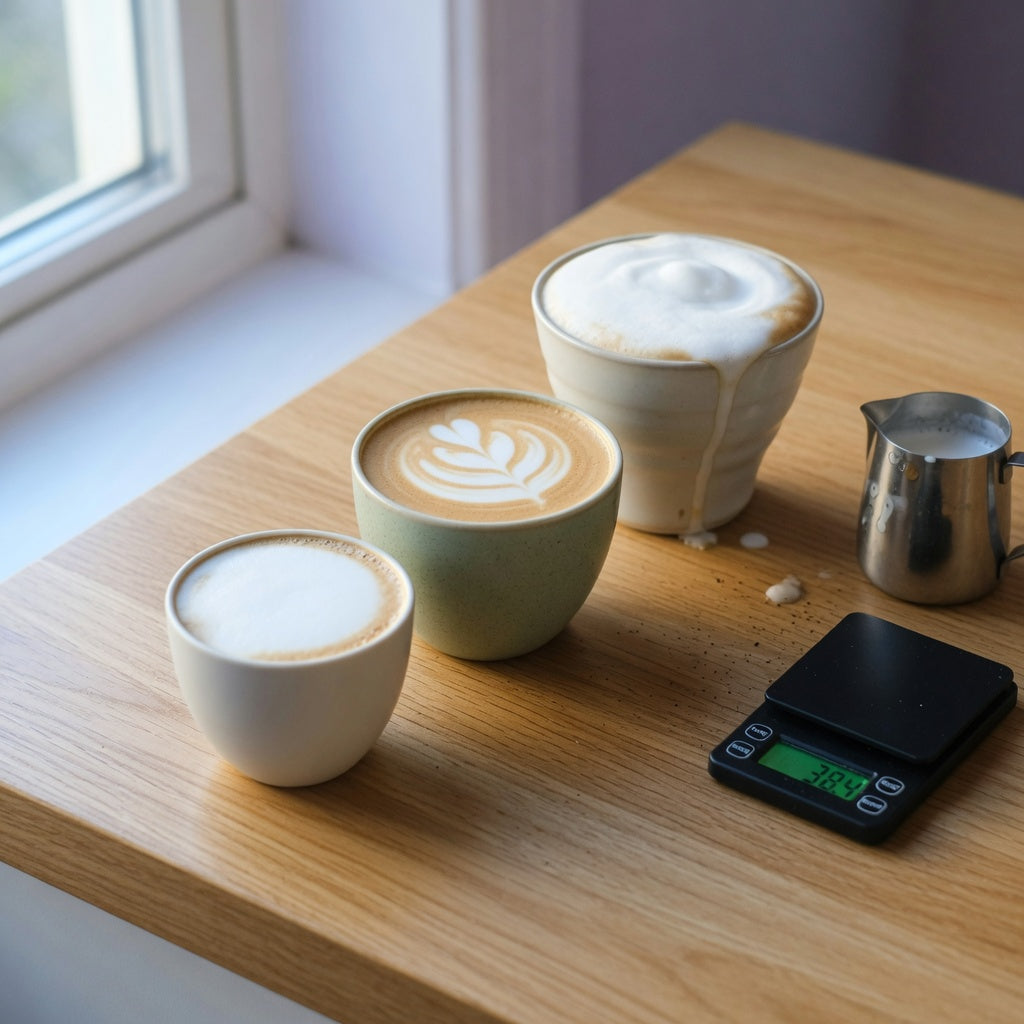
Ceramic Latte Cups Comparison: 250 ml vs 400 ml vs 440 ml
A practical ceramic latte cups comparison of our three current sizes — 250 ml, 400 ml, and 440 ml — covering the capacity math, handle and footprint trade-offs, FDA lead limits, and the care rules ...
Read more
Leave a comment
This site is protected by hCaptcha and the hCaptcha Privacy Policy and Terms of Service apply.