
Piccolo Cup Everyday Mug Rotation Practical Purchase Checklist
Reading time: about 9 minutes
A compact cup earns its place in the rotation at 7:15 a.m., when the dishwasher is half full and the clean shelf has one open spot. A piece can look right online yet be skipped because the serving is too small, the handle crowds neighboring mugs, or its care routine does not suit the household. This piccolo cup everyday mug rotation practical purchase checklist turns those ordinary friction points into a buying decision.
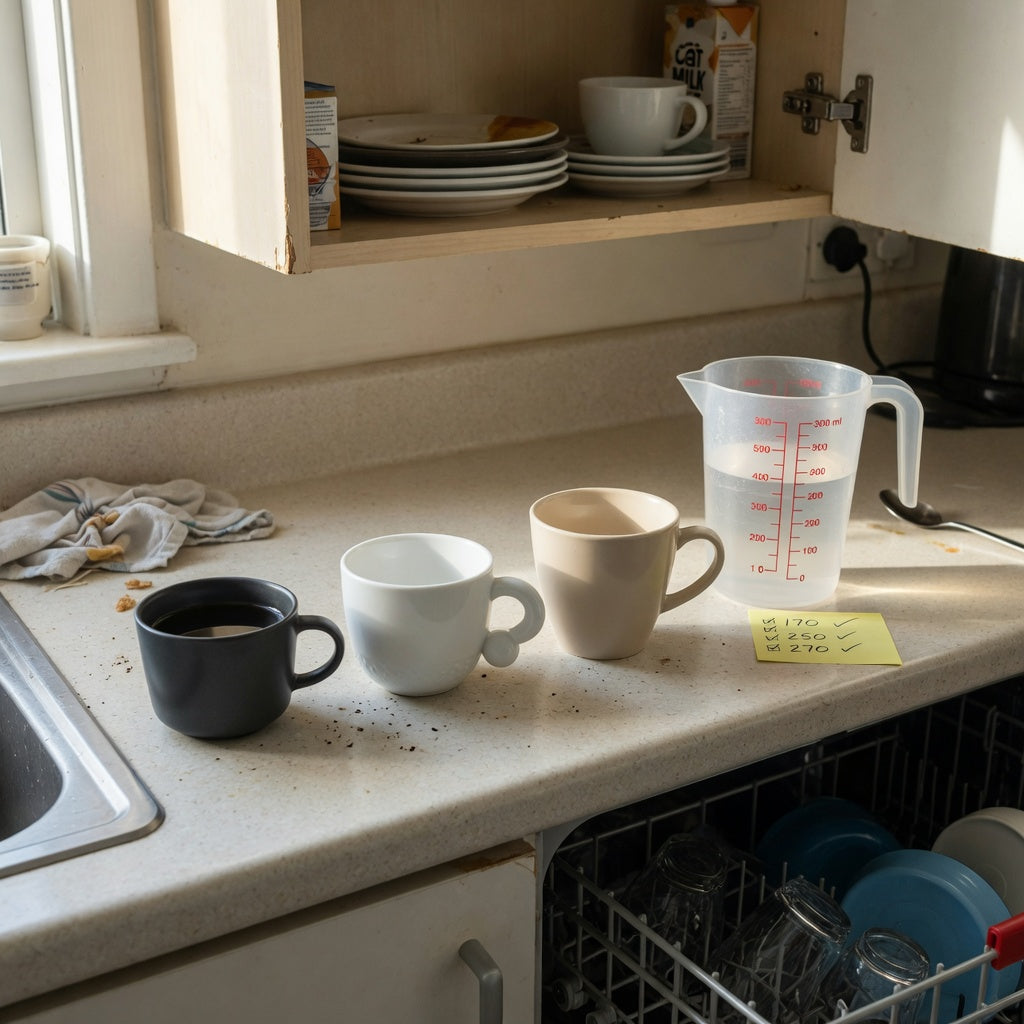
At CoffeifyMug, we handle and sell compact coffee and tea cups, and we separate verified catalog facts from details that still need checking. The facts confirmed for this comparison are straightforward: the Retro is 170 ml, the Ball Handled mug is 250 ml, and the Emerald mug is 270 ml. Capacity does not prove external dimensions, material, weight, or care compatibility. We also do not present any of these products as a certified piccolo cup, assign them a fixed milk-to-coffee ratio, or claim barista testing or cafe provenance.
Why does a compact cup stop getting used?
An everyday rotation is not the full set in the cabinet. It is the smaller group that repeatedly moves from shelf to counter, desk, sink, drying rack, and back again. A cup usually falls out of that cycle when its capacity creates unwanted refills, its shape is awkward to store, or washing it takes more effort than the owner accepts on a busy day.
Run a short routine audit before ordering. For three normal drink sessions, use cool water and a measuring jug to check your usual pour, record whether you refill, note where the cup spends most of its time, and notice when it gets washed. Gift buyers can ask the recipient about morning drink size, dishwasher use, and cabinet space instead of choosing by appearance alone. Those answers are more useful than guessing what a compact cup should hold.
Which capacity fits your repeat pour: 170 ml, 250 ml, or 270 ml?
Start with the amount you actually drink, then accept the trade-off attached to it. These are listed capacities, not prescribed beverage recipes.
| Option | Verified capacity | Routine it may suit | Trade-off to check |
|---|---|---|---|
| Retro Coffee Tea Cup | 170 ml | Short coffee or tea servings when a refill is acceptable | Lowest capacity of the three; external size and care details still require verification |
| Ball Handled Coffee Tea Mug | 250 ml | A moderate serving for breakfast, a meeting, or a shorter desk session | The projecting handle shape must fit your hand, shelf, and washing setup |
| Emerald Coffee Tea Mug | 270 ml | The largest listed serving among these options | Only 20 ml more than the Ball Handled mug, so shape may matter more than capacity |
The jump from 170 ml to 250 ml adds 80 ml, which can meaningfully reduce refill pressure for some routines. The difference between 250 ml and 270 ml is only 20 ml. If both contain your normal pour, compare handle design, dimensions, and care information rather than treating the larger number as automatically better.
A listed capacity is also not a requirement to fill hot liquid to the rim. Leave the headspace you need for carrying, milk, foam, or stirring. If your usual drink exceeds 270 ml, all three options are too small by their verified capacities, particularly once ice or generous headspace takes up room.
Will the cup fit your cabinet, washing area, and office desk?
Capacity is not an external dimension. A 170 ml cup is not guaranteed to be narrower or shorter than a 250 ml mug, especially when handles and decorative shapes are involved. In our store, we treat shelf fit as a separate check rather than assuming the lowest capacity has the smallest footprint.
- Cabinet: Measure clear width, height, and depth, including space lost to hinges, shelf lips, and neighboring handles. Compare those numbers with the current product listing. If a needed dimension is absent, treat it as unknown.
- Dishwasher: First confirm that dishwasher use is permitted. Then check tine spacing, vertical clearance, and the path of the handle so it does not force an unstable loading position.
- Drying rack: Identify where the base and rim will rest. Do not assume a decorative cup is stackable or force a distinctive handle between narrow rack slots.
- Office desk: Check the available coaster area and decide which side the handle needs to face. A handle that projects toward a mouse, notebook, or charging cable can make an otherwise suitable cup inconvenient.
If space is tight, buying one cup before building a matching set is the practical move. The same applies to gifts: a polished unboxing does not compensate for a cup that cannot fit the recipient's shelf or normal pour.
Which material and care facts need confirmation?
The verified source details supplied for this article do not include body material, finish, overall dimensions, weight, microwave suitability, or dishwasher suitability. We will not fill those gaps with assumptions. Before ordering, check the current listing and any supplied care information for details that affect daily use.
- The stated body material and surface finish
- Overall height, diameter, base width, and widest handle span
- Handle opening or grip information relevant to your hand size
- Dishwasher, microwave, and hand-washing instructions
- Any limits involving decorative finishes, sudden temperature changes, or stacking
If dishwasher suitability is not stated, do not use repeated dishwasher cycles as a test. If hand washing would immediately push the cup out of your rotation, pause until the care method is confirmed. Product information can change, so use the details shown on the product page at the time you buy.
Which CoffeifyMug option fits your routine?
Capacity should narrow the field; shape and care should finish the decision. Shoppers who want to compare other visual profiles can first browse our collection of unique coffee mugs, then return to the measured pour and storage limits they recorded.
Short servings with refills built into the routine
If your normal coffee or tea can fit within a listed 170 ml capacity and you do not mind returning to the kettle, review the Retro Coffee Tea Cup. It is the lowest-capacity option in this comparison, which makes it a deliberate choice for shorter servings rather than a reduced version of a large desk mug. It is not the right pick for a one-pour drink over 170 ml.
A moderate pour with a distinctive handle
If 170 ml is too restrictive but your regular serving fits within a listed 250 ml capacity, consider the Ball Handled Coffee Tea Mug. The 80 ml increase over the Retro is the practical reason to shortlist it; the ball handle is the style reason. Confirm handle clearance and finger fit before choosing multiples, because an unusual handle is not automatically more comfortable in every hand or cabinet.
The largest capacity in this three-product comparison
If you prefer the most volume available here, the Emerald Coffee Tea Mug has a verified 270 ml capacity. It may suit a longer breakfast or tea break where fewer refills matter. The gain over the 250 ml option is only 20 ml, so choose the Emerald for the combined capacity and design fit, not because that small difference guarantees a substantially longer drink.
What should you inspect at unboxing?
Before the first wash, place the cup under clear light and on a dry, level counter. A quick inspection catches practical problems before the piece enters a daily washing cycle.
- Confirm that the product and style match the order.
- Set the base on a level surface and check for pronounced rocking.
- Inspect the rim for chips, cracks, rough spots, or sharp points.
- Look closely at both handle attachment points for gaps or hairline cracks.
- Inspect the interior and exterior finish for damage that differs from the listing.
- Follow the supplied first-wash instructions, then use cool measured water to find a comfortable fill level with enough carrying headspace.
Minor visual variation may be cosmetic, depending on the stated finish. A sharp rim, visible crack, loose handle, or unstable base is different: stop using the cup and contact our store with clear photos and the order details.
Piccolo cup everyday mug rotation practical purchase checklist
Use this piccolo cup everyday mug rotation practical purchase checklist while the product pages and your measurements are still in front of you.
- Measure the normal pour. Use a measuring jug instead of estimating from your current mug.
- Set a refill limit. Decide whether one refill is acceptable during breakfast, work, or an evening tea break.
- Remove undersized options. Do not force a regular drink over 270 ml into this three-product group.
- Verify external dimensions. Capacity alone cannot confirm cabinet, coaster, or dishwasher fit.
- Map the storage spot. Include hinges, neighboring handles, shelf height, and the path used to remove the cup.
- Check handle fit. Consider finger space, grip preference, and lateral clearance.
- Confirm material and care. Look for explicit dishwasher, microwave, hand-washing, and finish instructions.
- Account for headspace. Milk, foam, stirring, and ice reduce the practical beverage volume.
- Limit the first order if uncertain. Try one piece through a normal week before committing to a matching rotation.
The goal is not to own the smallest cup or the largest one. It is to choose the capacity and shape that can move through your real shelf, counter, desk, and washing routine without becoming an occasional-use piece.
Frequently asked questions
What should a piccolo cup everyday mug rotation practical purchase checklist include?
Include your measured drink volume, refill tolerance, cabinet clearance, handle space, washing method, and any missing product specifications you need confirmed. Also record whether the cup will live mainly at a kitchen table, beside a computer, or in a shared office cupboard.
Is a 170 ml cup large enough for everyday coffee?
It can be if your normal serving fits within that listed capacity and you accept the headspace or refill trade-off. It is too small for a regular drink over 170 ml. Measure your current pour rather than relying on labels such as small or compact.
Is 250 ml or 270 ml better for an office desk?
The capacity difference is only 20 ml, so neither wins on volume alone. Compare the Ball Handled mug's handle shape with the Emerald mug's overall form, then verify desk footprint, coaster fit, and care requirements. Choose the one that fits your work area without crowding a keyboard, mouse, or cables.
Are the Retro, Ball Handled, and Emerald products certified piccolo cups?
No such claim is being made here. They are compact coffee and tea options with verified capacities of 170 ml, 250 ml, and 270 ml. We do not assign a fixed coffee-to-milk ratio or claim barista testing or cafe provenance.
Can I assume these compact cups are dishwasher and microwave safe?
No. Check the current product page and supplied care instructions for each item because those details are not among the verified facts used in this comparison. Do not put a cup through a dishwasher or microwave solely to find out.
Measure one normal pour and your exact shelf clearance, then compare those numbers in the unique coffee mug collection. Shortlist the Retro at 170 ml, the Ball Handled mug at 250 ml, or the Emerald at 270 ml only after its capacity, shape, and confirmed care routine all fit the way you actually use cups.
More from our blog
Read more

A small ceramic coffee cup home coffee station product shortlist guide
Compare the Pleated, Emerald, and Retro options by counter footprint, serving habit, cleanup, and visual role. Each scenario includes a reason to choose the cup, a reason to skip it, and a measurem...
Read more
Black Tea Mug Home Coffee Station Product Shortlist Guide
A practical three-product shortlist for a shared tea-and-coffee counter. Compare the Round 390 ml, Gradient 400 ml, and The Flow 400 ml by serving size, visible handle shape, counter space, and car...
Read more
Leave a comment
This site is protected by hCaptcha and the hCaptcha Privacy Policy and Terms of Service apply.