
Minimalist Ceramic Mug First Time Buyer Practical Purchase Checklist
Reading time: about 9 minutes
A mug can look perfectly proportioned in a product photo, then feel undersized beside your brewer or cramped when your fingers meet the handle. That mismatch usually begins before checkout: the silhouette was judged, but capacity, material wording, profile, and handle clearance were not verified. This minimalist ceramic mug first time buyer practical purchase checklist turns those details into a decision you can make before the box arrives.
We handle and sell ceramic drinkware in our store, and our team checks the rim, handle joint, base, and listing copy as separate evidence. That experience also makes us careful about claim boundaries. We use minimalist as a shopper-facing style lens for the visible clean forms in the current range, not as a formal design classification or a promise of premium quality, durability, insulation, or unlisted performance.
How does the minimalist ceramic mug first time buyer practical purchase checklist work?
Read the listing in a fixed order so a strong photo does not distract from a missing specification. These six checks cover the details that affect a first purchase most often.
- Capacity: Find a stated ounce or milliliter figure. Match it to your measured drink, not to how large the cup looks beside props in a photo.
- Material: Confirm that the listing says ceramic. Do not silently upgrade that fact to porcelain, stoneware, or a particular glaze composition unless the page does.
- Shape: Compare front, side, and top views. Note the body profile, rim opening, base footprint, and any pleated surface instead of relying on the product name alone.
- Handle: Check the visible opening, distance from the body, and total mug width. A handle can look generous in isolation but still be compact relative to an adult hand.
- Care: Look for explicit dishwasher and microwave wording. If it is absent, record those uses as unconfirmed rather than treating them as standard ceramic features.
- Unknowns: Mark missing dimensions, weight, rim thickness, stacking information, and performance claims instead of assuming favorable answers.
This minimalist ceramic mug first time buyer practical purchase checklist is intentionally strict. A blank field is not automatically a product flaw, but it is still a decision gap. If that gap affects daily use, ask our team before ordering or compare a listing that states the needed detail.
Capacity and headroom: will it fit your real coffee or tea pour?
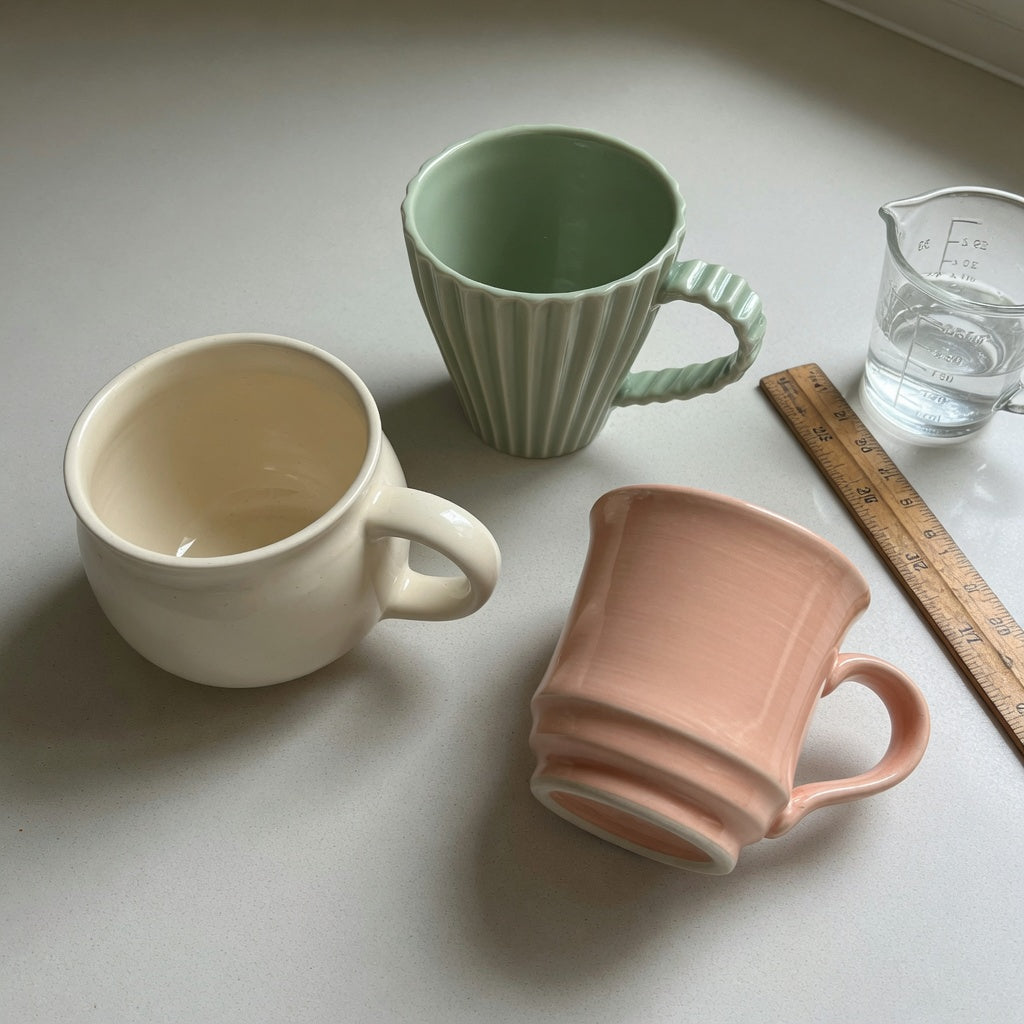
Measure the drink you actually make. Pour your normal serving into a kitchen measuring jug and record the fluid ounces or milliliters, including the milk you usually add. For iced coffee or frothed drinks, allow headroom for ice, foam, and movement between the counter and your desk. A capacity that only fits the liquid at the rim is not a comfortable everyday fill.
A listing may state capacity without explaining whether the number is measured to the brim or to a practical fill line. Ask for clarification if spill margin matters. Smaller cups can suit short coffee servings or tea, but they are not a good choice for a large iced drink. If no capacity appears, do not estimate it from hands, spoons, coffee beans, or other photo props.
Ceramic and care labels: which claims can you rely on?
Ceramic is the verified material category for these options. That word alone does not establish a ceramic subtype, firing method, glaze composition, wall thickness, chip resistance, or heat-retention performance. We do not fill those gaps with assumptions, and first-time buyers should not use terms such as porcelain or stoneware unless the individual listing does.
If your routine depends on a shared office dishwasher or reheating coffee in a microwave, an explicit care statement should be a purchase requirement. We do not apply one blanket dishwasher-safe or microwave-safe answer to every round, pleated, and retro form. Check the current product page, and contact us if the care wording is absent. A mug with unconfirmed machine-care instructions is not a practical match for someone who needs that certainty at checkout.
Round, pleated, or retro: which visible form fits the first purchase?
Style becomes useful when it is tied to where the mug will sit and how much visual detail you want. These are starting points based on visible form, not quality rankings.
| Reader situation | Why the form may fit | Relevant next step |
|---|---|---|
| You want a quiet outline for a clean kitchen counter or low-visual-noise office desk. | The round profile presents the simplest visible body shape among these three named forms. | Open the round coffee tea mug and verify its listed capacity, dimensions, and handle opening. |
| You want visible surface detail for an open shelf or gift unboxing. | The pleated exterior adds a repeated contour that is easy to distinguish from a smooth round body. That is a visual observation, not a claim that the texture improves grip. | Review the pleated coffee tea cup, then confirm capacity, handle clearance, and care information. |
| You prefer a more distinctive outline while staying within a simple ceramic category. | The retro-labeled form has a stronger visual identity than the quieter round option and may stand out more on an open shelf. | Compare the retro coffee tea cup against your available space and usual drink volume. |
None of these product names proves durability, insulation, stackability, or machine-care compatibility. If you need a sealed lid, long-duration insulation, or a cup for outdoor travel, this ceramic category is likely the wrong fit. To compare additional visible forms, open our unique coffee mugs collection and apply the same six checks to each listing.
Handle clearance and counter footprint: will it work at your desk?
Measure a mug you already find comfortable. Record the inside height and width of its handle, then note the total exterior width from the opposite side of the body to the outer edge of the handle. Compare those numbers only when the new listing provides equivalent measurements. Two-finger, three-finger, and four-finger grip preferences vary, so there is no universally correct handle opening.
Total width matters on a desk beside a keyboard, while base diameter matters for a coaster or compact coffee station. A larger handle opening generally requires more lateral room; a compact handle saves space but may feel cramped for larger hands. If the listing lacks scale or dimensions, photos cannot settle that trade-off. Ask for measurements before treating the handle as a confirmed fit.
Gift unboxing and first-use checks that photos cannot complete
Inspect a new ceramic mug under neutral light before its first drink. Check the rim for a visible chip, the body for a crack, and both handle attachment points for damage. Set the empty, dry mug on a known flat counter to check for pronounced rocking. These checks do not predict long-term durability; they simply identify obvious arrival issues that cannot be verified online.
For a gift, complete the inspection before discarding the packaging. If you find a visible chip, crack, damaged handle joint, or major mismatch with the listing, do not use the mug. Photograph the item and packaging, then contact our store with the order details. Glaze color can also appear different under warm kitchen bulbs and fluorescent office lighting, so compare it in neutral daylight before deciding that the color is materially different.
Which missing listing details should pause the order?
An unknown should stop the purchase when it connects directly to your daily routine. Use these practical blockers rather than expecting every listing to answer every possible question.
- Pause if capacity is missing and your coffee maker uses a fixed serving volume.
- Pause if dimensions are missing and the mug must fit a tight shelf, coaster, or machine platform.
- Pause if handle clearance is unclear and larger hands or a specific finger grip are a priority.
- Pause if dishwasher or microwave use is essential but the care statement is absent.
- Choose another category if you require a lid, leak resistance, or stated insulation for commuting.
Our rule is simple: do not convert a blank listing field into a favorable assumption. If the unknown has no effect on your use, it may be reasonable to proceed. If it determines fit, care, or drink volume, ask for the missing fact first.
Frequently asked questions
How do I use a minimalist ceramic mug first time buyer practical purchase checklist?
Start with your measured drink volume, then verify ceramic material wording, visible shape, handle fit, and care instructions. Write down anything the listing does not state. Proceed only if each unknown is irrelevant to your routine or has been clarified by our team.
What capacity should I choose for my first ceramic mug?
There is no universal capacity because coffee makers, tea servings, milk additions, and ice all change the required space. Measure your normal finished drink and allow headroom above it. If the listing does not state ounces or milliliters, ask before ordering rather than estimating from the photos.
Are the round, pleated, and retro ceramic cups dishwasher and microwave safe?
We do not give one blanket answer for all three forms. Check the care wording on each current product page because compatibility must be confirmed at the individual listing level. If the page is silent, treat dishwasher and microwave use as unconfirmed and contact us before purchase or use.
Which mug shape works best on an office desk?
The round form is the quietest visual starting point, the pleated form adds visible surface detail, and the retro form has a more distinct outline. Desk fit still depends on total width, base footprint, capacity, and handle clearance. Shape alone cannot confirm that the mug will fit beside your keyboard or on your coaster.
What should I do if a new ceramic mug has a chip or visible crack?
Do not drink from a mug with a visible chip or crack. Photograph the affected area and packaging, then contact our store with the order information. If the concern is wobble, first test the empty mug on a clean, dry, level surface to rule out an uneven counter.
Three tabs and one measured pour before checkout
Measure your usual drink once, note any shelf or coaster limits, and open the round, pleated, and retro product pages in separate tabs. Keep only the options that meet your capacity, visible shape, handle, and essential care requirements. If none clears every use-case blocker, return to the collection and repeat the checklist instead of turning an unknown into an assumption.
More from our blog
Read more

White and Gold Coffee Mug Weekend Coffee Product Shortlist Guide
Compare two white-and-gold wave mugs by listed capacity and visible form. This scenario-based shortlist explains which option fits a solo pour or brunch tray, when to skip both, and what to verify ...
Read more
Geometric Coffee Mug First Time Buyer Practical Purchase Checklist
Use this first-purchase checklist to compare the capacity, material, visible shape, dimensions, and care details stated on a mug listing. It also explains when a geometric mug fits a desk, kitchen,...
Read more
Leave a comment
This site is protected by hCaptcha and the hCaptcha Privacy Policy and Terms of Service apply.