
Geometric Coffee Mug First Time Buyer Practical Purchase Checklist
Reading time: about 9 minutes
A mug can look compact beside a coffee pot in a product photo, then arrive too wide for the coaster next to your keyboard or too small for the drink you pour every morning. That is the problem our geometric coffee mug first time buyer practical purchase checklist is built to prevent: it turns the current listing into checks you can complete before ordering.
Our team handles non-standard mug shapes during product review, packing, and customer questions. We pay attention to details that shoppers feel immediately but photos can understate: the contact ring under the base, knuckle room inside the handle, the drinking rim, and the widest part of the body. Use only the capacity, material, dimensions, and care statements shown on the current product page. If a detail is missing, treat it as unknown rather than filling the gap with an assumption.
Will the listed capacity match your actual coffee or tea?
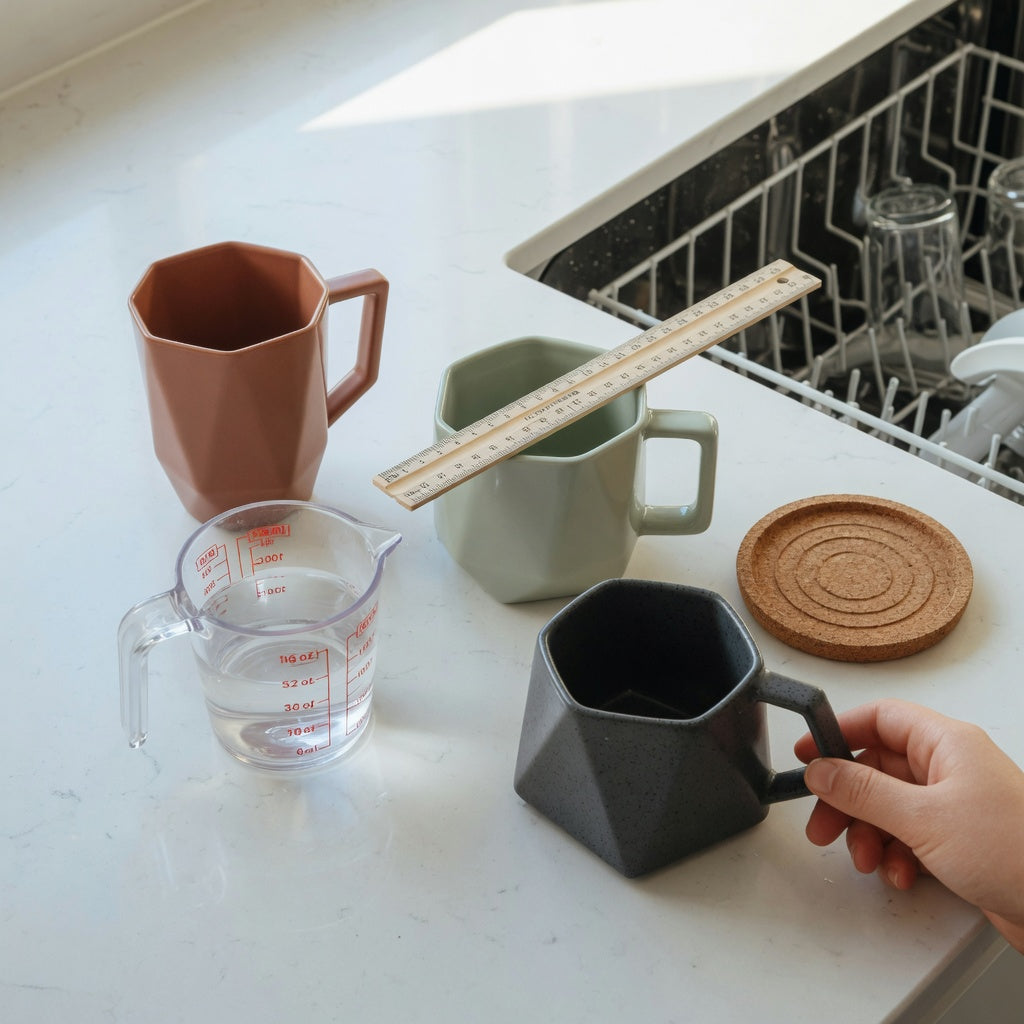
Measure your usual drink before comparing mugs. Pour a normal serving into a measuring jug, including milk or creamer, and record the volume in milliliters or US fluid ounces. One US fluid ounce is about 29.6 milliliters, which helps when your kitchen measure and the listing use different units.
Do not assume the stated capacity equals a comfortable fill level. Coffee needs some headroom if you carry it between rooms, and iced coffee needs room for ice displacement. A larger listed capacity can reduce refills, but the full mug may also be heavier. The product page cannot settle that trade-off unless it states both capacity and empty weight, so mark weight as unknown when it is not provided.
If no capacity appears on a listing, ask before ordering. Product photos beside a spoon, book, or coffee maker are not reliable measuring tools because perspective changes apparent size.
Does the stated material fit microwave, dishwasher, and hand-wash routines?
Read the material field rather than assuming every geometric mug is ceramic. Ceramic and glass can both chip at the rim, base, or handle join if they contact a hard sink or neighboring dish. Metallic materials or metallic decoration affect microwave suitability. Dishwasher-safe and microwave-safe are separate claims, so one does not establish the other.
The finish also affects daily handling. A matte surface may feel different from a glossy glaze, while textured planes can create extra contact points in a crowded dishwasher rack. Those are comparison factors, not guarantees about a specific mug. Check what the current listing actually says about its finish and care.
If care instructions are absent, do not treat silence as dishwasher or microwave approval. Ask our store for clarification or plan to hand wash and avoid microwave use until the material and decoration are confirmed. In a dishwasher, leave enough clearance that the handle and projecting planes do not knock against another item during the cycle.
Will the visible shape work on your desk, shelf, and dishwasher rack?
Geometric describes the visible current form, but it does not tell you how the mug will fit your space. Look for overall height, base width, widest body width, and total width including the handle. The last measurement is often the one that determines whether a mug fits beside a monitor, under a cabinet shelf, or between dishwasher rack tines.
| Listing detail | Why it matters | What to do if it is missing |
|---|---|---|
| Height and widest width | Controls cabinet, desk, and dishwasher clearance | Measure the available space and ask for dimensions |
| Base or contact-ring view | Helps you assess how the mug meets a flat counter | Request a clear photo of the underside |
| Handle opening | Affects finger and knuckle clearance | Ask for the inside height and width |
| Rim close-up | Shows whether the drinking edge is smooth or visibly shaped | Do not infer rim comfort from a front photo |
A faceted outer wall does not necessarily mean the drinking rim has the same geometry. Check the close-up. Also consider standard accessories: an unusual footprint may not fit a car cup holder, and a non-standard rim may not accept a generic reusable lid.
Which CoffeifyMug product page should you compare first?
Start with the visual feature that brought you to the category, then verify the practical data on that product's current listing. We use the following sequence with first-time shoppers:
- For a visibly angular, rhombus-style silhouette: Open the Rhombus Coffee Tea Mug. It is the relevant next comparison when the named form is your priority. Check its current capacity, material, total width, base view, and care wording before deciding that the appearance suits daily use.
- For a different named geometric silhouette: Compare the Planet Coffee Tea Mug against the Rhombus page. This helps you judge the visible shapes side by side without assuming they have the same grip, footprint, capacity, or material.
- For shoppers balancing color treatment with form: Review The Gradient Coffee Tea Mug. Use the current photos to assess the color transition and visible outline, then confirm the same practical specifications rather than choosing on color alone.
- For buyers who are still unsure about the silhouette: Browse the unique coffee mugs collection. The collection is the better next step when you want to compare several non-standard forms before committing to one product page.
Product names and images help narrow the field, but they do not establish an unlisted production method, provenance, creator, edition size, or material. We do not use those claims unless the product page supports them.
Geometric coffee mug first time buyer practical purchase checklist: 9 checks
Keep this geometric coffee mug first time buyer practical purchase checklist beside the product page. A blank answer is useful because it identifies a question to resolve before checkout.
- Write down the main use: morning coffee, tea, iced coffee, office desk, shared kitchen, or gift.
- Measure your normal serving, including milk and the headroom needed for carrying.
- Record the listing's stated capacity and make sure the unit is clear.
- Confirm the stated body material and any separately listed coating, glaze, or decoration.
- Copy the height and widest width, including the handle, then compare them with your shelf, coaster, desk, and dishwasher space.
- Inspect photos of the base, rim, handle opening, and handle joins. Do not rely on the front image alone.
- Read the exact dishwasher, microwave, and hand-wash instructions. Do not extend one care claim into another.
- Consider storage and transport. Decide whether stacking, a vehicle cup holder, or a reusable lid is essential.
- List every unknown and ask our store about the specific product. Do not substitute a specification from another mug with a similar appearance.
For a gift, capacity and care are often more useful than a dramatic silhouette. A recipient who uses a small office dishwasher or has a crowded cabinet may value easy clearance more than visual complexity.
What should you inspect as soon as the mug arrives?
Do the first inspection before making a drink or wrapping the mug as a gift. We use a flat, dry counter and clear side lighting because both make physical issues easier to see.
- Set the empty mug on the counter and rotate it a quarter turn. Check for persistent rocking rather than judging it on a soft mat or uneven table.
- Inspect the drinking rim, base edge, visible planes, and both handle joins for chips, cracks, or sharp damaged areas. Do not use a mug with a structural crack.
- Wash it only according to the stated care directions. Avoid using a first wash as an experiment with an unverified dishwasher setting.
- Fill it with cool water first and lift it by the handle over the sink. This gives you a low-risk check of full weight, balance, and knuckle clearance.
- Place it in the actual cabinet, dishwasher position, or desk spot where it will live. Packaging dimensions cannot answer that final fit question.
If the mug is a gift, inspect it before the gift date rather than leaving the shipping box sealed. That gives you time to address visible damage or a mismatch between the listing and the item received.
Who should choose a plain cylinder or travel mug instead?
A geometric coffee mug is not the best choice for every routine. Choose a sealed travel mug if leak resistance and vehicle cup-holder fit matter most. A straight-sided, stackable mug is usually more practical for a crowded shared kitchen, while a lightweight mug with a generous rounded handle may suit someone who finds narrow handles difficult to grip.
Households prioritizing break resistance for young users should choose drinkware made and labeled for that purpose. Geometric mugs make more sense for shoppers who value a visible, non-standard form and are willing to check storage, cleaning clearance, and handle fit before buying.
Frequently asked questions
What belongs on a geometric coffee mug first time buyer practical purchase checklist?
Include the listed capacity, stated material, overall dimensions, visible base and rim shape, handle clearance, and exact care instructions. Add your normal serving size and the available space on your desk, shelf, or dishwasher rack. Any missing specification should become a question for the store.
How can I tell if a geometric mug will fit my dishwasher and cabinet?
Compare the mug's stated height and widest total width with the usable clearance in both places. Measure the width including the handle, not only the body. If the listing omits dimensions, ask before ordering rather than estimating from photos.
Is a geometric coffee mug a good gift for someone I do not know well?
It can be, especially when the recipient enjoys visibly distinctive drinkware. The risk is practical fit: you may not know their preferred capacity, cleaning routine, grip needs, or cabinet space. Choose a listing with clear specifications and inspect the mug before wrapping it.
Should I assume a geometric coffee mug is ceramic and microwave safe?
No. Confirm the material and microwave statement on the specific product page because the shape alone establishes neither. Metallic material, decoration, or other construction details can change care requirements, so an unlisted microwave claim remains unknown.
How should I compare the Rhombus, Planet, and Gradient mugs?
Open all three product pages and create four rows for each: capacity, material, dimensions, and care. Then compare the current photos for base, rim, handle, and visible form. Choose the mug with the fewest unresolved questions and the closest match to your actual use, not simply the most striking front image.
Open the Rhombus, Planet, and Gradient pages in separate tabs and run the nine checks against each one. Pause on any blank specification, ask us to clarify it, and use the unique coffee mugs collection only after you know which capacity, material, care routine, and footprint will work in your space.
More from our blog
Read more
Minimalist Ceramic Mug First Time Buyer Practical Purchase Checklist
Compare the listing details that affect daily use: stated capacity, ceramic material wording, visible profile, handle clearance, care claims, and missing specifications. This checklist also maps ro...
Read more
Ocean Coffee Mug First Time Buyer Practical Purchase Checklist
Compare the Mountain Sea and Landscape mugs by visible imagery, ceramic material, form, listed capacity, and clearly marked care unknowns. Includes practical checks for ordering and unboxing.
Read more
Leave a comment
This site is protected by hCaptcha and the hCaptcha Privacy Policy and Terms of Service apply.