
Matcha Set With Cups and Pouring Bowl: What to Compare
Reading time: about 13 minutes
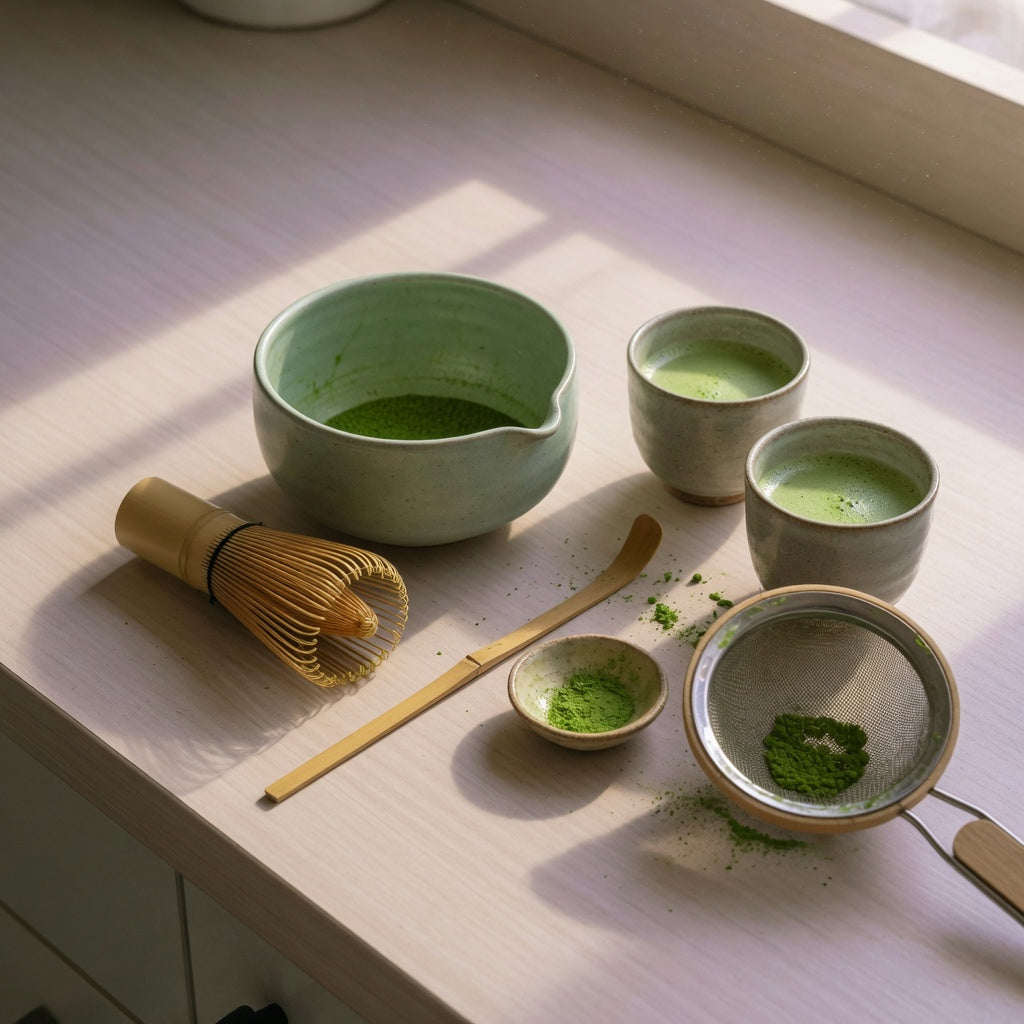
The spill shows up at the pour, not while the whisk is moving. A wide bowl of green foam sits on the counter, two cups are waiting, and a smooth rim sends a ribbon of tea down the outside of the clay. That is when a matcha set with cups and pouring bowl stops being a gift-box photo and becomes a tool question: does the bowl actually aim the tea, and are the cups the right size for the drink you make?
We see the same pattern in packing notes and in messages after a gift unboxing. The foam looked right. The second cup did not. Sometimes the spout was only a painted dip in the rim. In our store we treat cups plus a pouring bowl as a modern home kit. Traditional descriptions use the chawan as the bowl you both whisk in and drink from, and a yunomi as a separate teacup. A pouring lip, sometimes called a katakuchi, is a serving convenience, not a ceremony standard. It earns a spot on the counter when you share, pour into a mug, or start a latte. It is extra washing if you always finish the tea in the bowl.
The piece we point shoppers toward for this shape is our rounded ceramic matcha tea set with pouring bowl. The catalog title is the only product fact we will treat as settled: rounded ceramic, sold as a matcha tea set, with a pouring bowl. Cup count, bamboo tools, stated capacity, glaze notes, and care lines have to be read on that listing. A styled table in a photo is not a packing list. If you also need a daily mug beside the set, those sit with the rest of the drinkware in the new catalog.
What belongs in a matcha set with cups and pouring bowl?
Shoppers ask us whether a beginner needs every piece, or whether a bowl and a whisk are enough. The tools split cleanly, in plain language and in the Japanese names you will see on boxes.
- Chawan. The wide bowl. In a pouring set you whisk here, then tip the tea out, rather than drinking from it.
- Chasen. The bamboo whisk. Split tines are what build the foam. A stiff, poorly split whisk leaves clumps and can shed tips into the bowl.
- Chashaku. The bamboo scoop. Useful, but scoops are not identical. Do not treat one level scoop as a gram weight until you have checked it on a scale.
- Sifter. Optional, and the piece people skip until the first lumpy bowl. Sifting before water hits the powder is the simplest fix for dry clumps.
- Kusenaoshi. A whisk holder. Not required. It gives a damp chasen a place to dry in something like its shipped curve instead of lying flat in a puddle.
- Cups. Separate from the bowl. Their job is serving. If the listing does not state how many ship, or their volume, do not guess from a photo.
A wide mug can work for one person who drinks on the spot. A narrow measuring cup is a poor stand-in: the whisk hits the walls, tea climbs the sides, and you spend the whisking time wiping the counter. This format is a bad fit if you want one vessel and almost no extra washing, or if you only ever want an electric frother and a splash of milk. Buy the bowl-and-cups format when the pour is the point.
Why keep cups if the tea can stay in the chawan?
Because the drink changed, not because the older way was wrong. One person, straight usucha, no milk: the chawan is enough, and a spout is optional. Two people after dinner: you whisk once and pour, so the second cup is not sitting while you finish yours. A latte needs a cup or mug with headroom. A shallow bowl sized for a small straight tea will overflow the moment dairy or oat milk goes in.
We use a simple check at the counter. If the batch is meant to be shared, the cups should look full when you divide it, not like a stain in the bottom of a large cafe mug. Home recipes for classic straight matcha often describe a small serving — around 2 grams of powder and roughly 60 ml of water near 80°C, hot but not a rolling boil — finished with a short whisk in an M or W. A thicker style, koicha, uses more powder and less water. Those figures are common seller guidance, not a rule, and the card that came with your tea should win if it disagrees. This is about bitterness and texture, not a health claim.
The number many listings skip is the one that decides the purchase: are the included cups closer to that small straight pour, or closer to a milk drink?
If the page is silent, write unknown in your notes. Do not borrow a milliliter figure from a similar set on another site, and do not assume our pouring-bowl listing matches a cup size you saw elsewhere.
Bowl room and spout control on a weekday counter
No standards body publishes a required bowl diameter, spout angle, or whisk prong count. Retail guides do not agree with each other, so we will not pretend one millimeter is the correct matcha bowl. Function is easier to judge than a spec sheet that was never written.
The bowl needs enough width for the chasen to travel without striking the wall on every pass. Too narrow and you splash. Very deep, and small for one serving, and you chase dry powder around a puddle the whisk barely reaches. A spout should be a real lip. Tip the empty bowl over a cup in the sink before the first tea so you can see whether the lip is formed. A decorative notch that lets liquid run back along the belly still makes a mess, just a slower one.
The catalog calls this piece a rounded ceramic set with a pouring bowl. A rounded interior is what we look for in this category so the whisk has a smooth path instead of corners. That is a reason to open this listing first, not a measured claim about wall thickness, diameter, or capacity. Handmade or small-batch glaze can differ from the hero photo. Variation is normal. It is a defect only if the page promised a uniform color. Confirm on the listing, because we are not filling those blanks here: stated capacity, whether the spout is described as part of the rim, how many cups are in the box, and which bamboo pieces are actually included.
| How you drink | What fits | Where sets disappoint |
|---|---|---|
| One person, straight tea | Drink from the chawan; spout optional | Extra cups that live in a cupboard |
| Two or three people sharing | Room to whisk a larger batch, then a controlled lip into small cups | A dribbling rim, or cups so large the pour looks lost |
| Latte or other milk drink | Whisk in the bowl, pour into a cup with room for milk | A shallow bowl that overflows once milk is added |
| Speed over fine foam | Electric frother in a mug | The bamboo whisk sits unused and stays damp |
Whisk tines, damp storage, and the piece that ages first
The ceramic usually outlasts the whisk. In our experience the bowl is still sound when the chasen has opened up, lost its curve, or started leaving bits of bamboo in the foam. The causes customers describe are ordinary. The whisk was left wet in a closed cabinet, pressed flat under a plate, or sent through a dishwasher because the box said the set was machine safe.
A kusenaoshi is the plain fix we suggest. Rinse the whisk with warm water, then rest it on the holder so the tines dry in a curve close to the shape they shipped in. We tell people to skip a long soak, and to keep soap off the bamboo if the smell will linger in the tines. Dark, damp storage is how mold shows up on a whisk that otherwise looked fine at unboxing. There is no government rule that a holder is mandatory, and we will not invent a lifespan in months. If the tines have uncurled past the point where they spring back after a short warm rinse, foaming gets worse. That is a replacement whisk, not a failed bowl.
Prong count is a weak shopping number on its own. More tines can mean a finer surface when they are thin and split cleanly. A dense, cheap whisk can still clump and snap. Look at the tips in the listing photos instead of chasing a single count that brands do not measure the same way.
An electric frother is a fair substitute only when you want a faster latte and do not care about the fine hand-whisked surface. It is a bad trade if you bought the set for that texture. Plenty of home drinkers keep both and use the frother on rushed mornings.
If a discounted box arrives without the scoop, you can still make tea with a small measuring spoon. Treat a missing chashaku as a packing or listing problem, not as a piece every set quietly omits. Check the contents line before you assume the photo's full lineup is what ships. The catalog title alone does not tell us whether this pouring-bowl set includes a scoop, a whisk, a sifter, or a holder.
Food-use ceramic, lead labels, and bamboo that is not the bowl
When a box leans on a lead-free slogan, we point people to U.S. FDA notes on glazed pottery rather than to the slogan. Lead in a glaze or a painted decoration can move into food or drink if the piece was not fired properly. Some ware sold with a lead-free label has still shown lead that testing could draw out. Washing or boiling does not pull that lead out of the glaze. Pieces sold only as ornament may be marked not for food use. In that same guidance, everyday pottery made for commerce is described as much less likely to be the problem than crude handmade work, antiques, damaged pieces, ware of uncertain origin, or the brightly orange, red, or yellow decorated styles the agency flags.
A lead-free line on an imported set is not proof by itself. We will not claim a lab test, a certification, or a food-contact pass for any bowl, including the one on our listing, unless the current page says it in plain language. If the page is silent, that silence is part of the comparison. Prefer ware sold for drinking. A decorative piece marked not for food use does not belong in a tea set, no matter how the glaze photographs.
Dishwasher safety is maker-specific, and pages rarely split the sentence by material. A ceramic bowl might tolerate a machine while the chasen, chashaku, and holder must not. If you cannot tell which sentence applies to which piece, hand-wash the bamboo and read the bowl line again before the first cycle. The same caution applies to microwave use. Do not fill that gap from a similar product on another site.
Gifting adds one more failure. A set that looks complete at the unboxing and then grows mold on the whisk feels like a bad present even when the clay was sound. Leave a one-line drying note in the box. If the recipient mostly drinks from larger coffee mugs, small matcha cups may be the wrong gift. In that case, look through the drinkware in the new catalog for a daily mug they will actually reach for, and treat the matcha bowl as its own decision.
Straight usucha, a shared pour, or a home latte
Pick the drink before you pick the bundle. The same pouring bowl is not equally useful for all three.
- Straight tea for one. A bowl you drink from may be all you need. Cups and a spout are optional extras you will wash and store.
- A shared pour. You want bowl room for more than a single sip and a lip that aims into two or three small cups. Do not assume any pouring bowl makes three servings. Only a stated capacity can support that.
- A latte at home. Whisk in the bowl, then pour into a cup that can take milk. If the set's cups are sipping size, you will end up using a different mug anyway.
- A bottle for the commute. A real spout helps. A round rim does not. You still want a wide bowl for the whisking step, then a careful pour.
Water at a hard boil tends to push matcha toward a harsher taste. Water that is only lukewarm leaves powder sitting on the surface. Those are counter observations from making the drink, not a lab standard. Sift, add the powder, add the water, whisk briefly, pour. Koicha is a separate, thicker preparation. Do not use a thin usucha ratio and expect that result.
Matcha powder itself is usually not in a utensil set. Origin, harvest, and whether the tencha was stone-milled will not appear on a bowl page. Buy the tea as its own decision. A well-shaped pouring bowl will not fix a tin that has gone stale in a warm cupboard.
Lines to read on the listing before you add it
Use this as the last pass, on the live page, not from memory of a review or a styled photo.
- Pieces named in the description: bowl, cups, whisk, scoop, sifter, holder. Count words, not props in a photo.
- Spout: a formed pouring lip, or a round bowl bundled with cups. The title says pouring bowl; the description should say how the lip is formed.
- Capacity of the bowl and of each cup, in ml if the page gives it. If it does not, leave the number blank.
- Whether tea is included. Assume it is not until the page says otherwise.
- Care sentences, and which material each sentence covers.
- Food-use wording. A lead-free slogan is not a lab report.
- Glaze: if variation is mentioned, your piece may not match the hero photo.
- What the seller says happens if a scoop or whisk is missing on arrival.
Start with the current pouring-bowl listing and check those lines before it goes in the cart. If the cups are the wrong volume for how you actually drink, or you still need a daily mug beside the matcha bowl, compare sizes in the new catalog before you buy a second vessel you will not use.
Frequently asked questions
Do I need a matcha set with cups and pouring bowl, or can I whisk in a mug?
You can whisk in a wide mug or an ordinary bowl if the chasen fits and you drink it there. A set is worth it when you want a stable wide bowl, a lip that pours into separate cups, and tools that stay together. A narrow measuring cup splashes and leaves clumps more often. If you always drink alone from the bowl, skip the extra cups.
Why buy drinking cups if matcha is traditionally finished in the chawan?
The cups are for sharing, for pouring into a mug, or for a latte that will not fit back in a shallow whisking bowl. They are a serving choice, not a requirement of the tea. If nobody else is drinking and you do not add milk, a single chawan is the simpler kit and the easier wash-up.
How should I dry a bamboo whisk so it keeps its shape?
Rinse it with warm water, then rest it on a holder so the tines dry in a curve instead of lying flat and wet. Do not leave it sealed in a cupboard while damp, and do not put bamboo in the dishwasher even if a ceramic bowl on the same page is described as machine-safe. If the listing does not include a holder, a clean cup used only for drying can stand in until you have one.
Does a lead-free label mean the ceramic is safe to drink from?
Not by itself. FDA guidance notes that some pottery labeled lead free still had lead that testing could draw out, and that washing or boiling does not remove it. Look for a clear food-use statement on the current listing. Display ware marked not for food use does not belong in a tea set, no matter how the glaze looks.
Can one pouring bowl make enough matcha for two or three cups?
It can, if the bowl is large enough to whisk that batch and the cups are small enough to share it. Nothing in the format guarantees three servings. Read the stated capacity on the product page. If capacity is not listed, do not invent it from a photo, and do not expect one straight-tea whisking to fill large latte cups.
More from our blog
Read more

Unique Gradient Coffee Mug: Compare Glaze, Care, Size
A unique gradient coffee mug may be a fired glaze, a printed ombré, or a coated finish, and those choices change washing, reheating, and gift risk. Here are the listing details we ask buyers to con...
Read more
Wide Bottom Mug for Desk: What Buyers Should Compare
A wide bottom mug for desk work is harder to knock over because the foot is broader and the weight sits lower. It can still spill. Compare ceramic, lidded stainless, and suction designs, plus care ...
Read more
Leave a comment
This site is protected by hCaptcha and the hCaptcha Privacy Policy and Terms of Service apply.