
Lungo Coffee Cup Everyday Mug Rotation Practical Purchase Checklist
Reading time: about 8 minutes
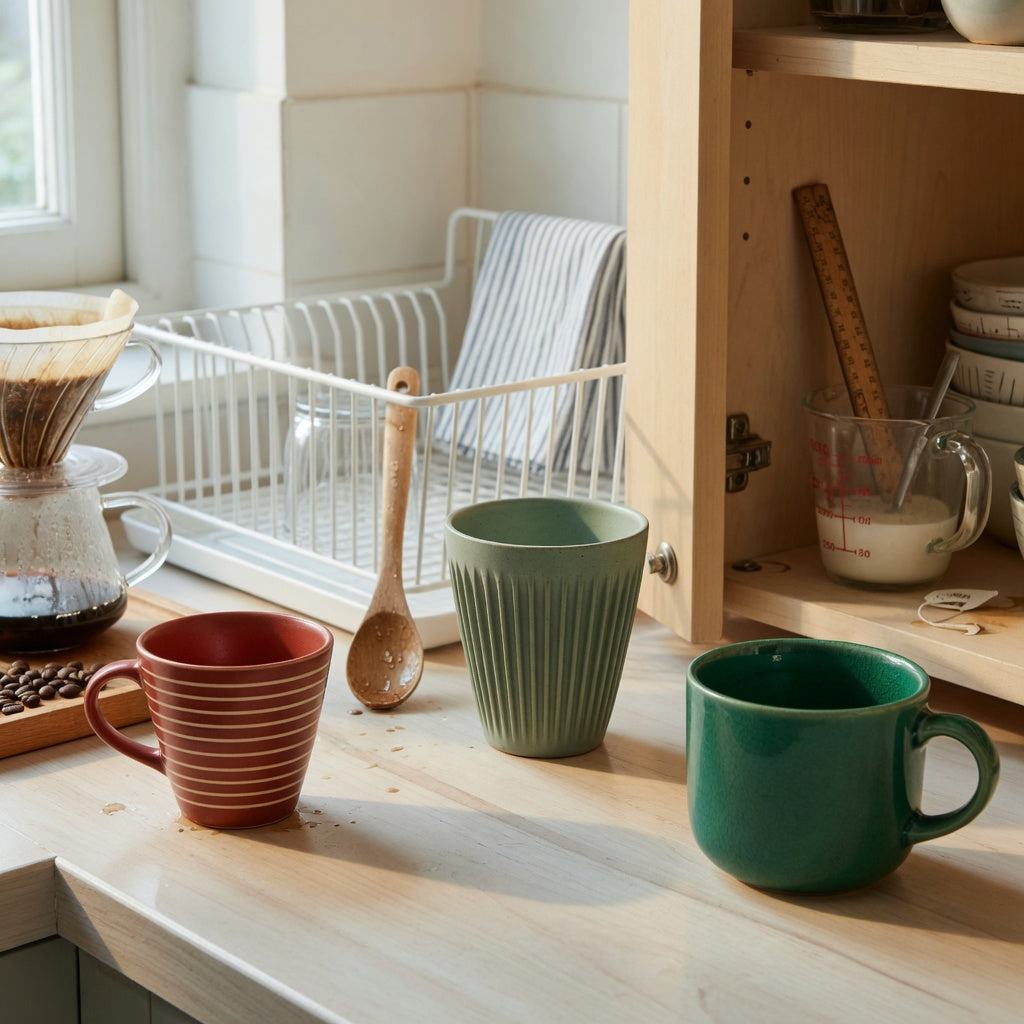
By the third morning without a wash cycle, a cupboard can look full while the cup you actually want is sitting on an office desk or waiting beside the sink. Our lungo coffee cup everyday mug rotation practical purchase checklist begins with that familiar problem: how often cups are used, how much you pour, and how much room the rotation occupies between cleaning cycles.
In our store, we compare this compact group using the facts we can support. The Retro is listed at 170 ml, the Pleated at 200 ml, and the Emerald at 270 ml. Those figures help compare capacity and potential headroom. They do not establish exterior dimensions, material, stackability, dishwasher suitability, or compatibility with a particular brewer, so those details should be confirmed on the current product listing or with our team before purchase.
How much headroom does your usual pour need?
Listed capacity is useful for comparison, but it is not a universal comfortable-fill line. We use nominal headroom as a planning figure: subtract your measured final drink volume from the cup's listed capacity. The result shows how the three options differ on paper, although rim shape and the method used to establish listed capacity can affect the space you see in the actual cup.
- Prepare the drink as you normally serve it, including any water, milk, or other liquid additions.
- Measure that final liquid volume with a suitable marked measuring vessel.
- Decide how much carrying margin feels reasonable for your routine. A cup used at the kitchen counter has different spill considerations from one carried upstairs or across an office.
- Compare that measured volume against 170 ml, 200 ml, and 270 ml rather than relying on a universal lungo serving size.
For example, a measured 150 ml drink produces a nominal difference of 20 ml in a 170 ml cup, 50 ml in a 200 ml cup, and 120 ml in a 270 ml cup. That arithmetic does not guarantee spill-free carrying, but it makes the trade-off clear: the same pour leaves progressively more potential headroom as listed capacity increases.
Lungo coffee cup everyday mug rotation practical purchase checklist
Use this checklist before choosing a quantity or capacity. It keeps the decision tied to your real kitchen and washing schedule rather than an idealized matching set.
- Count peak cup use. Check how many cups are out of the cupboard immediately before your normal wash cycle.
- Measure the final pour. Include the liquid additions you regularly use instead of comparing capacity with coffee alone.
- Choose intentional headroom. A listed capacity only slightly above your measured pour offers less nominal margin than a larger option.
- Record the storage envelope. Measure available shelf height, depth, and width. Overall handle span matters as much as the cup body.
- Check the serving route. Note whether the cup stays at the counter or travels past a keyboard, carpet, stairs, or other spill-sensitive areas.
- Measure equipment clearance. If the cup must sit beneath a brewer outlet, compare actual exterior dimensions before assuming it fits.
- Verify material and care details. Look for explicit dishwasher, microwave, and cleaning guidance. Capacity does not answer those questions.
- Plan the mix. Repeat one capacity if everyone pours the same amount, or combine capacities when household preferences genuinely differ.
Running the lungo coffee cup everyday mug rotation practical purchase checklist once is usually faster than returning to the cupboard every morning and finding that the only clean option is too close to the rim or larger than you prefer.
170 ml, 200 ml, or 270 ml: which role fits your rotation?
The useful comparison is not small, medium, and large in the abstract. It is your measured pour, the nominal buffer you want, and the role each cup will play between wash cycles.
| Cup | Reader situation | Why it fits | Trade-off to check |
|---|---|---|---|
| Retro Coffee Tea Cup | Your final drink sits comfortably below 170 ml after allowing for your preferred margin. | At 170 ml, it is the lowest listed capacity in this comparison and suits shoppers who do not need the extra volume. | It provides the least nominal headroom of the three for an identical pour. Confirm exterior dimensions and care separately. |
| Pleated Coffee Tea Cup | A 170 ml capacity feels too close to your regular fill, while 270 ml is more capacity than you expect to use. | Its listed 200 ml capacity is 30 ml above the Retro and makes it the middle listed option. | It still offers 70 ml less listed capacity than the Emerald, which matters if additions bring your drink close to 200 ml. |
| Emerald Coffee Tea Mug | Your measured drink or additions require the most room within this three-product group. | At 270 ml, it offers 100 ml more listed capacity than the Retro and 70 ml more than the Pleated. | The extra capacity may be unnecessary for a shorter pour. Do not infer shelf, desk, or brewer fit from millilitres alone. |
These are capacity comparisons, not drink prescriptions. There is no single lungo volume that suits every recipe or routine. Measure what you make, then select the linked product whose listed capacity leaves the nominal buffer you actually want.
How many cups fit your wash schedule and storage?
Count cups at the busiest point between cleaning cycles. If one person uses one cup and everything is washed nightly, a working cup plus a spare may be enough. If two people leave cups at separate desks and the dishwasher runs every other day, count the actual peak in-use total before adding an optional guest or backup cup.
- Same pour, same routine: repeating one capacity makes the expected fill level consistent from cup to cup.
- Different household preferences: a mixed-capacity rotation can prevent one person from receiving too little headroom or more cup than needed.
- Unknown gift preference: the Pleated 200 ml is the middle listed option, but that does not make it universally correct. The recipient's usual drink volume and care preferences still matter.
Storage needs a separate check. In our experience, shoppers often measure shelf height but miss the cabinet lip, handle span, or the space taken by cups air-drying beside the sink. A 170 ml capacity also does not prove that a cup is physically shorter, narrower, or stackable. If your rotation depends on close stacking or a specific rack slot, confirm exterior measurements and nesting guidance rather than estimating from capacity.
Which material and care details must be confirmed?
The verified information used for this comparison establishes the three listed capacities, not material composition or care compatibility. Before checkout, confirm any detail that affects your routine: stated material, finish guidance, microwave suitability, dishwasher instructions, and restrictions supplied with the product. If a listing is silent on one of those points, treat it as unknown and ask our team instead of assuming.
We also recommend a short inspection when a cup arrives, especially before a gift unboxing. Check the rim for chips or rough damage, look around any handle-to-body joints for visible hairline cracks, and place the cup on a flat counter to see whether the base sits steadily. Compare the received finish with the current listing, keep the packaging until the inspection is complete, and follow the supplied cleaning directions before first use. A single dishwasher cycle is not evidence of long-term dishwasher suitability when that care method has not been stated.
Where does a compact lungo cup stop making sense?
This group is not the right next step if your measured drink plus preferred headroom exceeds 270 ml. It is also a poor match for a large iced drink that needs substantial room for ice, a commute that requires a lid and insulation, or an equipment setup that demands an exact fit you have not verified. In those situations, a larger mug, an insulated travel vessel, or a cup with confirmed exterior dimensions is the more practical purchase.
A mixed rotation also has limits. Different capacities serve different drinkers well, but they may not share the same exterior profile or storage behavior. Choose matching capacities when uniform filling and predictable cupboard organization matter more than accommodating several pour sizes.
Frequently asked questions
What should a lungo coffee cup everyday mug rotation practical purchase checklist include?
Measure your normal final pour, choose the nominal headroom you want, count cups used between wash cycles, and record shelf and equipment clearances. Confirm material, care, exterior dimensions, and stackability separately because the listed capacity does not establish those details.
Is 170 ml enough for a regular lungo coffee cup?
It can be if your measured final drink leaves a carrying margin within the Retro's listed 170 ml capacity. There is no universal lungo volume, so a shopper whose pour sits close to 170 ml should compare the 200 ml Pleated rather than assume the smaller option will feel comfortable.
Should I choose the 200 ml Pleated or 270 ml Emerald?
Choose by measured volume and desired nominal headroom. The Emerald provides 70 ml more listed capacity than the Pleated, while the Pleated avoids committing to the largest capacity when your regular drink sits well below 200 ml.
Are the Retro, Pleated, and Emerald cups dishwasher-safe and stackable?
This comparison does not verify dishwasher suitability or stackability for those products. Review the current product details or ask our team before purchasing, particularly if daily dishwasher cycles or compact stacking are essential to your rotation.
Before adding cups to your rotation, measure one normal pour, count the cups out at the end of your wash interval, and write down your shelf and brewer clearances. Once the capacity is settled, compare the available shapes and finishes in our unique coffee mugs collection and choose only after the remaining material, dimension, and care details match your routine.
More from our blog
Read more

Wassail Mug Everyday Mug Rotation Practical Purchase Checklist
A practical comparison of three listed mug capacities, with hands-on checks for pour size, handle comfort, cabinet fit, desk use, and care requirements before adding another mug to your regular rot...
Read more
Matcha Latte Mug Everyday Mug Rotation Practical Purchase Checklist
Compare the 250 ml Ball Handle, 390 ml Round, and 400 ml Spittoon using a real rotation audit: finished drink volume, visible opening shape, sink routine, desk use, and storage. We also flag the de...
Read more
Leave a comment
This site is protected by hCaptcha and the hCaptcha Privacy Policy and Terms of Service apply.