
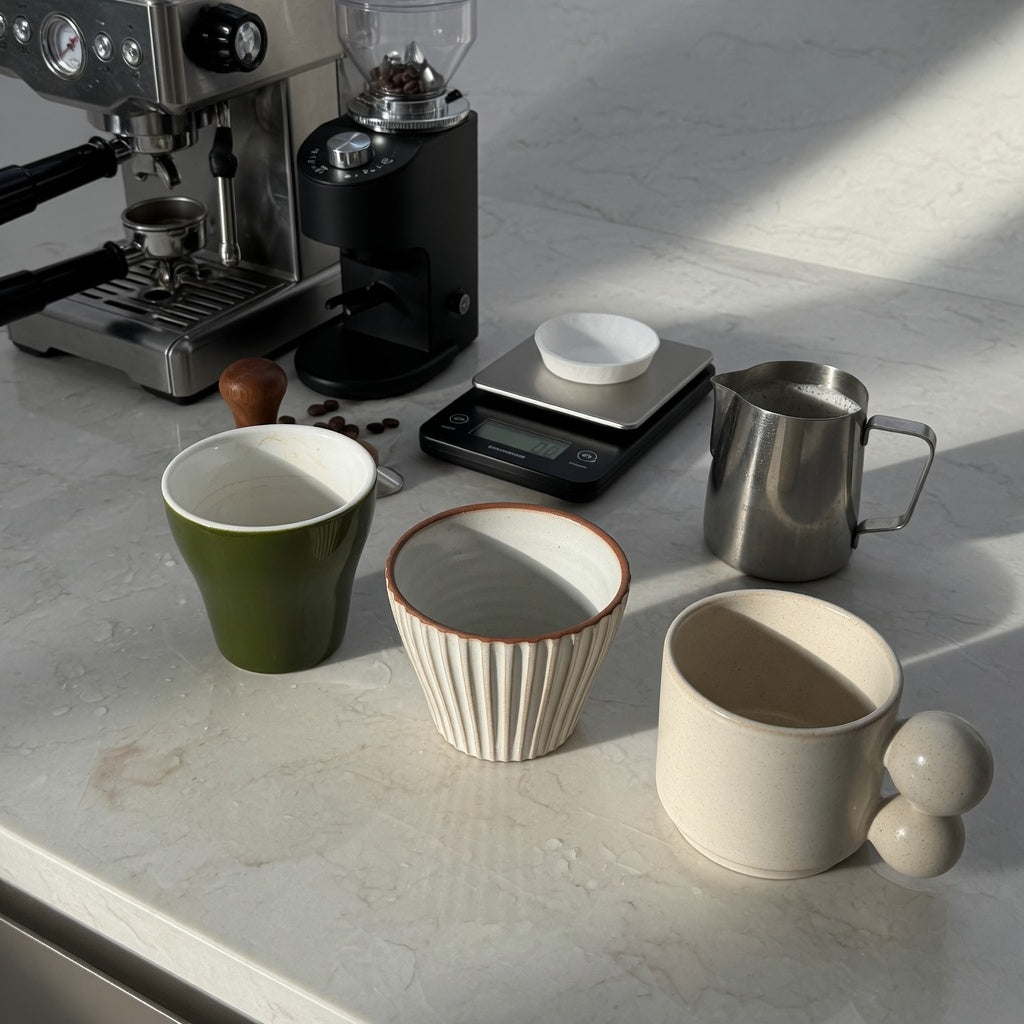
Macchiato Cup Home Coffee Station Product Shortlist Guide: 3 Sizes
Reading time: about 8 minutes
A grinder, scale, milk pitcher, and knock box can use almost every practical inch beside an espresso machine. Add a cup with more volume than the drink needs, and the station starts requiring a small shuffle before every shot. Our macchiato cup home coffee station product shortlist guide focuses on three compact ceramic options: the 170 ml Retro, 200 ml Pleated, and 250 ml Ball Handle.
We sell and handle this category, so we separate verified product facts from assumptions. The relevant facts here are capacity, ceramic material, and visible form. Capacity alone does not prove that a cup will fit beneath a particular machine, on a drip tray, or under a shelf. Those clearances still need to be measured against the current product page information and your own setup.
Macchiato cup home coffee station product shortlist guide: 170, 200, or 250 ml?
Capacity is the first useful filter because it affects potential headroom. It is not a complete measure of exterior size, however. Handles, wall shape, and proportions can change how a cup occupies the counter, so do not assume the lowest-capacity option automatically has the smallest footprint.
- 170 ml Retro: Start here if your usual drink is consistently short and spare volume is not a priority.
- 200 ml Pleated: Choose the middle capacity if you want more pouring margin without moving directly to the largest option.
- 250 ml Ball Handle: Consider this size if your espresso and foam amounts vary or you prefer a distinctive rounded handle.
All three are compact relative to mugs intended for long drinks. They are not sensible substitutes for a large Americano, tall milk drink, or iced coffee, where liquid and ice require substantially more room.
How much headroom does a short macchiato-style drink need?
Macchiato proportions provide context, not a universal formula. Many versions begin with espresso and add a modest amount of milk foam, while home recipes may use a double espresso, a looser foam texture, or a fuller milk pour. The useful capacity is therefore the space your normal drink occupies plus a buffer below the rim.
- Make your usual drink in the cup you currently use.
- Add the amount of foam you would serve, not an idealized café portion.
- Check whether the foam sits close enough to the rim to spill during a short carry.
- Use that result to decide if you need less unused volume or more headroom.
A listed capacity should not be treated as a target fill line. If the drink reaches the brim, there is no practical carrying margin. The right cup leaves enough room for your pour without surrounding a small espresso with more empty ceramic than you want.
170 ml Retro: a focused option for consistently short pours
Choose the 170 ml Retro Coffee Tea Cup if your routine rarely changes: espresso, a restrained foam top, and a short trip from the station to the table. It has the lowest listed capacity in this shortlist and a visible retro form. That makes it the most focused choice for shoppers who do not want to size around an occasional larger drink.
Skip the Retro if you regularly make a generous foam cap, change between single and double espresso recipes, or serve people who prefer more milk. It also is not the option to buy for long sipping sessions or iced drinks. Verify its exterior measurements rather than assuming that 170 ml guarantees compatibility with your machine or shelf.
200 ml Pleated: middle capacity with a textured exterior
The 200 ml Pleated Coffee Tea Cup is the middle choice. Its listed capacity provides 30 ml more potential room than the Retro, while the visible pleated exterior gives the cup a more textured appearance on an open shelf or counter. It suits a shopper whose normal recipe is short but not identical every morning.
There is a small care trade-off. If a milk splash dries on a pleated exterior, a sponge may need to follow the contours instead of making one pass across a smooth wall. Skip this option if fast exterior wipe-downs or a plain ceramic surface matter more than texture. Move up to 250 ml only if the extra headroom serves a routine need.
250 ml Ball Handle: extra margin for changing recipes
The 250 ml Ball Handled Coffee Tea Mug has the highest listed capacity in the group: 50 ml more than the Pleated and 80 ml more than the Retro. That additional space can be useful when your espresso base, foam volume, or milk pour varies. Its defining visible feature is the ball-shaped handle rather than a conventional loop.
Handle comfort is personal, so we do not treat the ball form as universally easier to hold. Some shoppers like grasping a rounded handle between their fingers; others prefer putting fingers through a standard loop. Skip this cup if you make a strict short recipe, dislike extra empty space, or have limited lateral clearance beside other tools. At 250 ml, it still is not intended to replace a tall iced-coffee glass or a large latte mug.
Which cup should stay on the station every day?
Use the scenario that matches most of your drinks, not the unusual order you prepare once a month.
| Option | Verified attributes | Choose it for | Skip it when |
|---|---|---|---|
| Retro | 170 ml ceramic; retro form | Consistent short espresso and foam pours | You need generous headroom or serve varied recipes |
| Pleated | 200 ml ceramic; pleated exterior | A middle capacity and visible surface texture | You want the quickest possible exterior wipe-down |
| Ball Handle | 250 ml ceramic; ball-shaped handle | Changing recipes and the most capacity of the three | You prefer a standard loop or have tight side clearance |
The useful role of this macchiato cup home coffee station product shortlist guide is to narrow the decision by routine. It is not an appliance compatibility chart. We cannot claim that any of these cups fits a specific spout, drip tray, warming area, or shelf without comparing actual exterior measurements.
How should ceramic cups be handled on an active coffee counter?
Most avoidable ceramic damage happens through contact with other hard objects, not through the coffee itself. At our store, we treat inspection, rinsing, and uncrowded storage as practical parts of using a cup near metal tools and other ceramics.
- Inspect the rim, body, and handle area during unboxing. Do not use a cup with a crack, moving handle, or sharp chip.
- Rinse coffee and milk residue before it dries, then use a soft, non-abrasive sponge.
- Follow the Pleated cup's exterior contours if liquid has dried around the textured surface.
- Avoid abrupt temperature changes, such as taking a very cold ceramic cup directly to very hot liquid.
- Do not force cups into a tight stack. Rim-to-rim contact and pressure from neighboring handles can cause chips.
- Use a dishwasher or microwave only when the current product listing or packaging confirms that care method. If no guidance is stated, hand washing is the cautious choice.
These steps address common category damage modes such as rim chips, hairline cracks, surface abrasion, and handle impacts. They are especially relevant when the cup lives beside a tamper, pitcher, or knock box instead of inside a cabinet.
What should you check on your counter before ordering?
A two-minute station check is more useful than choosing by capacity alone.
- Make your normal drink and note how much empty space remains below the rim.
- Measure the available width, depth, and height where the cup will sit.
- Include room for the handle and enough clearance to lift the cup without striking a shelf or tool.
- Compare your measurements with any exterior dimensions shown on the current product page.
- Decide whether you prefer the Retro form, Pleated texture, or Ball Handle before placing the order.
For a gift, use the recipient's actual drink routine rather than your own. A compact macchiato cup can be a poor match for someone who mostly drinks long coffees or tea by the mugful. If none of these three scenarios fits, compare other forms in our unique coffee mugs collection instead of forcing a compact option into the wrong role.
Frequently asked questions
What should a macchiato cup home coffee station product shortlist guide compare?
It should compare listed capacity, usable drink headroom, ceramic form, handle style, care needs, and the space available around the brewing tools. It should also explain why a shopper might skip each option. Capacity by itself cannot confirm appliance or shelf compatibility.
Is 170 ml large enough for a home macchiato?
It can be if your usual drink is a short espresso-based pour with restrained foam. Make the drink once in your current cup and check the finished volume and carrying margin. Choose 200 ml or 250 ml if your foam regularly approaches the rim.
Should I choose 200 ml or 250 ml for more foam?
The 250 ml Ball Handle provides 50 ml more listed capacity than the 200 ml Pleated cup, so it offers more potential headroom. Choose 200 ml if your recipe only needs a moderate buffer and you prefer the pleated exterior. Choose 250 ml if your pours vary enough to use the additional space.
Are the Retro, Pleated, and Ball Handle cups dishwasher safe?
We are not making a dishwasher-safety claim without confirmed care information. Check the current product page or packaging before starting a dishwasher cycle. Hand wash with a soft sponge if no specific dishwasher guidance is provided.
Does the lowest-capacity cup always take up the least counter space?
No. Capacity describes internal volume, while exterior width, height, wall shape, and handle projection determine physical fit. Measure your station and compare any listed product dimensions before assuming the 170 ml option has the smallest footprint.
Your next step: Make your usual drink, measure the place where the cup will live, and choose the smallest listed capacity that still leaves a comfortable buffer below the rim. Confirm exterior dimensions and care instructions on the selected product page before ordering.
More from our blog
Read more
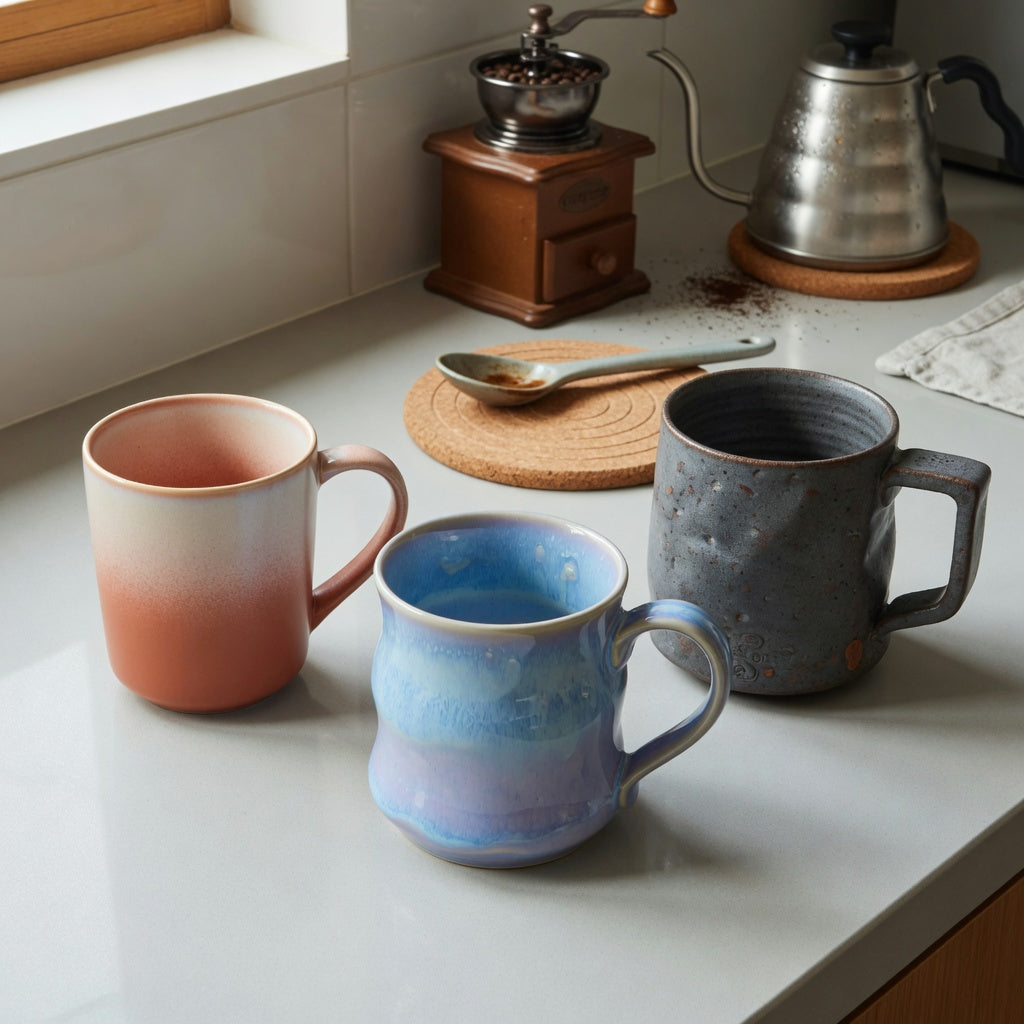
Hot Toddy Mug Home Coffee Station Product Shortlist Guide
Compare The Gradient and The Flow at 400 ml with The Rock at 480 ml, then use a counter-and-handle check to rule out poor fits. Each option has a clear use case, skip reason, and care boundary.
Read more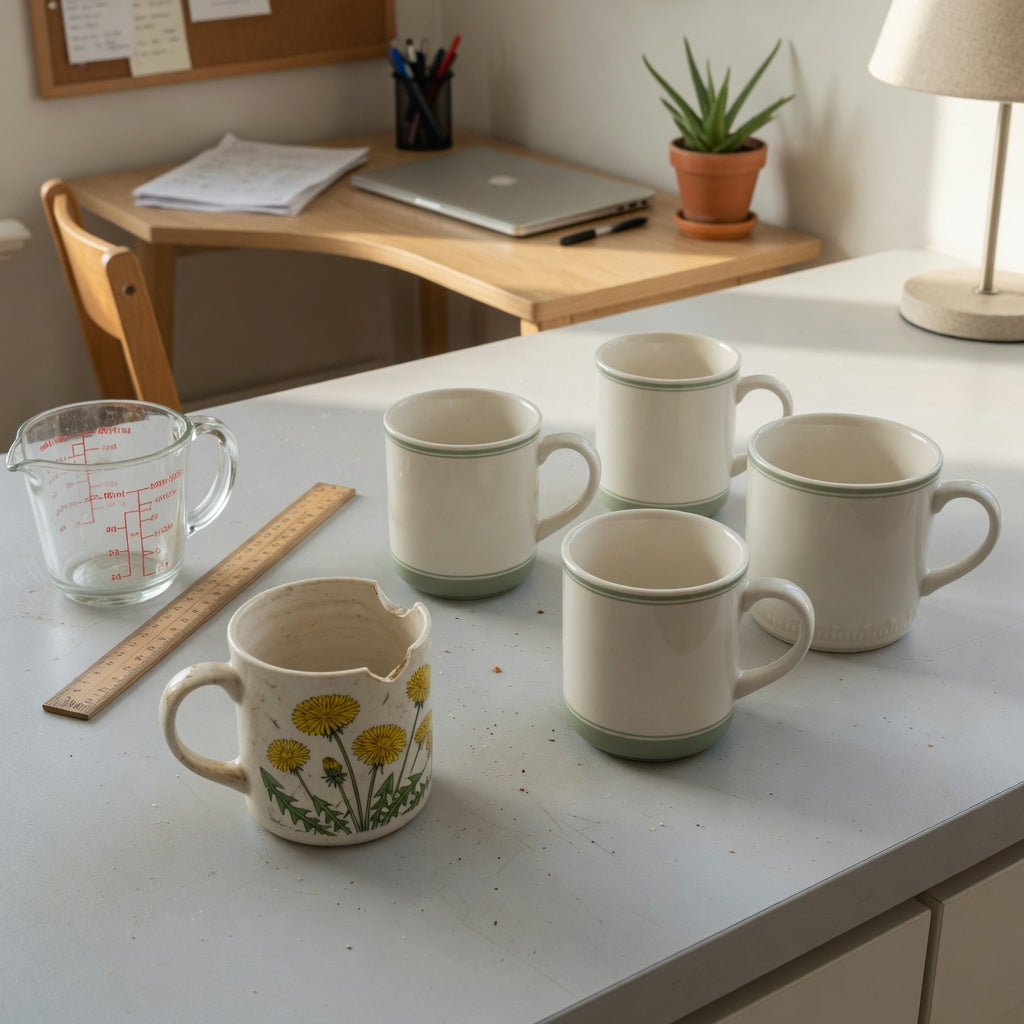
Dandelion Coffee Mug Replacement Purchase Practical Purchase Checklist
Use the old mug's actual fill, handle opening, cupboard footprint, and care routine to compare The Gradient and The Flow at 400 ml with The Rock at 480 ml without guessing at unverified specificati...
Read more
Leave a comment
This site is protected by hCaptcha and the hCaptcha Privacy Policy and Terms of Service apply.