
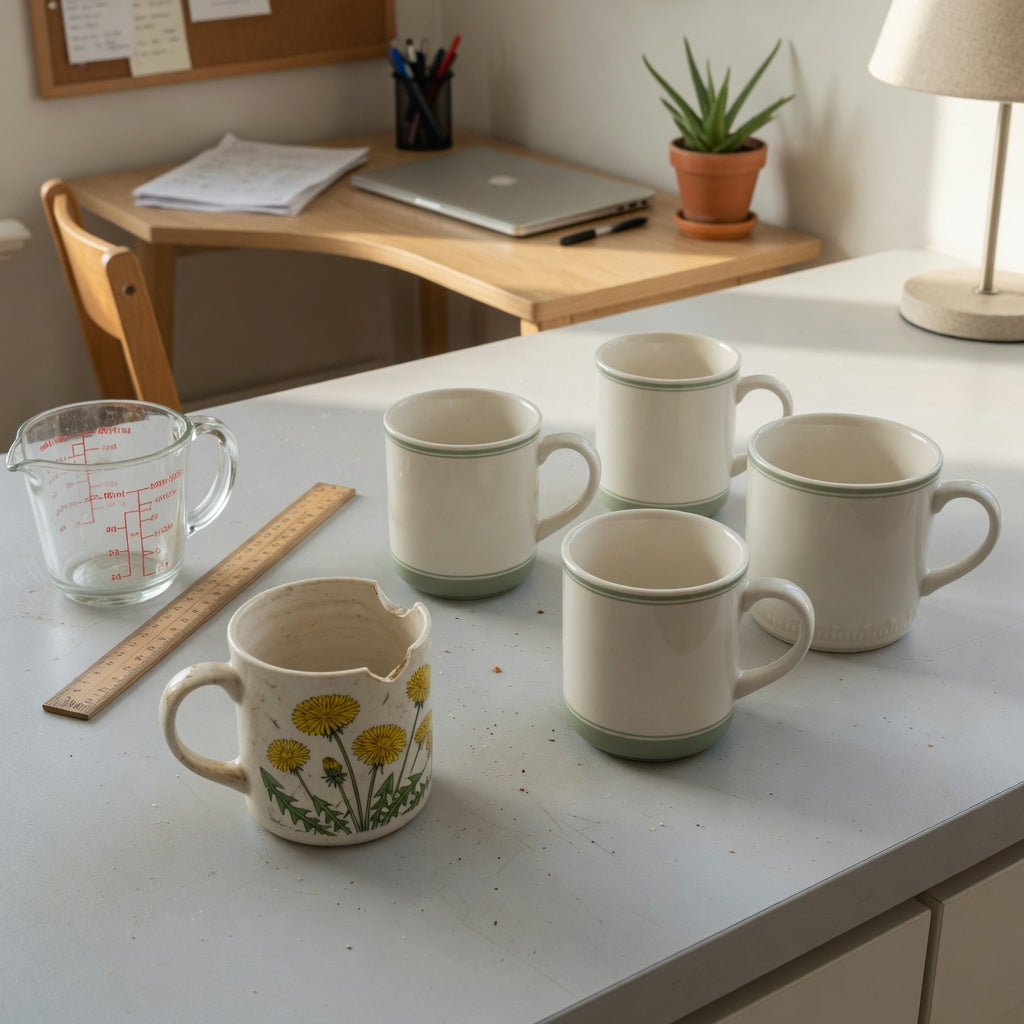
Dandelion Coffee Mug Replacement Purchase Practical Purchase Checklist
Reading time: about 10 minutes
A rim chip catches the light after washing. The handle shifts slightly as you lift the mug from the kitchen counter. Or the cup is still intact but no longer holds enough for the hot drink you now make. This dandelion coffee mug replacement purchase practical purchase checklist starts with the limitation of the old mug, because replacing the wrong feature simply creates a new annoyance.
In our store, we use capacity as the first filter and handle comfort as the second. From handling and packing mugs, we know that two options with the same listed capacity can still feel different once they are carried from a kitchen to an office desk. The verified catalog facts for this comparison are limited but useful: The Gradient is 400 ml, The Flow is 400 ml, and The Rock is 480 ml. Material, empty weight, external dimensions, handle-opening measurements, and care compatibility must be confirmed from the current product listing rather than guessed from a name or photograph.
Which limitation in the old mug needs to be replaced?
Inspect the old mug while it is clean, dry, and empty. Use angled light to check the rim and handle junctions, but do not drag a fingertip across a visible chip. Set the mug on a flat counter to see whether the base sits steadily, and hold the body while gently checking for movement at the handle without stress-testing it.
- Structural damage: A rim chip, hairline body crack, or movement at a handle joint is a reason to remove the mug from everyday hot-drink service.
- Capacity mismatch: The mug may still be sound but require frequent top-ups or leave more unused drink than you want.
- Grip mismatch: A narrow opening can pinch larger fingers, while a handle positioned far from the body can feel less controlled when full.
- Routine mismatch: The mug may be too tall for a shelf, too wide for a dishwasher rack, or awkward beside a keyboard and monitor stand.
Faded artwork or surface staining is different from structural damage. If the dandelion design carries sentimental value, the old mug can remain a display piece while a new mug handles daily use. We would not rely on a glued handle or filled rim chip for routine hot drinks unless the repair method is explicitly rated for that use.
Is 400 ml enough, or did the old mug need 480 ml?
Do not estimate capacity by looking at the mug. Measure it. A thick-walled mug can appear larger than its usable interior, while a compact-looking shape may hold more than expected.
- Fill the old mug to the level you normally use, leaving your usual clearance below the rim.
- Pour that water into a marked measuring jug and record the working volume in milliliters.
- Refill the empty mug carefully to the brim and measure again as a separate total-capacity reference.
- Use the working volume to judge your routine and the total figure to compare with listed product capacity, while checking how each current listing defines its measurement.
The Gradient and The Flow are both listed at 400 ml. The Rock is listed at 480 ml, an 80 ml increase over those two options. If mugs were filled to their listed capacities with a water-like drink, that additional liquid would add roughly 80 grams before accounting for any difference in the empty mugs themselves. That matters if you carry a full mug down a hallway, hold it through a meeting, or have a grip that tires quickly.
Capacity alone does not reveal height, rim diameter, base diameter, or total width including the handle. A 480 ml mug is not automatically the better replacement, especially on a crowded desk or in a compact cupboard.
Which handle measurements predict comfort at a desk?
Handle comfort is personal, so we do not describe any handle as universally comfortable. At our packing bench, the useful comparison is how the handle works with the buyer's actual finger position and the weight of a full mug. Before opening the product pages, record a baseline from the old mug:
- The inner height and width of the handle opening
- The number of fingers you normally place inside the loop
- The clearance between your knuckles and the mug body
- The distance the handle projects from the body
- Where your thumb rests when lifting the mug one-handed
A side-on photograph of your usual grip, with a ruler beside the handle, can make online comparison more concrete. Product images are useful for screening shapes, but they are not scale drawings. If a current listing does not provide the handle dimensions you need, treat comfort as an unresolved question rather than assuming the photograph will match your hand.
Shoppers who need an oversized opening, a two-handed design, or a grip intended for reduced hand strength should require explicit measurements and features. A different mug style may be a better choice than any option selected primarily by capacity.
Will it fit the cupboard, dishwasher rack, and daily care routine?
Measure the space the replacement must occupy, not just the old mug. We suggest recording overall shelf clearance, maximum rim diameter, base diameter, and total width including the handle. For an office desk, check the coaster or clear counter footprint as well as the space between the mug and nearby cables, notebooks, or a monitor stand.
Dishwasher fit is another physical measurement. Check the distance between rack tines and the clearance above the rack so the rim and handle will not be wedged against neighboring items. Capacity does not establish stackability or rack fit.
Care claims also need to come from the current listing. Do not infer stoneware, porcelain, another ceramic material, dishwasher suitability, or microwave suitability from appearance alone. If a care method is not explicitly stated, hand washing with a soft, non-abrasive sponge is the conservative choice until the seller confirms otherwise. Resistance to rapid temperature changes should not be assumed either.
Before the first wash, inspect a delivered mug under angled light. Check the rim, body, base, and both handle junctions, then place it on a flat counter to confirm that it sits steadily. This is especially useful during gift unboxing, when packaging can otherwise be discarded before the recipient has checked the mug.
Which CoffeifyMug option matches each replacement situation?
| Replacement situation | Why the option belongs on the shortlist | Relevant next step |
|---|---|---|
| The old mug was in the 400 ml class, and you do not want a larger listed capacity. | The Gradient keeps the comparison at a verified 400 ml. It is a starting point, not a guaranteed fit, so compare its current handle photos, dimensions, material, and care details with your notes. | Review The Gradient 400 ml coffee and tea mug. |
| You want a 400 ml replacement, but The Gradient's current profile or handle does not suit your grip. | The Flow provides another verified 400 ml option without changing the listed capacity. The current page should decide the tie through handle geometry, dimensions, finish, and care information. | Compare The Flow 400 ml coffee and tea mug. |
| The old 400 ml-class mug regularly felt too small, and you intentionally want more capacity. | The Rock increases listed capacity to 480 ml. Confirm that the added liquid weight, external footprint, and handle fit work for the trip between your kettle, counter, and desk. | Check The Rock 480 ml coffee and tea mug. |
| The exact dandelion look, exterior shape, or handle style matters more than a direct capacity match. | A broader visual comparison is more useful than forcing a choice among three capacity figures. Keep your measurements beside you while reviewing the current range. | Browse the unique coffee mugs collection. |
There is no capacity-based reason to declare The Gradient better than The Flow: both are verified at 400 ml. The deciding evidence must come from the current handle shape, measurements, material, care instructions, and the appearance you prefer. The Rock is a purposeful increase in capacity, not an automatic upgrade.
Dandelion coffee mug replacement purchase practical purchase checklist
Work through this list with the old mug, a measuring jug, and a ruler on the counter. A blank answer marks an unresolved buying risk.
- Name the failure: Record whether you are replacing structural damage, inadequate capacity, an uncomfortable handle, or a poor fit in your routine.
- Separate function from sentiment: Decide whether the new mug must reproduce the dandelion artwork or only replace the old mug's daily role.
- Measure the normal fill: Record how many milliliters you actually pour rather than relying only on brim capacity.
- Choose a capacity class: Shortlist The Gradient or The Flow for a listed 400 ml, or The Rock for a listed 480 ml.
- Account for the extra contents: Decide whether carrying roughly 80 grams more liquid at the larger listed capacity suits your grip and walking distance.
- Measure the physical space: Note shelf height, base diameter, rim diameter, and total available width including the handle.
- Record the grip: Measure the old handle opening and note finger count, knuckle clearance, and thumb position.
- Resolve unknown specifications: Confirm current material, external dimensions, empty weight, and care instructions on the relevant product page.
- Match the real routine: Consider the dishwasher rack, office desk, coaster, kitchen counter, and path along which you carry the full mug.
- Inspect on arrival: Before washing or gifting, check the rim, body, base, and handle junctions in good light.
The choice is ready only when capacity, grip, space, and care all have clear answers. A product photograph can support those answers, but it should not replace a missing measurement or care statement.
When is a direct mug replacement the wrong answer?
The 400 ml options are not a good match if your main complaint was insufficient volume. The 480 ml Rock is not the obvious choice if you are trying to minimize carried weight or fit a very tight shelf, since its external dimensions and empty weight still need verification.
A different product type will suit you better if you require a locking travel lid, documented insulation, a tall shape for iced coffee and a straw, an oversized assistive handle, or confirmed stackability. None of the three verified capacity facts establishes those features. If an exact dandelion pattern is non-negotiable, use the collection images to confirm the design rather than choosing by milliliters alone.
Frequently asked questions
How do I use the dandelion coffee mug replacement purchase practical purchase checklist?
Place the old mug beside a measuring jug and ruler. Record its normal fill, total capacity, handle opening, full width, and the limitation you want to fix, then compare those findings with the verified 400 ml and 480 ml options. Do not treat an unlisted material, measurement, or care method as confirmed.
Should I choose The Gradient or The Flow if both are 400 ml?
Capacity cannot decide between them because both are listed at 400 ml. Compare their current handle geometry, exterior dimensions, material, care instructions, and visual style against the notes from your old mug. Choose the one that resolves the old grip or fit problem without introducing a new one.
Is The Rock 480 ml too large for replacing an average mug?
It may be if the old mug's capacity was already adequate or if you have limited cupboard and desk space. The Rock offers 80 ml more listed capacity than The Gradient and The Flow, so account for the additional liquid weight and verify its external dimensions before ordering.
How can I judge mug handle comfort while shopping online?
Measure the inner opening of the old handle and photograph your normal grip from the side. Compare finger count, knuckle clearance, thumb position, and handle projection with the current product information. If the measurement you need is missing, handle comfort remains uncertain.
Can I assume the replacement mug is dishwasher and microwave safe?
No. Capacity and appearance do not confirm material or care compatibility. Follow the current product page's explicit instructions; if a care method is not stated, use a conservative hand-washing routine and do not assume microwave suitability.
Set the old mug on the counter and record the four decision points now: working volume, handle opening, available footprint, and required care method. Open the product page that matches your capacity row, or return to the current CoffeifyMug collection if no option resolves every limitation without adding another.
More from our blog
Read more
Macchiato Cup Home Coffee Station Product Shortlist Guide: 3 Sizes
Compare the 170 ml Retro, 200 ml Pleated, and 250 ml Ball Handle ceramic cups by drink headroom, counter placement, visible form, and care. Each option has a clear reason to choose it and a reason ...
Read more
Loose Leaf Tea Mug Everyday Mug Rotation Practical Purchase Checklist
Compare the verified 250 ml Ball Handle, 390 ml Round, and 400 ml Spittoon options by serving pattern, visible opening, shelf fit, and separate-filter needs. This checklist also flags dimensions, m...
Read more
Leave a comment
This site is protected by hCaptcha and the hCaptcha Privacy Policy and Terms of Service apply.