
Lungo Coffee Cup Weekend Coffee Practical Purchase Checklist: 3 Sizes
Reading time: about 9 minutes
The first Saturday refill often arrives before the weekend paper is halfway read: a cup chosen for a quick weekday pour has little room left once you carry it from the kitchen counter to the table. Our lungo coffee cup weekend coffee practical purchase checklist starts with that real routine, not with a supposed universal drink size.
At CoffeifyMug, our team handles and sells compact coffee cups, and we hear practical questions during product comparisons and gift unboxings: How much will I pour, how much space should remain below the rim, and where will the cup travel? The verified catalog capacities for this comparison are the Retro at 170 ml, the Pleated at 200 ml, and the Emerald at 270 ml. Material, external dimensions, and care instructions are separate details to confirm on the relevant listing.
What does this lungo coffee cup weekend coffee practical purchase checklist measure?
Start by describing the serving rather than assigning a drink name a fixed volume. A weekend lungo may be one measured pour at the counter, a cup carried to a reading chair, or an iced coffee assembled slowly at a desk. The useful comparison is the listed capacity plus the amount of empty space you want below the rim.
- Your actual pour: Use a kitchen measuring jug or the measured output in your recipe. The word lungo does not establish one fixed amount for every routine.
- Your movement: Counter-only use needs a different buffer from a trip to the sofa, breakfast table, or home-office desk.
- Your additions: Ice takes up space, and milk or tea changes the total contents. Compare the whole cup, not just the coffee portion.
- Your care requirements: If dishwasher or microwave use is essential, treat explicit listing instructions as a purchase requirement.
This sequence keeps the decision grounded. Pick the capacity that can hold your planned contents while leaving your preferred gap, then check the physical and care information that capacity cannot provide.
Which listed capacity suits a slower Saturday pour?
The three verified capacities create a clear comparison from smallest to largest. That spread is useful for choosing a serving size, but it does not establish a standard lungo volume or promise a particular recipe result.
| Product | Listed capacity | Weekend situation | Capacity logic |
|---|---|---|---|
| Retro coffee tea cup | 170 ml | You usually make one measured pour and keep the cup on the counter. | It is the smallest listed option, with less total capacity available for a below-rim gap than the two larger choices. |
| Pleated coffee tea cup | 200 ml | 170 ml feels close, but 270 ml seems more than you plan to use. | It is the middle capacity, giving you an intermediate point for a single serving and visible space below the rim. |
| Emerald coffee tea mug | 270 ml | You want the largest listed capacity for a longer sit or for liquid plus ice. | It provides the most total capacity in this set, although actual headroom still depends on your fill level and the cup's shape. |
The listed number is a comparison point, not a recommended fill line. A cup filled right to its stated capacity leaves no useful carrying buffer, so judge each option using the amount you actually pour and the gap you want to see. Capacity also does not reveal the external height, diameter, or footprint.
That is why we do not describe the Emerald as automatically better than the Retro. The smallest option may suit a deliberate counter-side serving, while the largest may be unnecessary if you prefer a tighter pour. The product page is the next step once the capacity range matches your routine.
How much headroom do you need between the counter and the sofa?
Headroom is the visible gap between the liquid surface and the rim. It becomes noticeable when you lift the cup, set it on a tray, or move it beside a book or laptop. The catalog capacities do not provide a measured rim-to-fill distance, so use your own serving amount to evaluate this part of the decision.
- Pour the amount you normally drink into a kitchen measuring jug.
- Transfer that same amount to each candidate cup and look directly at the gap below the rim.
- Set the cup on a level tray, lift it, and walk the short distance you normally travel at home. This tests your routine without pretending the cup is spillproof.
- If you add ice, recreate the usual ice and liquid combination. Ice occupies part of the listed capacity, so a liquid-only comparison can be misleading.
A brim-full test only shows how much the vessel can contain. It does not show how comfortable your normal weekend serving will feel. In our store, we find that this simple measured comparison is more useful than choosing by the drink name alone.
What material, dimensions, and care details still need checking?
The verified facts available for this comparison establish capacity only. They do not establish whether each cup is ceramic, porcelain, stoneware, glass, or another material; they also do not establish external height, diameter, handle dimensions, dishwasher safety, microwave safety, or a specific care method. Those details should be confirmed on the product listing rather than inferred from a photograph or product name.
- Material: Look for an explicit material description. Material can affect how the cup feels in hand and which care instructions apply, but we do not assign a material to these products without a listing statement.
- Dimensions: Check published height and diameter if they are provided, then compare them with your shelf, tray, cabinet opening, and desk space. A 270 ml capacity does not guarantee a particular external footprint.
- Rim, handle, and base: During unboxing, inspect the rim for chips or hairline marks, any handle join for cracks or movement, and the base or foot ring for rocking on a flat counter. These are the first points our team checks on handled cup shipments; this inspection is not a claim that any listed cup has a defect.
- Care: Follow explicit dishwasher, microwave, or hand-wash instructions. If dishwasher use is allowed, position the cup so the rim cannot strike another dish during the first cycle, then check the rim and surface afterward.
A glossy surface is not proof of dishwasher or microwave compatibility. If care convenience is a deciding factor, clear instructions deserve more weight than appearance.
Which cup fits a kitchen, desk, gift, or iced coffee routine?
Match the reader situation to the capacity decision, then use style and confirmed care details as tie-breakers.
- One measured serving at a kitchen counter: Start with the 170 ml Retro coffee tea cup if your planned amount fits with the gap you want. The reason is its position as the smallest listed capacity, not a claim that every lungo belongs in 170 ml.
- Counter to reading chair or home-office desk: Compare the 200 ml Pleated coffee tea cup if 170 ml feels close and 270 ml feels unnecessary. The middle listing gives you another capacity point for leaving room below the rim, but it is not a spill-resistant desk vessel.
- Longer sitting time or ice plus liquid: Inspect the 270 ml Emerald coffee tea mug if you need the largest listed capacity in this comparison. Count the ice as part of the occupied space and verify the product's external dimensions and care instructions before ordering.
- Gift shopping with an unknown routine: Compare the three capacities and the product information in our unique coffee mugs collection. A recipient who drinks tea or iced coffee still needs a cup chosen around total contents and care, not a guessed universal serving size.
A larger cup can be awkward on a crowded breakfast tray, while a smaller cup may lead to an earlier refill. Neither result is a product failure; it is a mismatch between the cup and the way it is used.
When is a compact lungo cup the wrong purchase?
These cups are designed for personal serving situations, but a different style or product category makes more sense if any of these requirements apply:
- Travel use: You need a lid, insulation, or verified car cup-holder fit. None of those features is established by the listed capacities here.
- Several guests at once: You regularly serve multiple people and want one vessel to reduce repeated pours. A serving vessel or coordinated set may suit that workflow better.
- Exact equipment compatibility: You need a guaranteed fit under a particular machine or on a particular saucer. External dimensions and equipment-brand associations are not verified in this comparison.
- Documented heat retention: Heat retention is a required specification for your purchase. This article makes no heat-retention claim, so choose a product with an explicit specification if that feature matters.
- Mandatory care features: Dishwasher or microwave compatibility is non-negotiable, but the listing does not state it clearly. Do not treat an attractive finish as a substitute for care guidance.
What should you confirm before checkout?
Run these five checks before choosing a weekend coffee cup:
- Measure the amount of liquid you actually plan to pour, including ice or other additions.
- Choose 170 ml, 200 ml, or 270 ml according to the space you want below the rim, not according to a generic lungo rule.
- Check the product listing for material, external dimensions, and care instructions, since those facts are not supplied by capacity alone.
- Picture the cup on its real route: counter, tray, table, reading chair, or office desk. Add a different style to your shortlist if you need a lid, spill protection, or travel fit.
- Inspect the rim, any handle join, and the base when the cup arrives, before its first wash or dishwasher cycle.
Frequently asked questions
How do I choose a lungo cup for slow weekend coffee?
Use our lungo coffee cup weekend coffee practical purchase checklist to measure your actual pour, preferred gap below the rim, and amount of movement. Then compare the verified 170 ml, 200 ml, and 270 ml capacities. We do not assign one universal volume to every lungo routine.
Is the 170 ml Retro enough for my weekend lungo?
It can be a sensible choice if your measured amount fits comfortably below the rim and the cup usually stays on the counter. It is the smallest listed capacity in this comparison, so choose a larger option if you need more total room for movement, ice, or a combined pour.
Should I choose 200 ml or 270 ml if I carry the cup to the sofa?
Compare the two using the same measured amount and look at the visible headroom. The 270 ml Emerald has the larger listed capacity, while the 200 ml Pleated is the middle option if the larger capacity feels unnecessary. Neither should be treated as spillproof without an explicit feature statement.
Are these cups dishwasher-safe and microwave-safe?
The verified capacity facts do not answer that question. Check the individual product listing for explicit dishwasher and microwave guidance, and do not infer compatibility from the cup's appearance or name. If the instructions are unclear and the feature is essential, choose a listing with clear care information.
Can I use a compact lungo cup for iced coffee or tea?
You can compare the cups as vessels for those drinks, but the listed capacity does not promise a particular iced coffee or tea serving volume. Include ice and all additions in the total space, leave the headroom you want, and confirm material and care instructions before use.
Write down your measured pour, desired headroom, movement, and non-negotiable care requirement. Then compare the three product pages through the full CoffeifyMug cup selection and choose the capacity that fits your actual weekend routine.
More from our blog
Read more
Herbal Tea Mug Weekend Coffee Practical Purchase Checklist | 400-480 ml
Compare The Flow (400 ml), Morning and Night (440 ml), and The Rock (480 ml) for slower weekend tea and coffee routines. This checklist separates measurable capacity from handle comfort and flags m...
Read more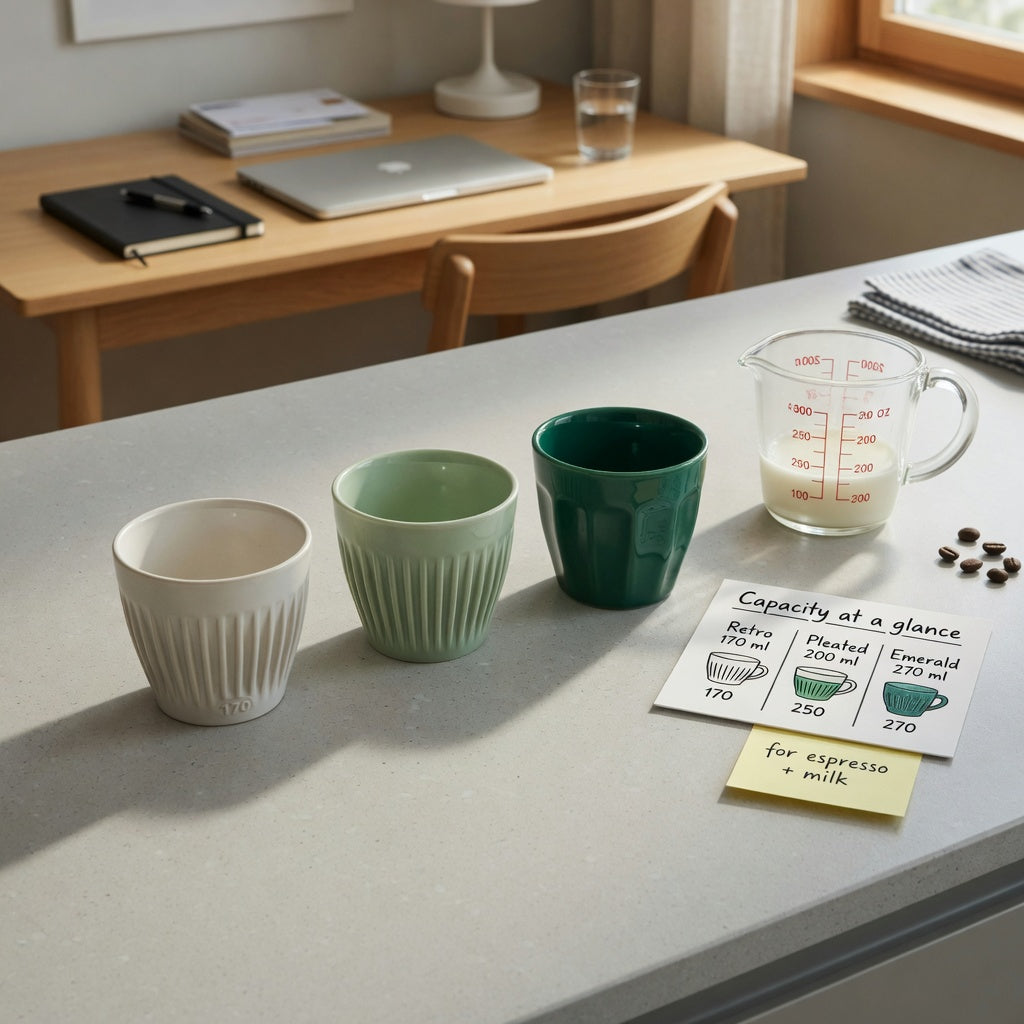
Cappuccino coffee mug gift choice practical purchase checklist
Choose a useful cappuccino-style coffee gift by matching the recipient's finished pour and available space to CoffeifyMug's listed Retro 170 ml, Pleated 200 ml, or Emerald 270 ml options, with clea...
Read more
Leave a comment
This site is protected by hCaptcha and the hCaptcha Privacy Policy and Terms of Service apply.