



Big Latte Mug Morning Routine Product Shortlist Guide: 400–480 ml
Reading time: about 10 minutes
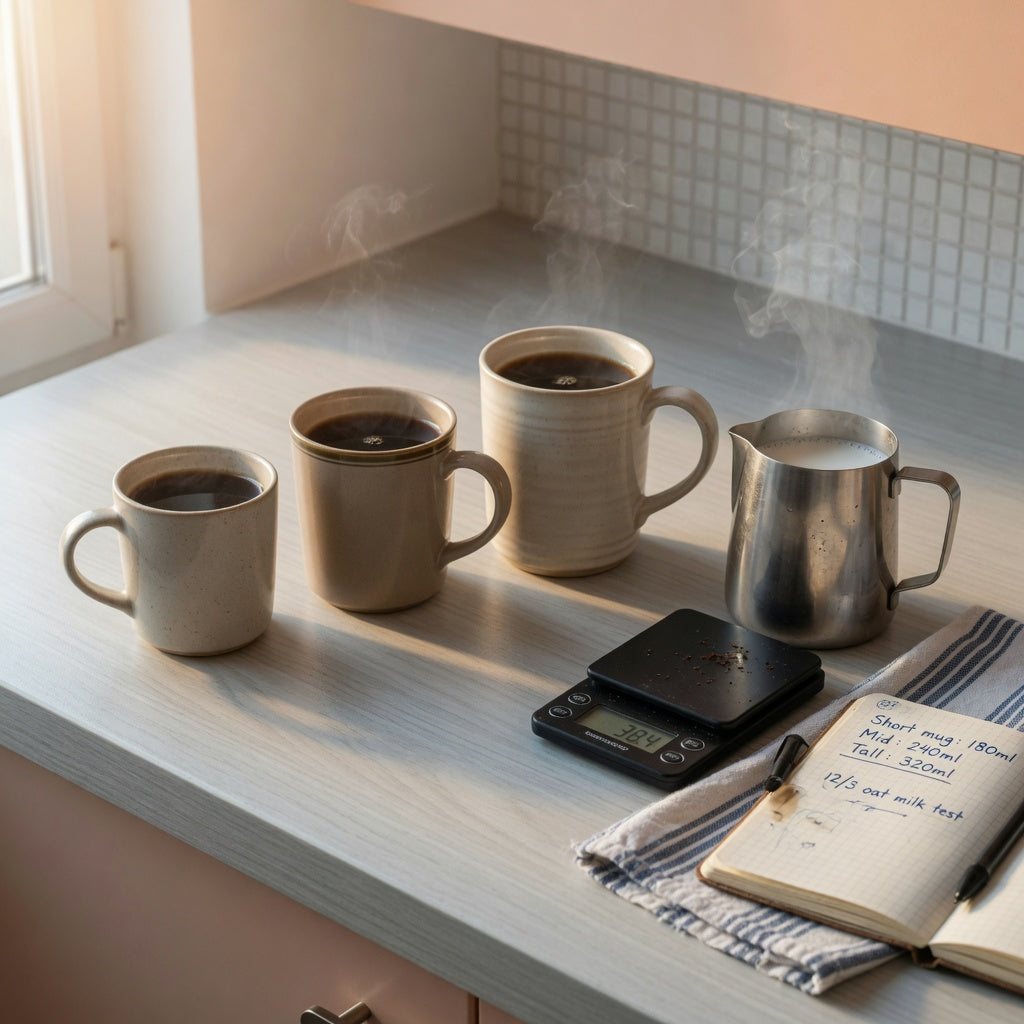
The espresso pump stops, the milk is still spinning in the pitcher, and you reach for a mug. That reach is the decision this article is about, and it is why this big latte mug morning routine product shortlist guide is organized around three things you already know about your own mornings rather than a wall of specifications nobody reads at 6:50 a.m.
We sell these mugs and we answer the emails afterward. The 480 ml that was too much drink for one shot. The tall one that cleared the group head but not the shelf above it. The handle that looked roomy in a photo and felt cramped once the mug was full and hot. None of those were manufacturing defects. They were sizing decisions made without the buyer's own numbers.
Three numbers from your own morning that beat any capacity chart
Answer these in order before you compare a single measurement. It takes about a minute, and on its own it removes most of the shortlist.
- Pour-to-sip time. How long does the mug sit before it is empty — ten minutes at the counter, or forty at a desk? A drink that lasts forty minutes spends most of that time losing heat, which changes what size you want far more than any spec sheet does.
- Usual volume. Not the large you order out, but what you actually finish at home. Plenty of people buy a 16 oz takeaway and then pull one shot with a modest pitcher at their own machine.
- Refill tolerance. Would you rather have one big mug and be done, or two smaller ones that are hot both times? This single preference decides between the top and bottom of our range more often than anything else we ask.
Honest answers of 'ten minutes, one shot, one cup' put a 480 ml mug against you. Answers of 'an hour at a desk, two shots, no time for round two' make the smallest option feel like a compromise every single morning.
What a big latte mug means once you convert milliliters
The phrase is looser than it sounds. Specialty café latte cups are commonly listed near 300–355 ml, while retail mugs sold under the same name run well above that. No single capacity attaches to the term, which is why two mugs described almost identically can differ by 150 ml.
The arithmetic is fixed. NIST Handbook 44 lists one U.S. fluid ounce as 29.57353 ml, and the packaging conversion in NIST Handbook 130 puts 16.0 fl oz at 473.176 ml. Against that, our three sizes line up like this:
| Mug | Listed capacity | Roughly in U.S. fl oz | Morning it tends to suit |
|---|---|---|---|
| The Flow | 400 ml | About 13.5 | One milk-forward latte, finished within roughly 15 minutes |
| Morning and Night | 440 ml | About 14.9 | The same drink with breathing room for a foam cap |
| The Rock | 480 ml | About 16.2 | Long drinks, iced builds, or a two-shot pour |
One caveat on that table: a listed capacity is a ceiling, not a comfortable pour. Foam, milk expansion, and the headroom you need to walk a full mug to a desk all come out of the same number. A cup filled to the absolute rim is a cup you cannot carry, so budget a centimeter or two of clearance below the edge.
For scale, FDA compliance guidance for ceramic cups and mugs (CPG 545.450) describes them as normally holding about 240 ml, or 8 fl oz, and being made with a handle. By that reference every mug here is genuinely large — the differences between them are refinements inside the large category, not jumps between categories.
The big latte mug morning routine product shortlist guide: three mugs, three mornings
This is how we walk customers through it at the counter. Each pick names the morning it fits and, just as usefully, who should walk away from it. If none of the three matches your habit, the unique coffee mugs collection has other shapes and sizes worth comparing.
The Flow 400 ml — the one-and-done, drink-it-hot morning
Choose it if: you pull one shot, steam a modest pitcher, and drink the result while it is still hot. At 400 ml (about 13.5 fl oz) The Flow fills to a sensible level without leaving a wide band of empty ceramic at the top, and it reads as a large mug on the counter without demanding a second shot to keep the milk-to-coffee ratio sane.
Skip it if: you sip at a desk for an hour, or you make iced lattes. Ice occupies real volume, so a 400 ml mug empties quickly once it is half ice. If a refill annoys you more than a cooling drink does, size up.
Morning and Night 440 ml — the middle size, and the hardest to regret
Choose it if: you want a visibly generous mug but still pour a normal-strength latte. The 40 ml over The Flow is roughly the room a foam cap and a slightly generous milk pour need, so you are not negotiating with the rim every morning before you have had coffee.
Skip it if: you already know your habit is either small-and-fast or huge-and-slow. A middle size is a compromise, and people with settled routines rarely want one. In our experience the Morning and Night mug produces the fewest follow-up sizing conversations, precisely because it sits between two strong preferences instead of committing to either.
The Rock 480 ml — the long, milky, two-shot morning
Choose it if: your latte is genuinely a big drink — two shots, a full pitcher, ice in July — or one cup has to survive a meeting. At about 16.2 fl oz, The Rock is the only mug of the three that lands above the 16 fl oz line, which is where a lot of large takeaway sizes sit once you convert them.
Skip it if: you pull a single shot and stop there. One shot in 480 ml of steamed milk tastes mostly of milk, and the wider surface gives heat more room to escape before you finish. That is a mismatch, not a defect. A full 480 ml is roughly half a kilogram of liquid before you add the mug's own weight — fine on a table, noticeable on a staircase.
Handle comfort and desk footprint: what product photos hide
Capacity is the spec everyone compares and the one that causes the fewest disappointments. The failures happen elsewhere.
- Handle opening. Knuckle clearance is personal. A handle that fits four fingers loosely on one hand is a two-finger pinch on another, and you notice it the instant the mug is full. Check the handle measurements on the current listing instead of judging from a straight-on photo.
- Filled weight. Empty weight plus roughly 400–480 g of liquid tells you whether this is a one-hand carry or a two-hand carry for you. Look at the weight field on the exact product page you are buying rather than assuming it applies across the range.
- Desk footprint. Base diameter plus the handle beside it is the footprint that actually matters. On a narrow desk a bigger mug pushes your mouse hand out of position in a way the smaller one does not.
- Cleaning. A straight-sided interior is easier to sponge than a narrow shoulder. Verify dishwasher guidance on the individual listing — fired ceramic bodies and glazes differ, and a care claim on one mug is not automatically true of another.
Fit checks to run tonight, before the box arrives
None of these are capacity questions, and all of them are why a mug gets sent back.
- Group-head clearance. Measure from the drip tray to the group head with your scale sitting where it normally sits. Tall mugs fail here first, and it is the most common fit complaint we hear.
- Shelf height. Measure the gap above the shelf you plan to store it on, not just the shelf itself.
- Cup-holder diameter. If the mug travels in a car, a wide base often will not drop into the holder.
- Microwave clearance. Check turntable height and rotation room if you reheat.
When a big latte mug is the wrong purchase
We would rather tell you now than process the return.
You drink slowly. More volume means more minutes, and more minutes means a cooler drink. We do not make insulation claims for these mugs, so we will not pretend extra size solves that problem for you.
You want a flat white or a cortado. Those drinks live or die on a tight milk-to-coffee ratio. Scaling one into a large mug gives you a latte wearing a cortado's name. If that is your target, our cappuccino mug shortlist is the better read.
You are gifting without knowing their machine. A mug that does not clear their group head lives in a cupboard. If that is your situation, browse the unique coffee mugs collection for shapes that are less size-dependent, or start with the coffee mug gift idea shortlist.
You are buying on a 'lead-free' label alone. For ceramic cups and mugs, FDA's CPG 545.450 sets a lead action level of 0.5 micrograms per milliliter of leaching solution, applied to any one of six units tested. That is a test result, not a marketing phrase. If food-contact safety is your deciding factor, ask the seller what testing backs the claim.
Frequently asked questions
Is a 480 ml mug too big for a single-shot latte?
Usually yes, in flavor terms. One shot in 480 ml of steamed milk tastes predominantly of milk, and the drink cools faster than you expect because there is more of it. A 400 ml mug is a more natural match for a single shot; keep the 480 ml for two-shot builds or iced drinks.
Does the listed capacity include room for the foam?
It depends on the listing, and many quote a brim-full figure rather than a comfortable working fill. Assume you will give back a centimeter or two for foam and for carrying the mug without spilling, and check how the current product page describes its capacity before you buy.
Will a big latte mug fit under my espresso machine?
Measure the clearance between the group head and the drip tray with your scale in place — that is where tall mugs actually fail. If the gap is tight, the shorter 400 ml end of the range is the safer choice, since you can still fill it without needing the extra height.
Are these mugs dishwasher and microwave safe?
Check the care details on the individual product listing for the mug you are buying. Fired ceramic varies, and dishwasher or microwave guidance on one mug does not automatically carry over to another in the same store.
How should I use this big latte mug morning routine product shortlist guide if I drink iced lattes?
Weight volume more heavily than heat. Ice displaces a meaningful share of the cup, so a mug that feels generous hot can feel small iced. Skip the smaller options and plan the build around two shots and a full glass of ice.
Tomorrow morning: a sixty-second decision
Run the short version in your head while the kettle heats: how long the mug sits before it is empty, how much you actually pour, and whether a second cup is acceptable. Then pick the number that matches — 400 ml for fast and hot, 440 ml for a normal pour with headroom, 480 ml for long or iced drinks.
Start with The Flow if you drink it quickly, choose Morning and Night if you want breathing room without committing to a huge pour, or go straight to The Rock if one mug has to last the whole morning. Confirm the handle and base dimensions on the listing before checkout — the number that matters is the one you can actually carry.
More from our blog
Ready to pick your mug? Two ways to save on today's order:
Ordering 1–3 mugs? Get an extra 10% off your 1st order with code 10_OFF Apply 10% Off & Shop Wooden-Handle Mugs →
Gifting 4+ mugs? Buy 3, Get the 4th Free applies automatically at checkout (no code needed; offers do not stack) · Free standard shipping (Nov pre-Christmas delivery: 15–20 calendar days US) · Free replacement if chipped in transit.
Popular mug buying guides: Ceramic Mugs with Lids Compared · Wooden-Handle Tea Infuser Mugs Compared · Christmas & Secret Santa Mugs 2026 · Espresso & Cortado Cups Guide · Cup & Saucer Gift Sets · All 25 Mugs Spec Table · Mug Size Guide · Shipping & Promo FAQ
FIRST ORDER 10% OFF (CODE: 10_OFF) · OR BUY 3, GET THE 4TH FREE


Read more
14 Oz Ceramic Coffee Mugs Daily Use Guide: Practical Trade-Offs
A working 14 oz ceramic coffee mugs daily use guide: brim capacity versus the pour you actually drink, which drinks fit, how trim and decals change microwave safety, and which of our three sizes ma...
Read more
Unique Espresso Cups Daily Use Guide: Sizes, Fit and Care
A practical look at living with unique espresso cups: how our 170, 200 and 250 ml ceramic sizes handle real double-shot routines, what actually clears a group head, why glaze colour changes how you...
Read more
Leave a comment
This site is protected by hCaptcha and the hCaptcha Privacy Policy and Terms of Service apply.