



Large Round Coffee Mugs for Small Coffee Setup: What to Compare
Reading time: about 11 minutes
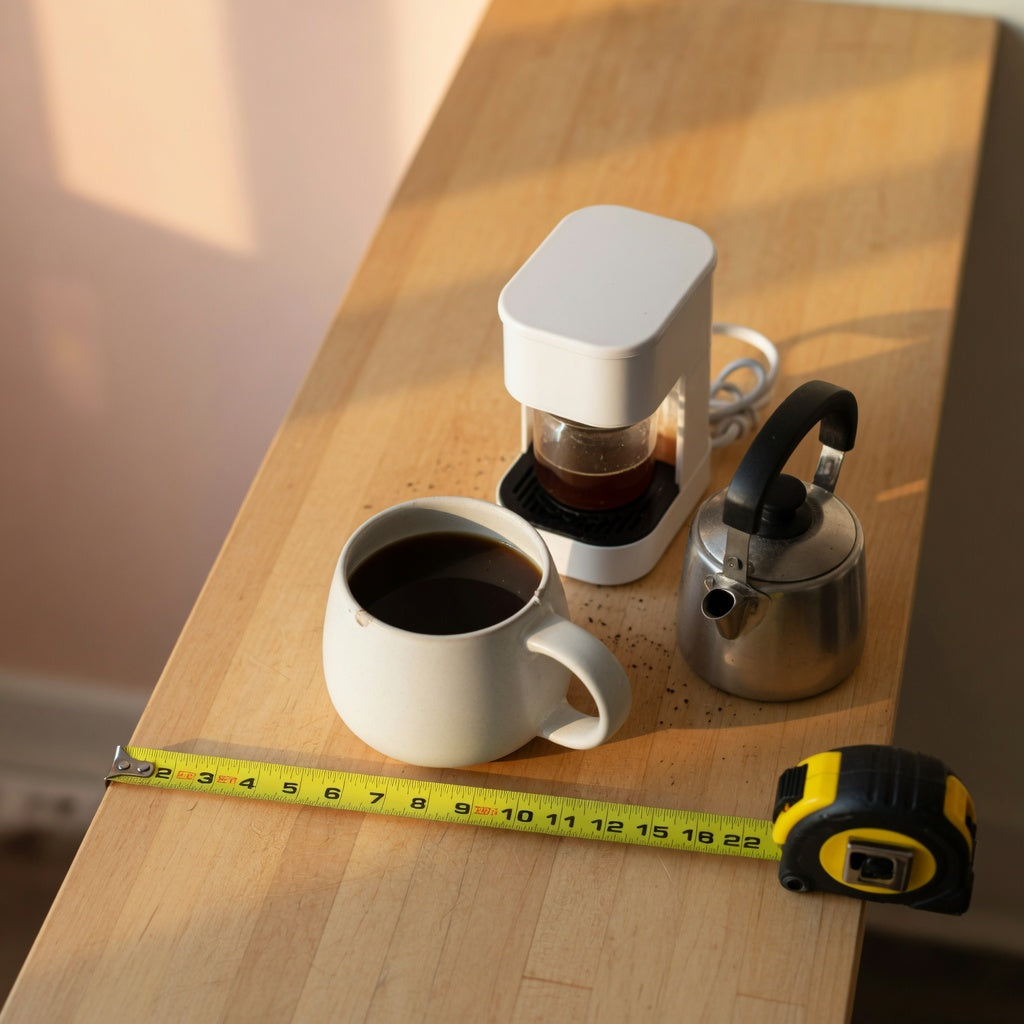
A 480 ml round mug looks modest in a product photo. Set it on a 22-inch apartment counter next to a drip machine, a kettle, and a grinder, and the widest point of its belly becomes the loudest thing in the room. That is the tension we hear about most from customers shopping large round coffee mugs for small coffee setup stations: they love the two-handed feel of a wide body, then find it fighting the brewer spout, the cabinet shelf, and the dishwasher rack.
We pack and handle these mugs every week, so most of the questions that reach us are practical. Will it fit under the machine. How much coffee does it really hold. Does the handle clear my knuckles when it is full. Here is how we would sort through it if the counter were ours.
Round is a shape, not a size, and the shape is what trips people up
A tall mug adds volume by growing upward. A round mug adds volume by growing outward, which keeps the rim closer to the counter but pushes the widest point of the body well past the footprint of the base. Two mugs with identical listed capacity can behave completely differently under a brewer for that reason alone.
So before you compare ounce counts, compare two measurements: the height from your counter to the lowest point of the dispensing spout, and the clear width of the recess the mug has to sit inside. On compact pod machines and narrow drip brewers the housing usually pinches inward near the drip tray. A wide body can bump that housing before the rim is centered, and then coffee lands on the rim instead of in the cup.
Do large round coffee mugs for small coffee setup stations clear your brewer?
Sometimes yes, sometimes no, and the answer is almost never printed on the product page. Run these four checks with a tape measure instead of eyeballing the listing photo:
- Spout clearance with the tray in place: measure from the tray surface to the spout, then subtract the mug height. You want working room left over, not a millimeter-perfect fit, because you still have to slide a hot mug in and out.
- Recess width at its narrowest: measure between the machine's vertical supports at the height the belly will actually sit, not down at counter level.
- Removable drip trays: many compact machines let you pull the tray to gain height. That changes your clearance and also changes the angle you lift at, which matters more with a heavy, wide body.
- Dripper seating: if you brew pour-over straight into the mug, set your dripper on the rim at home first. A base that only catches the inner edge of a wide mouth will wobble under a full cone of hot water, and that is a burn risk rather than an inconvenience.
We would rather a customer measure once and buy once than return a mug that technically holds 480 ml but never earns a spot on the counter.
Brim-full ounces versus the ounces you actually drink
Listed capacity is brim-full capacity. Under NIST Handbook 44, one U.S. fluid ounce equals 29.57353 milliliters, so the conversion is exact, but the number on a listing reflects liquid filled to the surface tension line. Nobody carries coffee across a room at that level.
Leave a working margin for walking, tilting, and stirring, then add whatever milk or creamer you take. A mug listed at 400 ml holds roughly 13.5 fluid ounces brim-full; your comfortable pour is meaningfully lower. If your usual drink is a 12-ounce coffee with a generous splash of milk, that headroom is the difference between a full mug and one you can lift without bracing your wrist.
Our three round shapes, with capacities exactly as listed on each product page:
- The Flow Coffee & Tea Mug — listed at 400 ml (about 13.5 fl oz), with a rounded silhouette that keeps the widest point in check.
- The Morning and Night Coffee & Tea Mug — listed at 440 ml (about 14.9 fl oz) for drinkers who want more room for milk.
- The Rock Coffee & Tea Mug — our largest listed capacity in this group at 480 ml (about 16.2 fl oz).
Body material, microwave marking, and dishwasher guidance belong to each individual listing rather than to this article. Those details can shift between production runs, so confirm them on the current product page before you commit, especially if the mug is a gift and you will not see it before it ships.
Which of the three fits your counter and your pour
| Your situation | What the shape costs you | Where to start |
|---|---|---|
| One cup, tight counter, splash of milk | Less headroom for a heavy milk pour | Flow, 400 ml |
| Milk-forward drinks on the same tight counter | A little more body to store | Morning and Night, 440 ml |
| Long desk sessions, biggest single pour | Most liquid weight and the most shelf width | The Rock, 480 ml |
| Undecided on silhouette | More comparison work up front | The full collection |
If none of the three matches the spot you have in mind, browse the unique coffee mug collection and compare silhouettes side by side. A straighter wall usually buys back shelf width; a rounder body buys back height.
Shelves, drying racks, and why round bellies refuse to stack
Storage is where round mugs cost a small kitchen the most, and it is the part buyers think about last. Straight-walled mugs stack. Round ones do not. The narrow rim and the swelling body mean each round mug claims its own patch of shelf, and stacking two is an invitation to a chipped rim.
In our experience packing tight pantry shelves, two wide round mugs consume roughly the linear space of three straight-sided mugs. Plan the shelf in horizontal inches first, height second.
The drying rack and dishwasher follow the same logic. A bulbous body spans more than one row of tines, and when you tilt it to fit, the belly leans into the space the next glass needs. In a compact 18-inch dishwasher, three large round mugs can claim most of a lower rack.
If stacking and storage are your main constraints, our breakdown of large unique coffee mugs and what buyers should compare goes deeper on shape versus gifting.
Handle balance and filled weight on a desk or a narrow counter
A wide body moves the center of mass away from the handle, and that distance is what your wrist actually feels. Water is close to one gram per milliliter, so a mug holding 480 ml carries roughly 1.05 pounds of liquid before the weight of the mug itself is counted.
- Finger clearance: two fingers through the handle is a different grip than three. With a heavier fill, a two-finger grip pushes your knuckles toward the hot wall.
- Thumb rest: a handle positioned high enough for your thumb to brace the rim above it steadies a full mug more than a roomier handle alone.
- Base contact on a warmer: if coffee lives on a desk mug warmer, look at the underside. A recessed foot ring can hold the base slightly above the heating plate, and if the flat center never touches, the warmer cannot conduct heat into the mug.
One honest limitation: these are open, wide-bodied mugs, not travel mugs. A round belly generally will not sit in a car cup holder, and nothing here seals or locks. If the mug commutes with you, a lidded vessel is the right tool and a round ceramic mug is the wrong purchase.
Heat: thick walls help, a wide mouth works against you
A heavy mug feels like it should hold heat longer, and the mass does help at first, absorbing heat from the brew instead of letting the ceramic wall rob the coffee. But heat leaves an open mug mostly through the surface, and a round body presents a wider surface than a narrow cylinder holding the same volume.
Practical fixes, in order of effort: warm the mug with hot tap water for about a minute before you pour, keep the fill line lower than you think you need, and drink from the mug rather than parking it on a desk for half an hour. A lid or a preheated thermal carafe will always beat an open ceramic mug over a long sitting. That is a tool mismatch, not a defect.
Lead, cadmium, and what a lead-free label does not prove
Glaze safety deserves a plain explanation, because a wide mug keeps a large volume of hot, mildly acidic coffee in contact with a decorated surface. Regulators treat cups and mugs as their own category: the FDA describes them as small ceramic hollowware used for hot beverages, normally holding about 240 ml and made with a handle. That assumed size is smaller than anything in this article, which is a useful reminder that oversized drinkware sits outside the norm regulators first had in mind.
- Lead: FDA Compliance Policy Guide 545.450 sets an action level of 0.5 µg/mL of leaching solution for ceramic cups and mugs, applied to any one of six units tested.
- Cadmium: FDA CPG 545.400 sets cadmium action levels at 0.5 µg/mL for small hollowware and 0.25 µg/mL for large hollowware, also judged on any one of six units. Yellow, orange, and red glazes are the ones we get asked about most.
- Labels are not tests: the FDA has reported imported pottery labeled lead free that still contained extractable lead, in some cases above the action level. A label is a claim; a named leach test is evidence.
- Decorative ware is different: under 21 CFR 109.16, ceramicware that looks food-safe but is sold as ornamental needs a conspicuous not-for-food-use warning or a hole through the food-contact surface. If a mug has neither, treat it as drinkware.
- Research backs the concern: a published pilot study in Food Safety and Risk reported lead leaching from ceramic mugs into coffee and tea, with results varying cup by cup.
We cannot test every batch on your behalf and we will not claim a certification this page has not earned. What we will say: ask any seller, us included, for the specific standard and test behind a lead-free claim, and skip metallic rims or gold luster if the mug is going into a microwave.
Six measurements to take before you order
- Spout height: counter or tray surface up to the dispensing spout, tray installed.
- Recess width: the narrowest gap between the machine housing at belly height.
- Shelf width per mug: the widest point of the body plus an inch of breathing room.
- Shelf height: clearance between shelves, since a wide mug cannot be stacked to save space.
- Pour method: dripper base diameter if you brew pour-over into the mug, or the mug's height if you plunge an AeroPress over it.
- Warm spot: whether the underside is flat enough to sit flush on a mug warmer you already own.
Frequently asked questions
Will large round coffee mugs for small coffee setup counters fit under a single-serve brewer?
Measure the spout-to-tray gap and the width of the drip recess before you buy. Wide bodies can hit the machine housing before the rim centers under the spout, which is a fit problem rather than a capacity problem. Pulling a removable drip tray gains height but changes the lift angle on a heavy mug.
How much coffee actually fits in a 400, 440, or 480 ml round mug?
Those listed numbers are brim-full volumes, roughly 13.5, 14.9, and 16.2 U.S. fluid ounces. Once you leave a working margin for tilting and stirring and add milk, expect to pour noticeably less than the number on the page.
Do wide round mugs let coffee go cold faster than tall mugs?
Usually yes, because an open round mouth exposes more surface area to room air than a narrow cylinder of the same volume. Thick walls slow the first few minutes of heat loss by absorbing warmth, but they cannot stop evaporative cooling from a wide opening.
Can I set a pour-over dripper or AeroPress on a large round mug?
Only if the dripper base overlaps the rim properly. Test your brewer on the mug at home before relying on it, and never balance a full cone of hot water on a rim that only catches the inner edge. If the fit feels marginal, brew into a carafe and transfer.
How should I store wide round mugs in a small kitchen?
Keep them in a single row on a shallow shelf or hang them from pegs with generous lateral spacing. Avoid stacking them, because the narrow rim over a swelling body tips easily and chips at the lip, and give each one its own lane in the dishwasher rack.
Start with the mug whose widest point you can actually picture on your counter: measure your spout gap and shelf lane, then pick between the 400 ml Flow, the 440 ml Morning and Night, or the 480 ml Rock — and if your counter changes shape next year, the rest of our round profiles are worth a look before you commit to a set.
More from our blog
Ready to pick your mug? Two ways to save on today's order:
Ordering 1–3 mugs? Get an extra 10% off your 1st order with code 10_OFF Apply 10% Off & Shop Wooden-Handle Mugs →
Gifting 4+ mugs? Buy 3, Get the 4th Free applies automatically at checkout (no code needed; offers do not stack) · Free standard shipping (Nov pre-Christmas delivery: 15–20 calendar days US) · Free replacement if chipped in transit.
Popular mug buying guides: Ceramic Tea Cups & Infuser Mugs · Ceramic Mugs with Lids Compared · Wooden-Handle Tea Infuser Mugs Compared · Christmas & Secret Santa Mugs 2026 · Espresso & Cortado Cups Guide · Cup & Saucer Gift Sets · All 25 Mugs Spec Table · Mug Size Guide · Shipping & Promo FAQ
FIRST ORDER 10% OFF (CODE: 10_OFF) · OR BUY 3, GET THE 4TH FREE


Read more

Pottery Tea Cups for Small Coffee Setup: What to Check First
Pottery tea cups for small coffee setup buyers need to earn their footprint. We compare 170 ml, 200 ml, and 250 ml ceramic cups by counter space, capacity, handle clearance, glaze checks, and daily...
Read more
Coffee Mugs With Big Handles for Small Coffee Setup: What to Compare
A generous loop is only half the decision. We compare listed capacities, handle clearance and counter footprint so a mug with a genuinely open handle still fits a cramped coffee setup.
Read more
Leave a comment
This site is protected by hCaptcha and the hCaptcha Privacy Policy and Terms of Service apply.