



Pottery Tea Cups for Small Coffee Setup: What to Check First
Reading time: about 10 minutes
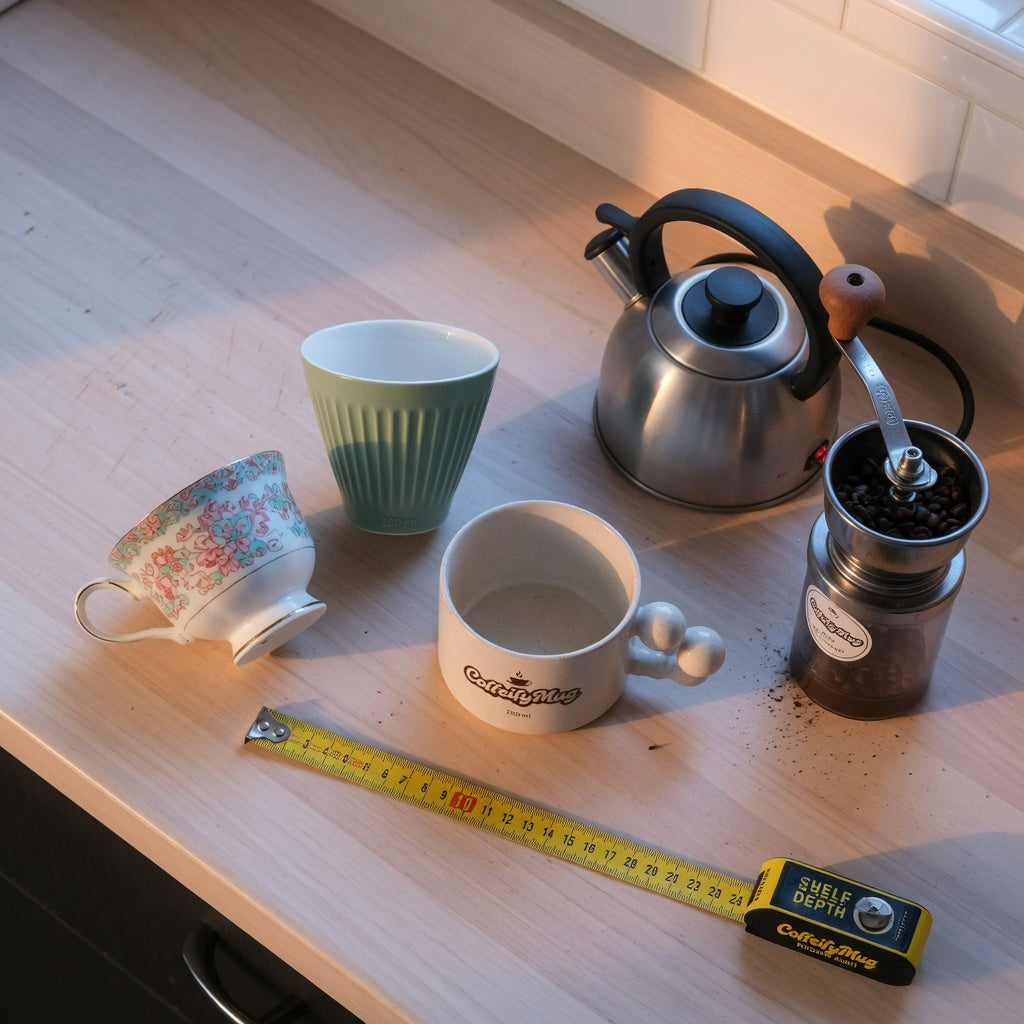
A 24-inch kitchen counter can disappear fast: kettle, grinder, scale, spoon rest, and one mug. In our store, we see shoppers fall for a cup in photos, then discover the handle bumps the backsplash or the saucer overhangs a narrow shelf. Pottery tea cups for small coffee setup decisions come down to measured footprint and usable capacity, not how the cup looks on a styled shelf. Before checkout, measure three things: the cup footprint including the handle, the vertical clearance under your cabinets, and the depth of the shelf where it will live.
How much shelf space do pottery tea cups for small coffee setup really need?
Start with the footprint, not the capacity. A 200 ml cup with a broad handle can need more clear space than a 250 ml cup with a tighter profile. Capacity tells you how much the cup holds. It does not tell you how far the handle sticks out, how wide the rim flares, or how much counter a saucer claims.
Our current comparison is simple on paper: the Retro Coffee and Tea Cup lists 170 ml, the Pleated Coffee and Tea Cup lists 200 ml, and the Ball Handled Coffee and Tea Mug lists 250 ml. All three are ceramic-body pieces. Those are the facts we can give you without guessing. For overall width, handle swing, and height, check the current product page or ask us before ordering. If you want to see how shapes compare side by side, browse the unique coffee mugs collection before you commit to a shelf spot.
- Measure handle swing, not just cup diameter. Put a ruler where the cup will sit and leave room for fingers between the handle and the wall.
- Count the saucer as double footprint. A saucer can turn a compact cup into a wide landing pad that crowds a scale or spoon rest.
- Check stack height. If the cup goes under an upper cabinet, measure from shelf to cabinet bottom, then subtract the height of any stack you plan.
- Leave an air gap. A cup that fits with zero clearance is a cup you will knock over while reaching for coffee.
Is 170 ml, 200 ml, or 250 ml the better capacity for a tight counter?
Capacity changes how often you refill, and in a small setup that rhythm matters. A smaller cup leaves room for the kettle and grinder, but it can mean more trips. A larger cup reduces refills but needs a clear landing spot. Here is how the listed capacities compare.
| Cup | Listed capacity | Best fit in a small setup | Trade-off |
|---|---|---|---|
| Retro Coffee and Tea Cup | 170 ml | Short tea or a small milk-forward coffee; good when you like a fresh refill | Not enough for a 12 oz coffee in one pour |
| Pleated Coffee and Tea Cup | 200 ml | A middle ground for daily tea or a modest coffee serving | Still a tea-cup size, not a breakfast-mug size |
| Ball Handled Coffee and Tea Mug | 250 ml | The largest listed capacity here, for a bigger tea or coffee serving | Handle clearance and counter width need checking |
A 250 ml cup is roughly 8.5 oz. If you routinely drink 12 oz in one sitting, you will refill it. That is a real trade-off, not a flaw. The 170 ml cup is the smallest listed capacity in this group, so it suits a tight counter where the cup shares space with a kettle and grinder. The 200 ml cup splits the difference for daily tea or a modest coffee. The 250 ml cup is the largest listed capacity here, but capacity alone does not tell you how far the handle extends. Verify overall width and handle clearance on the listing.
Does a handle change the footprint more than the cup body does?
Handles are not just a comfort choice. They change the footprint. The Ball Handled Coffee and Tea Mug is our 250 ml handled option by name, but capacity alone does not tell you how far the handle extends. If handle clearance is your main constraint, measure the total width with the handle, not just the cup diameter. Leave room for fingers between the handle and the wall, and check that the handle does not collide with a kettle or grinder when you set the cup down.
A handleless cup can save lateral space, but it puts the hot wall directly against your fingers. Thick walls, a flared rim, and a lower fill level can make a handleless cup more comfortable, but those details are product-specific. Do not assume every handleless pottery cup is easy to hold just because it looks simple. If you need a handle and a wide opening, check the specific piece rather than assuming a 250 ml cup will fit a tight gap.
What glaze and food-contact details should you verify before checkout?
Looks are not a safety spec. The FDA guidance on lead-glazed pottery explains that lead can be present in glaze or decoration, and improper firing can let it leach into food and drink. FDA also notes that washing, boiling, or other processing does not remove lead from pottery. That is why a chip, worn lip decoration, or bare clay patch on a drinking surface is a reason to ask questions rather than assume the cup is fine.
Pottery is an umbrella term. Earthenware, stoneware, and porcelain sit under it and differ in firing maturity and porosity. A cup label should tell you which body it is and how the glaze is described. Our current listings give capacity and ceramic body. If you need the glaze type, a finished-piece test report, or confirmation of dishwasher and microwave use, ask us before ordering. We would rather answer a question than have you guess.
- Intact glaze on tea-contact and lip surfaces. Ask about pinholes, bare clay, and rough spots, especially near the rim.
- Lead and cadmium testing. FDA guidance for cups and mugs uses a lead guideline of 0.5 micrograms per milliliter in any one of six units, and cadmium guidance of 0.5 micrograms per milliliter for small hollowware under 1.1 liter. Those are lab-testing benchmarks, not a visual guarantee.
- Crazing versus a crack. Crazing is a network of fine glaze lines; a structural crack may catch a fingernail, weep, or feel rough. Treat leakage or a rough lip as a stop sign.
- Lead free wording. FDA says ceramicware with extractable lead should not be labeled lead free. If the phrase matters to you, ask for the finished-piece basis behind it.
- Decorative-only warnings. Ornamental ceramicware that looks like foodware is treated as foodware unless it is permanently marked not for food use. A warning label means display, not tea.
One useful reference point: FDA defines cups and mugs as small ceramic hollowware commonly used for beverages such as coffee or tea above room temperature, normally holding about 240 mL and manufactured with a handle. That is a regulatory definition, not a safety rating. It does mean the 250 ml Ball Handled size is close to the FDA reference, while the 170 ml and 200 ml cups sit below it. CDC has also reported elevated blood lead levels tied to traditional glazed ceramic ware used for coffee and meals, which is why food-contact questions are practical, not academic.
Will a 250 ml cup feel too hot to hold in a small setup?
A cup that feels fine at 170 ml can feel different at 250 ml because there is more hot liquid in the vessel. Fill level matters too: leave headroom so you are not gripping a brimming cup. Check the rim shape, wall thickness, and handle opening on the specific piece. If you plan to microwave, confirm that the cup and any decoration are microwave-safe; metallic decoration should stay out of the microwave.
For daily use, a smaller cup can be easier to manage in a tight corner because you are less likely to carry it while reaching around a kettle. A larger cup may suit a slower morning, but it needs a clear landing spot. Match the cup to your movement, not just your drink volume.
How do you keep a small coffee setup from becoming a cup collection?
Small setups fail by accumulation. Keep two cups on open display: one 170 ml or 200 ml cup for tea and one 250 ml cup for a larger coffee, then store the rest. Rotate seasonally or keep a guest cup in a cabinet. An office desk has the same failure mode: a mug, a pod holder, and a notebook compete for the same rectangle. If a cup has no defined home, it becomes clutter.
We also suggest choosing one saucer rule. Either commit to saucers for sit-down tea or skip them for counter service. Mixing both usually means the saucer ends up under the kettle. Our current lineup is the quickest place to compare shapes, but the shelf rule is yours to set.
Which cup fits your counter: a quick buyer map
Use your measured clearance and your usual pour to pick a lane:
- Tight counter, short tea, no saucer: start with the compact 170 ml Retro cup. It is the smallest listed capacity in this group and the easiest to justify when every inch is spoken for.
- One cup for tea and a modest coffee: look at the middle-ground 200 ml Pleated cup. It splits the difference without becoming a full-size mug.
- Bigger serving and confirmed handle clearance: consider the largest listed 250 ml Ball Handled mug. Measure the handle swing before you fall for the shape.
- You need a 12 oz pour or a travel mug: these tea cups are not the right shape for that job. A larger mug or a different vessel will serve you better.
If none of those lanes fit, browse the full unique coffee mugs collection and compare current shapes against your measured clearance. The right cup is the one that fits your counter and your pour, not the one that looks smallest in a photo.
Frequently asked questions
What capacity should I choose for pottery tea cups for small coffee setup?
Match capacity to the pour you actually drink. Choose 170 ml for short tea or a small milk-forward coffee, 200 ml for a middle ground, and 250 ml when you want the largest listed capacity here. If you routinely drink a 12 oz coffee in one sitting, a 250 ml cup will need a refill; a larger mug is the more practical shape.
Do pottery tea cups need saucers in a small setup?
No. A saucer adds a second footprint and can overhang a narrow shelf. Skip it if counter space is tight, and use a small shared rest or towel if you want to protect the surface.
Are the Retro, Pleated, and Ball Handle cups dishwasher or microwave safe?
We cannot confirm appliance care from capacity and ceramic body alone. Check the current product listing or ask us before ordering, especially if the cup has metallic decoration; metal should stay out of the microwave.
How can I tell whether crazing is a crack?
Crazing is a network of fine glaze lines; a structural crack usually runs through the body and may catch a fingernail, weep, or feel rough. If a cup leaks or the surface is rough at the lip, retire it from drinking use.
Can I use a decorative pottery cup for tea?
Only if it is intended for food use. FDA treats ornamental ceramicware that looks like foodware as foodware unless it is permanently marked not for food use, so a decorative-only label or warning is a stop sign.
Before you buy, run a five-point check: measured counter clearance, handle swing, saucer decision, listed capacity, and glaze or care questions for the seller. Then choose from our current lineup by the space you actually have, not the cup that looks smallest online.
More from our blog
Ready to pick your mug? Two ways to save on today's order:
Ordering 1–3 mugs? Get an extra 10% off your 1st order with code 10_OFF Apply 10% Off & Shop Wooden-Handle Mugs →
Gifting 4+ mugs? Buy 3, Get the 4th Free applies automatically at checkout (no code needed; offers do not stack) · Free standard shipping (Nov pre-Christmas delivery: 15–20 calendar days US) · Free replacement if chipped in transit.
Popular mug buying guides: Ceramic Tea Cups & Infuser Mugs · Ceramic Mugs with Lids Compared · Wooden-Handle Tea Infuser Mugs Compared · Christmas & Secret Santa Mugs 2026 · Espresso & Cortado Cups Guide · Cup & Saucer Gift Sets · All 25 Mugs Spec Table · Mug Size Guide · Shipping & Promo FAQ
FIRST ORDER 10% OFF (CODE: 10_OFF) · OR BUY 3, GET THE 4TH FREE


Read more

Coffee Mug Gifts Ideas for Small Coffee Setup: What Fits
A gift mug has to earn its counter space. We compare our three ceramic capacities, explain usable fill and brewer clearance, and show when one mug beats a set in a small kitchen.
Read more
Large Round Coffee Mugs for Small Coffee Setup: What to Compare
A wide round body feels great in two hands and crowded on a 22-inch brew bar. We compare brewer clearance, usable ounces, shelf width, and glaze safety before you buy.
Read more
Leave a comment
This site is protected by hCaptcha and the hCaptcha Privacy Policy and Terms of Service apply.