



15 oz Ceramic Coffee Mugs Morning Routine Product Shortlist Guide
Reading time: about 10 minutes
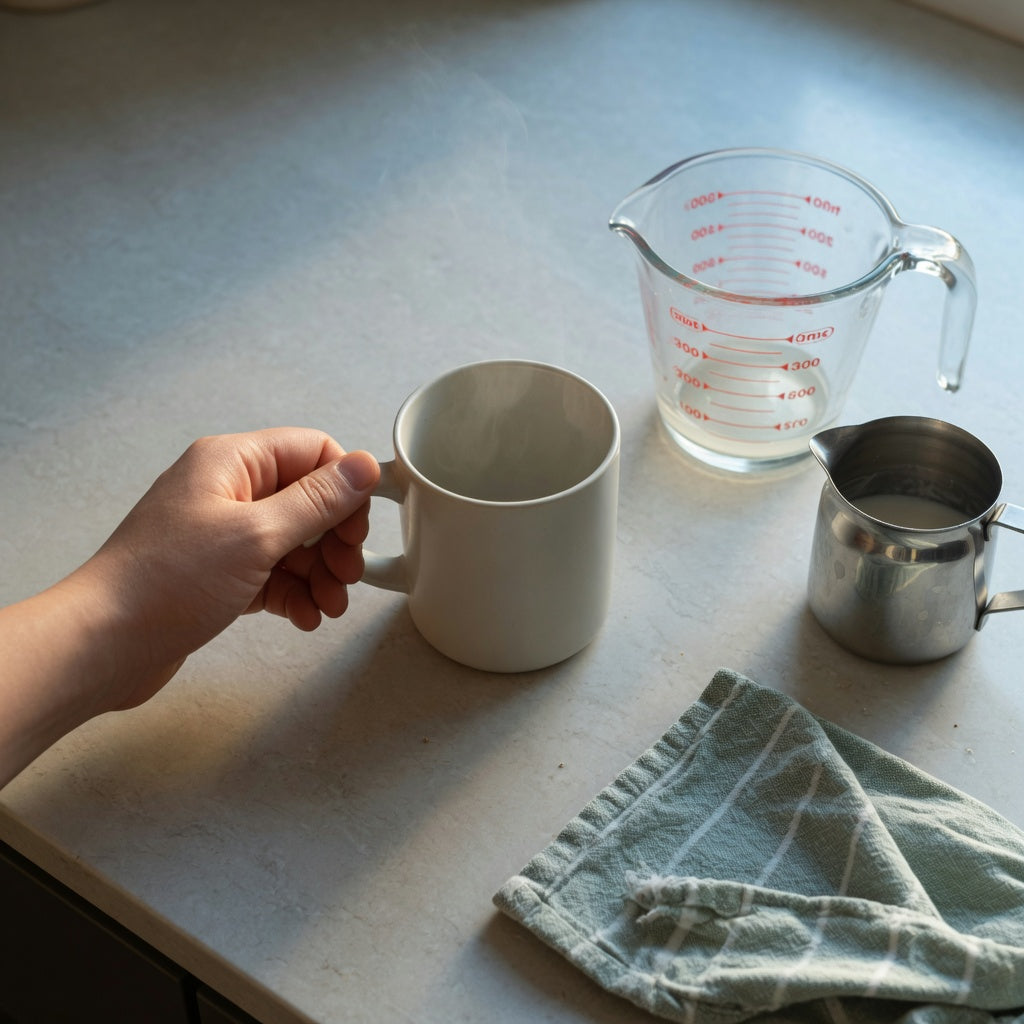
At 6:40 on a weekday, the coffee is brewed, the milk is already in, and the mug is full enough that carrying it to the desk feels like a small gamble. That is where mug decisions actually get made — at the counter, with a hot drink in hand, not on a product page.
This 15 oz ceramic coffee mugs morning routine product shortlist guide stays narrow on purpose. It works from three things you can measure before you buy: the volume you really pour, the room you want left at the rim, and how many trips back to the coffee maker you are willing to make.
Start with what we can state plainly. The Flow holds 400 ml (about 13.5 US fl oz). Morning and Night holds 440 ml (about 14.9 US fl oz). The Rock holds 480 ml (about 16.2 US fl oz). Those capacities are verified. Empty weight, handle opening, glaze chemistry, and appliance care are not part of that verified set — those details have to come from the current listing for the exact mug. If you would rather see the full range first, browse our unique coffee mugs collection.
What does 15 oz actually leave you after milk and stirring room?
Fifteen US fluid ounces is a volume, not a serving suggestion. Converted, it lands at roughly 444 ml. That figure describes the space inside the vessel. It tells you nothing about wall thickness, empty weight, or where the liquid sits when the mug is moving.
It is also not an official size. The FDA's guidance on lead in ceramicware describes cups and mugs as small hollowware for hot drinks and uses about 240 ml (8 fl oz) as its typical, though not exclusive, example. No standard says a mug sold as 15 oz must hold 15 oz of drinkable coffee below the rim. Sellers differ on whether capacity means brim-full, level with the lip, or filled to a comfortable line.
So run the arithmetic on your own pour:
- 10 fl oz of coffee is about 296 ml. Add 2 fl oz of milk (about 59 ml) and you are near 355 ml.
- 12 fl oz of coffee is about 355 ml. With 2 fl oz of milk you land near 414 ml.
- 12 fl oz of coffee plus 3 fl oz of milk reaches roughly 444 ml — the whole 15 oz, before any foam exists.
That last line is the one that surprises people. A 15 oz mug carrying a 12 oz coffee and 3 oz of milk has no foam allowance and no stirring room left. Foam is the wild card in all of this: it occupies volume but weighs almost nothing, so a latte can look under-filled and still slop over the handle on the first step.
15 oz ceramic coffee mugs morning routine product shortlist guide: match the mug to the pour
Here is how we would shortlist the three, reasoning from the drink and the walk rather than from which name sounds biggest.
| Mug | Stated capacity | Approx. US fl oz | Morning scenario it suits |
|---|---|---|---|
| The Flow | 400 ml | ~13.5 | A 10–12 oz black coffee or americano, with a refill you do not mind making |
| Morning and Night | 440 ml | ~14.9 | 12 oz coffee plus a modest splash of milk — the closest match to a 15 oz search |
| The Rock | 480 ml | ~16.2 | 12 oz coffee with a genuine milk or foam allowance, or one larger drink |
- The Flow (400 ml) — choose it if your first cup is modest, your machine is on the same counter, and a second pour ten minutes later is fine. Skip it if your drink alone approaches 400 ml, or if you like visible headroom for a spoon and a swirl of milk. A 12 oz coffee plus 2 oz of milk (about 414 ml) simply does not fit inside the stated capacity, so this is not the mug for that habit.
- Morning and Night (440 ml) — choose it if you searched for 15 oz and want the nearest match we stock; 440 ml is roughly 4 ml under 444 ml. It handles a 12 oz coffee plus 2 oz of milk (about 414 ml) with around 26 ml of margin on paper. Skip it if you add foam, whip, or a generous pour of cream, because 26 ml is not a comfortable buffer once the mug is moving.
- The Rock (480 ml) — choose it if your standard drink is a large milk coffee and you want the arithmetic to leave real room. The same 12 oz coffee and 2 oz milk total about 414 ml, which leaves roughly 66 ml below the stated capacity. Skip it if you specifically wanted a mug no larger than 15 oz, or if a bigger vessel just means you pour more than you intend to drink.
One caution we repeat to customers: none of those capacities is a fill line. How much usable headroom you get depends on the shape of the wall and how the seller measured, and we do not have measured pour lines for these three.
Does a full mug still feel manageable by the time you reach the desk?
Liquid is heavy. Water sits near 1 g per ml, so 400 ml is roughly 400 g before a single gram of ceramic is counted, and coffee is mostly water. At 480 ml you are lifting close to half a kilogram of drink alone. Add the mug and it climbs again — and nothing in our verified capacity data tells you the empty weight, so treat any guess about heft as unconfirmed until you read the exact listing or ask us.
Three things decide whether that number becomes a problem:
- Handle clearance. A handle needs enough opening for your grip, not just for a photo. Two fingers and a thumb is a different carry from four fingers wrapped through, and a fist-grip mug handles a full 480 ml very differently from a hooked-finger carry.
- Balance point. A mug that sits tall and narrow feels heavier at the rim than a squat one holding the same volume, because the mass is further from your wrist. This is why two mugs at identical capacity can feel nothing alike when full.
- The fill level you actually use. Most people stop well below the brim. If you naturally pour 10 oz, a 480 ml mug is mostly air and handle weight — harmless, but not the reason to choose it.
If grip strength is the real constraint — arthritis, a wrist injury, small hands, or a long carry down a hallway — a smaller pour in The Flow with a refill is usually the kinder routine. A near-full Morning and Night is the middle option. A brimming The Rock is the one to think twice about.
When is a 15 oz ceramic mug the wrong answer entirely?
Ceramic does one job well: it feels good in the hand, it does not hold onto yesterday's coffee smell the way some plastics do, and it suits a slow, seated drink. It is the wrong tool for a few common mornings.
- You sip one coffee across 90 minutes of meetings. Ceramic walls shed heat; a wide, open mug loses it faster than a tall one. If temperature retention is the priority, an insulated tumbler will outperform any ceramic mug, including a thick-walled one. We would rather say that than imply a bigger mug stays hot longer — capacity alone establishes nothing about heat retention.
- You want the mug to leave the house. An open ceramic mug with a handle is a kitchen and desk object, not a commuter vessel.
- You drink 6 oz and always have. Buying 15 oz to match a search term rather than your habit gives you a heavier object to wash for no benefit.
- You need the foam to be the point. A latte or cappuccino wants volume above the liquid line, which pushes you toward The Rock — but check your actual build first, because foam height varies wildly between machines and milk types.
If you are still deciding between body types rather than sizes, our breakdown of ceramic versus porcelain capacity and daily fit covers how material and shape change the feel of the same stated volume.
What should you confirm before the first dishwasher cycle?
Care instructions belong to the individual mug, not to the word "ceramic." A glaze, a decal, a metallic rim, or a printed wrap can change what an item tolerates, and a mug that survives the dishwasher for a month can still dull or craze over a year of nightly cycles. For The Flow, Morning and Night, and The Rock, check the current product listing or ask us directly — the verified capacities do not establish microwave or dishwasher suitability for any of them.
Worth knowing before you assume: a "microwave safe" label and a "lead free" label are separate claims. The FDA's lead guidance for ceramicware sets a guideline of 0.5 micrograms per mL of leaching solution for cups and mugs across six units, with test methods that include ASTM C738 and the AOAC 973.32 and 973.82 methods; its cadmium guidance sets 0.5 micrograms per mL for small hollowware under 1.1 liters. Neither label substitutes for the other, and finished-mug leach results are rarely published on retail listings.
The California Department of Public Health adds practical context: lead cannot be seen in a glaze, coffee and tea are acidic drinks that pull lead from contaminated ware faster than non-acidic liquids, heating speeds that leaching, and repeated dishwashing can damage a glaze and make later leaching more likely. Decorative pieces marked for ornamental use under 21 CFR 109.16 — the ones carrying a "Not for Food Use" warning — should stay on the shelf no matter how much they look like a coffee mug.
Two more habits that extend the life of any glaze: skip abrasive scouring powders on a glossy finish, and retire a mug once you see a chip on the lip or a network of fine surface cracks, which potters call crazing.
Frequently asked questions
Is 15 oz the same as 440 ml?
Not exactly. Fifteen US fluid ounces is roughly 444 ml, so a 440 ml mug comes in about 4 ml short — close enough that Morning and Night is the nearest match we stock to a 15 oz search. Check the listing's own figure rather than assuming a round conversion.
Will a 15 oz mug hold 12 oz of coffee plus cream without spilling?
Twelve ounces of coffee plus two ounces of milk is about 414 ml, or 14 fl oz, which fits inside a 15 oz capacity on paper. The catch is the margin: Morning and Night leaves roughly 26 ml below its stated 440 ml, and The Rock leaves about 66 ml. Neither figure is a guarantee once you add foam or walk with a full mug.
Are these three mugs microwave and dishwasher safe?
We cannot confirm that from capacity data, and we will not guess. Appliance suitability depends on the specific glaze, decoration, and finish of the unit you receive, so open the listing for the exact mug or ask us before you buy. If you reheat coffee daily, verify this first — it is a harder constraint than capacity.
Does a larger ceramic mug keep coffee hot longer?
Capacity alone does not settle heat retention, and we have no measured comparisons for this size to point to. More liquid holds more heat but also exposes more surface. If keeping a drink hot for an hour is the goal, insulated drinkware is the better purchase and ceramic is the wrong category.
Should I worry about lead in a ceramic mug I use every morning?
It is a reasonable question to ask any seller. The FDA publishes a leaching guideline for cups and mugs and notes that some ceramicware has released significant lead from food-contact surfaces, so if documentation matters to you, request it for the finished item. Do not treat a microwave-safe claim as proof of glaze safety — they are different tests.
Before you add one to the cart, run this four-line check
- Measure your normal coffee in milliliters once, using a jug rather than a scoop.
- Add your milk, creamer, or estimated foam volume to that number.
- Compare the total with 400 ml for The Flow, 440 ml for Morning and Night, and 480 ml for The Rock.
- Open the exact listing and confirm empty weight, handle opening, and care instructions before you commit.
Order the capacity that leaves your normal pour some breathing room, not the one with the biggest number. If you want to weigh shapes and finishes alongside capacity, our guide to what buyers should compare in ceramic mugs goes deeper on the details listings usually skip. And if you are still calibrating what an ounce of coffee even looks like in your own kitchen, start with how many ounces are in a mug of coffee before you size up.
Ready to pick your mug? Two ways to save on today's order:
Ordering 1–3 mugs? Get an extra 10% off your 1st order with code 10_OFF Apply 10% Off & Shop Wooden-Handle Mugs →
Gifting 4+ mugs? Buy 3, Get the 4th Free applies automatically at checkout (no code needed; offers do not stack) · Free standard shipping (Nov pre-Christmas delivery: 15–20 calendar days US) · Free replacement if chipped in transit.
Popular mug buying guides: Ceramic Mugs with Lids Compared · Wooden-Handle Tea Infuser Mugs Compared · Christmas & Secret Santa Mugs 2026 · Espresso & Cortado Cups Guide · Cup & Saucer Gift Sets · All 25 Mugs Spec Table · Mug Size Guide · Shipping & Promo FAQ
FIRST ORDER 10% OFF (CODE: 10_OFF) · OR BUY 3, GET THE 4TH FREE


Read more
Large Round Coffee Mugs Morning Routine Product Shortlist Guide
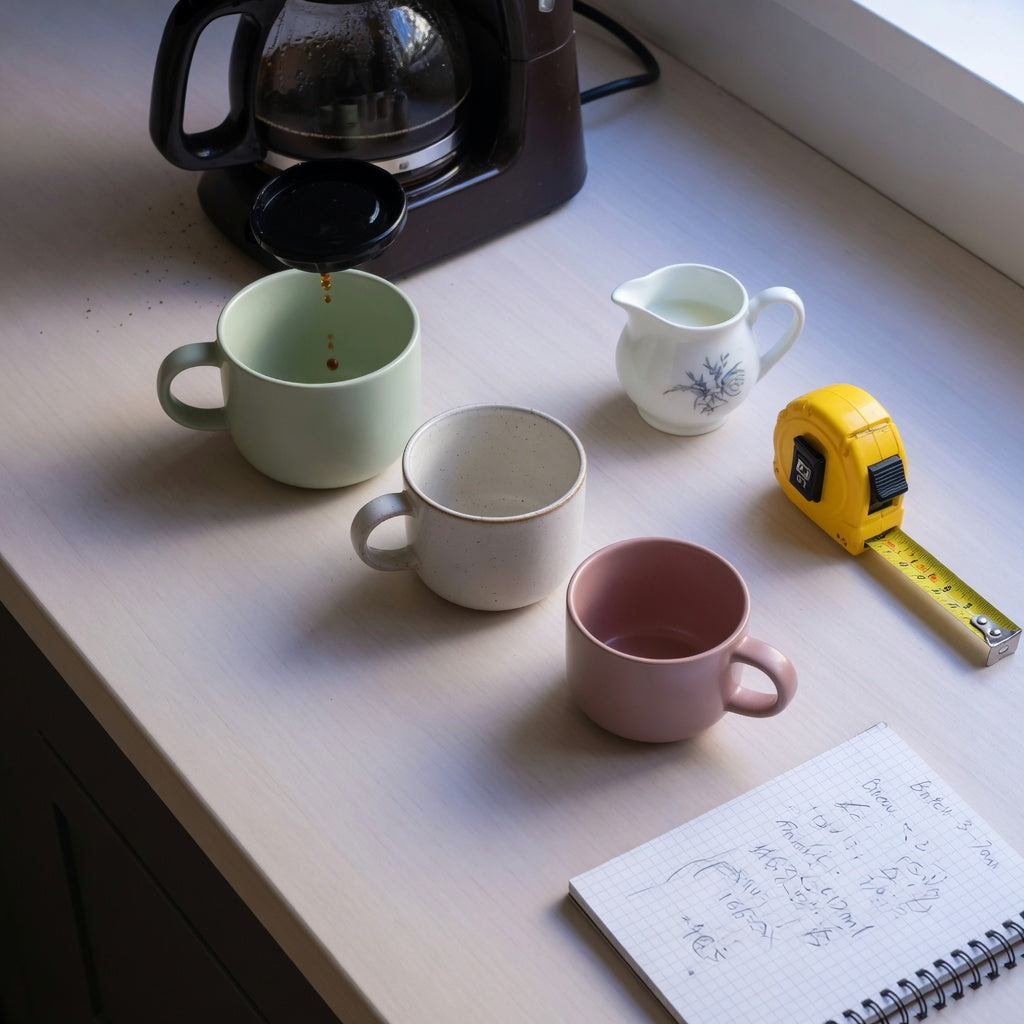
A practical, scenario-based shortlist for 400–480 ml rounded mugs: match listed capacity to your usual pour, brewer clearance, milk habit, and how often you refill before 9 a.m.
Read more
Pottery Tea Cups Home Office Practical Purchase Checklist for Desks
A desk-first buying checklist for pottery tea cups: what to verify about glaze and food contact, how 170, 200, and 250 ml capacities change your tea routine, and which trade-offs should decide the ...
Read more
Leave a comment
This site is protected by hCaptcha and the hCaptcha Privacy Policy and Terms of Service apply.