



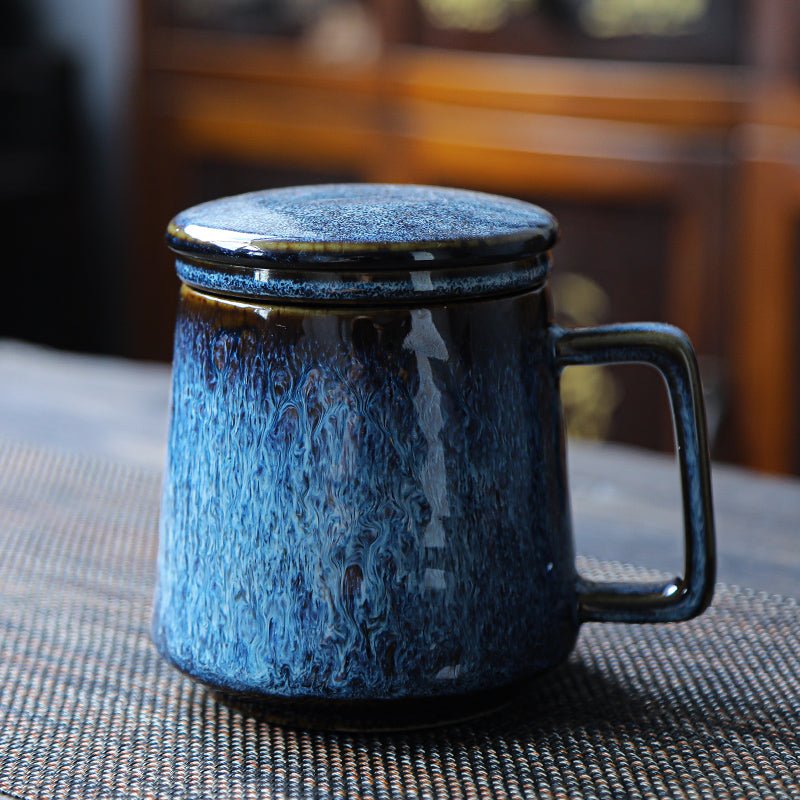
Large Round Coffee Mugs Everyday Mug Rotation Product Shortlist Guide
Reading time: about 13 minutes
There are two mugs on the shelf above our packing bench. One gets picked up five mornings a week. The other has not moved since spring. Both are round. Both were bought by the same person. The difference is that one was sized for the coffee actually made each morning, and the other was sized for the idea of it.
That gap between the mug you admire and the mug you reach for is what this large round coffee mugs everyday mug rotation product shortlist guide is built around. In our store, we pack and ship these mugs, so we hear the practical follow-up notes: the handle was tighter than expected, the rim was too wide for the dripper, the 480 ml looked reasonable on a screen and turned out to be a two-handed lift. Instead of rebuilding a broad buying guide, here is a short, scenario-based rotation from our own catalog — what each mug is genuinely good for, and who should skip it.
What does “round” change when the ounce count stays the same?
Two mugs can both list 16 ounces and behave nothing alike. A tall cylinder stacks that volume vertically. A round, bellied mug spreads it sideways. The round shape usually ends up shorter, which matters when your brewer spout sits low or your cabinet shelf gap is tight. It also exposes more liquid surface to air, so an open round mug sheds heat faster at the top than a narrow one — while the deeper body below holds steady. Fill it most of the way and the thermal mass does a lot of the work. Leave it half full and you own a wide, open bowl of cooling coffee.
Shape decides how the last third of the drink behaves, too. A bellied mug that narrows back toward the rim tips cleanly and pours where you aim it. One that flares outward past its widest point tends to dribble down the outside once you tilt it far enough to reach the bottom. That is the real difference in the short wide coffee mug vs tall mug argument: it is not just height, it is where the widest point sits relative to your hand and your lip. A bowl-shaped body also has a practical side effect that never shows up in product photos: it is comfortable in two hands and awkward in one if the handle is small.
How much of a 400, 440 or 480 ml mug is actually drinkable?
Listed capacity is a brim measurement. Nobody carries a surface-tension dome of hot coffee across a kitchen, so the number that matters is capacity minus a headspace of roughly 2 to 3 fluid ounces. NIST Handbook 44 lists 1 U.S. fluid ounce as 29.57353 milliliters, which makes the arithmetic simple:
- 400 ml — about 13.5 fl oz to the brim, so roughly 10.5 to 11.5 oz of comfortable pour.
- 440 ml — about 14.9 fl oz to the brim, so roughly 12 to 13 oz of comfortable pour.
- 480 ml — about 16.2 fl oz to the brim, so roughly 13.5 to 14 oz of comfortable pour.
Read those against your real brew. An 8- to 10-ounce drip plus a splash of milk fits the 400 ml size with room to walk. A 12-ounce cycle with creamer lands squarely in the 440 ml mug. The 480 ml option is the one that swallows a 14-ounce pour and still leaves defensive headspace for a desk commute. A shopper searching for a 20 oz round stoneware coffee mug is often comparing a brim number to a fill line without realizing it — and that is exactly why side-by-side capacity claims get misleading. A wide-body coffee mug for cream only helps if the extra volume is actually usable. Our listed sizes are 400, 440 and 480 ml, which is the honest frame for this shortlist.
Will the mug clear the brewer spout, the cabinet shelf, and the desk?
Fit is the most common reason a large round mug gets retired to the back shelf. Run these six measurements before you buy anything:
- Spout clearance. Measure from the drip tray to the spout with the tray in the position you actually use it. If you have a low single-serve brewer in a rental kitchen, this is the measurement that decides whether a wide-mouth round coffee mug is even in the running.
- Cabinet gap. Round bodies resist nesting, so measure the clear height between shelves rather than the shelf depth.
- Widest point of the body. Note the belly, not the rim. That is the dimension that collides with the shelf above and the wall behind.
- Cup-holder width. Wide, bellied mugs rarely drop into fixed car holders. Keep the round mug for the destination and use a lidded travel mug for the drive.
- Base flatness. A flat base makes solid contact with a mug warmer plate. A footed or recessed base may only touch at a narrow ring, which changes how the heat transfers.
- Stacking. If you rotate more than two mugs, single-layer storage saves more chips than any glaze claim.
If the answer to the spout-clearance question is “just barely,” treat that as a no. A large round mug that fits under the coffee maker with three millimeters to spare is a mug you will hold in your hand for four minutes every morning while the machine finishes. That is not a rotation. That is a morning obstacle.
The large round coffee mugs everyday mug rotation product shortlist guide: three picks, three morning jobs
Three mugs, three different morning jobs. Each one is listed with its capacity and the rounded silhouette you will see on the product page — nothing more, because handle dimensions and appliance compatibility should be confirmed on the live listing rather than assumed from a photo.
Start with the morning you actually have. If you brew one 8- to 10-ounce cup and leave, The Flow is the sensible first slot. If your rotation runs from a morning latte to a late herbal tea, Morning and Night is the middle. If you make one 14-ounce coffee and sit with it at a desk, The Rock is the anchor. The table below makes the trade-offs explicit.
| Mug | Listed capacity | Approx. fl oz to brim | Job it earns | Skip it if |
|---|---|---|---|---|
| The Flow | 400 ml | ~13.5 | Single 8–10 oz drip with creamer | You routinely pour 14 oz or more |
| Morning and Night | 440 ml | ~14.9 | Lattes, cappuccinos, evening tea | You need it in a car cup holder |
| The Rock | 480 ml | ~16.2 | Big black coffees, soup and oatmeal crossover | You have grip or wrist fatigue |
The Flow Coffee & Tea Mug — 400 ml, the compact daily driver
The Flow Coffee & Tea Mug is the smallest of the three at a listed 400 ml, with a visibly rounded body. It is the one that stops an 8-ounce brew from looking lost in the bottom of a wide vessel.
- Choose it if: your standard pour is 8 to 10 ounces with a splash of milk, your cabinet shelves are tight, or you want the lightest filled lift in the rotation.
- Skip it if: you make 14-ounce coffees, drink from a large latte bowl by habit, or want one mug that doubles as a soup bowl. You will be filling this one to the brim, and brim means no splash margin.
- Verify on the listing: handle opening size and the maker’s microwave and dishwasher statements. Do not infer either from a rounded silhouette.
Morning and Night Coffee & Tea Mug — 440 ml, the two-handed middle
The Morning and Night Coffee & Tea Mug sits at a listed 440 ml with a visibly rounded body. That extra 40 ml over The Flow is the difference between a mug that fits a milk drink and one that barely tolerates it.
- Choose it if: your rotation runs from a morning latte to a late herbal tea, you like cradling a warm bowl with both hands, or your sweet spot is a 12-ounce pour with foam.
- Skip it if: the mug needs to travel. A rounded 440 ml body takes up real horizontal shelf space and is a poor fit for narrow fixed cup holders.
- Verify on the listing: rim diameter against your pour-over cone or AeroPress base, and whether the base is flat enough for a mug warmer.
The Rock Coffee & Tea Mug — 480 ml, the heavy-pour anchor
The Rock Coffee & Tea Mug is the largest at a listed 480 ml, again with a visibly rounded silhouette. It is the mug for people who make one big coffee and expect it to still be there twenty minutes later.
- Choose it if: you brew 12 to 14 ounces, work at a desk for long stretches, or want a rounded vessel that crosses over into oatmeal and soup on slow mornings.
- Skip it if: you have grip fatigue, you like lifting a mug one-handed while standing, or you brew 8 ounces — at that volume this mug will look half empty and lose heat along the wide surface.
- Verify on the listing: base contact diameter for warmer use, plus current care markings.
If none of these three silhouettes matches what you pictured, the wider assortment in our unique coffee mugs collection covers sculptural and artisanal shapes beyond the classic round profile. Our breakdown of large unique coffee mugs for gifts and everyday use covers the gifting side of the same decision.
Handle room and filled weight: what a product photo cannot show
480 ml of coffee is roughly a pound of liquid before you add the mug’s own weight. That is the number to hold in your head when you look at a handle opening, because a big round mug that felt fine empty feels very different at the end of a long morning.
- Knuckle clearance. A rounded belly curves outward toward the handle. If the loop sits close to that wall, your knuckles press against hot ceramic. Look for visible daylight between the inside of the handle and the body.
- Joint thickness. Broad clay junctions where the handle meets the wall spread stress. Thin ribbon handles on a heavy bellied body concentrate it at two small points.
- Grip style. Three fingers through the loop demands a tall opening. A cupped grip with the handle as a thumb rest is what round mugs do best — and it changes whether handle size even matters to you.
This is also where a large round mug earns its keep or loses it. A wide body sits stable on a desk and resists the accidental elbow far better than a tall narrow mug. It also takes up more room on a crowded tray. If your office desk is already tight, measure the footprint before you fall for the silhouette.
Glaze, lead limits, and what “lead-free” on a tag actually proves
Coffee is acidic and hot, which is precisely why hollowware gets its own regulatory treatment. FDA’s action level for extractable lead in ceramic cups and mugs is 0.5 µg/mL of leaching solution under CPG 545.450, and the guideline is applied to any one of six units tested. FDA describes cups and mugs as small ceramic hollowware commonly used for beverages such as coffee or tea above room temperature; they normally, but not exclusively, hold about 240 mL (8 fl oz) and are manufactured with a handle. In other words, the cup-and-mug category is not limited to diner-size mugs.
Cadmium has its own limits. Under FDA CPG 545.400, the cadmium action level is 0.5 µg/mL for small hollowware and 0.25 µg/mL for large hollowware, judged on any one of six units. A jumbo vessel can be judged against a different threshold than a standard mug, which is one more reason to ask a seller what category their ware is tested against.
Two cautions matter more than the numbers. First, FDA has documented imported traditional pottery labeled “Lead Free” that still contained extractable lead, in some cases above those action levels. A sticker is not a test report. Second, a pilot study published in Food Safety and Risk reported that lead from ceramic mugs can leach into coffee and tea, that measured concentrations depended on the individual cup, and that the FDA cup-and-mug lead limit cited in the paper is 0.5 μg/mL in an acidic leaching solution. Decoration and firing quality matter, not just the base material. Decorative-only ceramicware that looks food-safe must carry a conspicuous not-for-food-use warning or a hole through the food-contact surface under 21 CFR 109.16.
Practically: buy drinkware sold explicitly for food use, ask a seller directly if the glaze is intended for hot acidic drinks, and treat yellow, orange, red and heavily decorated glazes as the ones to question hardest.
Care habits that keep a rotation mug out of the chip bin
- Respect thermal shock. Do not pull a cold mug from a chilly pantry and hit it with a full boil from an electric kettle. Warm the mug with a splash of hot water first.
- Use a coaster on stone. Setting a piping-hot mug on cold quartz or marble pulls heat out of the base unevenly.
- Keep metal out of the microwave. Gold luster, metallic rims and enamel trim are microwave hazards regardless of what the body is made of.
- Give round mugs space in the dishwasher. Crowding them against cast iron or utensils is how rims chip. Follow the maker’s own dishwasher and microwave markings rather than assuming.
We have seen the same pattern in our own packing notes: the mugs that survive a year of daily use are not the thickest ones. They are the ones that get washed without being stacked, dried without being slammed, and stored with a little air around the rim. That is a habit, not a specification.
Frequently asked questions
Is a 480 ml mug too big for one person’s morning coffee?
Not if you brew 12 to 14 ounces. At 480 ml the brim holds about 16.2 fl oz, so a 13-ounce pour plus creamer leaves sensible headspace. If you only ever make 8 ounces, the mug will look half full and the wide open surface will cool it faster than a smaller vessel would. A large round coffee mugs everyday mug rotation product shortlist guide is only useful if it starts with your actual pour, not the biggest capacity on the page.
Will a wide round mug work with a V60 or AeroPress?
Only if the dripper’s base is wider than the mug’s rim opening. Measure your cone’s outer base diameter and compare it to the rim on the product page. Once a round mug flares past the dripper footprint, the cone sits unstable — brew into a carafe and pour instead.
Do large round mugs keep coffee hotter than tall mugs?
It depends on how full the mug is. A full, heavy-walled mug holds heat well because of the liquid’s thermal mass. A wide mouth also exposes more surface to air, so a partly filled round mug cools faster than a narrow one at the same volume. A lid changes this more than shape does.
How do I check that a glaze is actually safe for coffee?
Buy from a seller who states the ware is made for food use and can speak to lead and cadmium limits — FDA’s action level for cups and mugs is 0.5 µg/mL of leaching solution. “Lead free” wording alone is not proof; FDA has found labeled pottery that still leached lead above those levels.
Can I stack three large round mugs in one cabinet?
Usually not without risk. Rounded bodies resist nesting, and stacking rim-to-base invites chips on the glazed edge plus top-heavy tumbles. Single-layer storage, a countertop tray, or under-shelf hooks keep a daily rotation intact far longer.
Before you commit, take four measurements: your usual pour in ounces, the spout-to-tray clearance on your brewer, the clear height of your cabinet shelf, and the width of your widest cup holder. Match those against 400, 440 or 480 ml, then pick your slot from the full collection. One good round mug used five days a week beats three that never leave the shelf.
More from our blog
Ready to pick your mug? Two ways to save on today's order:
Ordering 1–3 mugs? Get an extra 10% off your 1st order with code 10_OFF Apply 10% Off & Shop Wooden-Handle Mugs →
Gifting 4+ mugs? Buy 3, Get the 4th Free applies automatically at checkout (no code needed; offers do not stack) · Free standard shipping (Nov pre-Christmas delivery: 15–20 calendar days US) · Free replacement if chipped in transit.
Popular mug buying guides: Ceramic Tea Cups & Infuser Mugs · Ceramic Mugs with Lids Compared · Wooden-Handle Tea Infuser Mugs Compared · Christmas & Secret Santa Mugs 2026 · Espresso & Cortado Cups Guide · Cup & Saucer Gift Sets · All 25 Mugs Spec Table · Mug Size Guide · Shipping & Promo FAQ
FIRST ORDER 10% OFF (CODE: 10_OFF) · OR BUY 3, GET THE 4TH FREE


Read more
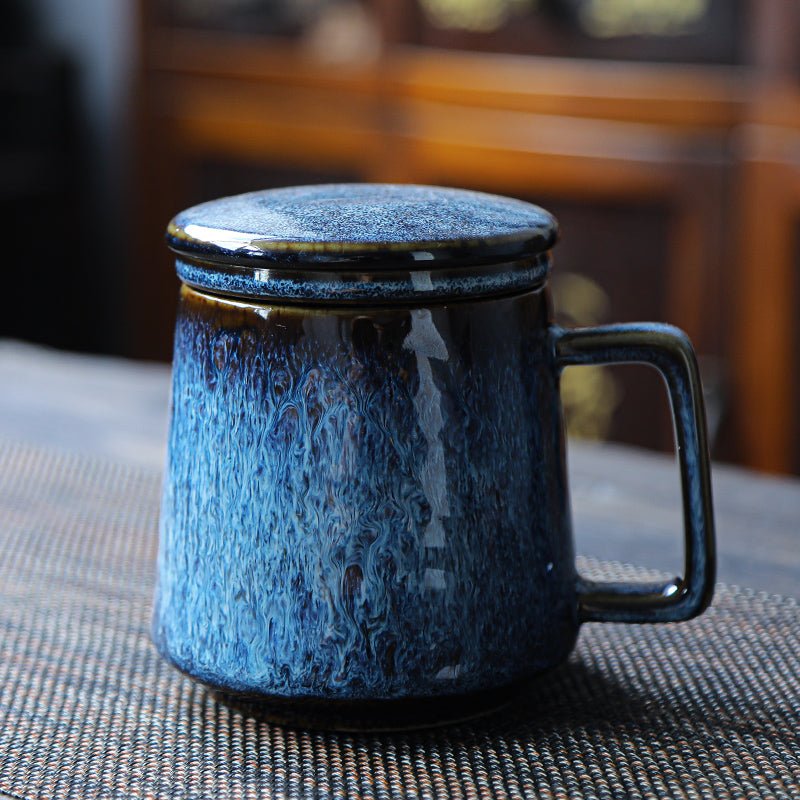
Coffee Mugs With Big Handles: Everyday Rotation Product Shortlist
A scenario-based shortlist for building a mug rotation that fits your hand: what the 250 ml, 400 ml and 480 ml sizes are each good for, how to judge handle clearance a photo can't show, and the bre...
Read more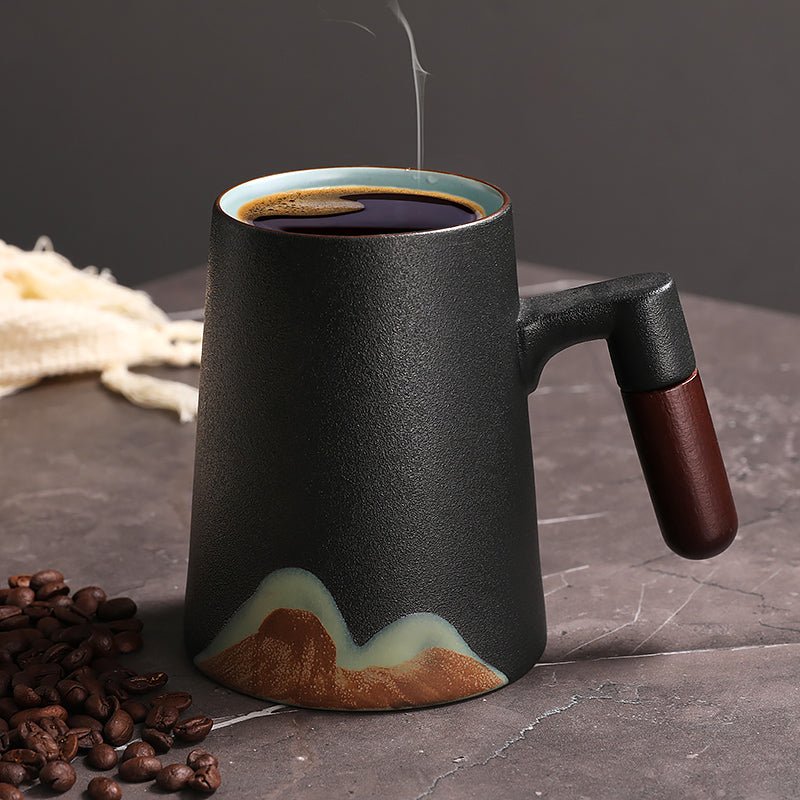
15 Oz Ceramic Coffee Mugs Everyday Mug Rotation Product Shortlist Guide
A shortlist built on true pour volume rather than a label: where our 400 ml, 440 ml and 480 ml mugs fit refill habits, 12 oz brews, handle clearance, shelf height and finish-specific care, with pla...
Read more
Leave a comment
This site is protected by hCaptcha and the hCaptcha Privacy Policy and Terms of Service apply.