



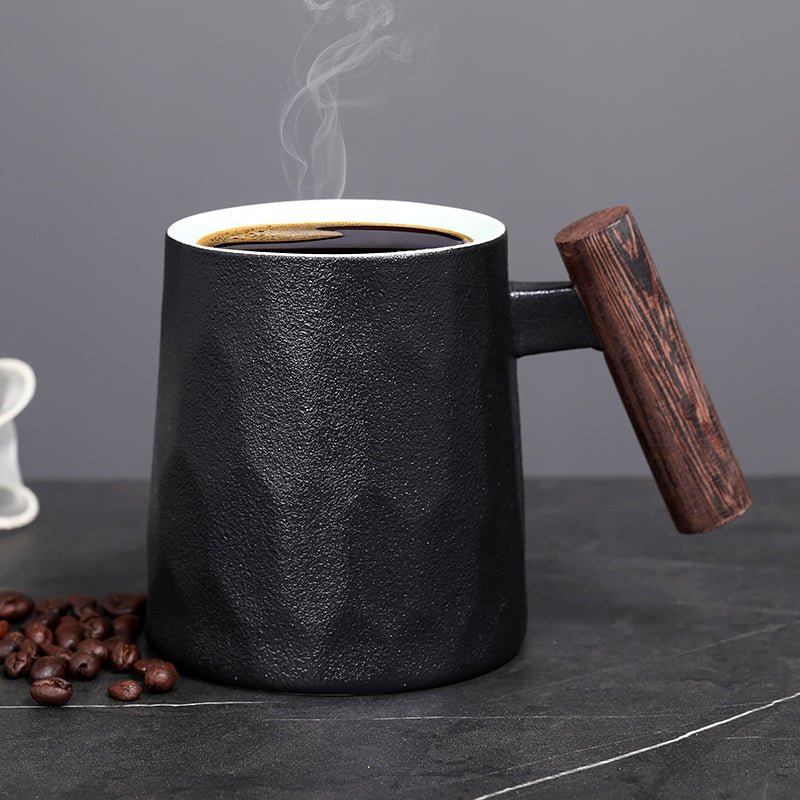
Large Round Coffee Mugs: Everyday Mug Rotation Purchase Checklist
Reading time: about 12 minutes
Three mugs sit on the shelf beside our packing bench, and the biggest one is usually the one that goes back. Not because of the glaze. Because it will not slide under the brewer spout without tilting, or the handle pinches a knuckle once the mug is full, or the last third goes cold while the mouth is as wide as a saucer. The large round coffee mugs everyday mug rotation practical purchase checklist we walk customers through is short, and almost none of it is about color: listed capacity against a realistic fill line, rim width against your dripper, base diameter against your mug warmer, and body height against the shelf above.
In our store, the questions that land a week after delivery are rarely about looks. They are about fit — the mug that will not clear a single-serve brewer, the one that feels heavier than expected once milk goes in, the handle that turns out to be two fingers wide for a four-finger hand. What follows is the counter version of the checklist, including the parts we cannot answer for you and you will have to measure at home.
What does the listed capacity actually pour: 400 ml, 440 ml, and 480 ml in a real rotation
Capacity is the first figure shoppers compare and the least reliable one. NIST Handbook 44 fixes one U.S. fluid ounce at 29.57353 milliliters and defines a measuring cup as exactly 8 fluid ounces, so converting a metric listing is arithmetic, not guesswork. What listings rarely say is whether that figure is brim-full or a comfortable pour.
For scale, the FDA describes cups and mugs as small ceramic hollowware normally, though not exclusively, holding about 240 mL (8 fl oz) and made with a handle. Every mug in the large round category sits well above that reference point, which is exactly why the category feels roomy and why the numbers get slippery.
| Mug | Listed capacity | Approximate U.S. fluid ounces | Rotation slot it suits |
|---|---|---|---|
| The Flow | 400 ml | About 13.5 fl oz | One full pour at a desk, or the afternoon tea mug |
| Morning and Night | 440 ml | About 14.9 fl oz | The middle mug: coffee early, tea late |
| The Rock | 480 ml | About 16.2 fl oz | Longest sits, biggest pours, milk-heavy drinks |
Two adjustments matter more than the raw number. First, a lidless mug is normally filled an inch or so below the rim. A 480 ml body carried to the brim across a room is a spill waiting for a doorframe; leave a finger's width of headspace and it behaves. Second, if you take milk or cream, set your target before you shop. A 480 ml mug with a generous splash of milk still leaves a satisfying cup, while a 400 ml mug topped up with milk becomes a smaller drink than you pictured.
Will a wide round body clear your brewer spout, cabinet shelf, and cup holder?
Capacity tells you nothing about height, and this is where most rotations break. A short wide round mug and a tall cylindrical mug can both hold 480 ml and behave completely differently in the same kitchen. Measure these six things before you order:
- Brewer clearance. Measure from the drip tray to the spout on your drip machine or single-serve brewer. Body height plus any base thickness has to fit underneath. Check whether the tray lifts out — on many single-serve machines that is the only way a larger mug works at all.
- Cabinet shelf gap. Measure the space between shelves, not the shelf itself. Rounded bodies often need more vertical room than their listed height suggests, because the widest point sits above the base.
- Desk footprint. A wide round base overhangs a small coaster and leaves a ring on a wooden desk. Measure your coaster, not the mug.
- Car cup holder diameter. Measure the holder's inner width. Wide, bellied mugs fail this test more often than any other.
- Mug warmer contact. A warmer needs flat base contact. A pronounced foot ring or a recessed base can hold the mug off the heating plate, so look closely at base photos before you assume it will work.
- Shelf depth and stacking. Big-handled mugs take more front-to-back room than a standard cup, and two of them rarely sit side by side on a narrow shelf. If storage is tight, plan for depth as well as height.
If you want the geometry that clears the most brewers and shelves, compare the rounded silhouettes in our unique coffee mugs collection side by side. Judging three profiles in one pass beats flipping between separate listings and guessing at scale.
How does the handle feel once the mug is full and you are standing at the counter?
Handle opening is the specification almost no listing publishes, and it decides whether you enjoy a mug or merely tolerate it. The test is simple: slide three fingers through the opening, then try a fourth. If your knuckles touch the body, you will pinch the handle instead of wrapping it, and a full large round mug gripped that way feels far heavier than it is.
Filled weight is the other number no listing gives you, and it is the one your wrist notices on the second cup. Two things change how heavy a mug feels: where the handle sits and how wide the base is. A handle mounted high on a tall body tips the mug forward when full. A handle set low on a wide body sits closer to level. When you lift, watch for two signals — whether the mug pulls toward your wrist, and whether your thumb finds a natural resting spot on the top of the handle instead of hovering in the air.
There is a real trade-off here. A big, open handle is comfortable bare-handed but takes more cabinet width, and oversized handles can crowd each other on a shelf. If storage space is the constraint, a slightly smaller opening usually nests better, even though it is less forgiving on a cold morning with stiff hands.
Short wide round mug or tall mug at the same ounce capacity?
Two mugs of identical volume can solve different problems. The short, wide version clears more brewers, fits more shelves, sits more stably on a counter, and gives you a comfortable drinking angle without tipping your head back. The tall version keeps aroma closer to your nose and takes less cabinet footprint, but it fails more brewer clearances and feels tippier when full.
A wide mouth carries its own cost: more exposed surface means faster cooling. Thick walls add thermal mass and hold heat, but they cannot fully compensate for a saucer-sized opening on a cold morning. If a hot cup down to the last sip is the priority, a narrower mouth or a lidded mug is the better tool. A wide round mug rewards people who drink steadily rather than slowly.
Shape affects spill risk too. Bellied mugs — narrow at the base, widest in the middle — can slosh forward when you tilt them, because the liquid rises against a curved wall. Wide, flat-bottomed bodies are more stable to set down. And a broad rim may be too wide for a pour-over dripper or AeroPress to sit securely, so measure the rim opening before you plan to brew directly into the mug.
Which of our three rounded mugs fits your morning, your desk, or your evening tea?
Most shoppers do not need one perfect mug. They need two or three that split the week sensibly. Map the situation to the mug, then verify the unknowns on the current listing.
- You pour once and drink at a desk. The Flow, listed at 400 ml (about 13.5 fl oz) is the smallest of the three, with a rounded silhouette. It suits a single full pour with headspace and doubles as an afternoon tea mug. If you plan to sit a dripper on the rim or slide it under a low spout, confirm rim width and height on the product page first — we publish the listed capacity, not every dimension a brewer demands.
- You want one mug that handles coffee and tea without a decision. Morning and Night, listed at 440 ml (about 14.9 fl oz) is the rotation workhorse. Big enough for a latte, small enough that a second cup is not something you regret at noon.
- You take the largest pour and add milk. The Rock, listed at 480 ml (about 16.2 fl oz) is the biggest of the three. Consider it for long mornings, oatmeal, or soup as well as coffee — but check height and handle clearance first, because the largest mug is also the one most likely to fail a fit test.
One honest limitation: an open, unlidded ceramic mug is a home mug, not a commuter mug. If a listing does not state a lid or insulation, do not expect it to hold temperature in a car or survive a bag. When the commute is the main event, buy a lidded tumbler and keep the round mug for the kitchen table. And if you are choosing for someone else's kitchen, our comparison of large unique coffee mugs for gifts covers the sizing questions gift buyers ask most.
Stoneware, porcelain, glass, enamel: what changes at the sink and in the microwave
Material affects three things you will actually notice — exterior heat, chip behaviour, and whether the mug belongs in the microwave at all.
- Stoneware and ceramic hold heat in the wall, so the outside stays warm rather than scalding. Follow the maker's dishwasher and microwave marks rather than assuming either is fine.
- Porcelain is often thinner and lighter for the same volume, which helps with filled weight, but thin walls pass heat to your hand faster.
- Glass lets you watch the fill level, genuinely useful in a large mug, but it shows coffee staining and heats unevenly.
- Enamel on steel gets hot on the outside quickly, so the handle can become uncomfortable, and enamelware is frequently not microwave safe. A round camp mug and a round ceramic mug look similar on a shelf and behave nothing alike.
Care habits matter as much as material. Avoid direct heat sources, do not plunge a hot mug into cold water, and let it come down in temperature before washing if it has just held boiling liquid. Thermal shock is a handling problem rather than a brand problem, and it is the most common way a good mug is lost in a kitchen that otherwise treats it well.
Is the glaze food-safe, and what does “lead free” actually prove?
This is the part of the checklist shoppers skip. FDA's action level for lead in ceramicware cups and mugs is 0.5 µg/mL of leaching solution, applied to any one of six units tested. For cadmium, the action level is 0.5 µg/mL for small hollowware and 0.25 µg/mL for large hollowware, again judged on any one of six units, and FDA notes that extractable cadmium from ceramicware could cause chronic cadmium poisoning with continued food use. Our three listed capacities sit comfortably inside the ordinary cup-and-mug range rather than the large-hollowware end.
The uncomfortable part: FDA has reported imported pottery labeled “Lead Free” that still contained extractable lead, in some cases above the action level, and a published pilot study in Food Safety and Risk found that lead from ceramic mugs can leach into coffee and tea, with results varying from cup to cup. Treat the phrase as marketing until you can see a named leach test. Yellow, orange, red, and heavily decorated glazes are the ones worth asking about in cadmium terms specifically.
Decorative ware is a separate category. Under U.S. rules for ornamental ceramicware that appears suitable for food, a conspicuous “not for food use” lead warning or a hole through the food-contact surface is required when those conditions apply. A decorative piece should never become your morning cup, however good it looks on a shelf.
The large round coffee mugs everyday mug rotation practical purchase checklist
- Convert the listed capacity to fluid ounces (divide milliliters by 29.57353) and subtract roughly an inch of headspace.
- Decide whether you need room for milk. If yes, shop 440–480 ml rather than 400 ml.
- Measure brewer spout clearance from drip tray to spout, and check whether the tray is removable.
- Measure the cabinet shelf gap, the shelf depth, and your car cup holder diameter.
- Confirm the base will sit flat on your mug warmer, with no foot ring holding it off the plate.
- Test handle opening against three fingers with knuckle clearance, and think about how it stores.
- Check rim width against your dripper, or accept that a wide rim pours and cools differently.
- Read the maker's dishwasher and microwave guidance instead of assuming.
- Ask for a named lead and cadmium leach test on brightly glazed or decorated pieces.
- Accept the trade-off: an open, wide, unlidded mug is a home mug, not a commuter mug.
Start with the size that matches your most common pour, then add a second for variety. If you are still deciding between profiles, our full collection of unique coffee mugs shows the rounded shapes together, which makes rim width and handle position easier to judge than three separate product pages ever will.
Frequently asked questions
Does a 400 ml mug really count as a large round coffee mug?
Yes. 400 ml converts to about 13.5 fl oz, comfortably above the roughly 240 mL the FDA uses as a typical cup-and-mug reference. Whether it feels large depends on your fill line and whether you add milk. If you drink black coffee in one pour, 400 ml is plenty; if you build a latte, move up to 440 or 480 ml.
Will The Rock 480 ml fit under my drip coffee maker?
We can confirm the listed capacity of 480 ml, not the height or the clearance under your specific brewer. Measure from your drip tray to the spout, then check the listed height on the current product page before ordering. When clearance is tight, a shorter wide body is the safer choice than a tall mug of the same volume.
Is a wide-mouth round coffee mug a bad pick if I sip slowly?
It is a trade-off rather than a flaw. A wide opening gives you aroma and a relaxed drinking angle, but more exposed surface means faster cooling. If you nurse one mug for an hour, a narrower mouth or a lidded mug will hold heat better; if you drink steadily, the wide shape is the more pleasant cup.
What belongs in a large round coffee mugs everyday mug rotation practical purchase checklist besides size?
Four things: brewer and shelf clearance, handle opening with knuckle room, flat base contact with your warmer, and glaze safety documentation. Size is the easiest number to compare and the least likely to make a mug unusable. Fit and food-contact verification are what actually decide whether a mug keeps its slot in the rotation.
Can I microwave a large round ceramic mug with a metallic rim or gold luster?
Not unless the maker explicitly says it is microwave safe. Metallic rims and gold luster are common reasons a mug is excluded from microwave use, and most listings do not address it directly. Plain glazed bodies are a different case, but still follow the manufacturer's mark rather than a general assumption about ceramic.
More from our blog
Ready to pick your mug? Two ways to save on today's order:
Ordering 1–3 mugs? Get an extra 10% off your 1st order with code 10_OFF Apply 10% Off & Shop Wooden-Handle Mugs →
Gifting 4+ mugs? Buy 3, Get the 4th Free applies automatically at checkout (no code needed; offers do not stack) · Free standard shipping (Nov pre-Christmas delivery: 15–20 calendar days US) · Free replacement if chipped in transit.
Popular mug buying guides: Ceramic Tea Cups & Infuser Mugs · Ceramic Mugs with Lids Compared · Wooden-Handle Tea Infuser Mugs Compared · Christmas & Secret Santa Mugs 2026 · Espresso & Cortado Cups Guide · Cup & Saucer Gift Sets · All 25 Mugs Spec Table · Mug Size Guide · Shipping & Promo FAQ
FIRST ORDER 10% OFF (CODE: 10_OFF) · OR BUY 3, GET THE 4TH FREE


Read more
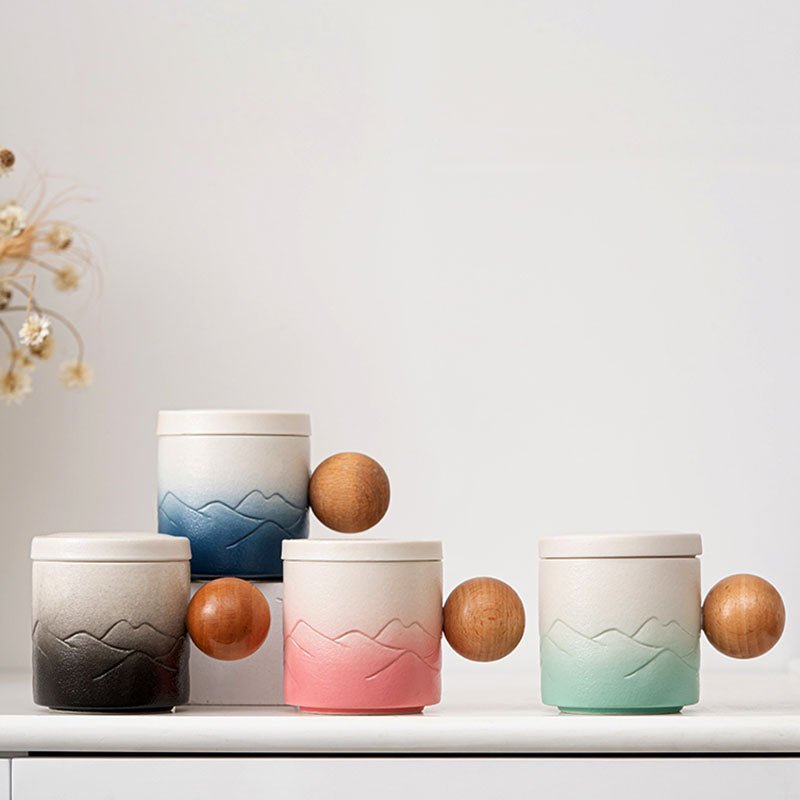
Wide Based Coffee Mugs: Everyday Mug Rotation Practical Checklist
A wide foot keeps a mug planted on a counter, but it will not rescue a tapered cup holder or a cramped shelf. Here are the measurements, capacity slots, and care checks we would run before giving a...
Read more
coffee mug gifts ideas everyday mug rotation product shortlist guide
Use drink habits, listed capacity, storage space, and care questions to narrow coffee mug gifts ideas into a practical everyday rotation shortlist. Compare three CoffeifyMug ceramic options with cl...
Read more
Leave a comment
This site is protected by hCaptcha and the hCaptcha Privacy Policy and Terms of Service apply.