



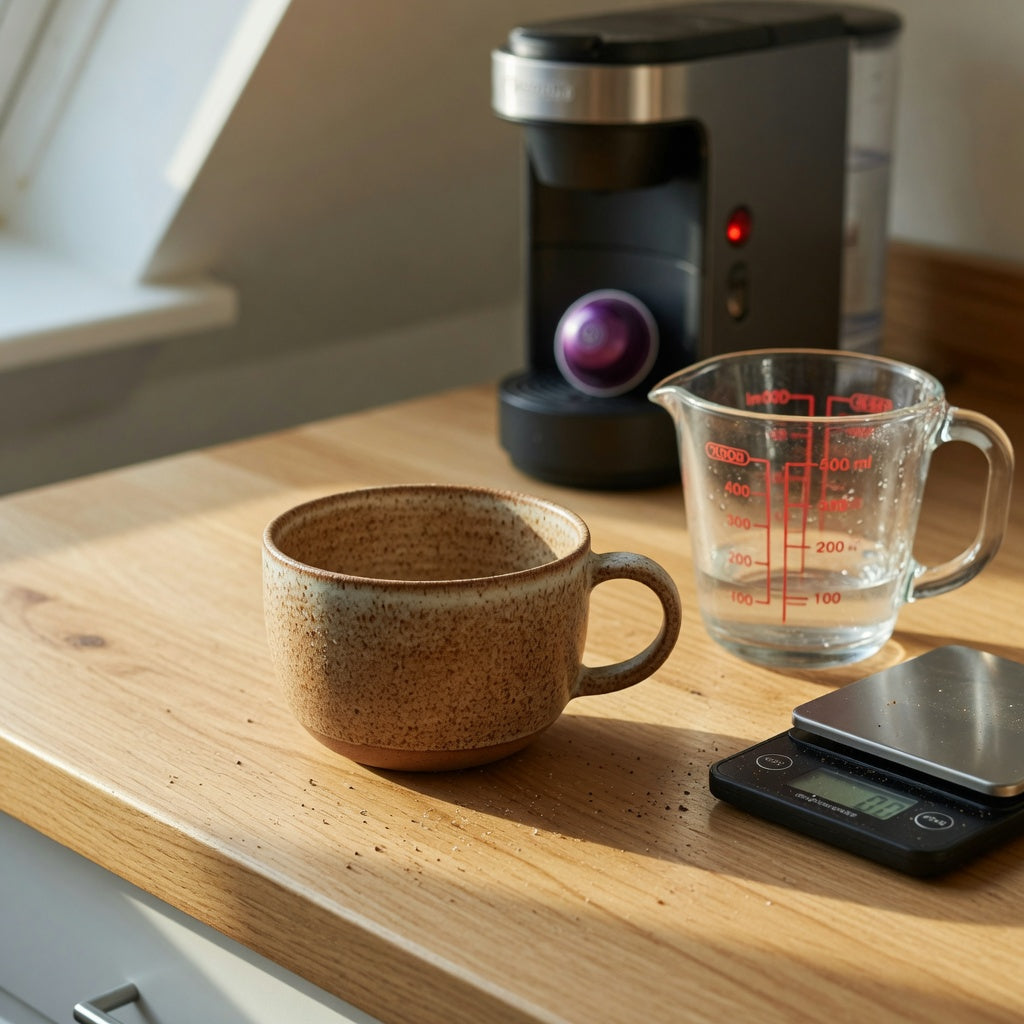
Large Round Ceramic Coffee Mug: What Buyers Should Compare
Reading time: about 10 minutes
Fill a mug to the lip, tip it into a measuring jug, and weigh it. The number you get back is almost never the number you drink. That gap — the headroom you leave for milk, foam, or simply carrying a full cup back to your desk without sloshing — is where most oversized-mug disappointment starts. A large round ceramic coffee mug photographs beautifully and drinks very differently once it is full and heavy.
We pack and ship these mugs from our store, and we hear back after the first dishwasher cycle — which ones stay in the rotation, and which get demoted to the back of the cabinet. So here is the comparison we would run ourselves, in the order that actually decides it: capacity, shape, physical fit, then care and glaze safety.
What does “large” mean once the mug is full?
Nothing official defines “large” or “round” for a coffee mug. The FDA’s ceramicware guidance describes a typical cup or mug as holding about 240 mL — roughly 8 fl oz — with a handle, and it separates small hollowware under 1.1 liters from large hollowware at 1.1 liters or more. Retail “large” and “oversized” labels live well above that reference point; listings in this category commonly advertise 16–24 fl oz, with some reaching 26–30 fl oz.
Unit conversion breaks more comparisons than any other single detail. NIST’s kitchen equivalents put one US fluid ounce at about 30 mL, 16 fl oz at 480 mL, and 24 fl oz at 720 mL. A mug listed at 480 mL is a 16-ounce mug, not a 20-ounce one. And if a listing gives capacity in pounds, stop there — pounds measure weight, and they say nothing about volume.
Then comes the question the spec sheet usually skips:
- Brim capacity is measured to the very edge. It looks generous in photos and spills in real life.
- Usable capacity is what you can carry at walking speed without staring at the surface.
- Working capacity subtracts whatever you add — a shot of espresso, steamed milk, foam, or cereal that displaces liquid.
A mug sold as 16 oz that genuinely holds 13–14 oz of drinkable coffee is not a trick. It is a wide mug doing what a wide mug does. The mistake is buying it expecting the pour of a narrow one.
We list our own mugs in milliliters rather than ounces, which removes one layer of arithmetic:
| Mug | Listed capacity | Approximate | Where it lands |
|---|---|---|---|
| The Flow | 400 ml | about 13 fl oz | A clear step up from a standard mug |
| Morning and Night | 440 ml | about 15 fl oz | A 12 oz brew plus milk, with room left |
| The Rock | 480 ml | 16 fl oz | One fill through a long meeting |
All three sit in the oversized-but-holdable band rather than the 26–30 oz jumbo bracket. If you want a true 24-ounce bowl mug, none of these is it — 720 mL of liquid is a different product and a much heavier lift one-handed. The three rounded silhouettes sit side by side in our collection of unique coffee mugs.
What a large round ceramic coffee mug changes at the rim
Shape is the variable most buyers skip, and it decides daily satisfaction more than the ounce count. A round, wide body gives you a broad open surface and a rim you can drink from at a shallow angle. A tall cylinder gives you depth and less exposed surface. Neither wins in the abstract.
What the round shape buys you:
- Frother and spoon room. A wide mouth lets a handheld frother or a spoon work without flinging foam over the edge.
- Latte layering. Foam spreads across a broad surface instead of climbing a narrow wall.
- A second job. Soup, oatmeal, cereal, and ice cream behave better in a wide, bowl-like mug.
- Stability. A wider footprint resists knocks better than a tall narrow mug of the same volume.
The cost is heat. More exposed surface means the coffee cools faster, so a round mug is a poor companion if you nurse one drink for an hour at a desk. It is also clumsier in a car cupholder and less stackable in a crowded cabinet. If a warm last sip forty minutes in matters more than foam, a tall lidded or double-walled vessel will beat any open ceramic mug.
One detail shows up in reviews far more often than in spec sheets: the foot. An unglazed, gritty base can leave faint scratches on a wooden desk or a varnished table. Check whether the bottom ring is polished or felt-padded before you buy, or budget for a coaster. If the listing does not show the base, ask.
Will it clear your brewer, your cupholder, and your top shelf?
Two fit failures produce most of the “love it, cannot use it” feedback. The first is machine clearance: a mug too tall for the dispense area under a pod machine or a drip brewer’s spout becomes a mug you fill from a carafe, which defeats the point.
Run this before you commit:
- Height under the brewer, measured with the drip tray in its normal position — not removed.
- Rim diameter, since a wide mug can foul the machine housing even when it is short enough.
- Handle opening, measured inside — the number that decides whether four fingers fit or two.
- Empty weight, then filled weight. A 480 mL fill is about 480 g of liquid before the ceramic is counted at all.
- Base diameter against your coaster, cupholder, and cabinet shelf.
- Foot finish, as above.
When a listing does not publish a dimension, ask. That is a fair question for any store, and the answer tells you how well the seller knows the product. We would rather answer a measurement question than process a return.
Hand size deserves its own note. Buyers with large hands, or with arthritis, often find a thick, generously arched handle easier to hold than a slim loop — and the difference matters most when the mug is full. A light mug with a thin handle feels fine empty and unpleasant at 480 mL. Handle dimensions for our three mugs are best confirmed against the current product page, since that page is the source of truth for what ships.
Microwave, dishwasher, and metallic trim: read the label, not the vibe
Handmade and reactive glazes are a big reason people search for a large round ceramic coffee mug in the first place. They are also why care instructions differ from piece to piece, sometimes within one line.
USDA FSIS is direct about microwaves: only cookware manufactured for microwave use belongs in one, and metallic paint or trim is not safe. Safe glass and ceramic are usually labeled for microwave use. If a piece arrives with no clear mark, FSIS suggests a one-minute test — microwave the utensil beside, but not touching, a cup of water. If the utensil itself gets warm or hot, it is not microwave safe.
Dishwasher damage is gradual rather than dramatic. Detergent and heat dull a reactive glaze over time, and metallic lustres and gold rims wear faster than the body does. Crazing — the fine web of cracks that develops in a glaze — deserves watching, because a crazed surface is harder to keep clean. Skip thermal shock as well: no pouring boiling water into a mug pulled from a cold garage, and no plunging a hot mug into cold water.
For our own mugs, read the care section of the individual product page rather than assuming a rule from another mug in the collection.
What should “lead free” actually prove?
This is the part of the category where marketing runs furthest ahead of evidence. Glaze and decoration can leach lead if a piece is not fired properly. The FDA’s lead action level for cups and mugs is 0.5 micrograms per milliliter of leaching solution in any one of six units tested. For cadmium, the action level is 0.5 µg/mL for small hollowware under 1.1 liters and tightens to 0.25 µg/mL at 1.1 liters and above.
Two things follow. The FDA specifically flags handmade pieces with crude or irregular finishes, antiques, damaged or worn ware, flea-market and street-vendor pottery, and bright orange, red, or yellow decoration as categories needing extra caution. Washing or boiling does not remove lead. And “lead free” is a regulated claim, not a mood: the FDA states that ceramicware with extractable lead under its test method should not be labeled “Lead Free” at all.
A 2017 pilot study in Springer Nature Applied Sciences tested five commercial mugs already known to contain lead and found measurable leaching into coffee (0.2 to 8.6 µg/L) and tea (below 0.2 to 1.6 µg/L). Levels tracked the individual cup rather than the beverage or how long the drink sat. Five mugs is a small sample, so treat it as a reason to ask questions, not as a ranking of any mug type.
What to ask a seller: whether the glaze and decoration were tested, by which method, and whether the lip and rim were included. A store that answers clearly is a store worth buying drinkware from.
400 ml, 440 ml, or 480 ml: matching the mug to your morning
Capacity charts do not tell you who the mug is for. Here is the version we give people at markets, mapped to situation rather than spec.
Stepping up from a standard 8–12 oz cup. You want a wider drinking surface without a heavy pour at the end. The Flow coffee and tea mug at 400 ml is the smallest of the three and the easiest to adapt to.
A 12 oz brew with milk or creamer every morning. You need headspace so you are not pouring to the rim. The Morning and Night mug at 440 ml covers that with room left over, and its rounded silhouette suits a routine that starts with coffee and ends with herbal tea.
One fill through a long meeting, or soup and oatmeal out of the same vessel. The Rock coffee and tea mug at 480 ml is the largest we list, with the honest caveat that a full 480 mL is heavy one-handed.
Beyond capacity — handle opening, empty weight, microwave and dishwasher guidance, glaze testing — treat the current product page as the source and ask if something is missing. You can compare all three shapes in the unique coffee mugs collection.
Who a large round ceramic coffee mug is wrong for
Plenty of people should buy something else.
- You drink slowly and hate reheating. A wide open surface cools fastest.
- You commute with coffee in a cupholder. A wide base often will not sit stable in a standard holder.
- You have a small cabinet or stack mugs. Wide bodies refuse to nest.
- You want one-handed control with wrist or grip limits. A full 480 mL mug is a two-hand carry for many people.
- You need a mug that fits a tight brewer with no measurement wiggle room.
None of that makes the shape bad. It makes it a poor match. A standard 8–12 oz straight-sided mug, or a tall double-walled one, serves those needs better.
Frequently asked questions
How many ounces is a large round ceramic coffee mug?
There is no official figure. The FDA’s reference mug holds about 8 fl oz, while retail “large” mugs usually claim 16–24 fl oz. Using NIST’s kitchen equivalents, 480 mL equals 16 fl oz and 720 mL equals 24 fl oz — convert before comparing two listings.
Is a large round ceramic coffee mug good for lattes and soup?
Generally yes. A wide mouth gives you room to work a frother, layer foam, and set the mug down without sloshing, and the same bowl-like shape handles soup or oatmeal. The trade-off is heat loss: the open surface that helps foam also lets coffee cool faster than a tall mug would.
Will an oversized mug fit under my coffee maker?
Measure the height clearance with the drip tray in place, then check the rim diameter against the machine housing. Many oversized mugs clear pod machines and standard drip brewers, but plenty do not — and a mug that only fits with the tray removed becomes a daily annoyance.
Can I microwave a handmade or reactive-glaze mug?
Only if the maker says it is microwave safe, and metallic paints or trims should stay out regardless. If an unlabeled piece is in doubt, microwave it for one minute beside a cup of water — if the mug itself warms, it is not microwave safe.
How do I verify a large ceramic mug’s glaze is lead free?
Ask for the test, not the slogan. The FDA sets a lead action level of 0.5 µg/mL for cups and mugs and restricts the “Lead Free” label to ware that passes its leaching method. A seller who can name the test and confirm the lip and rim were included is the one to buy from.
More from our blog
Ready to pick your mug? Two ways to save on today's order:
Ordering 1–3 mugs? Get an extra 10% off your 1st order with code 10_OFF Apply 10% Off & Shop Wooden-Handle Mugs →
Gifting 4+ mugs? Buy 3, Get the 4th Free applies automatically at checkout (no code needed; offers do not stack) · Free standard shipping (Nov pre-Christmas delivery: 15–20 calendar days US) · Free replacement if chipped in transit.
Popular mug buying guides: Ceramic Tea Cups & Infuser Mugs · Ceramic Mugs with Lids Compared · Wooden-Handle Tea Infuser Mugs Compared · Christmas & Secret Santa Mugs 2026 · Espresso & Cortado Cups Guide · Cup & Saucer Gift Sets · All 25 Mugs Spec Table · Mug Size Guide · Shipping & Promo FAQ
FIRST ORDER 10% OFF (CODE: 10_OFF) · OR BUY 3, GET THE 4TH FREE


Read more

Unique Ceramic Mug Ideas: What to Compare Before You Buy
A practical comparison of unique ceramic mug ideas by listed capacity, clay body, handle comfort, glaze safety, and care, plus the questions to ask before buying a sculptural, hand-painted, or pers...
Read more
Yellow Coffee Mug Gift: What to Compare Before You Buy
A yellow coffee mug gift usually fails on details the photo hides: shade, real fill volume, glaze versus print, and a care claim nobody checked. Here is the compare-first order we use in our store ...
Read more
Leave a comment
This site is protected by hCaptcha and the hCaptcha Privacy Policy and Terms of Service apply.