
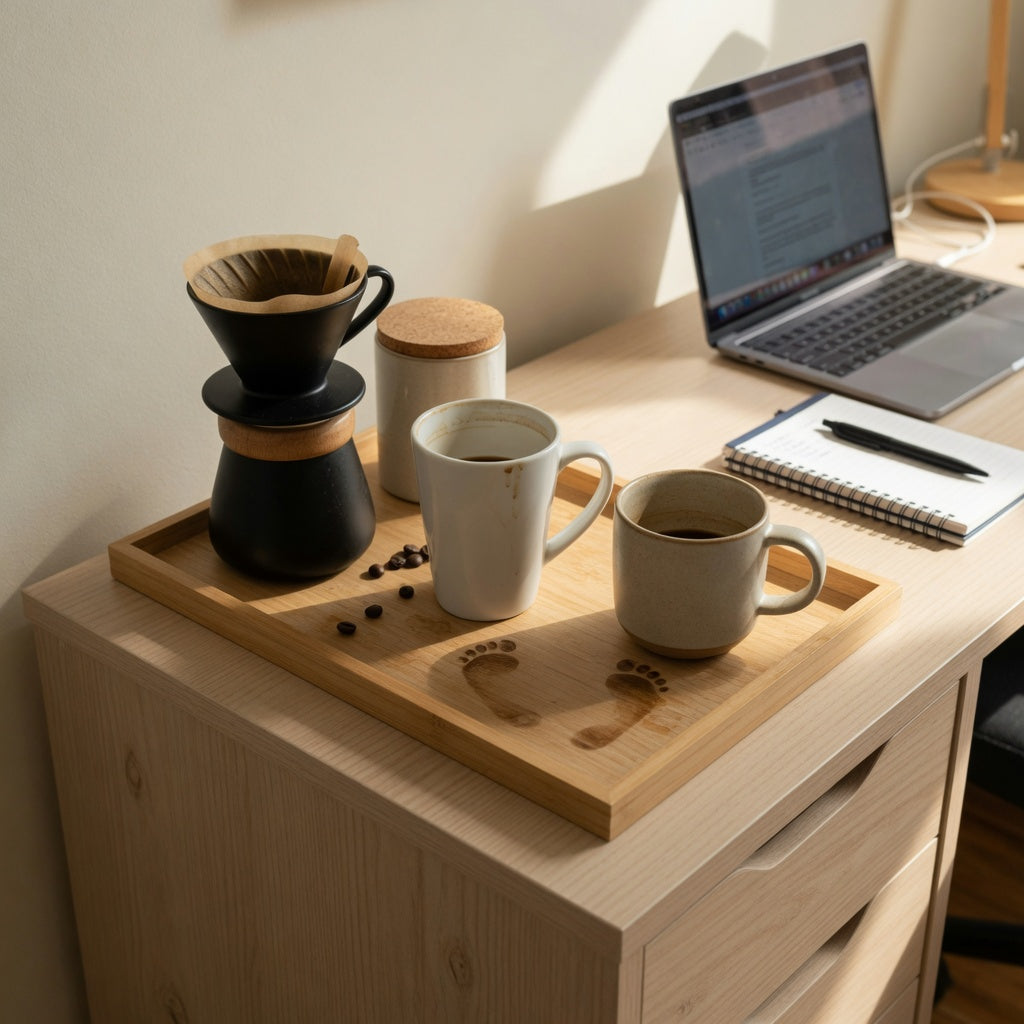
Home Office Coffee Station Mugs: Size, Heat and Care
Reading time: about 11 minutes
A fresh mug of coffee can go cold between the first calendar alert and the end of a 30-minute call. Meanwhile, the handle catches a charging cable, and the mug that looked compact online takes up half the station tray. Those are the real tests for home office coffee station mugs: how they behave beside a laptop, under a brewer, and through repeated reheating and washing.
We handle and sell mugs, so we evaluate this category in the places shoppers actually use it: on narrow sideboards, beside keyboards, below cabinet shelves, and on crowded dishwasher racks. In our experience, the best station mug is rarely the one with the longest feature list. It is the one whose dimensions, material, handle, and care instructions match your work routine.
Before choosing a design, decide how long your drink sits untouched, where the mug will be stored, and how you clean it. Those three answers quickly separate a useful daily mug from one that becomes shelf decoration.
Which home office coffee station mugs fit the tray, brewer, and desk?
Capacity alone does not tell you how much station space a mug needs. Two mugs with the same stated volume can have very different footprints: one may be tall and narrow, while another is low and wide with a handle that projects several inches from the body.
Compare these listing measurements with your actual setup:
- Overall height: Check clearance below the brewer spout, cabinet, shelf, or mug-tree branch.
- Body diameter: This determines how much room the mug occupies beside canisters, spoons, and coffee tools.
- Base diameter: Compare it with your coaster, warming plate, or tray ledge rather than assuming the widest body measurement applies.
- Total width with handle: This is the number that matters beside a monitor stand, wall, or neighboring mug.
- Stated capacity: Find out whether the volume is measured to the brim or leaves practical space for carrying and adding milk.
We use a simple paper-template test for tight stations. Mark the listed base diameter and total width on paper, place the template on the tray, and set your canister and spoon beside it. This exposes crowding that a product photo cannot show. It also leaves you a safe landing area so a full mug does not have to sit against the keyboard.
Ceramic, glass, insulated steel, or powered heat?
Interrupted drinking changes the material decision. A classic ceramic mug works well for someone who is willing to reheat. An insulated or powered option may suit a worker who regularly leaves coffee untouched through long calls.
| Mug type | Work pattern it can suit | Main trade-off | Check before buying |
|---|---|---|---|
| Standard ceramic | Regular desk sipping and microwave reheating when the listing permits it | No vacuum insulation, so the drink cools during longer pauses | Microwave safety, dishwasher safety, glaze, decoration method, and weight |
| Double-wall glass | Short work blocks and a station where the drink itself is part of the display | More vulnerable to impact; care and microwave compatibility vary | Glass type, wall construction, base stability, and manufacturer care directions |
| Insulated stainless steel | Longer periods away from the mug without access to a microwave | Cannot be microwaved, and lids add parts that need separate cleaning | Lid design, gasket removal, total width, and whether the listed capacity includes lid space |
| Self-heating or powered mug | A fixed desk with a free outlet and one consistent mug location | Adds a base, cable, and cleaning restrictions; heat support may stop away from the base | Power requirements, compatible base, temperature controls, and washing instructions |
A separate warming plate introduces another fit question. Contact-style warmers work through the bottom of the mug, and a pronounced foot ring can reduce how much of that base touches the heating surface. Check both products for compatibility rather than assuming any ceramic mug will perform the same way.
If you move between a desk, sofa, and kitchen island, a powered mug may create more cable management than convenience. If you refuse to reheat and routinely return to cold coffee, standard ceramic is not the strongest fit. The work pattern should decide the material.
Tall or round: which silhouette earns its station space?
A tall mug can give an open coffee station more vertical presence, but height can conflict with a low brewer spout, shelf, or hanging organizer. If your setup has generous vertical clearance and you want that taller visual profile, review the current dimensions, material, capacity, and care information for the Landscape Tall Coffee Tea Mug. It is not a sensible choice based on appearance alone if your mug tree or cabinet height is already tight.
A rounded shape can look balanced beside curved canisters and a compact tray, but “round” does not automatically mean small. If that silhouette fits your station style, compare the listed body diameter, base, handle projection, and care details for the Round Coffee Tea Mug. Use the current product page as the source of truth rather than estimating dimensions from photography.
Neither silhouette is automatically better at holding heat. Material, wall construction, lid design, and fill level matter more than the outline. Choose the shape for physical fit and handling, then check construction for heat performance.
What do the handle, rim, base, and lid change at a keyboard?
A mug can fit the tray and still feel awkward every time you lift it. We pay attention to four contact points because they are where daily irritations and common defects show up first.
- Handle opening: Consider whether you naturally use a two- or three-finger grip. A decorative loop may feel cramped, while an oversized handle increases the mug’s total footprint.
- Handle balance: A full mug should not feel as if the body wants to rotate away from your hand. This matters when you are lifting it one-handed while using a mouse or mute button.
- Drinking rim: Rim thickness changes the sip feel. Inspect the listing photos for a smooth, even edge, and check a new mug closely for chips before first use.
- Foot ring: A rough or uneven unglazed foot can mark a wood desk or make the mug rock. Use a coaster on sensitive surfaces.
- Lid parts: A lid may slow cooling and reduce splash risk, but it is not leakproof unless the listing explicitly says so. Sliding pieces and removable gaskets also add cleaning work.
Our quick unboxing inspection is practical: place the empty mug on a flat counter, press lightly near the rim to check for rocking, inspect the handle joins under bright light, and run a finger around the base for rough spots. A new mug with a chipped rim or hairline crack at the handle should not become the daily desk mug; contact the seller about the defect.
Can the mug handle reheating, dishwasher cycles, and daily residue?
Microwave-safe and dishwasher-safe are separate claims. Plain-looking ceramic is not automatically approved for either, and decoration can change the care requirements. Always follow the current instructions for the exact mug.
- Confirm microwave safety before reheating. Do not put stainless steel or a mug with metallic trim in a microwave.
- Avoid sudden temperature swings unless the manufacturer says the material can handle them. Rapid changes can stress ceramic and glass.
- On a dishwasher rack, position the mug so its rim and handle cannot rattle against plates or other mugs.
- For lids, remove any gasket or slider only as directed, wash beneath it, and let every part dry fully before reassembly.
- If preserving printed artwork is the priority, ask whether the decoration is under the glaze or surface-applied. Hand-washing with a nonabrasive sponge is the cautious option when decoration care is unclear.
A dishwasher-safe statement does not promise that surface artwork will never dull or scratch. Detergent, abrasion, decoration method, and cycle conditions all affect wear. This is a meaningful trade-off with funny work-from-home mugs and personalized designs: the more the purchase depends on the print, the more closely you should read the care line.
Food-use safety deserves the same attention. The FDA compliance guidance for ceramicware lists an action level of 0.5 µg/mL of leaching solution for lead from cups and mugs. Ceramic drinkware above applicable lead-leaching guidance may be considered adulterated. Shoppers cannot verify compliance from glaze color or appearance, so rely on clear food-use information from the seller or manufacturer and ask questions if a listing is vague.
Tray, mug tree, hooks, or cabinet: where should mugs live?
A station works better when it holds the mugs used during the week, not the whole collection. We usually favor one or two daily choices in the open and a cabinet for extras. That reduces dust on drinking rims and preserves a clear landing area for a full cup.
- Tray: Good for mugs with stable bases and for stations where you want the mug, canister, and spoon visible together. Leave part of the tray empty rather than filling every inch.
- Mug tree: Uses vertical space, but requires compatible handle openings, enough branch spacing, and a stable base. Load opposite sides evenly.
- Hooks or a rail: Useful above a shallow counter. Check handle geometry, mug height, wall clearance, and the space needed to lift each mug off the hook.
- Cabinet: The better place for gift mugs, seasonal designs, and pieces used only occasionally. Store mugs clean and fully dry.
Buy the mug before the organizer if possible. A tree designed around short diner-style cups may not accept a tall mug, while tightly spaced hooks can make rounded bodies knock together. Organizer compatibility is a measurement problem, not a styling detail.
Which designs work on camera, and which are better as gifts?
A design that feels funny during gift unboxing may feel distracting during a client call. For an on-camera station, quieter graphics, landscapes, and balanced color usually integrate more easily than dense text. One-sided artwork also deserves attention: depending on which hand holds the mug, the design may face you, face the camera, or point away from both.
If you want a mug to add personality rather than disappear into the background, browse our collection of unique coffee mugs after recording your station measurements. Start with the artwork, then reject any option that does not fit your brewer clearance, storage method, and cleaning routine.
For gifts, match care demands to the recipient. A detailed novelty print that benefits from hand-washing is not a strong match for someone who puts every cup through the dishwasher. A visually simpler daily mug may get more use, even if it produces a less dramatic unboxing.
Frequently asked questions
Which home office coffee station mugs work best for long meetings?
Choose according to what you will do after the drink cools. Ceramic suits people who are happy to reheat, insulated stainless suits longer passive heat retention without a microwave, and a self-heating mug suits a fixed desk with a free outlet. No material removes every trade-off.
Are ceramic coffee station mugs microwave and dishwasher safe?
Some are, but the exact product listing must confirm each claim separately. Metallic decoration rules out microwave use, and surface-applied artwork may need gentler cleaning even if the mug body tolerates a dishwasher. Follow the manufacturer’s current care directions.
What mug capacity works best beside a laptop?
An 11- to 16-ounce bracket is a useful place to start comparing standard desk mugs, not a universal best. Choose the amount you normally finish before it cools, then check the external height, base diameter, and total width because capacity does not reveal footprint. Keep any open drink away from the keyboard’s immediate edge.
Should mugs be stored at a home office coffee station?
Store one or two frequently used mugs there if it saves steps and the station remains clear. Keep seasonal and occasional mugs in a cabinet so open rims collect less dust and the tray retains a safe landing spot. Wash and dry a mug fully before hanging or storing it.
How long will coffee stay hot in a desk mug?
There is no honest universal time because starting temperature, room temperature, fill volume, wall construction, and lid use all affect cooling. Standard ceramic generally suits active sipping or reheating, while insulated and powered options are intended for longer interruptions. Treat precise heat claims cautiously unless the listing provides clear test conditions.
Run this five-minute station-fit check before ordering
- Measure the available height, body space, base area, and total width beside the handle.
- Decide whether your normal response to cold coffee is reheating, insulation, or powered warming.
- Compare stated capacity with the amount you actually finish, and ask whether the figure is measured to the brim.
- Confirm material, food-use information, microwave safety, dishwasher safety, and decoration care.
- Match the handle and mug height to your tray, hooks, tree, shelf, or cabinet.
- Check how the design faces when held in your usual hand and whether it suits video calls as well as display.
Keep those notes beside the product tab while comparing the tall and round options above. If you want a wider range of visual styles, continue through our distinctive mug collection and remove any candidate that cannot answer your fit and care questions. That is the fastest way to choose home office coffee station mugs that earn their space beside the desk.
More from our blog
Read more

Unique Ceramic Mountain Mug Gift: What Buyers Should Compare
Compare design method, usable capacity, handle comfort, food-contact glaze details, care, and expected variation before gifting a mountain mug. We also explain who is better served by a travel mug ...
Read more
Best Ceramic Mug for Apartment Counter: 7 Fit Checks
A compact mug can still fail if its handle flares, base rocks, or care instructions do not match your routine. Compare seven practical fit, safety, and storage checks before buying for a small apar...
Read more
Leave a comment
This site is protected by hCaptcha and the hCaptcha Privacy Policy and Terms of Service apply.