
Best Ceramic Mug for Apartment Counter: 7 Fit Checks
Reading time: about 9 minutes
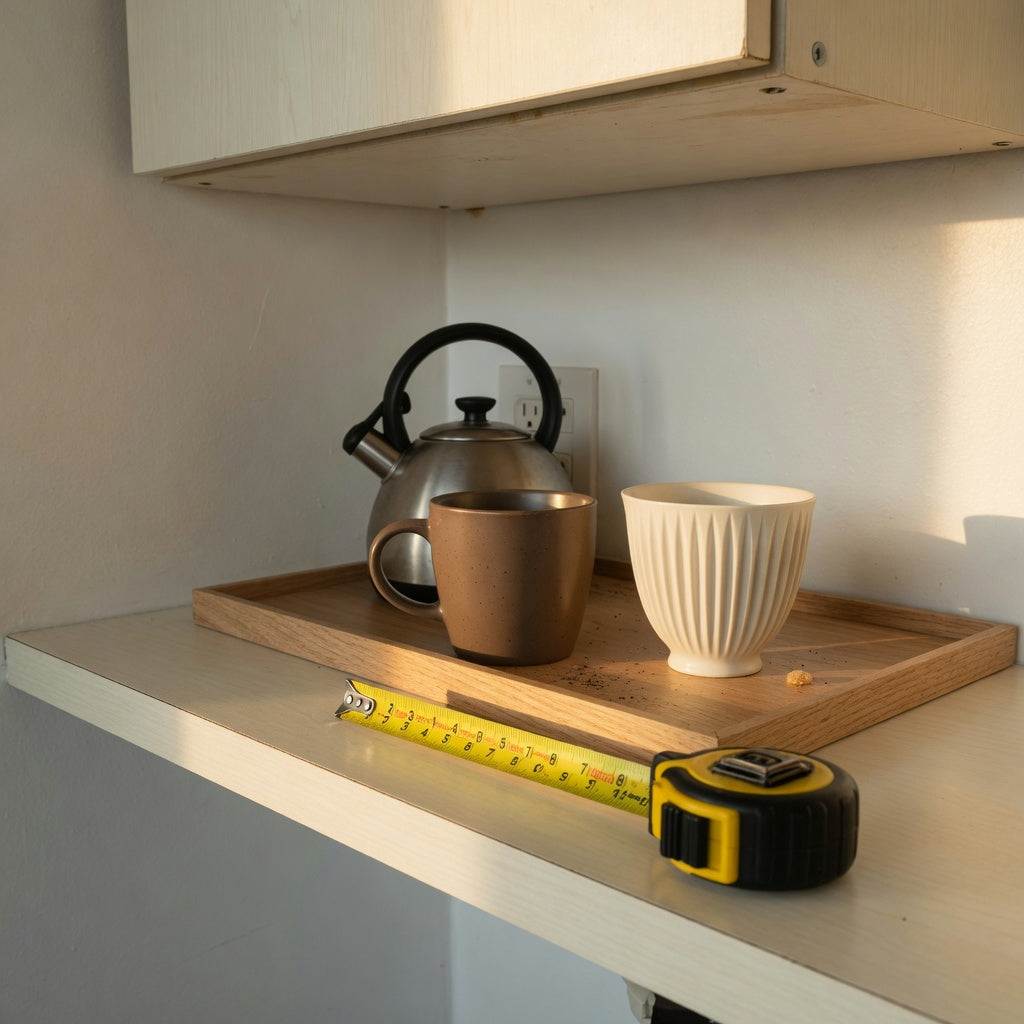
A narrow apartment counter can be full before coffee is poured: kettle, grinder, dish rack, and the edge of a cutting board. Finding the best ceramic mug for apartment counter use starts with that crowded rectangle, not with glaze color. A cup can look compact in a studio photo and still fail at home because its handle hits the kettle or its foot rocks on laminate.
At CoffeifyMug, we evaluate mugs as daily objects, not isolated décor. We picture the wet hand reaching from the sink, the short shelf above the microwave, and the tight dishwasher rack where a handle can knock a saucepan. The right answer may be one mug on a coaster, a genuinely stackable pair, or a textured cup that earns a place on an open shelf.
Is the best ceramic mug for apartment counter use slim or stackable?
Space-saving can describe several layouts, and each one moves the storage problem somewhere different.
| Layout | How it uses space | Best fit | Main trade-off |
|---|---|---|---|
| Single daily mug | Occupies one fixed counter or shelf position | One regular coffee or tea drinker | No matching spare for a guest |
| Designed-to-stack pair | Uses vertical room instead of a second side-by-side position | Two regular drinkers or one guest mug | Only works if the mugs nest securely and the handles align |
| Mug tree or rack | Moves cups upward, but its base remains on the counter | Full cabinets with an otherwise unused corner | Adds another object to clean around |
The critical word is designed. A dependable stack usually has a defined ledge, tapered wall, or other seat that keeps the upper mug from balancing loosely on the rim below. Handles also need enough separation to avoid knocking together. If a product page does not explicitly describe a mug as stackable, do not infer it from a compact-looking photo.
Dry mugs before nesting them. Moisture between ceramic surfaces can leave residue and make close-fitting cups harder to separate. Twisting two wet mugs apart is also an easy way to chip a rim.
Which dimensions decide the fit beside a kettle?
Measure the usable rectangle beside the kettle, not the full length of the countertop. That usable area ends wherever the kettle lid opens, a cabinet door swings, or your hand needs room to set down a hot cup.
- Overall width including the handle. This is often more useful than body diameter. A slim cylinder with a flared handle may occupy more room than a rounder mug with a tucked handle.
- Base diameter and flatness. A broad contact ring can resist an accidental bump, but it also claims more surface. After delivery, place the empty mug on a flat counter and press gently at four points around the rim; repeated rocking can indicate an uneven foot.
- Widest body point. Measure the rim or any outward curve, not only the base. Flared walls can interfere with neighboring canisters or prevent close cabinet rows.
- Height and hand clearance. Check the shelf above the mug and the space needed to lift it without scraping the cabinet. Also confirm that it fits your dishwasher rack if machine washing matters.
- Stated capacity. Look for whether the number describes brim capacity or a comfortable fill below the rim. Those are not always the same amount.
An 8–16 oz range is a practical comparison band for a compact coffee station, not a rule. A short coffee or tea drinker may prefer the lower end, while milk drinks and larger tea servings may justify the upper end. An oversized bowl-style cup can be heavier when full and harder to maneuver in a crowded sink.
We have not run independent heat-retention comparisons across every compact ceramic shape, so a smaller footprint should not be treated as proof that a mug keeps coffee hot longer. Wall thickness, opening diameter, starting temperature, and the presence of a lid all affect the drinking experience.
Round or pleated: which profile earns the open-shelf space?
If the counter is already visually busy and you want a straightforward silhouette, check the current Round Coffee Tea Mug details. Compare the listed capacity, total width, handle clearance, and care information with your measurements. A round name or photo does not automatically guarantee a compact footprint or stackability.
If the mug will remain visible on an open shelf and tactile detail matters, review the Pleated Coffee Tea Cup product page. Pleating can give wet fingers more surface cues than a completely smooth wall, but grooves also need more deliberate washing. This style is a weaker fit for someone who wants an exterior that can be cleaned with one quick wipe.
Do not treat either shape as a substitute for a travel mug unless its current listing explicitly provides a sealed lid and travel features. Ceramic is appropriate for the counter, table, or desk. A leakproof insulated vessel is the better tool for a backpack, train commute, or drink that must stay hot through several meetings.
Which glaze, rim, and foot details matter on laminate or stone?
Before first use, inspect ceramic under bright light. In a small kitchen, the vulnerable areas are usually the parts that contact a dish rack, faucet, countertop, or neighboring mug.
- Interior glaze: Look for an intact food-contact surface. Unexpected chips, exposed ceramic body, cracks, or deep pits inside the cup deserve a question to the seller before use.
- Rim and handle joint: A very thin rim can feel refined but may be less forgiving when it touches a dishwasher tine. Check the points where the handle joins the body for a hairline crack or rough edge.
- Foot ring: An unglazed foot may offer more friction, but trapped grit can leave a mark on pale laminate. A fully glazed foot may slide more easily. A clean coaster is a simple buffer for either style.
- Added base pads: Cork and silicone can protect a counter, yet both can hold moisture if the mug is put away wet. Dry the base and inspect any adhesive edge periodically.
Ceramic is a broad category, so read the body material and care statements instead of assuming every porcelain, stoneware, or earthenware cup behaves identically. For U.S. food-contact guidance, the FDA action level for extractable lead in ceramic cups and mugs is 0.5 micrograms per milliliter of leaching solution, assessed on any one of six units under specified methods. Ceramicware exceeding the FDA guideline may be considered adulterated.
That threshold does not verify a specific product by itself. Look for a clear statement that the mug is intended for food and beverage contact, and ask the seller if the listing is unclear. A marketplace phrase such as lead-free is useful information, but it is not the same as a test report you can inspect.
Will microwave and dishwasher habits cause chips or crazing?
Only microwave or machine-wash a mug if its current care instructions explicitly allow it. Microwave-safe ceramic can still develop a hot handle, and metallic decoration should stay out of a microwave. Dishwasher-safe also means compatible with the wash process; it does not mean chip-proof in a crowded rack.
- Give the rim and handle enough rack clearance that they cannot strike a pan, glass, or another mug during the cycle.
- Avoid abrupt temperature changes, such as moving a very cold mug directly into intense heat or placing a very hot mug on a cold, wet surface.
- Use a nonabrasive sponge for the glaze and a soft brush around a pleated exterior or the underside of the rim.
- Dry the interior, foot, and handle joint before stacking or returning the mug to a closed cabinet.
One common small-kitchen failure is mechanical rather than chemical: the rim taps the faucet, the handle catches a saucepan, or two wet mugs are twisted apart. If you notice a new interior chip, a crack at the handle, or a network of fine glaze lines known as crazing, pause use and contact the seller for product-specific guidance.
Which renter-friendly storage setup saves space without drilling?
- One mug on a defined tray: A tray does not create more counter, but it stops the mug, spoon, and coffee supplies from spreading onto the food-prep area.
- A dry, designed stack: This can reduce side-by-side cabinet use. Do not force unrelated mugs to nest simply because their openings appear similar.
- A shelf riser: A freestanding riser can use empty cabinet height without drilling. Confirm that its legs leave enough room for the handles below.
- A mug tree in a dead corner: This is useful only if the rack base fits space that the kettle and prep area cannot use. Include the hanging handles when measuring its reach.
We have not run a standardized square-inch comparison between mug trees, racks, and shelf risers. Measure each organizer's full base and the hand space needed to remove a cup. Be cautious with adhesive hooks: ceramic is heavy, and a failed hook can drop a mug onto tile or stone.
Seven counter checks to complete before checkout
- Measure the free counter rectangle beside the kettle.
- Compare that space with the mug's total width, including its handle.
- Check cabinet height, shelf depth, and dishwasher clearance.
- Choose capacity from the amount you regularly finish, not the largest available number.
- Review the rim, handle joint, foot style, and food-contact information.
- Confirm microwave and dishwasher claims instead of assuming all ceramic has the same care requirements.
- Count a mug as stackable only if the current product page says it is designed for stacking.
The best ceramic mug for apartment counter setups is the one that passes these checks with room to spare. Use the article to narrow the decision, but use the current product listing as the source of truth for dimensions, material, capacity, and care details at checkout.
Frequently asked questions
Do stackable ceramic mugs actually save space on a small apartment counter?
They can reduce side-by-side storage if they are specifically designed to nest securely. They do not eliminate handle width, and a rack or mug tree still occupies counter space at its base. For one regular drinker, a single mug on a coaster may use less daily space than a full stackable set.
Are compact ceramic mugs microwave and dishwasher safe for daily use?
Only if the product listing explicitly states those care options. Microwave-safe does not guarantee a cool handle, while dishwasher-safe does not prevent impact chips from a crowded rack. Keep metallic decoration out of the microwave and follow the current seller instructions.
What is the best ceramic mug for apartment counter use if I own only one cup?
Prioritize a stable foot, comfortable handle, and capacity that matches the amount you normally drink. Total width matters more than the word compact in a title. One well-fitting mug is often more practical than buying a set that consumes cabinet space you do not have.
Will an unglazed ceramic foot scratch a laminate counter?
It may leave a scuff if dust or grit becomes trapped underneath. Keep the foot clean, dry it after washing, and use a coaster if the counter marks easily. A glazed foot may mark less but can slide more readily on a polished surface.
What should I measure before ordering a mug for a tiny apartment kitchen?
Measure the free counter rectangle, the available cabinet height, the shelf depth, and the clearance in your dishwasher. Write down your preferred fill amount and decide whether stacking is truly necessary. With those numbers in hand, compare available shapes in our unique coffee mugs collection and keep only the options whose current pages answer your fit and care questions.
More from our blog
Read more
Home Office Coffee Station Mugs: Size, Heat and Care
A desk mug has to clear the brewer, sit securely near electronics, and match your reheating and washing habits. Compare materials, footprint, handle comfort, storage, decoration wear, and the trade...
Read more
Pleated Ceramic Tea Cup: Compare Size, Glaze, Grip and Care
A pleated cup can feel secure and look polished on a tea tray, but folds affect cleaning, stacking, and how capacity reads. Compare body type, usable volume, rim and foot finish, glaze details, car...
Read more
Leave a comment
This site is protected by hCaptcha and the hCaptcha Privacy Policy and Terms of Service apply.