
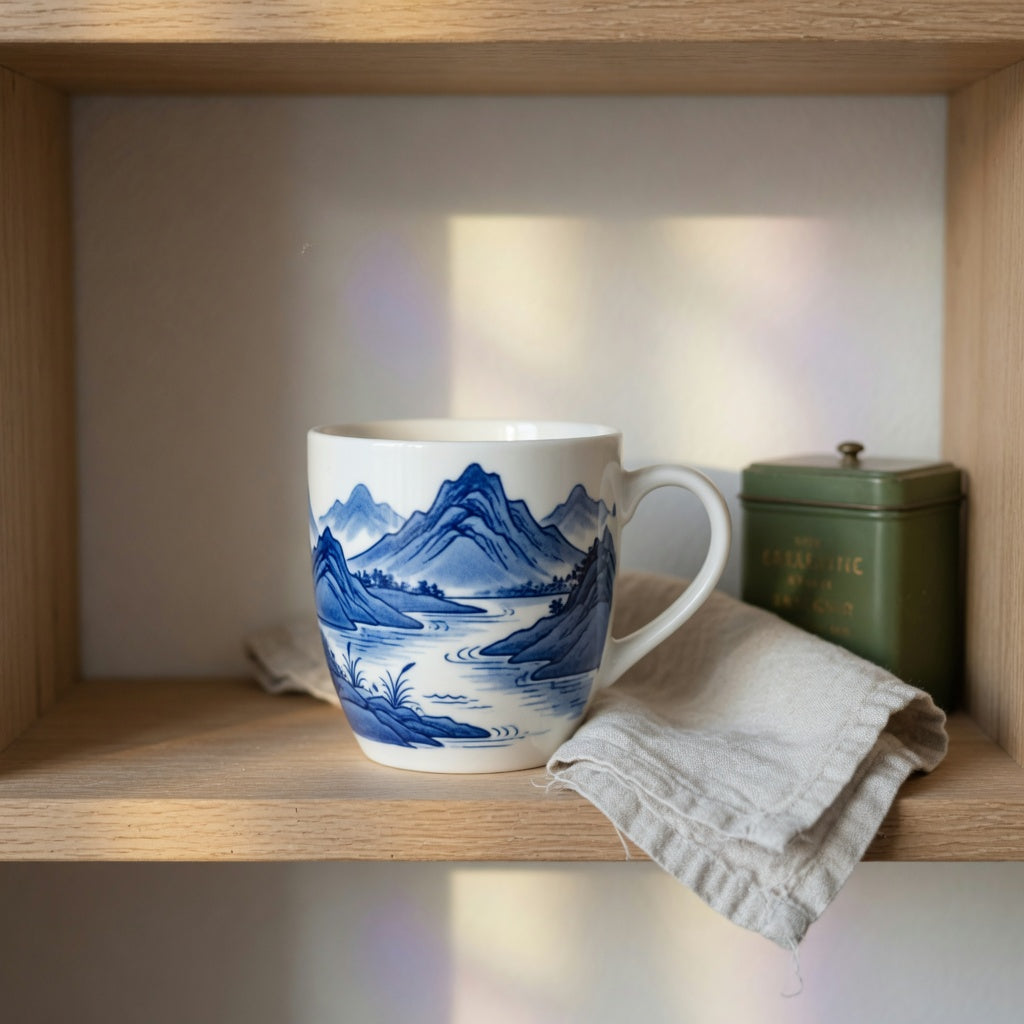
Home Decor Landscape Tea Mug: What Buyers Should Compare
Reading time: about 14 minutes
The first disappointment we hear is rarely a cracked handle. Someone unboxes a scenic mug, leaves it on an open shelf, then brews black tea the next morning and finds a brown ring already set inside. Or the mountain that looked deep in the listing photo turns out to be a small patch beside the handle. A home decor landscape tea mug has two jobs: hold a hot drink safely, and still read as a small landscape on a desk, a cabin shelf, or a gift tray. Those jobs fail in different ways. We check them separately.
In our store, a handsome glaze is not a capacity, a food-use statement, or a microwave mark. If you are leaning toward our landscape coffee tea mug, open the current listing and read the marked size, materials, and any dishwasher or microwave note. Do not borrow those details from a similar scenic cup on another site. Photos travel. Specs do not.
What should a home decor landscape tea mug survive besides the photo?
Shoppers using this phrase usually want a ceramic cup whose appeal is the scene: Chinese blue-and-white mountains and water, a pine forest wrap, a watercolor ridge, a desert horizon, or a handmade stoneware glaze that only suggests land and sky. The same search also returns joke mugs about landscaping as a job. Those are a different gift.
Compare the failure that would bother you first:
- Drink use. Daily tea or coffee, or a piece that stays empty on a shelf.
- Picture survival. Underglaze or carved slip versus a surface print that can dull, chip at the rim, or look flatter in person.
- Appliance limits. Metal infusers, metallic rims, and wood or bamboo lids do not follow the same microwave rules as plain ceramic.
- Leaf control and size. A smaller printed mug, a mid-size nature wrap, and a larger lidded steeping mug are different tools.
- Stains. Tea tannins show fast on a pale interior. A dark glaze hides them and also hides the color of the liquor.
If the scene is why you are buying, protect the scene. If the steep is why you are buying, protect the parts that touch the tea. Still sorting forests, cabins, and studio looks? Start in our unique coffee mugs and judge the room, not the prettiest thumbnail.
Blue-and-white mountains, a forest wrap, or a glaze that only hints at land?
Style is the split we walk through with customers. A careful wash cannot fix a scene that was wrong for the room.
Blue-and-white ceramics were invented in China. Cobalt is brushed onto a white body, usually under the glaze, so the mountains sit under glass rather than on top of it. Jingdezhen potters refined the body with kaolin in the Yuan dynasty. In Britain, cabinets and sideboards were built to show this ware. A lidded mountain-and-water mug can still do that on a modern sideboard, but only when the listing actually includes the lid, infuser, or saucer. We will not guess the set from a styled photo.
Printed forest, cabin, desert, and park wraps behave more like everyday coffee mugs. The scene often runs around the outside, which suits a hiker or a farmhouse open shelf. Studio lighting makes the greens and blues pop. In the hand, the print can be smaller, flatter, or a different green. If the image is a mockup, look for a straight-on photo of the wrap behind the handle before you trust the color.
Handmade stoneware may be a poured glaze, carved slip, or a one-off underglaze painting. Each cup varies. That is the appeal and the limit. A later order will not match the tree line. These pots can be excellent daily drinkers when the maker states food use and care. They are a poor choice when you need three identical gifts.
Buyers also ask us about Japanese landscape porcelain when the cup should be looked at as much as used, and about heavier cabin stoneware when it has to feel solid beside a wood counter. Naming a style does not answer dishwasher safety. Clay, glaze fit, and any added parts decide that.
| Scene type | Fits when | Skip it when |
|---|---|---|
| Blue-and-white mountain-and-water | You want a calmer sideboard piece, and the listing states food use | The page never says whether the cup is ornamental only |
| Printed forest, cabin, desert, or park wrap | You want a familiar mug for a hiker or farmhouse kitchen | The only picture is a mockup, or you will scour the outside |
| Handmade stoneware or carved scene | You want one varied gift and the maker states care | You need matching multiples, or firing details are missing |
Food-use glaze, or a landscape that should stay empty?
This is the check we refuse to skip, especially with handmade, antique-looking, or brightly painted pieces. On our packing table, the preventable misses are the ones where nobody read the base, the ounce mark, or whether a metal basket was even in the box.
U.S. FDA guidance treats cups and mugs as small hollowware for coffee or tea, often described around 240 milliliters (8 fluid ounces) and usually with a handle. That describes the regulatory category. It is not the size of any mug we sell. The lead guideline for cups and mugs is 0.5 micrograms of lead per milliliter of leaching solution, based on any one of six units, using ASTM C738 or the other methods named in the guide. A cadmium guide sets 0.5 micrograms per milliliter for small hollowware under 1.1 liters, and 0.25 micrograms per milliliter for large hollowware of 1.1 liters or more.
FDA states that lead can leach from some ceramic food surfaces and, with continued use, can cause adverse effects including chronic lead poisoning. The cadmium guide says extractable cadmium could cause chronic cadmium poisoning with continued food use. Properly fired lead glaze binds the lead so migration is insignificant. Inadequate firing can let lead move into the drink. Ware that still releases extractable lead under that test should not carry a lead-free label, and that label may be treated as false or misleading. A badge on a product photo is not a test report.
A cup that looks fit for food is treated as food ware unless it meets the ornamental rules: a consumer-visible stick-on warning and a permanent version of that message on the base. If the base says not for food use, do not steep in it once to try. Washing or boiling does not remove lead. A home swab is an option on a piece you already own. If it finds leachable lead, do not cook, serve, or store drinks in it.
Be especially careful with crude or irregular handmade ware, antiques, damaged glaze, uncertain sellers, and decoration in bright orange, red, or yellow. Ordinary commercial factory drinkware is described as much less likely to have a lead problem. That still does not make every factory landscape mug right for daily tea. A decorative-only piece stays empty. A daily mug should come from a seller who states food-contact use in plain language. We do not treat a scenic mug in our catalog as tested just because the picture is a landscape. The listing has to say so.
If the base says the piece is not for food, believe the base. A mountain scene does not change the chemistry.
Porcelain, stoneware, underglaze, and the lid that leaves the microwave
Construction decides whether the picture and the steep are still decent a year from now. In our experience, porcelain landscape cups tend to feel lighter and show cobalt cleanly, while stoneware feels heavier and suits cabin and farmhouse shelves. Neither body is automatically dishwasher-safe. We will not assign a yes or no to scenic mugs as a group, and we will not assign one to a linked product unless the current page says it.
Underglaze painting and carved slip sit under or within the glassy surface. Daily washing is less likely to abrade the picture itself, though a chipped rim still ruins the look. A surface print can be crisp, which is why forest and park wraps photograph so well, and it can scuff if you scour the outside or stack cups so one rim rides on another mug's scene. Metallic lines are a separate problem. They can spark or degrade in a microwave even when the clay body is fine.
Category listings often add a stainless infuser, a ceramic lid, a wood or bamboo lid or handle, and sometimes a saucer. Those parts are common. They are not proof that any one page includes them. Metal does not belong in the microwave. Wood and bamboo usually should not go in either, and a long dishwasher cycle is hard on them. Steep, lift the basket, rest it where it will not dump tea on the counter, and only then heat the ceramic body if that body is marked microwave-safe. If the listing is silent, leave the unit out of the microwave.
How much tea fits, and will fine leaves stay in the basket?
Capacity is where scenic mugs quietly fail daily use. Listings in this category usually cluster in three bands. Match the band to how you drink, then confirm the number on the page:
- About 11 to 12 oz. A standard printed mug. Fine for a tea bag or one coffee. Tight if you want loose leaf to open.
- Around 15 oz. A common nature-wrap size. Easier for a fuller cup. Still not a teapot.
- About 18 to 20 oz, often lidded. Built for steeping. Heavy when full. Needs a stable shelf and a hand that can manage mug, lid, and hot liquid together.
Those ranges describe how scenic listings are grouped. They are not a specification for our landscape mug unless the current product page prints an ounce or milliliter mark.
Check the basket in the same pass:
- Rolled oolong forgives a coarse basket. Broken black tea and many herbals do not. Dust in the cup means the mesh failed.
- A good lid or saucer sits flat as a drip rest. A rocking lid dumps tea onto the wood.
- A pale interior shows liquor color. It also shows tannin by the second or third cup.
- A sculpted branch handle can look rustic and still pinch when the mug is full and hot.
A lidded infuser mug is a poor commute cup. It is also a poor choice if you only use tea bags and want a wooden knob to survive every dishwasher cycle. For bagged tea or coffee, a simpler scenic mug without metal or wood is usually the better daily tool.
Brown tea film without scouring the scene
Black tea and some herbals leave a brown film. The mistake is scrubbing the artwork while you chase the stain. Work the interior glaze, not the outside print. Our gift care tips for a landscape ceramic coffee mug are the shorter companion to the rule we use at the sink: follow the maker, and do not invent a harsher method because the ring looks stubborn.
When the maker allows ordinary care on a glazed interior, this is what we suggest:
- Rinse after the last cup. Dried tannin is what people attack with a scouring pad.
- On the stained interior only, use a soft sponge and a paste of baking soda with a little water. Let it sit a few minutes, then rinse. Keep steel wool and powdered cleanser off any printed or metallic outside.
- Run a dishwasher only if that exact piece is marked for it. Remove wood, bamboo, and metal first when the listing says those parts are not dishwasher-safe.
- Do not treat ceramic as fade-proof. Overglaze enamels and some decals dull faster than cobalt under a clear glaze. If the page does not say how the image is applied, hand-wash the outside.
- Crazing, the fine crackle some glazes develop, can trap brown lines. If the food surface is chipped, crazed through, or worn dull, retire it from drink duty. Stain care will not fix a lead problem.
A nature scene on the shelf, not a landscaper joke
Search results mix two gifts. One person wants mountain-and-water, pines, or a desert horizon as home decor. Another wants a gag about lawns, mulch, and the family landscaper. Both can be right. They are not interchangeable at the table.
A scenic mug earns a place as decor when you will actually leave it out: one statement mug on a book stack, a cup and saucer on a sideboard, or a small set on an open kitchen shelf. Cobalt and white suit a calmer wall. Forest greens and cabin browns suit wood, linen, and stone. A loud park print will dominate a quiet room. The recipient should drink tea or coffee. A display-only piece can suit a ceramics collector after you confirm the not-for-food-use mark. It is a worse gift for someone who pours boiling water into whatever you wrap.
Skip it when they need a leakproof commute cup, a matched set of eight, or a mug with zero extra parts that all go in the microwave and the dishwasher. Enamel camping cups belong on a camp table, not beside underglaze meant for a sideboard. A heat-activated coating can wear, and it rarely still reads as a considered landscape once the color shift fades.
An office desk is a different test from a cabin shelf. A tall lidded mug crowds a keyboard tray, and the infuser has nowhere clean to drip. A simpler scenic cup, once the listing confirms food use and care, usually sits more quietly beside a monitor. If the person loves drinkware as decor more than any single mountain, compare a few shapes in the unique coffee mugs collection before you lock onto one scene.
Seven checks on the listing before it leaves the shelf
Run this on the page in front of you, not from memory of a similar mug:
- Food use versus display only. If a permanent base warning says not for food, do not drink from it.
- Photo match. Real product photo or mockup, and does the wrap continue behind the handle?
- Marked capacity in ounces or milliliters, not a guess from the photo scale.
- If an infuser is included, mesh or hole size, plus whether the lid or saucer works as a drip rest.
- Which parts are ceramic, metal, wood, or bamboo, and which of those the maker marks dishwasher-safe or microwave-safe.
- How the image is applied: underglaze, carve, or surface print. If that line is missing, plan to hand-wash.
- Interior color, handle clearance, and whether you need one mug or identical multiples.
When those lines fit a daily scenic cup, read the current landscape mug listing and buy only what that page states. If you are still choosing among forests, cabins, and studio looks, use the same seven checks on each collection page. The scene should still please you after the dishwasher question is answered, not before.
Frequently asked questions
Will a home decor landscape tea mug fade in the dishwasher?
Only the maker's mark for that exact piece can answer this. Cobalt under a clear glaze generally holds up better than a surface print, overglaze enamel, or metallic accent, but ceramic alone is not a dishwasher promise. If the listing is silent, hand-wash the outside and keep scouring pads off the scene. Remove wood, bamboo, or a metal infuser before a cycle even when the clay body is marked safe.
Can I microwave a landscape mug that has a stainless infuser or a wood lid?
Take the metal basket out first, and do not microwave wood or bamboo lids and handles. Heat only the ceramic body if that body is marked microwave-safe. A metallic rim or gold-looking line in the landscape can also be a problem without an infuser. If the current listing does not state microwave use, leave the mug out.
How do I know a scenic mug is safe for daily tea?
Look for a plain food-use statement and check the base for a permanent ornamental warning. You cannot see FDA lead or cadmium numbers on the shelf, so be extra cautious with antiques, damaged glaze, uncertain handmade ware, and bright orange, red, or yellow decoration. If a home swab finds leachable lead, do not drink from the piece or store drinks in it. Washing will not remove the lead.
Is a blue-and-white mountain mug a better gift than a printed forest wrap?
It is the better gift when the recipient likes display ceramics and a calmer cobalt-and-white shelf. A printed forest, cabin, or desert wrap is often better for a hiker or a casual coffee drinker who wants a familiar mug shape. Handmade stoneware fits when variation is welcome and fails when two cups must match. Confirm capacity and food-use wording on the listing you actually order.
What size landscape tea mug should I pick for loose leaf?
Match the ounce mark on the page to how you steep, not to the landscape. Shoppers often compare roughly 11 to 12 ounces for a simple cup, about 15 ounces for a fuller nature mug, or a larger lidded mug around 18 to 20 ounces when the leaf needs room. Fine mesh matters as much as volume if the tea is broken or dusty. Those bands are comparison ranges, not a spec for every scenic mug we sell.
More from our blog
Read more
Wooden Handle Tea Mug for Coffee Lovers: What to Compare
A wooden handle tea mug for coffee lovers is usually a glazed or glass cup with a wood grip, not a carved wooden cup. Compare the joint, the real fill, hand-wash limits, and glaze testing before yo...
Read more
Tall Coffee Mug vs Tea Mug Size Comparison Buyer Guide
A taller mug is not automatically a bigger drink. Convert the listing, leave headroom for milk or an infuser, and measure shelf and cup-holder gaps before you choose.
Read more
Leave a comment
This site is protected by hCaptcha and the hCaptcha Privacy Policy and Terms of Service apply.