
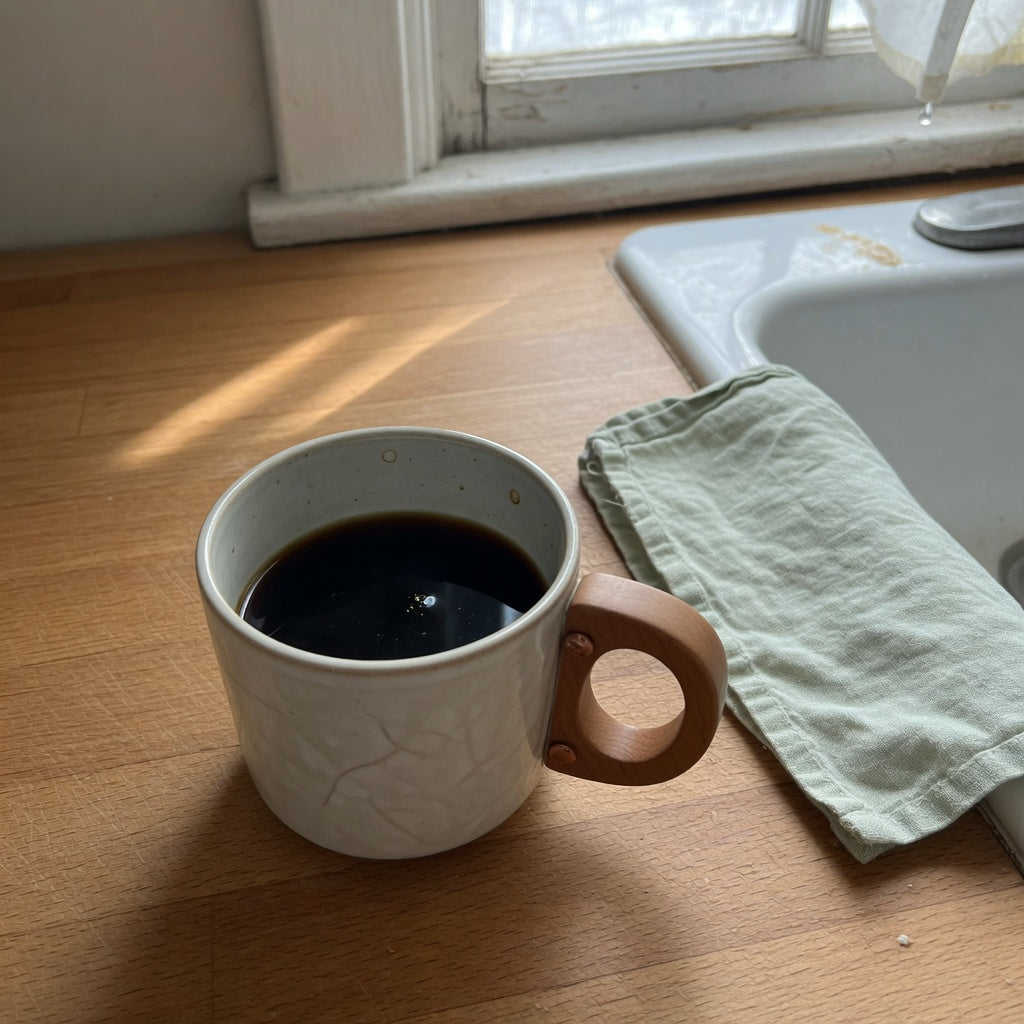
Wooden Handle Tea Mug for Coffee Lovers: What to Compare
Reading time: about 13 minutes
The mug that looks right next to the kettle can still be the wrong one for a weekday pour. We see it when a gift is unboxed on the counter, filled from a pot still close to brew heat, and only then shows a small wood grip stuck to the body. A wooden handle tea mug for coffee lovers is usually that combination: a ceramic or glass cup with an attached wood handle, sometimes offered with a lid or a loose-leaf infuser, not a vessel carved from a solid piece of wood. People buy the grip. They retire the mug because of the joint, the care rules, or a glaze line that never got past a slogan.
In our store we would rather walk through those limits before checkout than after a handle shifts over a laptop. If you are comparing this style with us, open the Mountain Sea II coffee tea mug with wooden handle and read the live listing for body material, stated size, whether any lid or infuser is included, and the care note. Those details have to come from that page. A lookalike photo elsewhere is not evidence. For other shapes, the unique coffee mugs collection shows what else we actually list.
Which of these three cups is the listing selling?
Search pages mash three different objects into one phrase. They are not interchangeable, and the surface that meets the drink changes with each one.
| What you are holding | What should touch the drink | What fails in real use | Better fit |
|---|---|---|---|
| Glazed ceramic or glass body with a separate wood handle | The glaze or glass, not the wood | A joint that loosens, wood that cracks or fades, conflicting appliance claims | Daily tea or coffee if you will hand-wash and keep it out of the microwave unless the whole mug is cleared |
| Insulated mug with a wood accent | Whatever liner the listing actually names | A decorative grip that was never the only barrier between your hand and a hot wall | Desk or commute use only after you confirm the liner and the handle's real job |
| A cup carved entirely from wood | The wood itself | Food-contact limits, plus leak and flavor pickup that a continuous glaze does not have | Display or careful occasional use, not a stand-in for a glazed mug |
The third row is the one shoppers skip. In the FDA Food Code model for retail and food service, wood and wood wicker generally may not be used as a food-contact surface. That model is written for food service, not as a ticket for a home kitchen, but it is the clearest official line on wood meeting food. The exception is narrow: hard maple, or an equivalently hard, close-grained wood, for cutting boards, cutting blocks, bakers' tables, and utensils such as rolling pins, doughnut dowels, salad bowls, and chopsticks. A carved drinking cup is not on that list. A wood handle on a glazed mug is a different object. The drink should meet glaze or glass. The wood is a grip. If a seller will not say which of the three you are buying, stop there.
Does a wooden handle tea mug for coffee lovers stay holdable after a hot pour?
Coffee drinkers care about the grip because brew temperature and drinking temperature are not the same number. A Journal of Food Science review hosted by Oregon State University separates brewing temperatures, often near 195–205°F, from a suggested service range of about 130–160°F, where preference and scald risk are balanced. The same review notes that spills near 180°F are very likely to cause serious burns, and that children and older adults are at higher risk. A handle that feels polite at the first sip can still be the only thing between that liquid and a hand, a desk, or a child walking past the counter.
We do not promise the wood never warms up. We also do not have a timed measurement for how long a typical grip stays milder than the cup wall. Published wood research is narrower than the marketing line. A USDA Forest Products Laboratory literature review reports that thermal conductivity along the grain is significantly greater than across the grain, with longitudinal-to-radial ratios around 1.75 to 2.75 depending on species, moisture content, and temperature. A short grip cut across the grain and a longer handle running with the grain are not the same heat path. The joint, where wood meets the hot body, can feel warmer than the outer curve of the handle.
Hold the mug the way you actually drink: a full hand, not a two-finger pose for a photo. This style is a poor match if you need a handle you can ignore, if the mug will sit at the edge of an office desk, or if children are nearby while the drink is still in the burn range above. A loose joint in those settings is not a cosmetic flaw. It is a spill.
Glued pad or a grip over a stub: check the joint first
Handle shape gets the product title. Attachment gets the failure. Two builds show up often enough in buyer questions that we ask about both before treating any listing as a daily driver.
- Glued pad. The wood sits on the outside of the cup and depends on adhesive. Heat, detergent, and a long soak work against that bond. If the pad lifts, a full cup can rotate in your hand.
- Wood over a ceramic or glass stub. You should be able to see or feel a rigid post or loop under the wood. The wood is a sleeve or a shaped grip, not the only structure. That is a better question to ask. It is still not permission to run a dishwasher cycle.
- Short dowel or round ball versus a thumb rest. A ball handle looks tidy and can crowd a larger hand. Three fingers and a thumb fighting for a short dowel is a different problem from heat. A thumb rest spreads the load. Neither is comfortable just because the title says ergonomic. Span, thickness, and where your thumb lands matter more than the adjective.
On arrival, check it at the sink, not over a keyboard. Look at the joint in good light. Rock the handle gently with the mug empty. Watch for a gap, a glue smear, or a wobble. Fill with warm water and hold it for a minute. If anything shifts, that mug does not go into a gift box or a Monday rotation. Ceramic also chips in transit, and a crack at the joint is not something a pretty sleeve will hide. Keep those questions next to the current Mountain Sea II page and answer them from that listing only.
Hand wash, dry the seam, and treat appliance icons as a conflict
Wood and a hot, wet, alkaline cycle do not get along, even when the ceramic would. University of Minnesota Extension notes that dishwashers clean cutting boards well, but thin plastic or wooden boards may be damaged, and wood may warp. A mug handle is a smaller piece of wood, sometimes finished, sometimes only glued. We treat that board guidance as a warning, not as a mug test. Listings disagree with each other. Some print dishwasher and microwave safe. Others say the wood handle rules both out. Believe the more restrictive note until the maker explains the joint, the adhesive, and whether any finish on the wood is rated for that heat and moisture.
Do not guess the Mountain Sea II appliance status from a similar name. The current listing has to say whether that exact assembled mug is cleared for the dishwasher or the microwave. If it does not, hand wash it. An icon on a different product is not evidence. This style is a bad fit for a kitchen that only runs the dishwasher, and a bad fit for reheating a half-cup in an office microwave.
- Wash with warm water and a mild detergent. Do not leave the handle soaking in the sink.
- Rinse the joint. Soap left where wood meets the body is how a finish goes cloudy.
- Dry the handle and the seam with a towel, then let the mug air-dry upright before it goes in a cupboard.
- Skip the microwave unless the listing clears the assembled mug, handle included. A ceramic or glass body does not clear the wood.
- Oil the grip only if the maker says to. Wipe off the excess, and keep oil off the drinking rim.
A species name is not a finish, and a finish is not the drinking surface
Walnut, beech, rosewood, and sandalwood show up as selling points. They rarely come with proof of the species or with the name of the finish. Ask for both. A finish story for the handle is not a food-contact story for the cup, because the handle should not be the drinking surface. Cooking oils are a poor stand-in if you condition the wood on your own. They can oxidize and leave a smell on a piece you touch every morning.
U.S. rules allow certain white mineral oil as a component of nonfood articles intended for contact with food, when that oil meets the specifications in 21 CFR 172.878 and the use stays inside 21 CFR 178.3620(a), including the limits across 21 CFR parts 170 through 189. That is a regulatory permission for specified uses. It is not a home recipe, and it is not a reason to oil a joint the maker never mentioned. If the listing is silent, leave the handle alone and keep it dry.
A lead-free line is not the same as a leach test
The handle gets the photos. The glaze is what the coffee sits against. FDA compliance guidance for ceramic cups and mugs sets an extractable-lead action level of 0.5 micrograms per milliliter of leaching solution in any one of six units. The methods cited are ASTM C738, specified AOAC methods, or FDA laboratory methods. In that guidance, cups and mugs are small ceramic hollowware commonly used for coffee or tea above room temperature, normally about 240 mL (8 fl oz), and normally made with a handle. That normally-about-8-fl-oz line describes the regulatory category. It is not the capacity of any mug in our shop, and it is not your comfortable fill.
FDA states that some ceramic foodware leaches significant quantities of lead from the food-contact surface, that foods can extract the metal, and that continued food use can cause adverse effects including chronic lead poisoning. Separately, FDA states there is no known safe level of exposure to lead. Cadmium is the paired issue. FDA has reported significant extractable cadmium in imported and domestic ceramic ware, notes that acid foods can extract it, and warns that continued use could cause chronic cadmium poisoning. FDA's contaminant transparency tool lists a cadmium action level of 0.5 micrograms per milliliter of leaching solution for ceramic small hollowware under CPG 545.400.
A title that says lead-free does not show you those results. Ask whether this glaze was leach-tested, which method was used, and what the numbers were. If there is no report, treat the phrase as marketing. We will not invent a certificate the listing does not publish. Only a result tied to the exact product counts. If you cannot find one, that is a reason to keep looking, not a reason to assume the glaze is fine.
Loose-leaf tea, latte foam, and the fill you can actually drink
The number on the page is often a fill to the rim, sometimes before an infuser, a lid, or a collar of foam takes space. Loose-leaf tea and a milky latte do not want the same headroom. An espresso-size pour rattles in a tall cup. A full mug of black coffee wants the opposite. Shoppers ask us whether one wood-grip piece can cover morning coffee, a latte, and hot chocolate. Often the body can, when it is a glazed or glass cup meant for hot drinks and you leave room under the rim. Confirm that on the listing in front of you. Do not borrow the answer from a review of a different brand.
Before you treat a wood-grip piece as an all-day coffee mug, check three things on the live page:
- Ounces or milliliters, and whether that figure is to the rim.
- Whether a lid or infuser is included, and whether you still have a drinkable fill once it is seated.
- Whether the maker says the body is for hot coffee, tea, and cocoa, or only for one of those.
It is not a travel tumbler. It is not a microwave reheating dish. It is also the wrong gift for someone who will never hand-wash a mug, no matter how good the grip looks in the box.
Frequently asked questions
Is a wooden handle tea mug for coffee lovers dishwasher safe?
Do not assume it is. Heat, detergent, and soaking are a rough combination for wood and for glued joints. Extension guidance on wooden boards already warns that dishwashers can damage thin wood and that wood may warp. If the current listing for the exact mug does not clearly clear the handle and the joint, hand-wash it, skip the soak, and dry the seam.
Can I microwave the mug because the ceramic or glass body is microwave safe?
No. The handle and any adhesive go into the oven with the cup. Listings conflict, and a body-only claim does not cover the wood. Unless the page for the mug you are holding clears the assembled piece, keep it out of the microwave.
How can I tell whether a wood handle will let go of a hot drink?
Look at the attachment, not just the shape. A glued pad with a gap is a weaker story than a grip that clearly sleeves a rigid stub, and even a stub is not proof of quality. Rock the empty handle, then test with warm water over the sink. If it moves, do not use it for hot coffee.
Can the same cup do loose-leaf tea and a morning latte?
Often yes, if the drinking surface is glazed ceramic or glass meant for hot drinks and you leave room for an infuser or foam. Confirm on the listing that any infuser or lid is actually included, and that the stated size is more than a rim-full marketing number. A short espresso pour and a full mug of coffee are different jobs.
Does a lead-free label mean the glaze passed a leach test?
Not by itself. FDA guidance for ceramic cups and mugs uses an extractable-lead action level of 0.5 micrograms per milliliter in any one of six units, with ASTM C738 or equivalent methods, and a separate cadmium action level of 0.5 micrograms per milliliter for small hollowware. Ask for the report on that glaze. FDA also states there is no known safe level of exposure to lead.
Six checks before the mug goes in the cart
This style is not for a microwave-every-refill routine, not for a dishwasher-only kitchen, and not for someone who wanted a solid wood cup to drink from. It earns a spot when the grip fits the hand, the joint looks solid, the care rules are acceptable, and the glaze story is more than a slogan.
- Body: glazed ceramic, glass, a named liner, or wood itself. If the page will not say, do not guess.
- Handle: species if stated, attachment you can see, and room for your hand and thumb.
- Capacity: the stated size, then a realistic fill once any infuser, foam, or lid is in play.
- Appliances: an explicit yes or no for dishwasher and microwave on the assembled mug.
- Glaze: any leach-test mention for lead and cadmium, not just a lead-free line.
- Care and packing: hand wash, dry the joint, oil only if the maker names a suitable product, and enough protection that ceramic survives the trip.
Start with the Mountain Sea II coffee tea mug with wooden handle if that is the shape you came to compare, and answer those six points from the live listing. If the grip, the hand-wash rule, or a missing test note is a mismatch, cross-check other shapes in the unique coffee mugs collection. The useful next step is a page that answers the joint, the fill, and the glaze, not a prettier photo of a handle.
More from our blog
Read more

Unique Coffee Mug for Home Office: What Buyers Compare
Shoppers comparing a unique coffee mug for a home office need capacity, heat behavior, wooden-handle care, and food-contact checks, not just a standout look. We cover spills, dishwasher limits, cam...
Read more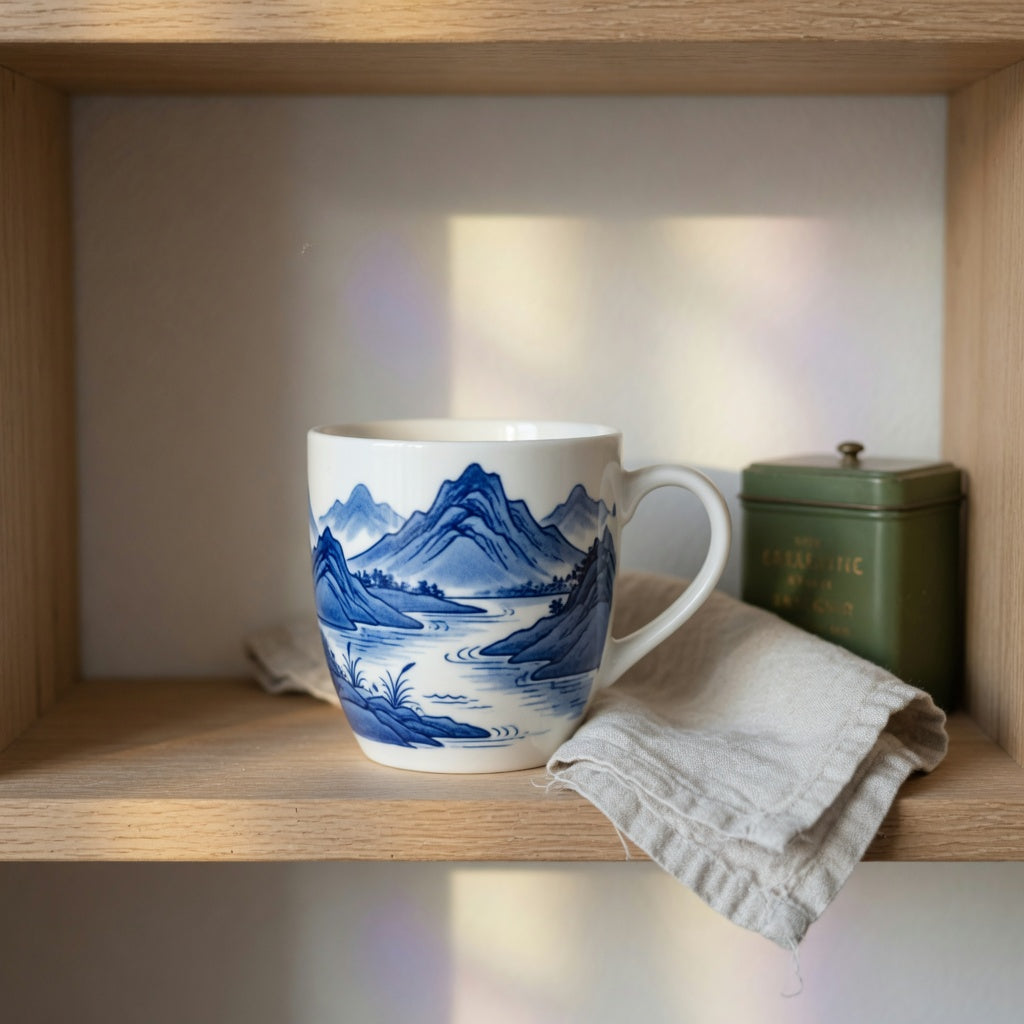
Home Decor Landscape Tea Mug: What Buyers Should Compare
A home decor landscape tea mug has to hold tea safely and still look right on a shelf. Compare food-use marks, scene type, capacity, infuser limits, and stain care before you trust the listing photo.
Read more
Leave a comment
This site is protected by hCaptcha and the hCaptcha Privacy Policy and Terms of Service apply.