
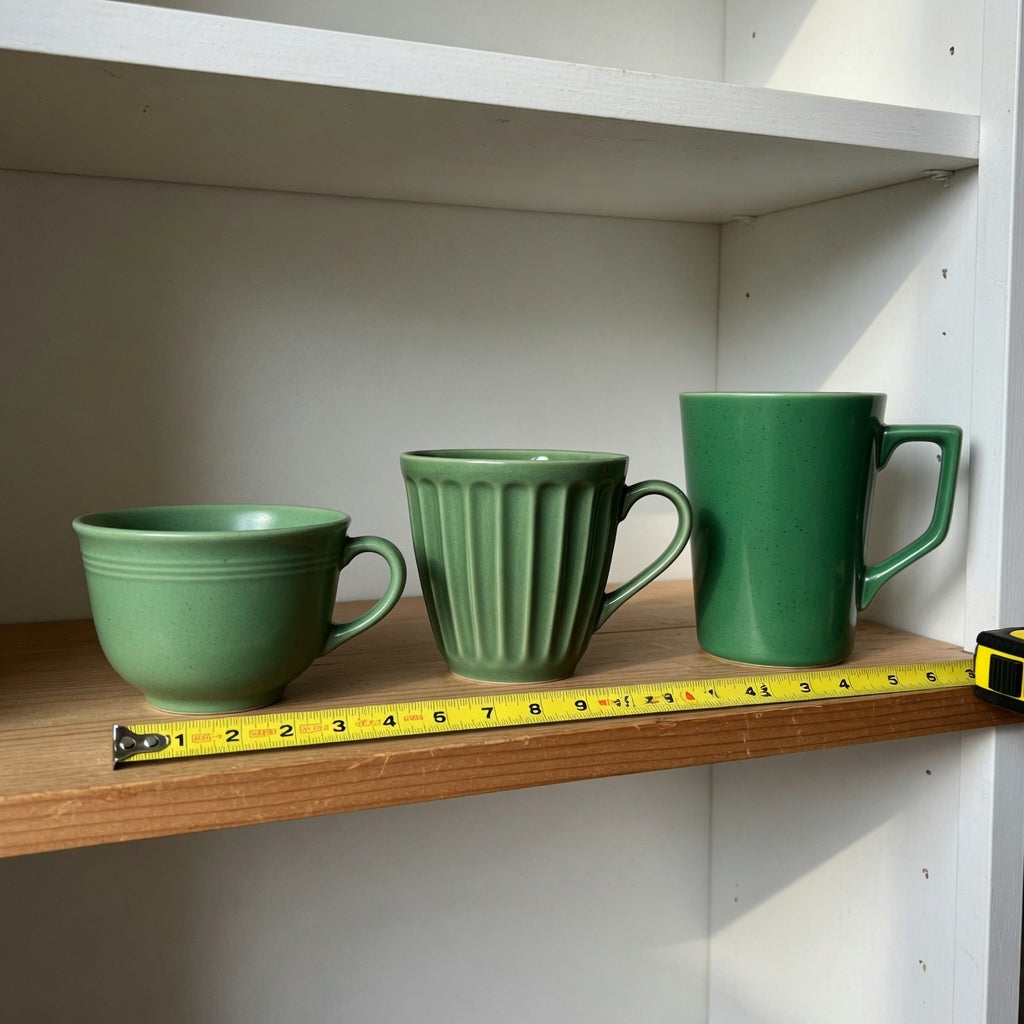
Green Tea Mug Storage Fit Guide: Compare 3 Current Shapes
Reading time: about 9 minutes
A mug can sit fully on a shelf and still block the cabinet door once its handle is turned outward. It can also clear the shelf above but require awkward tilting to get past an organizer rail. This green tea mug storage fit guide addresses those practical problems by comparing the current Retro, Pleated, and Emerald options by verified capacity, visible form, and refill preference.
In our store, we separate what we can verify from what product photography only suggests. The confirmed capacities are Retro at 170 ml, Pleated at 200 ml, and Emerald at 270 ml. The catalog facts supplied for this comparison do not include exterior height, width, depth, or handle-projection measurements, so we will not turn photos into unofficial dimensions or promise a cabinet fit that has not been measured.
Green tea mug storage fit guide: which shelf measurements matter?
Capacity measures how much the vessel holds. It does not tell you its outside height, the width of its body, or how far its handle extends. Before comparing mugs, measure the usable space rather than the cabinet's overall dimensions.
- Usable height: Measure from the shelf surface to the lowest obstruction above it. Include under-shelf baskets, rails, and the underside of adjustable shelf supports.
- Usable depth: Measure from the back panel to the inside face of the closed door. Cabinet hinges and door hardware can reduce the usable depth near the sides.
- Side clearance: Record the open width available for the mug body and its handle. If several mugs will share a row, account for the handles in their normal storage orientation.
- Access clearance: Check whether the mug must be lifted over a shelf lip or tilted beneath a rail. A mug that fits only after careful angling may become frustrating in daily use.
Handle projection is the distance from the side of the mug body to the handle's outermost point. Because no verified handle-projection figures are available here, treat the handle as a separate fit variable. If your shelf has very little spare room, confirm current exterior measurements before ordering.
How do the Retro, Pleated, and Emerald shapes compare?
The three options cover different serving volumes and present noticeably different silhouettes. This table uses only their listed capacities and visible forms; the storage notes are practical screening questions, not dimensional guarantees.
| Current option | Listed capacity | Visible form | Reader situation and fit logic | Refill preference |
|---|---|---|---|---|
| Retro coffee tea cup | 170 ml | Rounded, visually compact retro cup profile | A sensible first option for a shopper with a crowded shelf who prefers a lower-looking form, provided the actual outer measurements clear the space | Smaller pours with more frequent refills |
| Pleated coffee tea cup | 200 ml | Pleated exterior with a middle-capacity profile | Suited to an open shelf or cabinet where the textured body can be given enough side clearance | A middle ground between serving volume and refill frequency |
| Emerald coffee tea mug | 270 ml | More upright, elongated mug profile | Best considered by shoppers with confirmed shelf room who prioritize a larger pour over the smallest-looking silhouette | The fewest refills of these three capacities |
The Retro has the smallest listed capacity, but that does not automatically prove it has the smallest exterior dimensions. The Emerald has the largest listed capacity, yet capacity alone cannot establish its exact shelf footprint. Product photos can help you shortlist a form; measurements decide the final fit.
Which option deserves the first look in a low or crowded cabinet?
For a low fixed shelf, the Retro 170 ml is the first shape we would compare because its visible profile appears more compact than the upright Emerald. That is a shortlist recommendation, not a fit guarantee. A shopper who accepts smaller pours and more kettle trips has a clearer reason to choose it than someone who wants one larger drink at a desk.
The Pleated 200 ml sits between the other two in listed capacity. Its defining exterior texture gives it visual interest, but it also creates another point to check when mugs are packed side by side or placed beside a wire organizer. It is not the strongest candidate for a shelf where every bit of lateral clearance matters and no product measurements are available.
The Emerald 270 ml suits a different situation: the shelf or counter has already been checked, and reducing refill frequency matters more than choosing the smallest-looking option. Its more upright visible form makes vertical clearance a priority. It is not a practical blind purchase for a low cabinet with almost no margin above the current mugs.
Which shapes make sense on open shelves or as gifts?
Open shelves remove the cabinet-door problem, but they do not remove depth and access concerns. The mug body should remain securely supported, and the handle should not extend so far into a walkway that it is easily knocked. A shelf lip may also require extra lift clearance even when there is no shelf directly above.
The Pleated cup is the most texture-forward option in this group, making it a logical choice when the recipient displays mugs rather than packing them tightly in a closed cabinet. The Retro offers a quieter, compact-looking profile for a smaller shelf. The Emerald has a stronger upright presence and the largest listed capacity, but the gift recipient needs room for that form and a preference for larger servings.
For gift buying, storage is easy to overlook during unboxing. Ask whether the recipient uses a mug tree, an open shelf, a fixed-height cabinet, or an office cubby. If that information is unavailable, avoid treating capacity as proof of fit and favor a shape that matches mugs they already store comfortably.
How should refill preference affect the storage decision?
The capacity differences are concrete, and they create clear trade-offs. They do not establish brewing quality, temperature retention, or how a particular green tea will taste.
- Retro, 170 ml: Fits a short-pour routine. It makes sense for someone who enjoys refilling but is not a good match for a long work session where repeated trips to the kettle are inconvenient.
- Pleated, 200 ml: Provides the middle capacity of the three. It suits a shopper who wants more than the Retro without moving directly to the largest current option.
- Emerald, 270 ml: Holds the most of these three and therefore supports fewer refills for the same total amount consumed. It is the practical office candidate only after the desk, cubby, or cabinet space has been checked.
On a compact desk, a larger serving can reduce refill trips but still be the wrong trade if the mug interferes with a monitor stand, keyboard area, or fixed cubby shelf. On a kitchen counter with open space, the same storage concern may disappear. Use this green tea mug storage fit guide to establish a shortlist, then let the actual storage location break the tie.
What can product photos reveal about handles and shelf fit?
Photos reveal the visible silhouette, the location of the handle, and distinguishing details such as the Pleated cup's textured exterior. They can also show whether a form looks rounded or upright. Photos from separate product pages may use different camera distances or cropping, however, so apparent size should not be treated as a shared scale.
Handle orientation can change how many mugs fit in one row. Turning alternating handles in different directions may improve side-to-side use of space, but it can also make the rear mugs harder to remove. In a cabinet with doors, check the outer handle edge against the closed-door line. In an under-shelf rack, include the room needed to lift the handle past the rack opening.
We also do not infer stackability, material, dishwasher suitability, microwave suitability, origin, or brewing performance from the images. Those details require explicit current product information. If any of them is essential to your purchase, verify the relevant listing rather than assuming that mugs with similar silhouettes share the same specifications.
What should you check during the final minute before ordering?
Use this quick process with the exact shelf, cabinet, counter, or office cubby where the mug will live:
- Measure usable height to the lowest rail, shelf, or organizer above.
- Measure usable depth to the inside of a closed cabinet door, including hinge intrusions.
- Decide which direction the handle will face and how much neighboring space it can occupy.
- Choose your refill pattern: frequent 170 ml pours, middle-ground 200 ml pours, or fewer 270 ml pours.
- Compare the Retro first for a compact-looking form, the Pleated for visible texture and middle capacity, or the Emerald for the largest serving of these three.
- Open the relevant product page and confirm any current outer dimensions or other specifications required for your space.
- If clearance remains uncertain, do not rely on capacity or photography alone. Ask for the missing measurement or compare a different silhouette.
A storage setup that requires tilting the mug around a rail every morning is not a comfortable fit. Leave enough room to lift the mug naturally, turn its handle, and close the door without contact.
Frequently asked questions
Which option in this green tea mug storage fit guide has the smallest listed capacity?
The Retro coffee tea cup has the smallest verified capacity at 170 ml. That makes it the short-pour option, but it does not prove that every exterior measurement is smaller than those of the Pleated or Emerald mugs.
Will the Retro 170 ml fit in a shallow wall cabinet?
Capacity alone cannot confirm that. Measure the cabinet from the back panel to the inside of the closed door, then account for the mug's outer body and handle. The Retro is the compact-looking candidate in this comparison, but close-clearance storage still requires exterior measurements.
Does the Pleated 200 ml need extra room between neighboring mugs?
Its visible pleated exterior makes side clearance worth checking carefully, especially beside wire organizers or other textured pieces. No verified outer-width measurement is supplied here, so we cannot state how much space it needs. For tightly packed storage, confirm the widest point before purchasing.
Are the Retro, Pleated, and Emerald mugs stackable?
Stackability is not included in the verified catalog facts used for this guide. Do not assume that handled mugs will nest securely based on photos alone. If stacked storage is essential, ask for confirmation and the relevant rim, base, and handle measurements.
Which green tea mug is the best option for fewer office refills?
The Emerald has the largest listed capacity at 270 ml, so it is the clearest match among these three for fewer refills. Choose it only if its upright visible form suits your desk and storage space; otherwise, the 200 ml Pleated offers a middle option. Measure your space, write down your preferred capacity, and compare those notes against the current unique coffee mug collection before checking out.
More from our blog
Read more
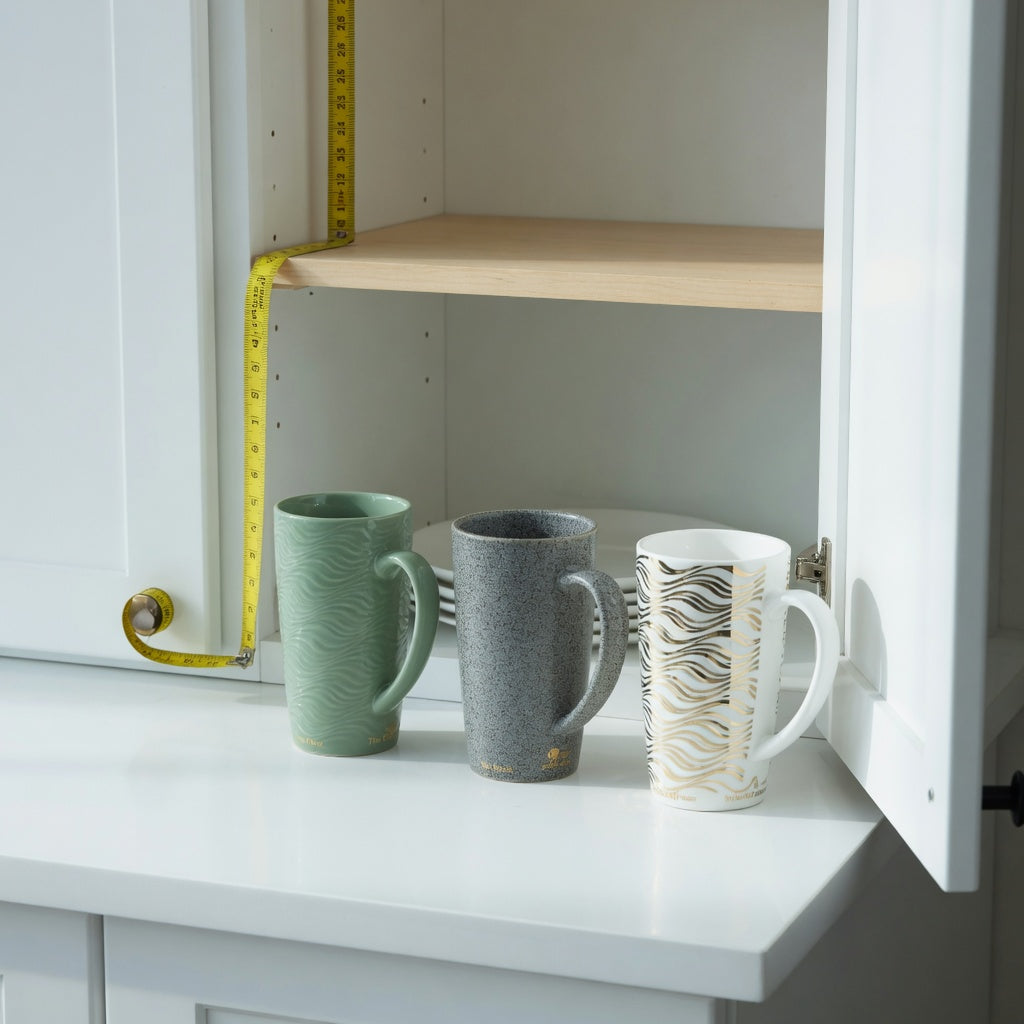
Large Unique Coffee Mugs Storage Fit Guide: Shelf Checks
Compare The Flow, The Rock, and White Golden Waves Tall by visible silhouette, handle envelope, shelf height, and cabinet depth. This guide separates product-page facts from practical measuring ste...
Read more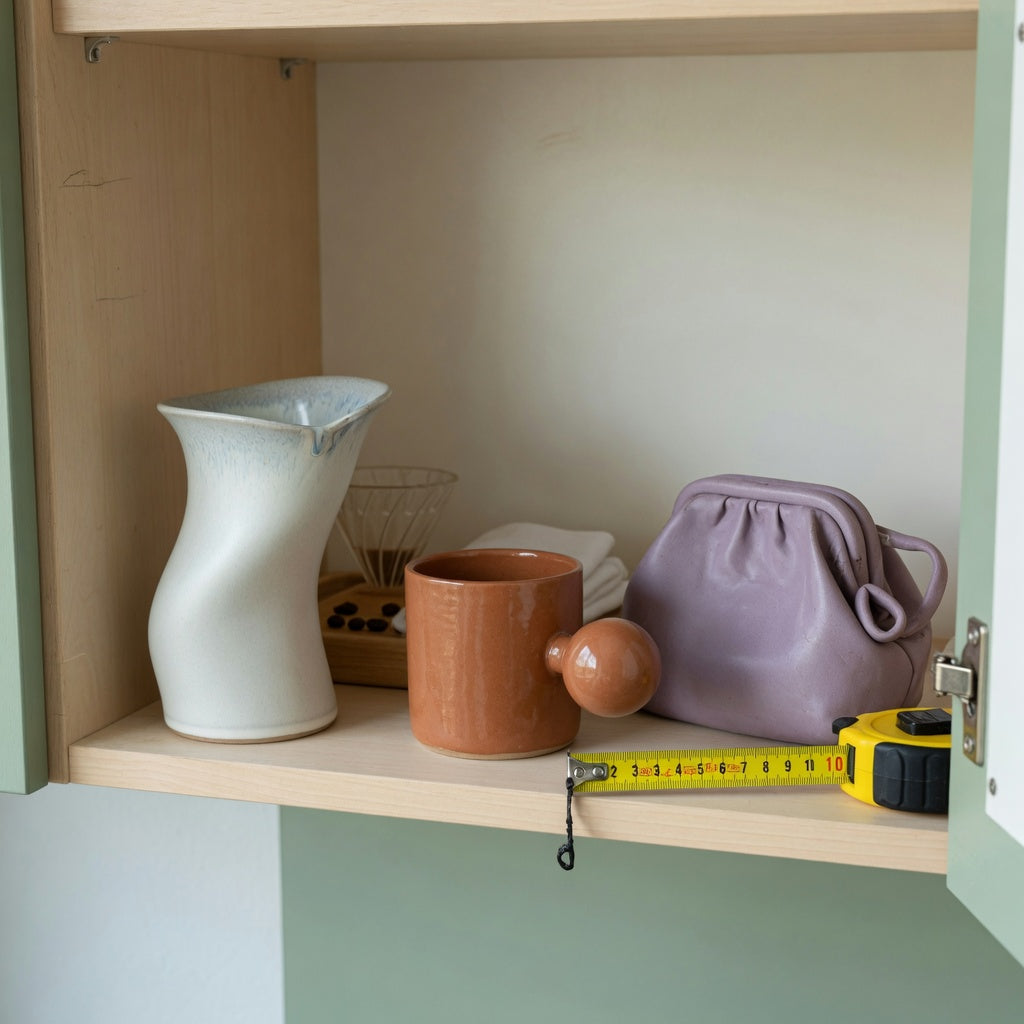
Ceramic Sculptural Mug Storage Fit Guide: 3 Shapes Compared
Compare The Flow 400 ml, Ball Handle 250 ml, and Handbag 310 ml by visible form, handle projection, and realistic cabinet or shelf needs. The measuring checklist avoids guessing from capacity alone.
Read more
Leave a comment
This site is protected by hCaptcha and the hCaptcha Privacy Policy and Terms of Service apply.