
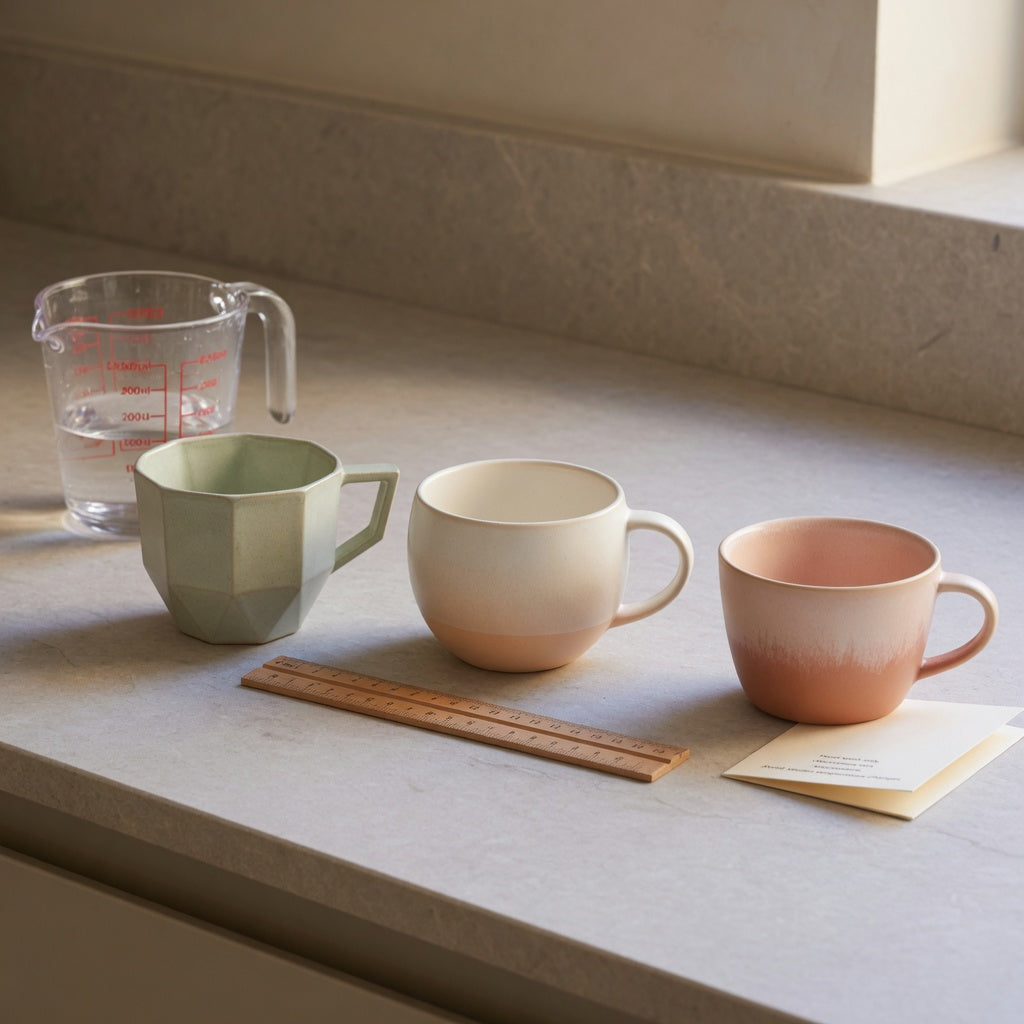
Geometric Tea Cup: Compare Shape, Material, Capacity, and Handle
Reading time: about 9 minutes
A cup can look right in a front-facing product photo and still be wrong for the office desk where it will live. The listed capacity may not match your usual pour, the handle opening may differ from what you expect, or the base may occupy more counter space than the photo suggests. In our store, we slow this decision down: a geometric tea cup should be compared through the current product page, not guessed from its name.
We use geometric only as a visible-form lens. It does not establish a design movement, creator, provenance, comfort advantage, or manufacturing method. For each option below, the current listing needs to confirm four central details: visible shape, exact material wording, numeric capacity, and handle design.
Names such as Rhombus, Planet, and Gradient provide useful starting points, but they are not specifications. Our comparison therefore maps each shopper situation to the most relevant page while keeping every unconfirmed product detail as a question to check before checkout.
What does geometric form reveal—and what remains unconfirmed?
When our team inspects drinkware for daily-use fit, we separate the cup into five visible zones. This prevents an unusual exterior from distracting us from the parts that affect storage, pouring, cleaning, and placement.
- External profile: Use side and three-quarter views to check for facets, curves, taper, or changes in width. A front view alone can hide depth.
- Interior well: A geometric exterior does not prove that the inside follows the same form. A top-down image is useful for checking the interior shape and available opening.
- Rim: Look for a clear close-up of the drinking edge. Thickness and finish are personal preferences, so they should not be inferred from the overall silhouette.
- Base or foot: A bottom or low-angle image can show the area that contacts a desk or kitchen counter. Exact base dimensions still need to come from the listing.
- Handle: Confirm whether one is present, how it is positioned, and whether dimensions or a scale reference show the internal opening.
Photos can support a form comparison, but they do not establish scale unless measurements are supplied. If height, widest body measurement, total width including the handle, or base size is missing, treat that detail as unresolved rather than estimating it from props.
Geometric tea cup materials: what should the product page state?
Shoppers comparing ceramic shapes should separate material from silhouette. Ceramic may be used as a broad retail material label, while porcelain and stoneware are more specific terms. Record the exact wording on each current page; do not silently change a listing that says ceramic into porcelain or stoneware.
Color and finish need the same discipline. A glossy, matte, or gradient appearance does not identify the body material on its own. It also does not confirm dishwasher, microwave, freezer, or other appliance compatibility.
- Does the listing name the body material directly?
- Does it separately describe the glaze or surface finish?
- Are a lid, spoon, saucer, filter, or infuser explicitly listed as included?
- Are care instructions and appliance compatibility stated for this exact item?
- Is any food-contact or certification information actually provided, rather than assumed from a similar mug?
An omitted specification is not automatically a negative answer. It is simply a question to resolve on the current page or with our store before ordering.
Rhombus, Planet, or Gradient: which listing should you inspect first?
The three product names point shoppers toward different visual ideas, but the current galleries and specification fields must confirm the actual form. Use this table as a routing tool, not as a substitute for the listings.
| Reader situation | Page to inspect | Conditional fit and checks |
|---|---|---|
| You want an angular or faceted-looking cup. | Rhombus Coffee Tea Mug | The name makes this the logical first page to inspect. Treat it as a fit only if the current gallery confirms the profile and the page states a suitable material, capacity, handle, and size. |
| You prefer a rounded or planet-like outline. | Planet Coffee Tea Mug | Start here if a rounded form is your priority, then verify what the current photos actually show. Check the base view, numeric capacity, material field, handle details, and care note. |
| You care about a color transition as much as body shape. | The Gradient Coffee Tea Mug | Inspect this page if a gradient appearance suits the recipient or room. Confirm whether the current visual effect comes from the finish, the silhouette, or both, and verify every practical specification separately. |
If the names are not enough to narrow the choice, open our unique coffee mugs collection to shortlist visible forms. Collection cards are useful for comparison, but each product page remains the deciding reference for material, listed capacity, handle, dimensions, included items, and care.
Capacity and handle: will the cup fit your normal pour?
Capacity is easier to compare after measuring the drink you already make. Use room-temperature water to fill your current favorite cup to its normal level, transfer that water to a measuring jug, and record the amount in milliliters or fluid ounces. If you add milk or ice, leave the same headspace you use in real life.
- Record your normal serving. If you usually drink about 250 ml, a listing that only says large does not provide enough information.
- Find the numeric listed capacity. If the page does not explain whether that figure is measured to the rim or represents a practical serving, ask before comparing it with your usual pour.
- Check the dimensions. Height affects cupboard and coffee-machine clearance. Widest body measurement and total width including the handle affect desk and shelf space.
- Compare the handle with your present cup. Note whether you normally use one finger, several fingers, or cradle the body. Do not infer comfort from the product name or shape.
- Account for the route from kettle to seat. A cup filled close to the rim may be less convenient to carry, even if the stated capacity looks ideal on paper.
For iced tea, ice takes up vessel space, so the drink volume alone does not tell you the capacity you need. For an office setup, total width may matter more than body diameter because the handle has to clear a keyboard, notebook, or neighboring mug.
Kitchen counter, office desk, or gift box: which details matter?
- For a daily kitchen cup: Prioritize numeric capacity, cupboard clearance, base dimensions, and explicit care instructions. A simpler cylindrical mug may be a better option if compact storage or stacking is more important than visible geometry.
- For an office desk: Check the total footprint and inspect the foot after arrival. A coaster is sensible until you know whether the contact surface is smooth enough for the desk.
- For a gift: Match the visual direction to the recipient, then verify material, capacity, handle, variant, and included contents. Do not assume that a presentation box, spoon, lid, or infuser is supplied unless the listing says so.
- For tea with loose leaves: Look closely at the interior rather than the exterior name. If the inside has visible corners or recesses, decide whether that suits your preferred strainer and rinsing routine.
A geometric cup is not the best choice for every job. Someone who needs a sealed travel lid, guaranteed cup-holder compatibility, easy stacking, or a specific appliance rating may be better served by a dedicated travel mug or a conventional straight-sided cup. If one of those features is non-negotiable and the listing does not confirm it, do not fill the gap with an assumption.
Ceramic care and arrival checks: what should you inspect?
Use ceramic-specific care only after the current listing confirms that material. During a personal delivery or gift unboxing, inspect the cup before discarding its packaging and before exposing it to a dishwasher cycle.
- Confirm the order: Compare the received variant and included pieces with the product page and order record.
- Inspect the rim and interior: Under angled light, look for chips, hairline cracks, sharp glaze bumps, unexpected bare patches, or pinholes. A fine network of glaze lines can be an intentional finish or unexpected crazing; if the listing does not clarify it, contact the store before use.
- Check the handle and foot: Examine the handle-to-body area without pulling or twisting it. Set the empty cup on a protected, level counter to check for obvious rocking, and feel the foot for rough points that could mark a desk.
- Follow the exact care note: If hand washing is directed, use mild dish soap and a soft, non-abrasive sponge. If dishwasher use is explicitly allowed, leave enough space that the rim and handle cannot knock against neighboring pieces.
- Avoid unsupported appliance use: A ceramic material label alone does not confirm microwave or other appliance compatibility. Avoid sudden temperature changes unless the product instructions expressly permit them.
Keep the shipping materials until the condition, variant, and included contents are confirmed. If a crack or chip affects the rim, body, or handle, pause use and contact our store for the appropriate next step.
A five-minute checkout comparison
| Comparison point | What you need to confirm | If it is missing |
|---|---|---|
| Visible form | Side, top, and base views of the current item | Do not infer the full shape from its name |
| Material | Exact wording such as ceramic, porcelain, or stoneware | Ask which material applies to the selected variant |
| Capacity | A number with ml or fl oz | Do not rely on small, medium, or large labels |
| Handle and dimensions | Handle presence, opening, height, widest point, and total width where listed | Compare only after the missing measurement is resolved |
| Care | Explicit washing and appliance instructions | Use the most cautious method and ask before appliance use |
| Included contents | Every accessory named in the listing | Assume nothing beyond the cup itself |
Open the candidate pages in separate tabs and mark each field as confirmed or unresolved. That makes the trade-offs visible without inventing a score or giving extra weight to the most dramatic product photo.
Frequently asked questions
How do I compare a geometric tea cup when dimensions are missing?
Do not estimate its scale from a hand, spoon, or styled background in the photos. Ask for the height, widest body measurement, total width including the handle, and base measurement that matters to your shelf or desk.
Are the Rhombus, Planet, and Gradient mugs all ceramic?
The product names and URLs do not establish their exact materials. Check the current material field on each page and record the wording exactly; do not transfer a ceramic, porcelain, or stoneware description from another mug or variant.
What capacity should I choose for tea with milk or ice?
Measure your usual serving in your current cup, then include the headspace you need for milk, ice, stirring, and carrying. Compare that routine with the numeric listed capacity, and ask whether the figure is brimful or practical if the page does not explain it.
Can I put a geometric cup in the dishwasher or microwave?
Only follow compatibility stated on that exact product listing. Shape, appearance, and a general ceramic label do not confirm dishwasher or microwave use, and one mug's care instructions should not be applied to another.
Which product page should I start with for a gift?
Inspect the Rhombus page first for a recipient who prefers angular forms, the Planet page for someone drawn to rounded forms, or the Gradient page for someone who favors color transitions—but only if the current gallery confirms that direction. Then verify capacity, material, handle, care, variant, and included contents before ordering.
Next step: Open the current unique mug selection and the three product pages in separate tabs. Eliminate any option that leaves one of your non-negotiables unresolved, then make the final choice by visible form.
More from our blog
Read more

Unique Ceramic Tea Cups: Compare Shapes, Sizes, and Handles
Compare three product-page directions—handbag, ball-handled, and pleated—without guessing at unverified specs. Check material, capacity, dimensions, grip, and care before buying.
Read more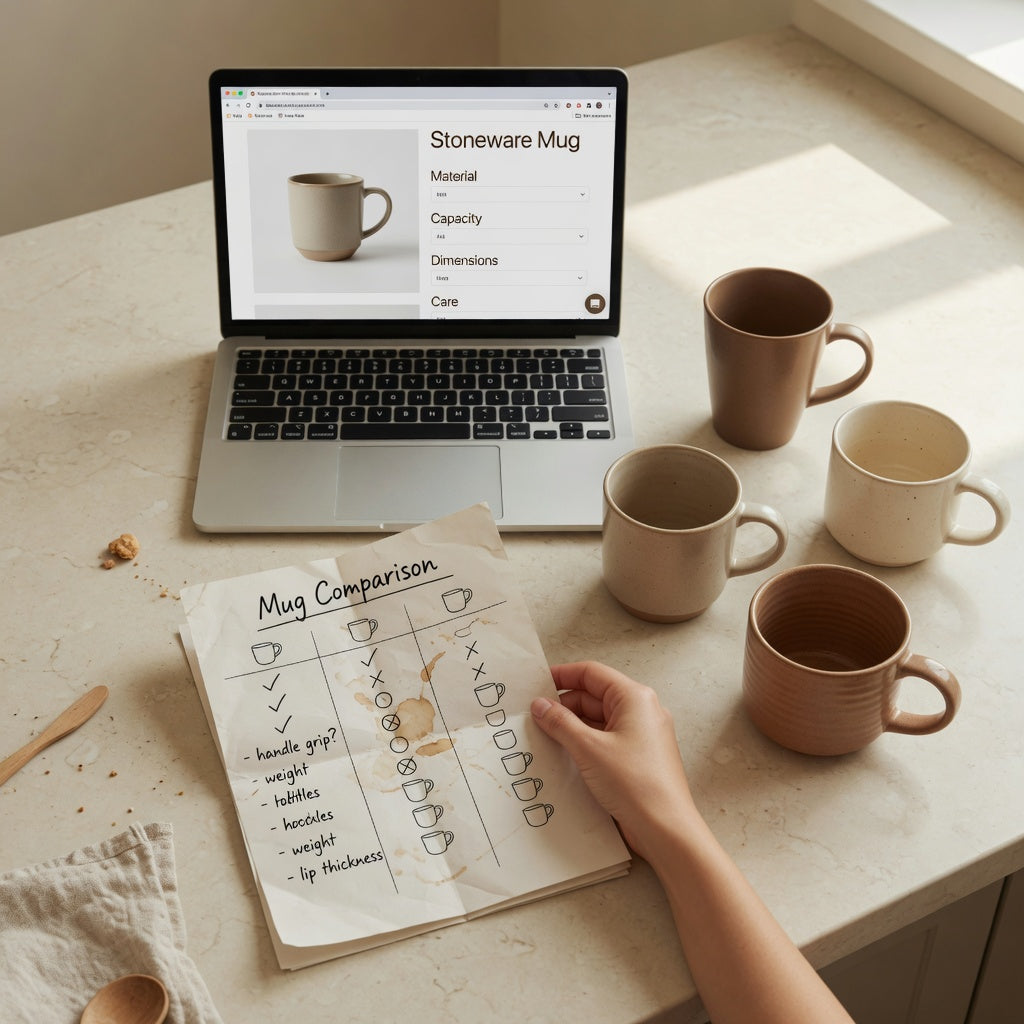
How to Tell if a Mug Is Ceramic: Check the Listing Facts
Learn how to tell if a mug is ceramic by checking the selected variant's material line, seller description, dimensions, care notes, and direct answers—not appearance alone.
Read more
Leave a comment
This site is protected by hCaptcha and the hCaptcha Privacy Policy and Terms of Service apply.