
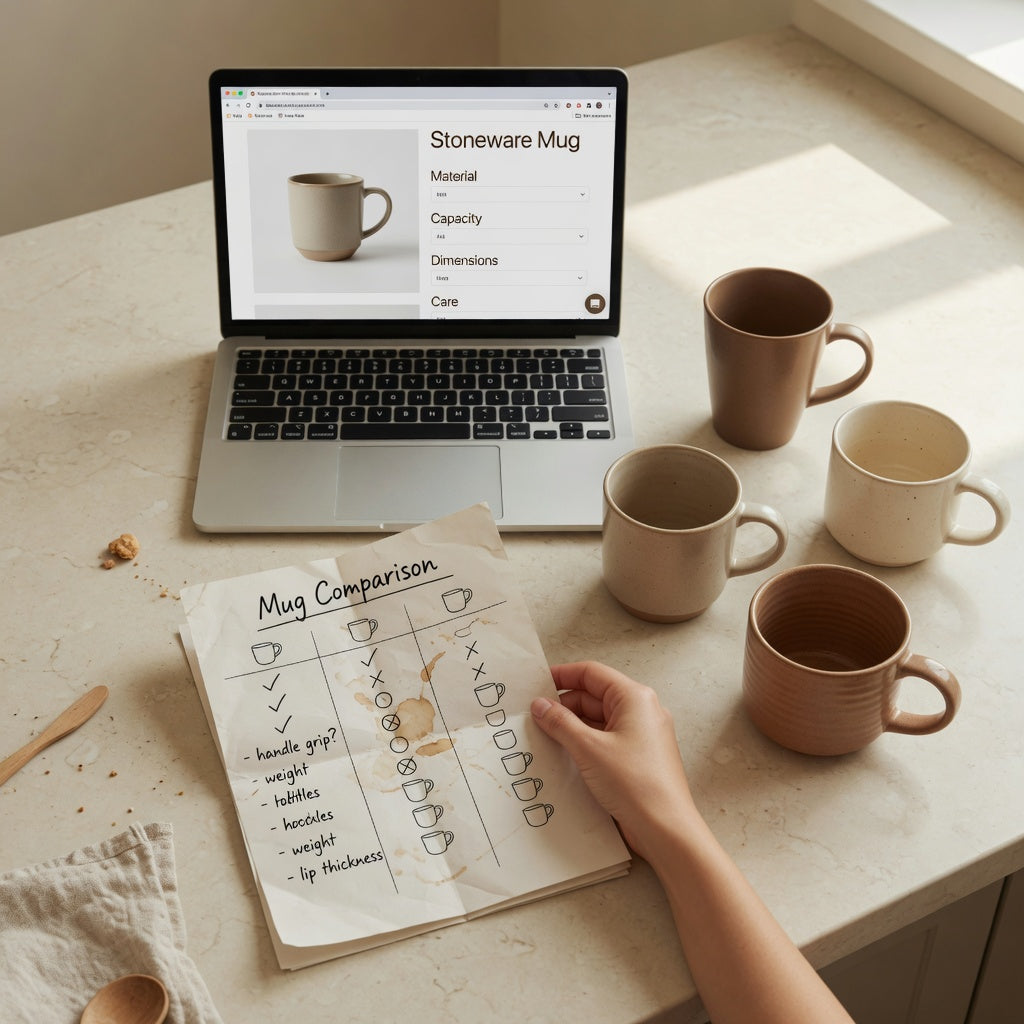
How to Tell if a Mug Is Ceramic: Check the Listing Facts
Reading time: about 8 minutes
Two mugs can look nearly identical on a kitchen counter: a glossy surface, thick-looking walls, and a substantial handle. That still does not identify the material. The same problem appears after a gift unboxing when the packaging is gone, or while a shopper has five tabs open and every item is simply called a coffee cup. The dependable way to learn how to tell if a mug is ceramic is to read the current material label for the exact item and variant, then ask the seller if the wording is missing or unclear. In our store, we use written listing evidence before appearance because it is specific, non-destructive, and tied to what the seller represents at purchase.
How to tell if a mug is ceramic from the current listing
Start on the live product page, not a search-result snippet or a photo saved elsewhere. Then work in this order:
- Select the exact option. Choose the color, size, or other variant you plan to buy if options are shown. If the page details change after selection, reread them rather than transferring a material statement from another variant.
- Find the material field. Check sections labeled Material, Materials, Specifications, or Product details. An explicit Material: ceramic statement is direct seller evidence for that item. Coffee mug by itself is not.
- Read the scope of the wording. Ceramic-coated, ceramic look, and glazed finish do not state that the whole mug is ceramic. Record the complete phrase rather than keeping only the word ceramic.
- Cross-check the page. Compare the description, specification table, and title. If one area says ceramic and another uses different material wording, do not choose the answer you prefer; ask the seller to resolve the conflict.
- Get missing facts in writing. Ask the seller to confirm the material for the exact product and selected option. Save the reply with your order information if material is a deciding factor.
This process establishes what the seller is representing; it is not an independent material analysis. If a workplace, institution, or other purchase requires separate documentation, request that document and confirm that it applies to the exact item under consideration.
Which listing details directly answer the material question?
Not every detail on a product page carries the same weight. Use this evidence order so a visual clue does not become an unsupported material claim.
| Page detail | What it can establish | Buyer action |
|---|---|---|
| Material field for the selected variant | The seller's direct material statement | Use the exact wording and note which option was selected |
| Description tied to the exact item | A supporting seller statement | Check that it is not generic copy covering several products |
| Legible package or maker label for the exact item | Additional written evidence | Compare it with the live page and ask about any conflict |
| Product title | A broad seller claim at most | Confirm it in the material or specification section |
| Care instructions | Claimed cleaning or appliance guidance | Do not use care wording to infer the material |
| Photos and customer reviews | Appearance and user observations | Use them for style or condition clues, not material confirmation |
A listing may use terms such as stoneware, porcelain, or earthenware instead of ceramic. Copy the exact term shown. If you specifically need the seller to confirm that the item is ceramic, ask that question rather than translating one material label into another on your own.
Capacity, dimensions, and care at a desk or kitchen counter
Once the material wording is clear, check whether the mug fits your routine. These specifications do not prove that a mug is ceramic, but they often decide whether it works in a real kitchen, office, or gift box.
- Capacity: Look for a measured value in fluid ounces or milliliters. Use it to compare your usual coffee or tea portion and the extra room you may want for milk or ice.
- Overall height and rim diameter: Compare the listed measurements with the clearance under your coffee maker and the height of your cabinet shelf. A product photo is not a reliable scale reference.
- Base diameter: Check it against the coaster or desk mat you plan to use. Do not estimate the footprint from an angled image.
- Handle opening and clearance: If the listing provides these measurements, compare them with your preferred grip rather than assuming a large-looking handle has ample finger room.
- Listed weight: Weight may matter for handling, but it does not confirm material. Heavy and light are relative descriptions unless the seller supplies a measurement.
- Care instructions: Read microwave, dishwasher, and hand-wash wording separately from the material field. Apply each claim only as written and only to the option it describes.
A listing that confirms ceramic but omits key dimensions may be a poor fit for a low brewer or narrow shelf. If you only buy dishwasher-compatible mugs and the page does not state that compatibility, the candidate is not ready for checkout. Ask the seller or choose a listing with clearer care information.
What should you do when the page, package, and mug disagree?
This often becomes apparent during an unboxing: the order page uses one term, the package uses another, or neither gives a clear answer. Pause and create a simple written record.
- Save the exact product URL, selected option, order confirmation, and a screenshot of the relevant listing text.
- Photograph any package label, base stamp, or conflicting wording without trying to interpret it from appearance alone.
- Send the seller one direct question that names the exact product and option.
- Keep material verification separate from an inspection for shipping or manufacturing damage.
Could you confirm the material stated by the maker for the exact option I am considering, and share the current capacity, dimensions, and care instructions that apply to it?
At an unboxing, inspect the rim for chips, the area where a handle joins the body for visible cracks if a handle is present, and the base for wobble on a flat counter. Those are condition checks, not material tests. Do not scratch the surface, scrape the base, chip an edge, expose the mug to flame, or force rapid temperature changes. These actions can damage the product and still will not provide a dependable material answer.
Which CoffeifyMug page should you check for kitchen, office, or gifting?
The links below are next-step pages, not evidence of an unverified specification. We recommend them conditionally: the current page must confirm the facts required by your use case.
- Kitchen-counter shopper: If the current presentation of the Round Coffee Tea Mug suits your preferred look, it may fit visually. Next, verify the exact material wording, selected option, capacity, height, rim and base diameters, handle clearance, and care instructions. Ask about any required field that is missing.
- Gift shopper: If the recipient likes the current presentation of the Pleated Coffee Tea Cup, it may suit their taste. Before sending it directly as a gift, verify the material, dimensions, capacity, and care for the selected option. A mug with unconfirmed care is not a confident choice for someone who only uses a dishwasher.
- Office-desk shopper: If The Flow Coffee Tea Mug catches your eye, treat it as a candidate only after the live listing confirms the capacity, dimensions, material, and care routine you need. If you require a lid, sealed transport, or cup-holder fit, do not assume those features from the coffee mug name; require explicit current statements.
- Shopper still comparing styles: Browse our unique coffee mugs collection, open your candidates side by side, and apply the same checklist to each page. This keeps visual preference separate from material verification.
A two-minute material-and-fit audit before checkout
- Select the exact product option.
- Find an explicit material statement.
- Check whether the wording describes the whole mug, a coating, or only a visual style.
- Record the capacity and the dimensions that affect your space.
- Read the care and appliance guidance as separate claims.
- Ask the seller to resolve omissions or contradictions.
- Save the answer if the material affects your decision.
In our experience, one precise pre-purchase message is more useful than a chain of guesses. This written trail is the repeatable answer to how to tell if a mug is ceramic without damaging it or borrowing facts from a similarly named product.
Frequently asked questions
How to tell if a mug is ceramic from an online listing?
Find an explicit Material: ceramic statement for the exact selected variant, or obtain written confirmation from the seller. A product name or photo is not enough by itself. Treat the listing as the seller's representation rather than independent material analysis.
Does a glossy or matte finish mean a mug is ceramic?
No. Glossy and matte describe visible finishes, not a confirmed material. Use the photo to judge appearance, then check the current material field for the actual answer.
Do microwave-safe or dishwasher-safe labels prove a mug is ceramic?
No. Those are care or appliance-compatibility claims, not material statements. Confirm the material and each care instruction separately instead of using one to infer the other.
Can I identify a ceramic mug by its weight or tap sound?
Not reliably enough for a buying decision. Shape, wall thickness, handle construction, and any contents can affect feel or sound, so do not strike, scratch, or alter the mug as a test.
What should I do if the seller does not name the mug material?
Ask for the exact material of the selected option, along with its current capacity, dimensions, and care instructions. If the seller cannot provide a direct material answer, the item is not a good choice for a shopper who specifically requires ceramic. Choose a listing that states the required fact clearly.
Your next step is to fill in five lines for the mug you are considering: selected option, exact material wording, capacity, key dimensions, and care instructions. If anything required is blank or contradictory, message the seller before checkout. If you still need a candidate, compare the current pages in our collection of unique coffee mugs with the same checklist and choose the listing that gives you enough written information for your kitchen, office, or gift routine.
More from our blog
Read more
Geometric Tea Cup: Compare Shape, Material, Capacity, and Handle
Compare the Rhombus, Planet, and Gradient product pages without guessing from their names. This guide shows how to verify shape, material, capacity, handle, care, and daily fit before choosing.
Read more
Animal Tea Mugs: Elk and Moon vs Crane Motifs
Compare the Elk and Moon and Crane motif pages without guessing at unconfirmed specifications. We explain how to check capacity, material, form, care, artwork placement, and fit for daily use or gi...
Read more
Leave a comment
This site is protected by hCaptcha and the hCaptcha Privacy Policy and Terms of Service apply.