
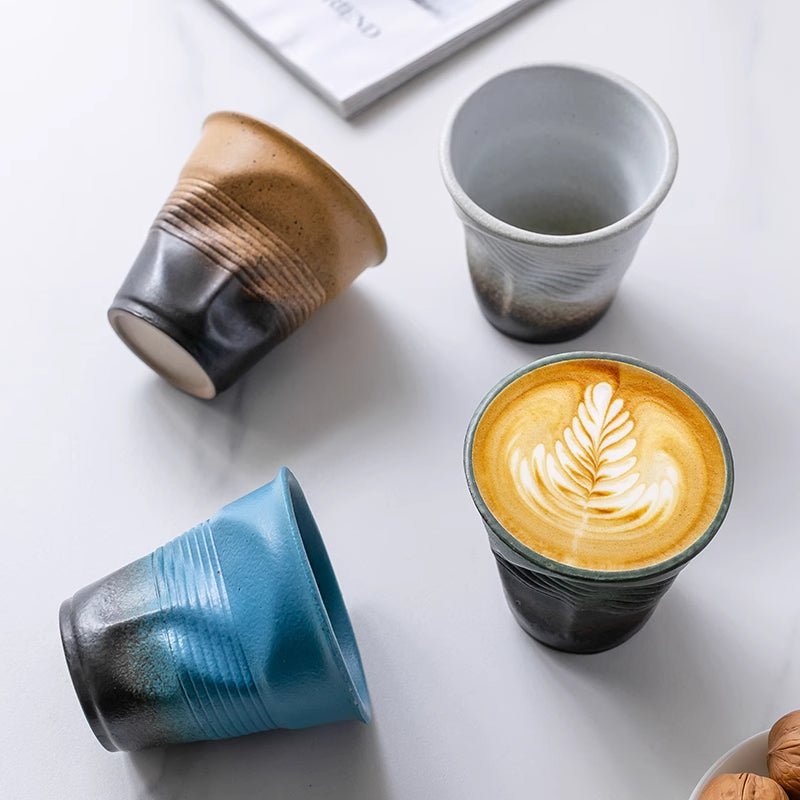
Flat White Cup Weekend Coffee Practical Purchase Checklist for 3 Sizes
Reading time: about 8 minutes
At 9:30 on a Saturday, a flat white often sits beside toast, a book, or a second cup waiting for someone else. That slower setup exposes details a hurried weekday drink can hide: the cup is filled too close to the rim, the handle feels awkward on the walk from the kitchen, or the mug takes up more table space than expected. This flat white cup weekend coffee practical purchase checklist focuses on those practical buying decisions.
At CoffeifyMug, we start with the product facts we can verify. The Pleated holds 200 ml, the Ball Handle holds 250 ml, and the Emerald holds 270 ml. We do not treat any capacity as a required flat white recipe, a barista standard, or proof of specialized geometry. Your finished pour and preferred headroom determine the useful fit.
What changes when a flat white stays on the weekend table?
A weekend coffee may travel only from the machine to the breakfast table, but that short trip can include a milk pitcher, plates, phones, and another person's drink. A cup filled to its listed capacity leaves little practical margin for carrying or setting it down. A cup that is much larger than your normal drink can also feel unnecessarily bulky in a compact place setting.
The best cup for flat white service at home is therefore not automatically the largest option. It is the one that holds your complete drink with enough clearance below the rim for the way you carry and serve it. We also avoid making heat-retention promises based on size. That would require verified information about material and construction that capacity alone cannot provide.
Which listed capacity fits your pour: 200 ml, 250 ml, or 270 ml?
Measure the drink you actually make, including espresso, steamed milk, and foam. Do not rely on the capacity of your current mug unless you have measured that mug separately; visual estimates are often misleading.
| Model | Verified capacity | Capacity difference | Useful buyer situation | Main trade-off |
|---|---|---|---|---|
| Pleated | 200 ml | Baseline | Your finished drink sits comfortably below 200 ml and you prefer the smallest option | Least room for extra milk or foam |
| Ball Handle | 250 ml | 50 ml more than Pleated | Your normal pour exceeds the comfortable range of a 200 ml cup | The distinctive handle needs a closer grip check |
| Emerald | 270 ml | 70 ml more than Pleated; 20 ml more than Ball Handle | You want the roomiest of these three listed capacities | Only a modest capacity increase over 250 ml |
Capacity minus beverage volume gives only theoretical headroom. For example, a 180 ml drink leaves 20 ml in a 200 ml cup, 70 ml in a 250 ml cup, and 90 ml in a 270 ml cup. A 235 ml drink would exceed the 200 ml listing, leave 15 ml in the 250 ml option, and leave 35 ml in the 270 ml option. Those calculations do not account for how the manufacturer measures capacity or how far below the rim you prefer to stop.
Our practical rule is simple: do not choose a cup that requires your everyday drink to reach the brim. If carrying margin matters, use a measuring jug and select the next capacity that gives you a comfortable buffer.
Flat white cup weekend coffee practical purchase checklist: seven checks before checkout
Run through these checks with your normal Saturday serving routine in mind. They turn a product photo and a capacity figure into a more dependable purchase decision.
- Measure the complete drink. Prepare your usual espresso and milk, transfer the finished drink to a measuring jug, and record the total volume. Repeat once if your pours vary.
- Allow room below the rim. Decide how much carrying margin feels comfortable instead of treating nominal capacity as a target fill line.
- Include weekend extras. If you commonly add more steamed milk, foam, or a second small pour after sitting down, include that in the measurement.
- Check the handle format. Compare handle clearance and shape in the product images. The Ball Handle is a deliberate design choice, so buyers who strongly prefer a conventional handle should examine it closely.
- Measure the storage space. Check shelf height, cabinet depth, and the space between other mugs. Exact cup dimensions should be confirmed on the current listing before ordering.
- Confirm material and care information. Do not assume dishwasher or microwave suitability from appearance. Follow the current product instructions for the specific model.
- Plan an arrival inspection. For your own kitchen or a gift unboxing, allow time to examine the rim, handle attachment, interior, and base before the cup is used.
Which CoffeifyMug option matches your Saturday routine?
For a smaller measured pour and a compact place setting
Start with the compact 200 ml Pleated Coffee Tea Cup if your complete drink is comfortably below its listed capacity. It is the smallest of the three, which makes it the logical first comparison for a neat flat white coffee cup beside a breakfast plate. It is not the forgiving choice for buyers who regularly add extra milk or fill a current 200 ml cup close to the rim.
For a middle capacity and a more distinctive grip
The 250 ml Ball Handled Coffee Tea Mug fits the buyer whose drink needs more room than the Pleated provides but does not require the largest option. Its verified advantage is 50 ml of additional listed capacity. The handle is also central to the design, so prioritize a close look at its shape and clearance if you carry coffee one-handed or serve two mugs at once.
For the greatest listed capacity in this comparison
Choose the roomier 270 ml Emerald Coffee Tea Mug when your measured pour needs the most capacity available among these three. It gives 70 ml more than the Pleated, but only 20 ml more than the Ball Handle. That smaller difference matters: if 250 ml already provides enough margin, select between those two based on form and handling rather than expecting a dramatic size change.
If none of these shapes suits your grip or table setup, compare alternatives in our current unique coffee mug collection. Check each listing independently because capacities and care details may differ.
Which material, dimensions, and care details still need verification?
The verified catalog information supplied for this comparison establishes the model names and capacities. It does not establish material composition, exact height, rim diameter, base diameter, empty weight, handle opening, wall thickness, stacking compatibility, or matching saucer availability. Those details can change how a cup feels even when its capacity looks right.
- Material and finish: Confirm the current product description rather than inferring composition from photography alone.
- Dimensions: Check overall height, widest diameter, base footprint, and handle clearance against your shelf and coffee machine area.
- Appliance care: Look for explicit dishwasher and microwave instructions. An attractive finish does not by itself confirm either use.
- Serving compatibility: Verify saucer fit, stacking, and lid compatibility if any of those are requirements rather than optional extras.
In our experience handling mug comparisons, capacity usually narrows the shortlist, while grip, cabinet fit, and care instructions decide the purchase. A missing specification is a reason to verify, not a reason to guess.
What should you inspect after unboxing and during washing?
Set the empty cup on a dry, level kitchen counter and check that it sits steadily. Under bright light, inspect the drinking rim for chips, the interior for sharp irregularities, and the points where the handle meets the body for visible hairline cracks. If damage is visible, do not use the cup for a hot drink.
For routine cleaning, rinse milk residue before it dries, use mild dish soap and a soft sponge, and avoid abrasive pads unless the product's care instructions permit them. Pay attention to the Pleated model's exterior recesses and around the Ball Handle during hand washing. Use a dishwasher or microwave only when the current product information confirms that the specific cup is suitable.
Who should choose a different mug style?
These capacities are not a strong match for a large milk-heavy drink, an iced coffee that needs substantial room for ice, or a covered travel drink. A buyer who requires a standard handle, exact stacking, or a specific saucer should also verify those features before choosing. In those situations, review the broader CoffeifyMug mug selection and prioritize the missing requirement over appearance.
Frequently asked questions
What size flat white cup should I buy for a weekend pour?
Measure your complete drink first, then compare that figure with 200 ml, 250 ml, and 270 ml. Choose a size that leaves practical room below the rim; there is no required flat white ratio that makes one capacity correct for every household.
Is a 200 ml cup too small if I add extra steamed milk?
It may be. If your complete pour approaches 200 ml, the Pleated leaves little or no theoretical margin. Measure the drink after adding your normal milk and compare it with the 250 ml Ball Handle and 270 ml Emerald.
Is 250 ml or 270 ml better for more headroom?
The 270 ml Emerald provides 20 ml more listed capacity than the 250 ml Ball Handle. For a 230 ml drink, that is 40 ml of theoretical space instead of 20 ml, although practical clearance depends on how capacity is measured and where you stop below the rim.
Are these cups confirmed as dishwasher and microwave safe?
Those ratings are not established by the verified capacity information used for this article. Check the current product page or care instructions before using either appliance. Until confirmed, hand washing with mild soap and a soft sponge is the conservative option.
How do I compare the three CoffeifyMug sizes before ordering?
Use the flat white cup weekend coffee practical purchase checklist to record your drink volume, preferred rim clearance, grip needs, cabinet space, and care requirements. Then compare 200 ml, 250 ml, and 270 ml using those same criteria rather than choosing from appearance alone.
Make one normal weekend flat white, measure the finished volume, and write down the margin you want below the rim. Then compare that number with the three linked products or review the available mug shapes and capacities before adding a cup to your cart.
More from our blog
Read more
Americano Coffee Cup Weekend Coffee Practical Purchase Checklist
Measure your finished weekend serving, allow room for stirring and carrying, then compare the Pleated 200 ml, Emerald 270 ml, and Landscape Tall 350 ml without relying on unverified features.
Read more
Cappuccino Coffee Mug Weekend Coffee Practical Purchase Checklist
Compare the Retro 170 ml, Pleated 200 ml, and Emerald 270 ml by your actual weekend serving size. This checklist also flags material, dimensions, care, and performance details to confirm before che...
Read more
Leave a comment
This site is protected by hCaptcha and the hCaptcha Privacy Policy and Terms of Service apply.