
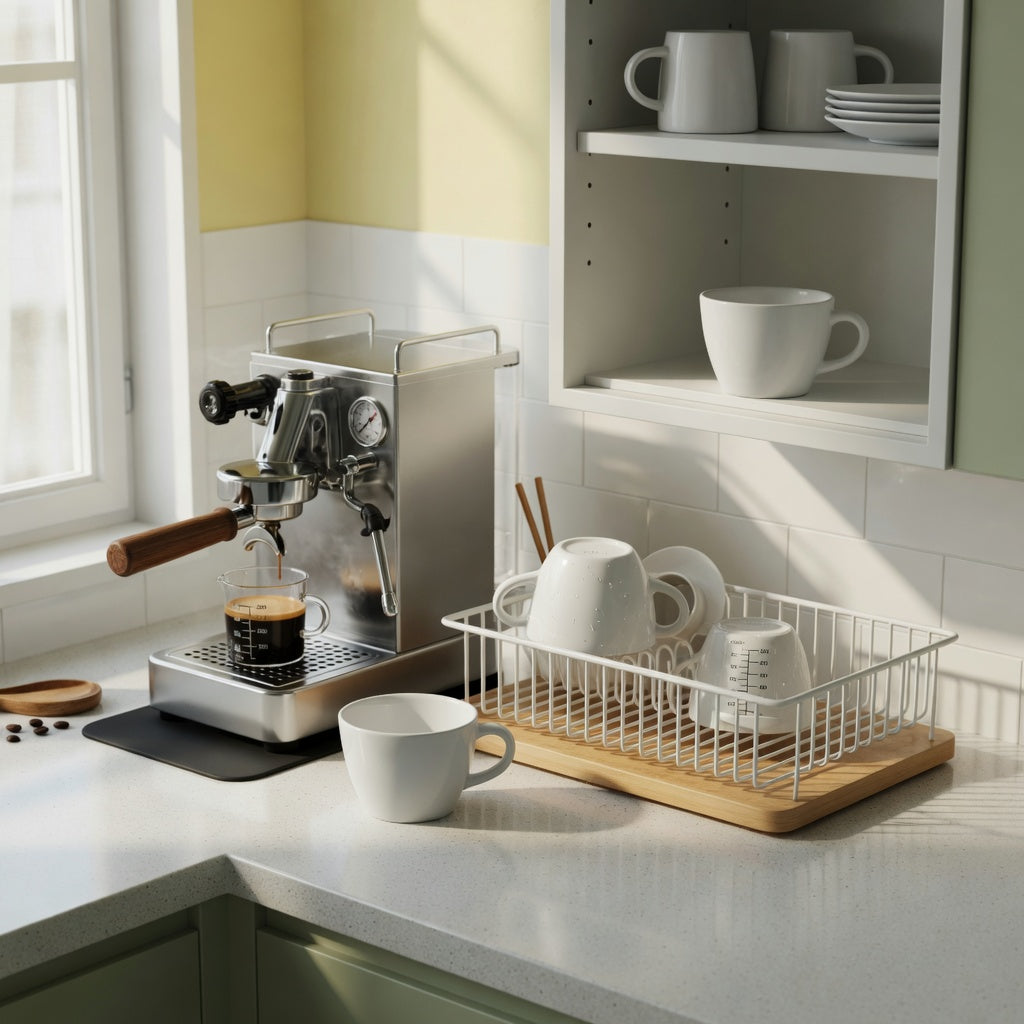
Flat White Cup Everyday Mug Rotation Practical Purchase Checklist
Reading time: about 9 minutes
At 7:15 a.m., one cup is beside the coffee setup, another is still in the dishwasher, and the attractive one at the back of the cupboard is too awkward to reach. That is how an everyday rotation usually breaks down: not because the cups are unattractive, but because capacity, storage, and washing habits were never considered together. A flat white cup everyday mug rotation practical purchase checklist turns those small daily frictions into decisions you can make before ordering.
In our store, we compare three verified capacities in this compact category: the Pleated at 200 ml, the Ball Handle at 250 ml, and the Emerald at 270 ml. We do not treat those numbers as drink rules or barista standards. They are comparison points. Material, external dimensions, stackability, and appliance-safe care must still be confirmed on the current product listing rather than inferred from a photograph.
How many cups do you use between wash cycles?
Count cups, people, and wash intervals before choosing a style. A one-person household making one drink each morning may only need one active cup and one spare. Someone who uses a fresh cup for two drinks a day but runs the dishwasher every other evening could have four cups waiting to be washed, plus a spare if an uninterrupted routine matters.
A useful starting calculation is: daily users multiplied by drinks per person, multiplied by days between washes. Adjust downward if you rinse and reuse the same cup. Add one spare only if guests, late dishwasher cycles, or a cup left at an office desk regularly interrupt the rotation.
- One drink, washed nightly: one active cup and one backup can be enough.
- Two fresh cups a day, washed every two days: four working cups cover the cycle; a fifth is optional.
- Two people sharing a nightly wash cycle: two active cups plus one spare may cover the routine.
- Home and office use: keep a cup at each location instead of transporting an open drinking vessel every day.
This method is more reliable than buying an arbitrary matching set. It also exposes the trade-off: every backup cup requires accessible storage. If the fifth cup has to sit behind mixing bowls, it is not genuinely part of the rotation.
Flat white cup everyday mug rotation practical purchase checklist: measure the pour first
Do not estimate your usual drink from the capacity printed on an old mug. Instead, fill that mug with water to the level where you normally want the finished coffee to sit, leaving the same clearance you prefer below the rim. Pour the water into a graduated measuring jug and record the result. Foam does not behave exactly like water, so this is a practical comparison rather than a precise recipe.
Subtract that measured pour from each listed cup capacity to estimate nominal headroom. A 170 ml test pour leaves 30 ml against a 200 ml listing, 80 ml against 250 ml, and 100 ml against 270 ml. A 240 ml pour does not sensibly belong in a 250 ml cup if you want comfortable carrying clearance; the arithmetic leaves only 10 ml before allowing for foam or movement.
The best cup for flat white use is therefore not automatically the smallest option. It is the capacity that holds your real pour with the amount of rim clearance you find comfortable on the walk from the kitchen counter to the table or desk.
200 ml, 250 ml, or 270 ml: where does the headroom go?
The three CoffeifyMug options differ in useful, measurable increments. The Ball Handle provides 50 ml more listed capacity than the Pleated. The Emerald adds another 20 ml over the Ball Handle and 70 ml over the Pleated. Those differences matter most when your measured drink sits close to one of the limits.
| Verified option | Reader situation | Why it fits | Trade-off to check |
|---|---|---|---|
| Pleated coffee tea cup | Your measured pour stays comfortably below 200 ml. | Its listed 200 ml capacity covers shorter pours without buying unused volume. | It is a poor fit if your normal drink approaches 200 ml because little nominal headroom remains. |
| Ball Handled coffee tea mug | Your pour needs more room than the 200 ml option provides but remains comfortably below 250 ml. | The listed 250 ml capacity adds 50 ml over the Pleated, and the named handle design gives you a distinct grip style to assess in the listing photos. | Confirm overall width, including the handle, before assigning it a narrow shelf or drying-rack slot. |
| Emerald coffee tea mug | A 250 ml listing leaves less carrying clearance than you prefer. | The listed 270 ml capacity provides a modest additional 20 ml for a slightly larger measured pour. | It is still a compact-capacity choice, not a substitute for a large mug used for long drinks or plenty of ice. |
Capacity does not reveal exterior footprint, wall thickness, weight, or the exact internal fill line. Treat this table as a shortlist, then confirm the remaining details on each linked page before purchasing.
Which cup belongs at the kitchen counter, office desk, or gift table?
At the kitchen counter, choose by measured pour first and cupboard fit second. A shorter drink that stays well below 200 ml points to the Pleated option because its verified capacity covers that use without moving up a size. A drink that crowds 200 ml points to the 250 ml Ball Handle, while a pour that needs a little more clearance than 250 ml provides points to the 270 ml Emerald.
An office desk changes the decision. Measure the clear area between the keyboard, monitor stand, notebooks, and any cable openings. Capacity alone does not prove that a cup has a smaller base or lower center of gravity, so check the listed external dimensions and product photography. If a lid or leak-resistant transport is essential, use a travel vessel instead; none of these cups should be assumed to provide those features.
For a gift, avoid choosing solely by color or product name. Ask what size the recipient already reaches for, whether the cup must fit beneath a particular coffee machine, and whether dishwasher or microwave compatibility is essential. If you do not know the recipient's pour size, browse the unique coffee mugs collection and compare the current specifications rather than presenting one capacity as universally suitable.
Which material, dimensions, and care details still need checking?
A practical shortlist should distinguish verified facts from open questions. The capacities above are verified catalog details. Do not infer porcelain, stoneware, another ceramic body, dishwasher safety, or microwave safety from appearance alone. Those terms describe different product and care considerations, and only the current listing should be used to confirm them.
- Measure the cupboard: record internal shelf height, usable depth with the door closed, and available width at the cup's widest point. Include the handle in that width.
- Check machine clearance: if the cup must sit beneath a coffee spout, compare its external height with the space from drip tray to outlet.
- Check care statements separately: dishwasher-safe wording does not automatically establish microwave suitability, and the reverse is also true.
- Plan side-by-side storage unless stacking is confirmed: a listing photo is not proof that cups nest securely. Stacking also changes the height and contact points you need to accommodate.
- Inspect the cup after unboxing: use bright light to check the rim, body, base, and handle junctions for chips or hairline cracks. Set it on a clean, dry, flat counter to check for unexpected rocking.
- Follow the stated first-use and cleaning instructions: after a milk drink, do not let residue dry around surface details or handle junctions. Let the cup dry fully before placing it in a cupboard or stack.
These checks matter in a gift unboxing as much as they do in your own kitchen. Inspect the item before wrapping it, retain the relevant care information, and avoid promising appliance compatibility that the product page does not state.
Which drinks should stay outside this compact rotation?
A 200-270 ml flat white coffee cup rotation is not a complete drinkware cabinet. Large batch coffee, a long tea steep, or an iced drink with substantial ice displacement may need a larger vessel. Choosing the 270 ml option does not solve a routine that regularly exceeds 270 ml before allowing any rim clearance.
This group is also not the right answer for sealed commuting, cup holders, or bags. Use a purpose-specified travel cup for those jobs. Shoppers who require confirmed nesting, a particular material, or appliance-safe care should pause if that information is absent and select a different documented style rather than filling in the gaps themselves.
A checkout checklist for a rotation that will stay accessible
- Measure your usual finished-drink level with a graduated jug.
- Choose how much carrying clearance you want below the rim.
- Compare that total requirement with 200 ml, 250 ml, and 270 ml.
- Calculate how many cups are used between wash cycles.
- Measure shelf height, closed-door depth, and width including handles.
- Confirm machine and drying-rack clearance where relevant.
- Verify material, dishwasher guidance, microwave guidance, and stacking claims on the current listing.
- Exclude iced, oversized, and travel drinks that need a different vessel.
- Buy only the number that can remain visible and easy to reach.
Keep this flat white cup everyday mug rotation practical purchase checklist beside the three product pages while comparing them. A cup earns its place through a measured pour, a clear storage position, and care requirements that match your routine, not through capacity alone.
Frequently asked questions
How do I use a flat white cup everyday mug rotation practical purchase checklist?
Measure your normal pour, decide how much rim clearance you need, and calculate how many cups you use between washes. Then verify external dimensions, material, and care instructions on the current product page before choosing a capacity.
Is a 200 ml cup large enough for a flat white?
It can be if your measured finished drink stays comfortably below 200 ml. For example, a 170 ml test pour leaves 30 ml of nominal headroom in the Pleated 200 ml cup, but that arithmetic is a comparison tool rather than a required drink ratio.
Should I choose a 250 ml or 270 ml flat white coffee cup?
Choose 250 ml if your usual pour leaves enough carrying clearance at that capacity. Move to 270 ml if the extra 20 ml resolves a real headroom issue; otherwise, decide between them using verified dimensions, handle preference, care information, and style.
How many flat white cups should one person keep in rotation?
There is no fixed number. Multiply drinks per day by the days between washes, reduce the total if you reuse a rinsed cup, and add one spare only if delayed washing or guests regularly create a gap.
Are the Pleated, Ball Handle, and Emerald cups dishwasher and microwave safe?
Capacity does not establish either form of appliance compatibility. Check each current product page for explicit care instructions, and do not assume that dishwasher suitability also means microwave suitability.
Next step: write down your measured pour and available shelf dimensions, compare them with the linked 200 ml, 250 ml, and 270 ml options, then use the unique mugs collection only if another shape or documented specification better matches the job.
More from our blog
Read more
Chai Tea Mug Replacement Purchase Practical Purchase Checklist
Use the old mug's failure, actual chai pour, grip needs, and storage space to compare The Flow 400 ml, Morning and Night 440 ml, and The Rock 480 ml. This checklist separates verified capacity fact...
Read more
Coffee Mug Wedding Gift Replacement: A Practical Purchase Checklist
Replace a broken or impractical wedding mug by checking its original failure, cabinet and machine clearance, serving needs, care requirements, and fit with the surviving mug. Compare three Coffeify...
Read more
Leave a comment
This site is protected by hCaptcha and the hCaptcha Privacy Policy and Terms of Service apply.