



Everyday Use Pottery Mug: Handle, Rim, and Glaze Checks
Reading time: about 13 minutes
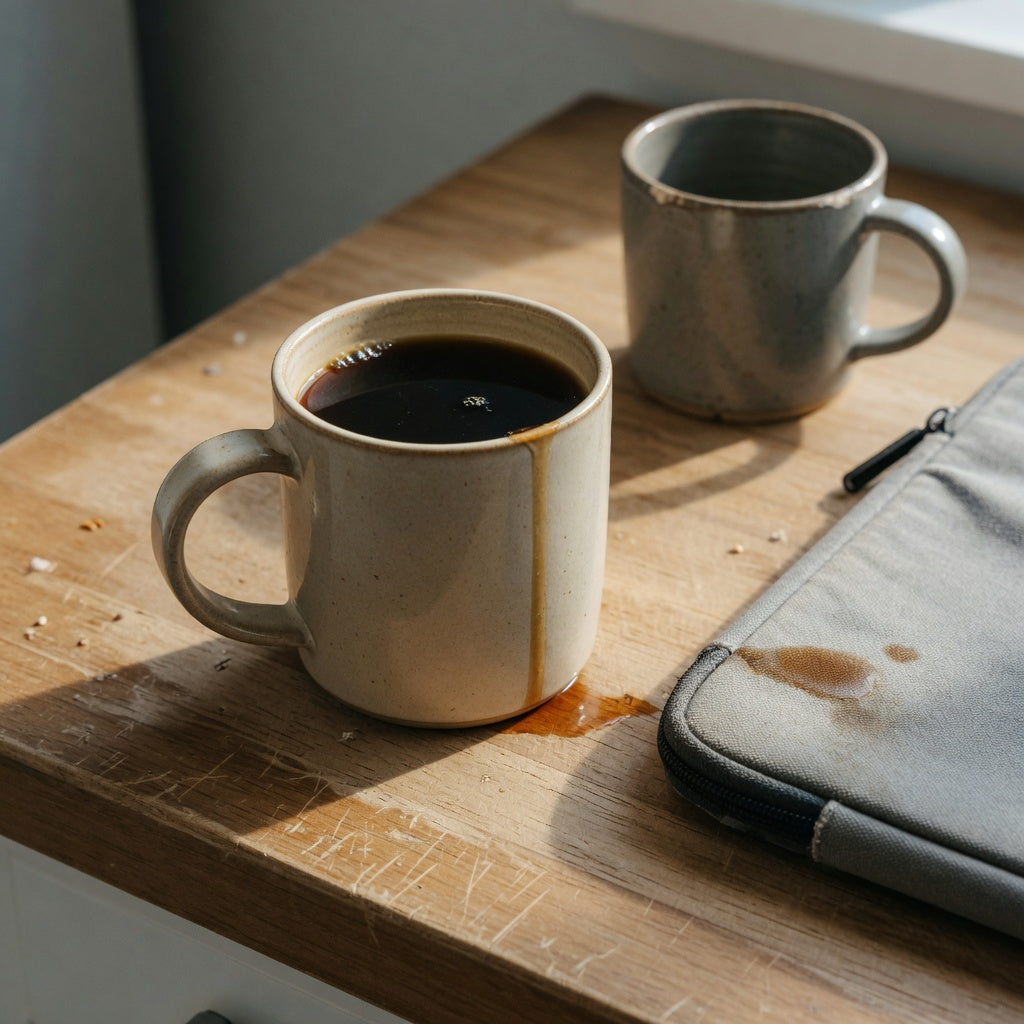
A sleeve stain on an office desk tells you more about a mug than the product photo did. Coffee ran off the rim. The handle was fine when empty and cramped once the cup had weight. An everyday use pottery mug is the cup that still works on the third refill, after the glaze has stopped being a surprise.
In our store we sort these pieces as drinkware first. Color is the last conversation, not the first. If you are already comparing distinctive shapes, open the current pages in our unique coffee mugs collection, including a structured option such as the Rhombus Coffee Tea Mug. The name points at a design direction. It does not state capacity, clay body, food-contact status, or appliance limits. Those have to be on the listing you are reading, and they can change.
What should you check before an everyday use pottery mug becomes the daily cup?
We use a short pass list on the counter when someone is choosing between a striking glaze and a plain cup they already trust.
- Food-contact intent: sold to hold drinks, not as decor with a warning or a hole through the wall.
- Drinking surface: interior and rim glazed, with a food-use claim about the finished piece rather than a clay brand name.
- Handle and foot: room for two or three fingers when the mug is full, and a base that sits flat.
- Rim: finished so liquid does not sheet down the outside onto a sleeve.
- Usable capacity: stated volume versus the pour you will actually drink once milk, foam, or sip space is included.
- Appliances: dishwasher and microwave wording for that exact mug, including any limit on metallic decoration.
- The first chip: a favorite you refuse to retire will stay in service past the point it should leave the cupboard.
A matched diner mug is the better buy when you need several identical cups and a low replacement cost. A pottery mug earns the daily slot when the rim and handle were finished for drinking, not only for a mold. Price and an unusual glaze do not guarantee either result.
| Buyer check | Useful evidence on the page | What a photo still hides |
|---|---|---|
| Food contact | Clear drinkware wording, no decorative-only warning | Whether lead can still move out of the glaze |
| Daily grip | Handle shape and how the mug sits when set down | Finger clearance once it is full |
| Rim and shape | Lip finish, wall, and how open the mouth is | Drip on a real sip, and how fast coffee cools |
| Appliances | Piece-specific dishwasher and microwave lines | Luster, decals, or a porous body that can void the claim |
| Care life | Foot, handle projection, and your plan after a chip | Stacking damage and thermal shock |
Is hot coffee safe in the glaze, or is the label doing too much work?
Gloss is not a test. U.S. regulators have found that some ceramic foodware leaches significant lead from surfaces that touch food. Lead compounds such as lead oxide were long used in glazes. If firing did not fully bind that lead, food and drink can draw it out. Continued use of ware that releases meaningful lead can cause chronic lead poisoning and a wide range of other adverse effects. That history is not a reason to fear every kiln-fired kitchen mug. It is a reason to skip vague safety adjectives.
For cups and mugs, FDA compliance criteria use an action level of 0.5 micrograms of lead per milliliter of leaching solution, in any one of six units, checked with specified laboratory methods. In that guidance, a cup or mug is small hollowware commonly used for coffee or tea above room temperature. Those pieces normally, though not always, hold about 240 milliliters (8 fluid ounces) and are made with a handle. That 8-ounce figure describes the regulatory category. It is not the capacity of any mug in our catalog.
A lead-free line is meaningful only when the finished mug does not leach lead. Industry guidance says ceramicware that still shows extractable lead under the FDA test method should not be labeled lead free, because the claim can be false or misleading. Shoppers also ask us about cadmium. A hangtag that says cadmium-free is not, by itself, a finished-piece result. If the page piles on safety words and never says what was tested, ask before that mug becomes a morning habit.
Decorative ware is the other miss. U.S. rules treat ceramic that looks suitable for food as foodware unless it has a specified visible warning and a permanent statement on the base, or a hole through the surface that would touch food. Lead in glazes and decorative decals can move into food if that ware is used to prepare, serve, or store it. The CDC reported a New York City family whose elevated blood lead levels were associated with traditional glazed ceramic used for cooking, storing meals, and making coffee. Lead on a glaze or paint can transfer into foods or drinks prepared, served, or stored in the ware. Souvenir cups and anything sold only for display stay on the shelf until you know they were made to be drunk from.
Regulators pay particular attention to cups because they hold drinks above room temperature. A chipped or worn interior is a worse surface than an intact glaze, because the drink can reach material the coating was meant to cover. If the listing never says the piece is for beverages, do not make it your everyday use pottery mug.
Does the clay name matter more than how the body was fired?
Pottery means clay that was formed and fired. It does not mean the wall is liquid-tight. For a daily drink, tightness depends on how fully the body is vitrified and whether the glaze fits that body.
Earthenware is the lower-fired end of the range. It can still be a reliable cup when the interior glaze seals it. An underfired, porous body is the problem case: stains, seepage, and uneven heat in ordinary use. Stoneware is typically fired higher, so the clay becomes denser. Porcelain is high-fired too, often with a finer body and a sharper rim. Those are tendencies. Wall thickness and whether you leave the cup uncovered will change temperature more than the marketing name. We do not publish heat-retention percentages. A number the mug in your hand has not earned is not a fact we will print.
- Weight. A daily mug should feel solid for its size. A chalky, oddly light piece can suggest porosity. That is a handling impression, not a lab result.
- Interior. Pinholes, crawled glaze, or bare clay where the drink sits are reasons to pass.
- Outside heat. Thin walls transfer heat quickly, so the cup can be too hot to cradle. A porous wall can also take on water and then overheat in a microwave.
- Foot ring. An unglazed foot is normal, and it can scratch a soft counter or a painted desk. Flat and even matters more than a glossy base.
If the job is keeping coffee hot on a train, pottery is the wrong tool. Use a lidded insulated cup. For a sit-down pour, compare rim, handle, and the care line on that exact page. We send people who are still sorting the first cup of the day to our note on what to compare in a morning coffee ceramic mug.
How do handle clearance, rim drip, and a wide mouth change a full cup?
Judge the mug full. An empty handle flatters itself.
We look for room to pass two fingers, preferably three, without knuckles grinding the wall. A narrow loop looks tidy in a photo and then pinches once the cup has weight. Balance is the other half. A heavy handle, or a wide bowl on a small foot, tips when you set it down one-handed. If the listing gives no handle opening and you cannot hold the piece, leave comfort unconfirmed.
Drip is what people mean when they say a mug drools down the outside. A slightly rounded lip can turn the stream back into the mouth. A thick, blunt rim can feel clumsy. A very thin rim can feel precise and still chip the first time it meets a faucet. For daily use we want a lip you still like after months of sips: glazed through, comfortable, and not so sharp that one knock retires it.
Shape is a temperature choice. A wide mouth shows the interior and lets aroma out. It also gives hot coffee more surface, so the drink cools faster than the same volume in a taller cup. Tea drinkers who want the cup to settle sometimes like that. Someone stretching one coffee through a meeting usually does not.
Stated capacity and usable capacity are different. Even a mug near that familiar 240 milliliter example may only give you a comfortable drink once you stop short of the rim. Milk or foam takes more of the line. If the page does not state volume, do not guess it from the photo.
What do dishwasher cycles, microwaves, and a boiling pour do to the piece?
Dishwasher-safe and microwave-safe describe one mug, not pottery as a material. A label can be voided by metallic luster, some decals, or an underfired porous body.
Gold or platinum luster and metallic bands can arc or scorch in a microwave. A porous wall is a second failure: water in the clay heats, and the mug becomes painful to hold. Follow the wording for that exact item. If the page is silent, hand wash it and keep it out of the microwave. Do not experiment with a full cup to find out.
Makers disagree about dishwashers, and both can be right about different risks. High-fired stoneware with a stable glaze often tolerates detergent. In our experience the damage is usually impact. Handles strike the rack, rims chip against other ware, and feet pick up hard-water film. Chemical durability and chip resistance are not the same thing.
Thermal shock is quieter. A mug taken from a cold sill and filled from a rolling boil can crack even if the glaze looked perfect. A hot cup under a cold rinse can do the same. Let the clay and the liquid move toward each other. Do not pull a pottery mug from the fridge and flood it with boiling water.
Care that matches those failures:
- Hand wash when the listing is cautious, or when the handle sticks out far enough to collide.
- Do not nest mugs tightly. Rim-on-rim stacking starts hairline chips.
- Dry the foot so it does not sit in a puddle and mark the counter.
- Stir with a spoon if you like. Do not store the spoon in the cup, or the interior picks up gray marks.
- Stop using the drinking surface once it is damaged.
Which patterned mug fits a desk, and what must the listing still prove?
Match the situation, then read the page. We will not guess ounces, clay, or appliance ratings from a photograph, and a similarly named cup somewhere else does not supply them.
For a graphic outline on a small shelf or a shared office desk, open the Rhombus Coffee Tea Mug. The name signals a geometric silhouette rather than a soft, irregular form, which helps if you want a cup you can spot in a crowded cupboard. It is not a commute mug, and it is a poor fit if you only drink from a lidded travel cup. On that page, confirm capacity, material, food-contact wording, and any dishwasher or microwave line for this version.
If a landscape name is what caught you, open the Mountain Sea Coffee Tea Mug and judge the surface, not the title. A scenic theme can suit a slow cup at the kitchen table. It is a weaker choice if you need a plain mug that hides tea staining or has to match a strict white set. The listing has to say whether you are looking at glaze, print, or another decoration. Those surfaces do not age the same way in a sink.
For a wave motif you still want on weekday mornings, look at the Golden Waves Kio Coffee Tea Mug. Treat the word golden as a question, not a materials fact. Some gold-looking surfaces are ceramic color. Some are metallic luster that must stay out of the microwave. If the current description does not say microwave-safe in plain language for this piece, do not assume it. Use the same caution for the dishwasher line.
None of these replaces a leakproof travel cup, a camp mug, or a matched set for a full table. They will not hold a drink at a scalding temperature for an hour. Keep pottery for the sit-down pour. When you want a specific look on a cup you will actually reach for, stay in the unique coffee mugs collection and run the same checks on the page you open.
When is a crazed, chipped, or cracked mug finished as drinkware?
Crazing and cracking get lumped together, and they are not the same defect. Crazing is a mesh of fine lines in the glaze, often from glaze and clay shrinking differently as they cool. A structural crack enters the clay body. It can weep, travel, or loosen a handle.
Some owners keep a lightly crazed, high-fired mug in service. The honest cost is stains in the lines and a surface that is harder to keep fresh with daily coffee or tea. We do not treat that habit as permission. Deep cracks, a crack that reaches the rim, flaking glaze, a damp ring under the foot, or a handle that flexes are retirement signs. Move that piece to pens or keys.
Also retire, or never start with, a souvenir cup that has no food-use information, anything labeled decorative or sold with a lead warning, a chip on the drinking edge, or any leak. A chip on the foot is mostly about stability and scratches. A chip where your lip rests is a cut risk and a place for residue to sit. If a new mug arrives with a crack you can catch on a fingernail, contact the seller before the first pour.
Before one of these cups joins the weekday rotation, confirm the listing instead of the photograph:
- Food-use wording is written on the page.
- The interior glaze is intact over the rim, without pinholes where the drink sits.
- You can picture two or three fingers in the handle once the mug is full.
- The foot sits flat, and you know whether the base is unglazed.
- Dishwasher and microwave language is specific to this piece, and you will follow it.
- You already know you will retire the drinking surface the day it chips.
If two patterned cups both clear that list, choose the one you will pull down on a rushed morning, not the one that only wins in an unboxing photo.
Frequently asked questions
Is an everyday use pottery mug safe for hot coffee every morning?
It can be, when the finished piece is sold for drinks, the glaze is intact, and you are not using a decorative or souvenir cup. Regulators screen cups and mugs because some glazes can release lead into hot liquid. If the listing will not say the mug is for beverages, or the rim is already chipped, pick a different cup.
Does a lead-free label mean the glaze was leach-tested?
Not by itself. A lead-free claim is misleading if the finished ceramic still releases extractable lead under the FDA test method. Ask what was tested on the completed mug. Clay that started without lead can still be paired with a glaze or decal that was not cleared the same way.
Can I put a handmade pottery mug in the dishwasher every night?
Only when that exact piece is stated as dishwasher safe. High-fired ware often tolerates detergent, but handles and rims chip from knocks, and some glazes dull. If the page is silent, hand wash it and do not stack rim to rim.
Why does the outside of a pottery mug get too hot to hold?
Thin walls pass heat quickly, which is common on handmade cups and uncomfortable if you like to cradle the mug. A porous body can also take on water and overheat in the microwave. If the listing never says microwave-safe, especially where you see a metallic-looking band, keep it out of the microwave.
How much coffee should an everyday mug actually hold?
Use the stated volume on the current listing, then subtract the space you leave below the rim and any milk or foam. A figure near 240 milliliters is only the regulatory example of a typical cup or mug, not a promise about the piece you are viewing. A taller shape usually keeps heat longer than a wide open bowl of the same fill. If ounces are missing, leave capacity unconfirmed.
More from our blog
Ready to pick your mug? Two ways to save on today's order:
Ordering 1–3 mugs? Get an extra 10% off your 1st order with code 10_OFF Apply 10% Off & Shop Wooden-Handle Mugs →
Gifting 4+ mugs? Buy 3, Get the 4th Free applies automatically at checkout (no code needed; offers do not stack) · Free standard shipping (Nov pre-Christmas delivery: 15–20 calendar days US) · Free replacement if chipped in transit.
Popular mug buying guides: Wooden-Handle Tea Infuser Mugs Compared · Christmas & Secret Santa Mugs 2026 · Espresso & Cortado Cups Guide · Cup & Saucer Gift Sets · All 25 Mugs Spec Table · Mug Size Guide · Shipping & Promo FAQ
FIRST ORDER 10% OFF (CODE: 10_OFF) · OR BUY 3, GET THE 4TH FREE


Read more
Gift Gradient Ceramic Tea Mug: What Buyers Should Compare
A gift gradient ceramic tea mug looks finished in a photo and then has to survive a real kitchen. We compare fill size, handle care, glaze food-contact claims, and packaging so the mug still works ...
Read more
Wassail Gift Mug: Capacity, Handle, and Care Checks
Shoppers searching for a wassail gift mug often land on a printed coffee mug, a cider cup, or a spice kit. We compare listed 400 ml, 440 ml, and 480 ml sizes, then the handle and care checks that d...
Read more
Leave a comment
This site is protected by hCaptcha and the hCaptcha Privacy Policy and Terms of Service apply.