



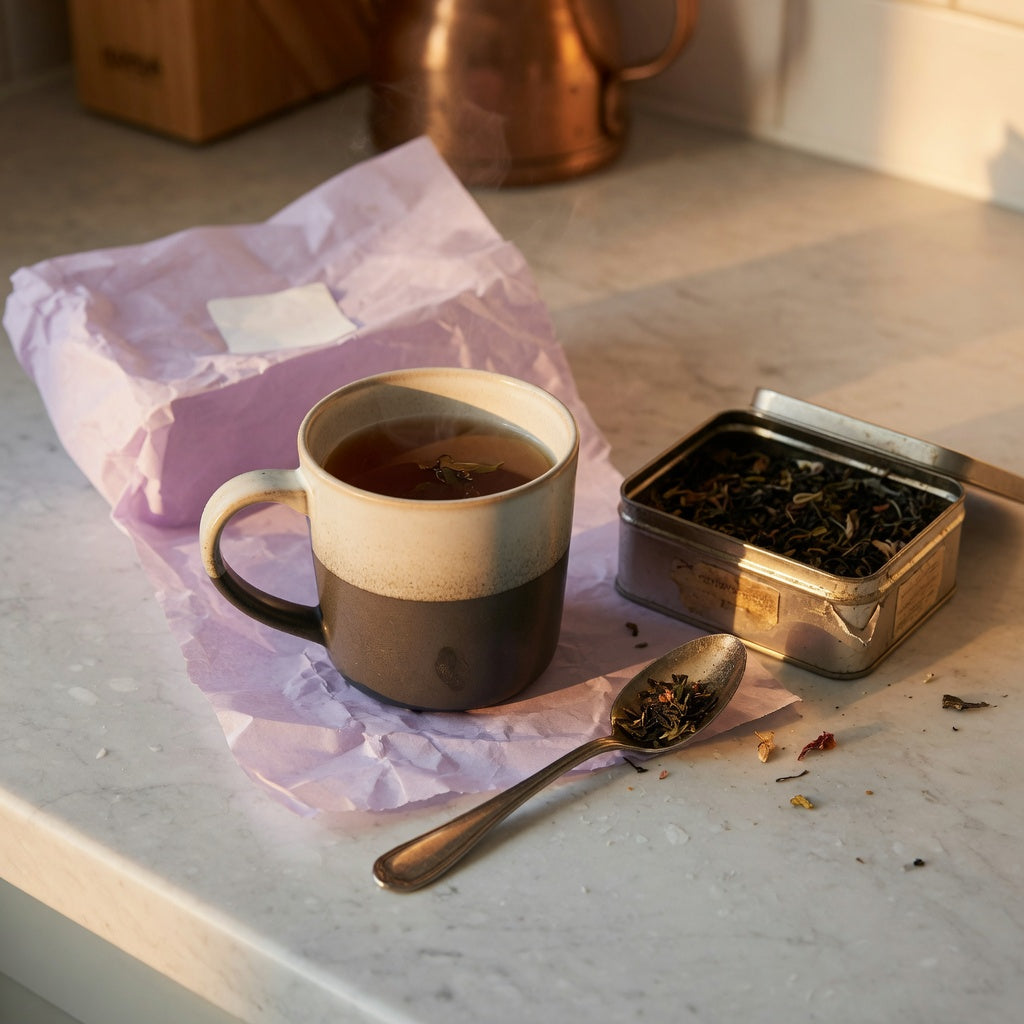
Gift Gradient Ceramic Tea Mug: What Buyers Should Compare
Reading time: about 12 minutes
The tissue paper looks finished, the fade photographs well, and the box is already taped. A gift gradient ceramic tea mug still has to survive Monday: a full pour, a wet handle, and a dishwasher someone else loads. The color is the easy part. Capacity, care, and whether the glaze is meant for drinking are the comparison that decides if it stays on the counter.
In our store we set these pieces where a recipient will use them, beside a kettle or on a desk mat, not only under a product light. A sprayed or dipped fade does not answer how much liquid fits below the rim, how the handle is fixed, or what the listing says about food contact. Those answers live on the current page for that exact mug.
Which gradient gift is a steeping set, and which is just a mug?
Shoppers use one search phrase for two different objects. One is a steeping set: ceramic body, lid, metal mesh basket, sometimes a wood handle, sometimes an embossed landscape. The other is a stoneware or porcelain mug with a matte, reactive, or hand-sprayed color fade and no infuser at all. They can share a palette and still be the wrong gift for each other.
Match the person before you match the fade:
- Daily loose-leaf drinker. They need basket depth, mesh fine enough to hold back dust, and room for larger leaves such as oolong. A lid slows cooling. If the listing does not show a removable infuser, do not guess that one is in the box.
- Coffee or bagged-tea drinker. A basket steals volume and adds a part to rinse. A plain ceramic body with a handle that fits the hand is usually the better gift.
- Desk or shelf-first recipient. Matte and reactive gradients vary from piece to piece. That variation is the look. A photo is a sample of the glaze family, not a promise of an identical fade.
Our catalog title for The Gradient Coffee Tea Mug is Gradient Ceramic Coffee Mug. Treat that live page as the only spec sheet for materials, stated size, included parts, and care icons on this version. We will not copy a wood handle, a mesh basket, or an ounce count from another brand’s steeper. If the page does not list an accessory, it is not part of the gift.
If the fade is right but the silhouette is wrong, compare shapes in our unique coffee mugs collection. A rounder bowl with a lower center of gravity sits steadier on a crowded desk than a tall, narrow cup. A wide rim also cools faster, which matters if they nurse one cup through a meeting.
Why do 12-ounce and 15-ounce labels fail a real pour?
Capacity is where gift orders go sideways. Across this category, shoppers try to reconcile labels that jump through roughly 12 oz, 13.5 oz, 14.5 oz, 15.2 oz, and figures near 400 ml. Those numbers are not interchangeable, and a printed capacity is often a fill-to-the-rim measurement. A comfortable pour stops below the rim so tea is not on the cuff halfway back to the desk.
On the counter we look for three figures, and only the current listing can supply them for the mug in the cart:
- Stated capacity. Read the number on this page, not a review of a different colorway or a similarly named steeper.
- Height and diameter. A tall narrow mug can claim the same ounces as a wide cup and still feel smaller in the hand. Measure the footprint against a keyboard tray or a crowded drying rack, not against a lifestyle photo.
- Usable fill with parts installed. A lid and infuser displace liquid. If those parts exist on this listing, drinking volume is lower than the empty-cup number.
Choose a large mug only if the person finishes a big cup. An oversized vessel that sits half full looks generous in a photo and awkward beside a laptop. We do not publish a capacity for The Gradient Coffee Tea Mug here, because that figure has to be read on the listing you are buying.
Do wood, mesh, and glaze share one dishwasher icon?
A single dishwasher badge is the mismatch we see most often when a steeping set is wrapped as one object. The ceramic body, a stainless basket, a lid, and a wood handle are different materials. Some steeping-set sellers clear the strainer for the machine and still tell you to hand-wash the mug so wood does not swell, stain, or loosen at the joint.
Separate the care before you wrap it:
- Ceramic body. Confirm microwave and dishwasher claims on this exact product. A gradient, matte, metallic, or reactive glaze is not proof either way. Matte surfaces can show tea staining sooner than a glossy interior. A light interior makes the liquor easier to judge; a dark interior hides color and sediment.
- Wood handle. If the listing shows wood, plan on hand-washing and drying the handle. Do not assume a microwave is acceptable. Glued wood handles are a known weak point in this category: shoppers report them loosening or snapping after repeated washing. The listing should say how the handle is attached. If it does not, treat durability as unproven.
- Metal infuser and lid. Mesh should hold back dust without stalling larger leaves. The basket should be deep, seat straight, and lift out without a fight when it is hot. A lid that only perches on the rim spills in a tote bag.
Even when a handmade gradient stoneware mug is sold as microwave- and dishwasher-safe, gentle hand-washing usually treats the glaze more kindly across years of daily tea. That is a longevity choice, not a hidden defect. If the recipient will only ever use a machine, pick a listing that states dishwasher safety for the whole mug, not just a removable strainer.
This style is a poor match for someone who needs a sealed commuter cup, a mug they can toss in a backpack, or a piece they plan to heat empty in a microwave. Ceramic and any attached wood or metal have to be cleared together. It is also the wrong gift if you need four identical fades for a wedding table. Small-batch color will look related, not cloned.
What a lead-free or cadmium-free slogan does not prove
Color fades and decorative glazes are where food-contact questions belong. The U.S. Food and Drug Administration has stated there is no known safe level of exposure to lead, and it monitors lead in foods and foodware, including pottery, because lead used in pottery may leach into food. Lead compounds such as lead oxide have historically been used in ceramic glazes. Fired at an inadequate or uncontrolled temperature, that lead may not be fully incorporated into the glaze and can move into food.
For cups and mugs, FDA Compliance Policy Guide Sec. 545.450 sets an action level for extractable lead of 0.5 micrograms per milliliter of leaching solution. That level is applied to any one of six units tested, using methods that include ASTM C738. FDA guidance also says ceramicware that still shows extractable lead under that method should not be labeled “Lead Free.” Using the phrase on ware that contains extractable lead can be considered false or misleading. A slogan on a product photo is not a leach test.
Cadmium is the companion issue on bright decorative color. The FDA states that pottery with cadmium-based pigments may leach cadmium into foods, and that there are no FDA regulations authorizing cadmium as a color additive or food additive, including as a component of foodware. Compliance Policy Guide Sec. 545.400 sets a cadmium action level of 0.5 micrograms per milliliter for small hollowware and 0.25 micrograms per milliliter for large hollowware, again on any one of six units. The agency’s toxic-elements program monitors glazed ceramicware, along with foods, for lead, cadmium, and other toxic elements.
Decorative ware has a labeling rule of its own. Under 21 CFR 109.16, ornamental ceramicware that appears suitable for food is considered to be for food use unless it carries the required conspicuous warning that it is not for food use, including a permanent statement on the base, or a hole is bored through the potential food-contact surface. A gift mug with no such warning is being presented as something you drink from. If a listing cannot speak to food contact, do not buy it as a tea mug.
We do not treat “lead-free” or “cadmium-free” as a finish line. On any gradient piece we would hand to a customer, we want the current listing to say it is intended for food, and we want safety wording tied to testing context rather than a slogan.
A home swab is a screen, not a substitute for a leach test, and a swipe on the outside glaze does not describe the interior that touches tea. If you need documented results, ask the seller before you purchase. Do not fill the gap with a claim copied from a lookalike mug.
Will a gift gradient ceramic tea mug stay hot, or crack on the first pour?
Performance arguments in this category land on three questions. The fade settles none of them, and we will not invent a temperature-drop number for a mug that has not published one.
Does it stay hot? Everyday ceramic holds heat better than a thin souvenir cup and worse than a vacuum tumbler. A lid helps. A wide mouth works against you. Listings rarely publish a comparable steep-time or temperature test, so “keeps tea hot” stays a story until you have used that shape. If all-morning heat is the real requirement, this category is the wrong tool.
Can it crack? Thermal shock is a real failure mode: a cold mug, boiling water, a hairline, then a leak on a desk or a lap. Warm the cup with a splash of hot water first, skip a mug that just came out of a cold car, and do not microwave it unless that exact listing allows it. We will not promise any gradient mug is immune to cracking.
Is the infuser actually useful? Only if one is included on the page you are buying. Leaf room matters for oolong and other large leaves. Mesh that is too open lets dregs through; mesh that is packed tight stalls the steep and is miserable to rinse. If the person drinks bags or coffee, skip the basket and spend the attention on handle comfort and the interior glaze.
The same ceramic body can hold coffee, tea, or another hot drink when the listing presents it as food-contact drinkware. That does not make it a soup crock, a piece for the dishwasher’s top rack “because it fits,” or a safe bet for heavily pigmented drinks if you are worried about staining a matte glaze. Coffee does not require an infuser. A basket you never use only gets in the way.
Which occasions actually suit a gradient ceramic gift?
Birthdays, Mother’s Day, Christmas, housewarmings, weddings, and teacher gifts are the occasions shoppers name. The mug earns its place when the person already drinks from ceramic at home or at a desk and will notice the color every morning. It is a weak gift for someone who wants a matched diner set, a camp cup, or a photo-printed souvenir.
Packaging is part of the gift. Foam, a fitted box, or a loose mailer decides whether you can hand it over the same day. Ceramic breaks in transit when the void fill is an afterthought. Read how this item ships. If you need a presentation box and the page does not mention one, plan your own wrap. Do not promise “ready to give” from another brand’s photo.
Value complaints we hear usually trace to a mismatch: a wood handle that was not built for the sink, a capacity smaller than the headline, or a glaze that looked metallic online and flat on the counter. Those are comparison failures, not proof that every fade is fragile.
Frequently asked questions
Is a gift gradient ceramic tea mug with a wood handle microwave-safe?
Not as a category. Wood and a microwave-safe ceramic body are different claims, and many steeping mugs tell you to keep a wooden handle out of the microwave and the dishwasher. Read the care lines for the body, lid, infuser, and handle separately. If wood safety is not stated on the listing you are buying, do not microwave it.
Does a lead-free label mean a gradient ceramic mug has no leachable lead?
No. FDA guidance says ware that contains extractable lead under the cup-and-mug method should not be called “Lead Free,” and that phrase can be misleading when extractable lead is present. The action level used for cups and mugs is 0.5 micrograms of lead per milliliter of leaching solution. Ask whether this mug was leach-tested, and do not copy a safety line from a lookalike listing.
Which capacity should I trust when labels jump from about 12 ounces to about 15?
Trust the number on the product page you are buying, then picture a fill below the rim. A rim-full ounce count overstates what someone can carry across a kitchen. If a lid or infuser is included, usable volume drops again. Height and width change the feel as much as the ounce label does.
Can one gradient mug be used for coffee as well as tea?
Yes, if the listing presents it as food-contact drinkware rather than a decorative object. Coffee does not need an infuser, and a basket you never use only adds washing. Check interior color if the drinker likes to see the liquor, and check how the handle is attached if the mug will be washed every day.
What should I verify on The Gradient Coffee Tea Mug before I send it?
Read the current page for materials, stated capacity, dimensions, included parts, care icons, shipping packaging, and any food-contact wording. Our catalog title identifies it as Gradient Ceramic Coffee Mug. That title does not prove microwave safety, a wood handle, or an infuser. If a spec is missing, treat it as unknown.
The counter check we use before a mug goes in a gift box
We use the same short pass in store, whether the mug is for a tea drinker or someone who mostly makes coffee at the counter.
| Check | What good looks like | Walk away if |
|---|---|---|
| Recipient fit | Daily ceramic drinker; loose leaf only if an infuser is actually included | They need a leakproof travel cup |
| Capacity | Stated size on this listing, with a realistic fill below the rim | You are copying ounces from a different product |
| Handle | Material and attachment described; wood means gentler washing | A glued wood handle is implied and never explained |
| Care | Microwave and dishwasher rules cover every part | One icon is doing the work for three materials |
| Food contact | Sold for drinking, with safety wording you can ask about | It looks ornamental and carries no food-use identification |
| Gift practicality | Packaging you have confirmed, and color variation you can accept | You need four identical fades by Friday |
If those rows match the person, start with The Gradient Coffee Tea Mug and confirm every row against the live listing. If the shape or the fade is wrong for their shelf, compare other forms in our unique coffee mugs collection before you commit to a box.
More from our blog
Ready to pick your mug? Two ways to save on today's order:
Ordering 1–3 mugs? Get an extra 10% off your 1st order with code 10_OFF Apply 10% Off & Shop Wooden-Handle Mugs →
Gifting 4+ mugs? Buy 3, Get the 4th Free applies automatically at checkout (no code needed; offers do not stack) · Free standard shipping (Nov pre-Christmas delivery: 15–20 calendar days US) · Free replacement if chipped in transit.
Popular mug buying guides: Wooden-Handle Tea Infuser Mugs Compared · Christmas & Secret Santa Mugs 2026 · Espresso & Cortado Cups Guide · Cup & Saucer Gift Sets · All 25 Mugs Spec Table · Mug Size Guide · Shipping & Promo FAQ
FIRST ORDER 10% OFF (CODE: 10_OFF) · OR BUY 3, GET THE 4TH FREE


Read more

Unique ceramic mug gift for home office: what buyers should compare
A unique ceramic mug gift for home office has to work beside a laptop, not only in a photo. We cover capacity, handle fit, rim drip, wooden-handle care, lid wording, and glaze claims to verify on t...
Read more
Everyday Use Pottery Mug: Handle, Rim, and Glaze Checks
We judge an everyday use pottery mug the way it gets used: hot coffee, a full handle, and a rim that should not drip. Here is what to verify on the listing before a patterned cup becomes the weekda...
Read more
Leave a comment
This site is protected by hCaptcha and the hCaptcha Privacy Policy and Terms of Service apply.