



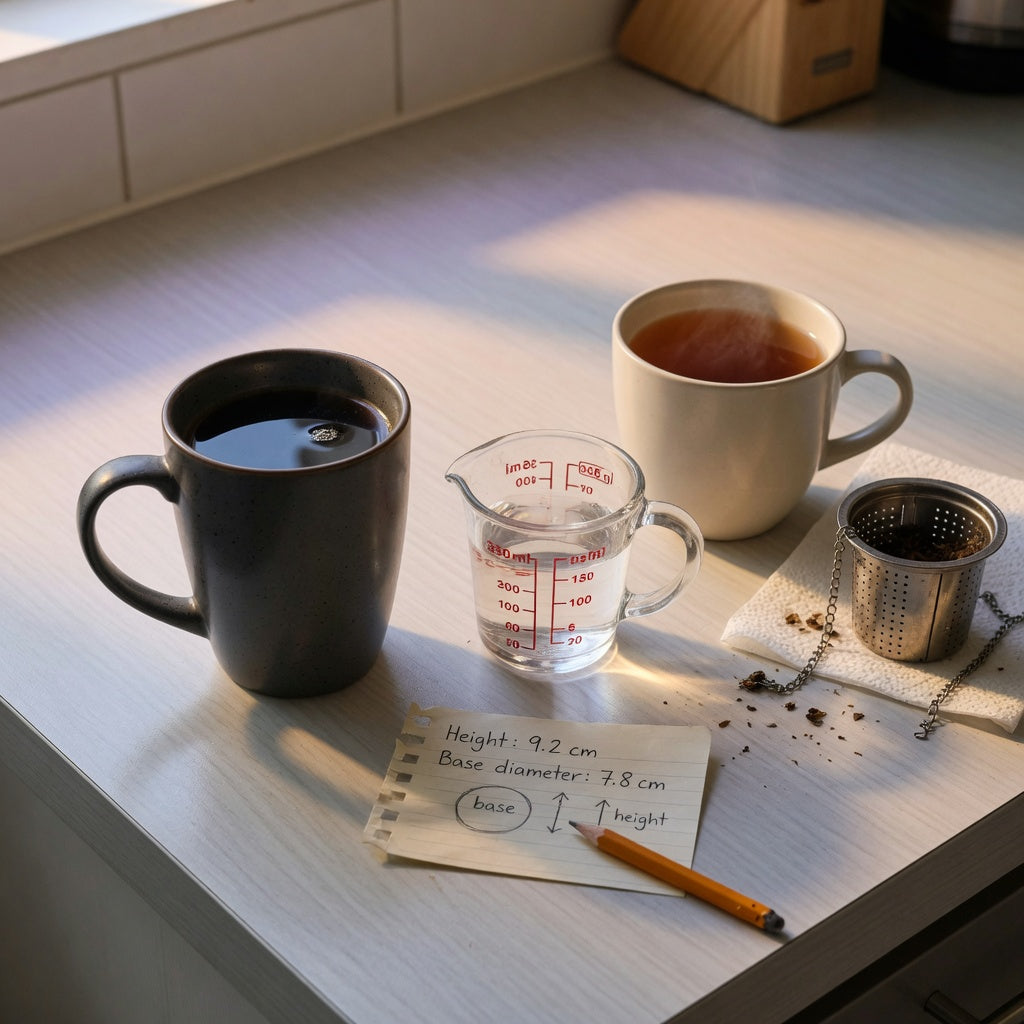
Everyday Coffee Tea Mug 350 ml: What Buyers Compare
Reading time: about 13 minutes
A customer unboxes a tall mug, fills it to the line they remember from the photo, and writes to us because the first step toward the desk left a ring on the counter. That miss shows up often with an everyday coffee tea mug 350 ml: the number in the title is brim-full capacity, not the volume you can carry. NIST Handbook 44 lists 1 US fluid ounce as 29.573 milliliters, so 350 ml is about 11.8 US fl oz. People still round that to 12 oz. In FDA pottery guidance, a cup or mug is small ceramic hollowware used for hot drinks such as coffee or tea. Those pieces normally hold about 240 ml, or 8 fl oz, and normally have a handle, though neither that size nor a handle is the only pattern that qualifies. A 350 ml mug sits about 110 ml above that example. It is a real daily size. It is not a cafe latte bucket, and it is not a travel bottle.
In our store, the catalog title on the Landscape Tall Coffee & Tea Mug includes 350 ml, and the word tall is part of that name. We treat the title as a starting point, not a finished spec sheet. Height, rim, base, handle opening, body material, and appliance marks have to be confirmed on the current listing. A styled photo will not settle them. If you are still choosing a shape, look through our unique coffee mugs, then run the checks below before you commit to one silhouette.
Brim-full 350 ml versus the pour you can walk with
Listings rarely split brim capacity from a comfortable drinking line. We do that split on the packing counter, because it changes which mug we recommend.
The liquid in a full 350 ml mug is about 350 grams if it is as dense as water, and that is before the clay. Headspace is not one fixed volume, because a wide rim and a narrow rim give up different amounts for the same gap under the lip. As a working illustration, holding back about 60 ml leaves near 290 ml, about 9.8 fl oz using the NIST factor. That is why a mug labeled 350 ml, or casually called 12 oz, can feel closer to 10 oz once you leave room to walk. The clay did not shrink. You left a gap so the first step would not mark a shirt.
How you drink decides whether that gap is a small tax or a reason to size up:
| How you drink | What 350 ml at the brim really gives you | When to look at a larger cup |
|---|---|---|
| Black coffee or plain tea | Most of the volume is usable if you keep a sip line below the rim | You want a long second cup in the same mug |
| Tea bag or basket infuser | The bag, swollen leaves, and room to lift them out all steal capacity | The basket is wide, or the leaf needs real depth |
| Coffee plus milk, or milk with foam | Headspace plus dairy means the coffee itself is well under 350 ml | You want about 350 ml of finished milky drink, not black coffee with milk forced in |
A 350 ml everyday mug is a poor match if your normal cup is coffee buried under milk and a thick foam cap. In that case we say so before checkout and point people toward a larger cup, often nearer 400-450 ml, rather than forcing dairy into this one. For straight coffee or tea at a desk, 350 ml is the size we see people finish before it goes flat in a wide bowl. How fill level and grip interact is covered in our note on fill, handle, and daily care for an everyday ceramic mug.
Will an everyday coffee tea mug 350 ml clear the machine, the shelf, and your hand?
Capacity does not predict fit. A short, wide 350 ml cup and a tall, narrow 350 ml cup hold the same liquid and fail in different kitchens. Tall can keep a smaller footprint on a crowded desk. Tall is also what hits the spout on a compact machine or the shelf above the mugs. The Landscape name includes tall. Confirm the actual height on the current page. Do not infer it from 350 ml.
Before we stand behind a fit, we ask customers to measure four things at home:
- Spout-to-tray height on the machine you own, with the drip tray where you actually leave it. A mug that clears a cafe machine can still jam a low pod machine.
- Shelf height, including the handle if you store cups upright. A mug you have to lay on its side will chip the rim against the shelf.
- Rim diameter for drinking, and base diameter for a car holder or a small coaster. Holders are often cut for tapered travel cups. A wide ceramic base, under a tall body plus a full pour, feels top-heavy and may not sit at all.
- Handle opening. Two fingers is the complaint we hear most. A full mug wants three fingers or a real grip. A thin ribbon handle can also feel sharp on the fingers even when the clay itself is not scalding. Do not judge that gap from a styled photo.
Write the numbers down. If the listing omits them, capacity alone cannot prove the mug will clear your machine or sit in a holder. We go further into height and ounce math in height and ounce fit on a tall 350 ml ceramic mug. Those notes describe the category. They are not a promise that every tall 350 ml piece shares one set of dimensions.
Desk clay versus a lidded 350 ml commute cup
An open mug and a 350 ml insulated travel mug can share a number and still solve different mornings. Single-wall ceramic, porcelain, or stoneware sheds heat. That is fine when you are at the keyboard and will finish the cup, or when you plan to reheat a last third. It is a bad deal if the mug goes into a bag, a car door, or a cold office for two hours.
A vacuum wall holds temperature longer. It also hides the surface of the coffee, can mute aroma, and usually cannot go in a microwave once there is a metal liner. Read the lid claim closely. Plenty of travel mugs sold as leak-proof are only splash-resistant while they stay upright. Tip one in a tote and the seal tells the truth. We would not hand you an open desk mug for a bag commute.
What a daily handled mug is not good for:
- A commute where the cup cannot stay upright
- Holding heat for hours with no reheat
- Oven baking, or anything that needs an oven-safe mark. A drinking-cup label is not an oven label
- Iced drinks beside a laptop with no coaster. Once the ice melts, the outside still sweats
Material still matters on the desk, and it is a listing fact, not a guess from shine:
- Porcelain is often thinner and lighter. A thin rim chips when it kisses a faucet or another cup in the rack.
- Stoneware is often thicker. Empty weight goes up, the wall feels warmer in the hand, and a full pour plus that clay can feel heavy if your grip is small.
- Neither body is insulated. Both cool faster than a vacuum mug. We will not quote a minute count. A fair, cited side-by-side for this exact size is rarely published, and one maker's wall thickness does not transfer to the next mug.
If your pattern is brew, sit, finish, start with a handled mug in this size and confirm the handle on the listing. If the pattern is brew and leave, buy insulation. Do not ask glaze to do a vacuum bottle's job. Glossy glaze can sit on porcelain or stoneware, so read the named material instead of judging the photo.
Dishwasher cycles, rim chips, and prints that fade
A dishwasher-safe icon is not a promise that the artwork will look the same after a year of cycles. Makers rarely say whether the color is inside the glaze or a surface decal. In our experience the first failure is quiet: a dull patch on a dark print, a lifted corner on a decal, or a chip where two rims tapped in the rack. The body can still look intact.
A few habits change how long an everyday mug stays pleasant:
- Rack it so the rim and handle do not touch another cup. Most chips we see start there, not in the wash water.
- If the only claim is dishwasher safe and the decoration sits on the surface, use a gentler cycle. A very hot dry is a guess when the maker is silent on artwork.
- Stop using the mug for hot drinks when the interior chips, cracks, or the glaze crazes and starts to stain. Scrubbing does not restore a damaged surface.
FDA advice on traditional pottery is a useful house rule even for a modern daily cup. Washing or boiling does not remove lead from a glaze. Pottery labeled not for food use, or that is antique, damaged, or of unknown origin, should not cook, serve, or store food and drinks. A hairline you barely see still counts as damage.
Microwave labels, metal rims, and water that can erupt
People reheat the last third of a 350 ml cup more often than they admit. That is reasonable with the right mug and a bad idea with the wrong one.
Microwaves bounce off metal and pass through glass, paper, and ceramic. A plain glazed cup can work. A gold or silver rim should stay out. Reflected energy can heat unevenly and can damage the oven. USDA says to use only cookware made for microwave use. Suitable glass and ceramic are usually labeled that way. China with metallic paint or trim is called out as unsafe, and so are foam-insulated cups. FDA also says not to heat food or drink on melamine. Heat only in ceramic or other ware specified as microwave-safe.
Check the mug in your hand, not the rest of a set:
- A microwave-safe mark on that piece
- No metallic band, no metal handle, no stainless liner
- No crack, no crazing you can feel, no interior chip
For an unmarked thrift-store find, USDA's check is practical. Set the empty piece in the microwave beside a cup of water, not touching it, for one minute. If the test piece comes out warm or hot, it is taking energy because of metal in the body or the glaze, and it is not microwave safe. For anything we sell, read the listing. Do not run experiments on a new mug to discover a metal rim the description should have named.
One more surprise. Water heated alone in a very clean cup can climb past boiling without bubbling. Move the cup, or tip in instant coffee, and it can erupt. Putting the coffee or the sugar in before you start cuts that risk sharply. Heat the drink, not a naked cup of water.
Lead and cadmium limits for a daily hot-drink mug
Pretty glaze and food-contact glaze are not the same purchase. FDA's lead action level for cups and mugs is 0.5 micrograms per milliliter of leaching solution, and any one unit in a six-unit sample can trigger it. That bar is tighter than 2.0 micrograms per milliliter for other small hollowware and 3.0 for flatware. In that guide, cups and mugs are the small hollowware people actually use for hot coffee and tea.
Cadmium has its own action levels: 0.5 micrograms per milliliter for flatware and small hollowware, and 0.25 for large hollowware. Hollowware there means ceramic ware with an internal depth greater than 25 mm. Because FDA already groups cups and mugs with small hollowware, the 0.5 figure is the cadmium reference that matches an everyday drinking cup, not the large-hollowware number.
A lead-free line on a product page is not, by itself, a test report. Ceramic that still releases extractable lead under the cup-and-mug method should not wear that label, and some ceramic foodware can leach lead into food. Bright vintage color, a piece sold as decor, or a mug with no maker and no food-use statement belongs on a shelf, not in the morning rotation. Tea makes a bad glaze obvious. Tannins darken crazed glaze, and a stained crack is both ugly and a reason to retire the cup. That side of the choice is in our piece on glaze, handle, and care on a 350 ml ceramic tea mug.
We will not stamp a food-contact, lead-free, or cadmium-free claim onto the Landscape mug from the catalog title alone. Unless the current listing states how the interior is finished and what it claims, treat that status as an open question before it becomes a daily hot-drink cup.
Measurements to demand when the listing only says 350 ml
When a page gives you one number, this is the list we want filled in before checkout. It is the same list we use when a gift order has to survive a real kitchen, not a product photo.
- Is 350 ml brim-full, and is that to the lip or to a fill line the maker actually uses?
- Height, rim diameter, base diameter, and the clear opening inside the handle.
- A named material, such as porcelain, stoneware, or bone china, written in the listing rather than guessed from a photo.
- Dishwasher language that mentions the decoration, not only the clay.
- A microwave statement, plus any metal on the rim, handle, or liner.
- Food-contact wording. Decorative is a no for coffee and tea.
- Empty weight, if a heavy hand feel bothers you. A full pour adds about 350 grams when the drink is as dense as water.
- Interior diameter and depth if you drop in a basket infuser. Loose leaf fails in a mug that looks roomy until the basket wedges.
Desk black coffee or plain tea, finished while you sit, is the situation this size is built for. Open the Landscape listing and match height, base, handle, and care icons to your machine and your rack. If the shape is wrong, or you need a wider bowl for milk, the unique mug collection is the faster way to compare other everyday silhouettes with the same checklist.
Frequently asked questions
Is an everyday coffee tea mug 350 ml enough for morning coffee with milk?
For black coffee or plain tea, 350 ml is about 11.8 US fl oz at the brim, roughly 110 ml more than the FDA's typical 240 ml cup example, so many people find it enough. Milk, foam, a tea bag, or an infuser all reduce the drink you can pour without spilling. If you want 350 ml of finished latte, choose a larger mug instead of forcing dairy into this one.
Why does a 350 ml or 12 oz mug feel closer to 10 oz when I fill it?
The labeled figure is usually brim-full, and 350 ml converts to about 11.8 fl oz, not a flat 12. Holding back about 60 ml of headspace, as an illustration, leaves near 290 ml, about 9.8 fl oz. Wide and narrow rims give up different volumes for the same gap, but the comfortable line always sits lower than the lip.
Will this 350 ml mug fit under a home espresso machine or in a car cup holder?
Not from the capacity alone. Measure spout-to-tray height against the mug's height, and measure base diameter against the holder you use. Tall bodies are often too wide or too top-heavy for holders made for tapered travel cups. Confirm those dimensions on the current listing before you buy.
Can I microwave a ceramic or stoneware mug just because it holds 350 ml?
No. Size has nothing to do with it. You need a microwave-safe label on that mug, no metallic trim or metal handle, no stainless liner, and no melamine. Foam-insulated cups are not microwave safe. Skip cracked or crazed glaze, and do not heat water alone in a very clean cup. It can superheat and erupt when you move it or add instant coffee.
Does dishwasher safe mean the print on a 350 ml mug will not peel?
It means the maker says the mug can go in the machine. It often says nothing about a surface decal. Color fired into the glaze usually holds up better than a print sitting on top. An interior chip, crack, or stain-holding craze is a reason to stop using that mug for hot drinks, even if the exterior art still looks fine.
Ready to pick your mug? Two ways to save on today's order:
Ordering 1–3 mugs? Get an extra 10% off your 1st order with code 10_OFF Apply 10% Off & Shop Wooden-Handle Mugs →
Gifting 4+ mugs? Buy 3, Get the 4th Free applies automatically at checkout (no code needed; offers do not stack) · Free standard shipping (Nov pre-Christmas delivery: 15–20 calendar days US) · Free replacement if chipped in transit.
Popular mug buying guides: Ceramic Tea Cups & Infuser Mugs · Ceramic Mugs with Lids Compared · Wooden-Handle Tea Infuser Mugs Compared · Christmas & Secret Santa Mugs 2026 · Espresso & Cortado Cups Guide · Cup & Saucer Gift Sets · All 25 Mugs Spec Table · Mug Size Guide · Shipping & Promo FAQ
FIRST ORDER 10% OFF (CODE: 10_OFF) · OR BUY 3, GET THE 4TH FREE


Read more
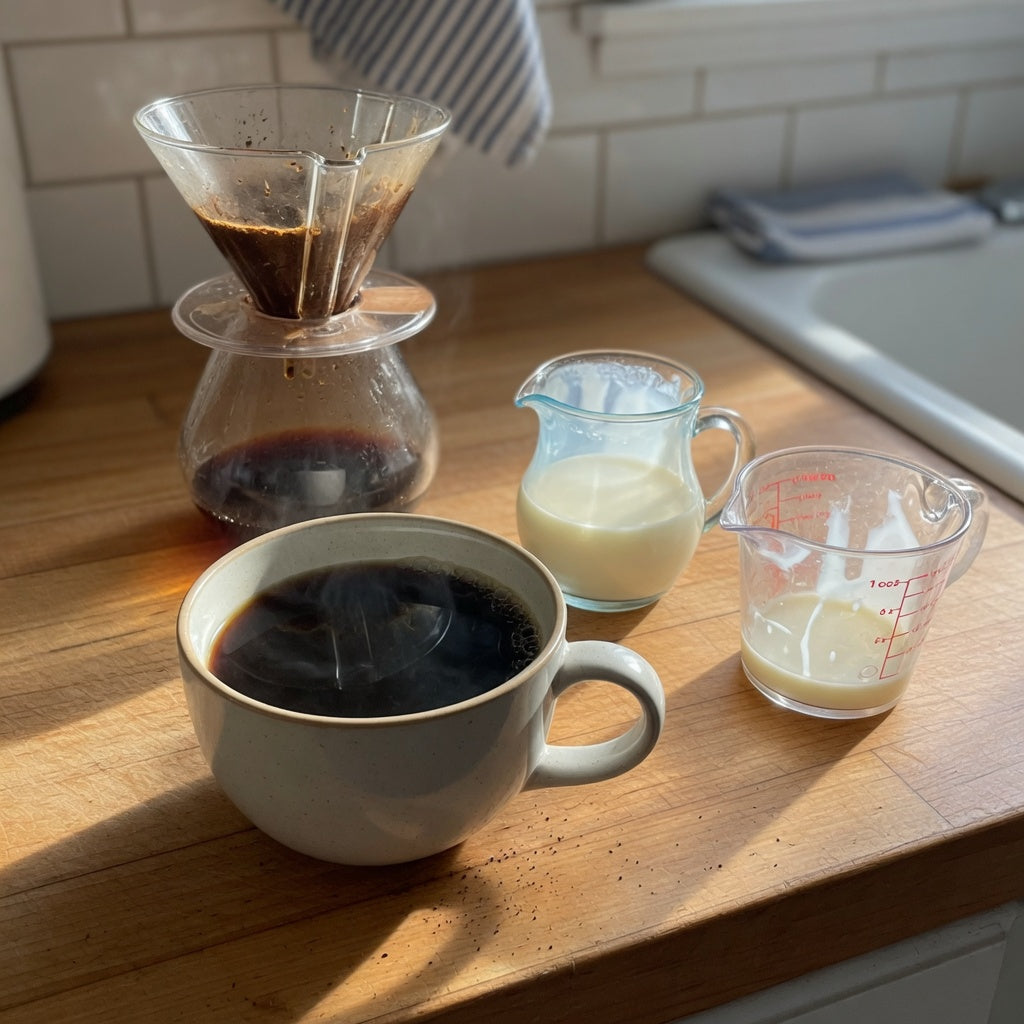
Large Mug for Morning Coffee: Ounces, Grip, and Fit
A large mug for morning coffee is not one official size. Compare brim capacity with a real pour, cream room, handle and weight, brewer clearance, and the listing facts worth confirming.
Read more
Small Retro Coffee Cup Gift: Size, Safety, and Fit
Shoppers hunting a small retro coffee cup gift are often choosing between a true small cup and a standard mug with vintage art. We compare capacity, drink fit, food-use labeling, and care so the pr...
Read more
Leave a comment
This site is protected by hCaptcha and the hCaptcha Privacy Policy and Terms of Service apply.