



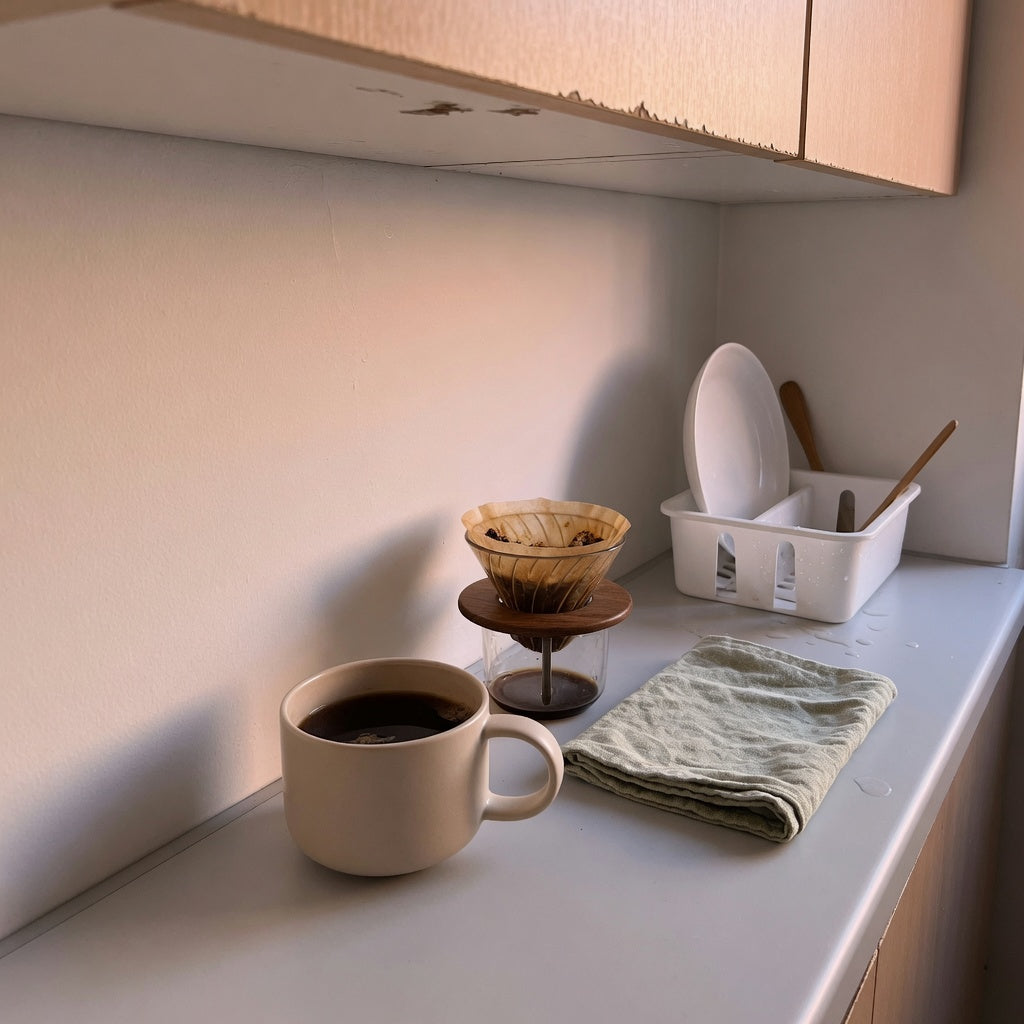
Everyday Ceramic Mug for Apartment Counter: 6 Fit Checks
Reading time: about 11 minutes
A 24-inch run of apartment counter has to hold the coffee maker, the drying rack, and the mug you grabbed half awake at 6:40 a.m. That mug never really gets put away. It sits out, dries upside down, gets refilled, and holds the same square of quartz all day. So an everyday ceramic mug for apartment counter duty is not about which one looks best on a styled shelf. It is about which one fits the pour, clears the cabinet, and feels balanced when it is full.
We handle drinkware daily in our store, and the shapes that get bought twice tend to be the boring ones with honest proportions. Stated capacity you can trust. A handle that takes real fingers. A base that sits flat. Decoration is a bonus, not the reason the mug works.
How much counter does an everyday ceramic mug for apartment counter life actually eat?
Look at the mug as a footprint, not a circle. Body diameter is only half the story. Handle projection, base ring, and overall height decide whether the mug sits beside the sink or becomes an obstacle you move twice a day.
- Width including the handle. This is the real counter footprint. A slim body with a wide handle can crowd a narrow run more than a slightly wider mug with a tucked handle.
- Height under the spout. Measure from the counter to the lowest point of your coffee spout, then compare it with the mug height plus any thick foot. A tall mug that will not clear the machine is a counter ornament.
- Base ring and foot. A flat, wide foot sits steadier on tile and quartz. An unglazed foot is rougher and can leave a dull scratch ring, so use a coaster if your counter is laminate or butcher block.
- Upside-down clearance. If the mug dries on an open rack or shelf, a handle that sticks out can hit the shelf above and waste air space you do not have.
Write down three numbers before you read another listing: free width beside the sink or machine, clearance from counter to the bottom of the upper cabinet, and distance from counter to the lowest part of the spout. In our experience, most regret starts with one of those three measurements, not with the glaze color.
Which capacity and empty weight should you compare for one mug that stays out?
Ounce numbers are not standardized across listings. The FDA describes a typical cup or mug as small ceramic hollowware of about 240 mL, roughly 8 fl oz, used for hot drinks like coffee or tea. Plenty of daily mugs sold now run larger than that. Treat the stated ounces as a brimful measure unless the listing says otherwise, then subtract headspace.
| Drink style | Capacity signal | What to verify first |
|---|---|---|
| Short black coffee or a small tea | A modest mug keeps the last third warm | Usable fill and rim comfort |
| Drip with milk, or a long steep | Extra headspace for milk and a spoon | Stated ounces versus brimful, height under spout |
| Carried to a desk or sofa | Handle opening and empty weight matter most | Full-mug balance, spill risk without a lid |
Leave roughly half an inch of headspace. A mug filled to the lip is a mug you carry with your eyes down.
Empty weight is the other half of the math. A thick-walled mug plus a full pour is a different lift than a thin cup, especially on the walk from kitchen to desk. If grip strength is a factor for you, a lighter mug with a generous handle usually beats a big mug with a small opening.
Honest limitation: ceramic is not a thermos. If you need coffee hot for an hour, an insulated tumbler will outperform any open ceramic cup, and no glaze changes that.
Does the handle take three fingers, and does the base stay flat when the mug is full?
Hand feel is where product photos fail by omission. A mug can look balanced and still tip forward when filled, or look generous and pinch your knuckles. Four things decide whether a shape becomes daily or fussy.
- Handle opening. Room for three fingers without knuckles pressed to the body is the minimum. Four fingers is better for large hands or a heavy pour.
- Rim thickness. A thin, rounded rim tends to feel cleaner and drip less. A thick rim that flares outward can send coffee down the side.
- Balance point. Fill it with water and hold it one-handed at the handle. If it nose-dives, you will notice that every single morning.
- Base stability. Set it on a hard counter and press one edge. A rocker means a warped foot or a bad fit, not rustic charm.
Do that water test the day the mug arrives, not in month three. A mug that wobbles on day one only gets worse after a few trips through the dishwasher.
Are dishwasher and microwave marks on a ceramic mug the same promise?
No. A dishwasher-safe claim does not prove microwave safety, and a microwave-safe claim says nothing about how a printed design will hold up under detergent and hot water. Those are different tests: glaze durability, thermal shock, and decoration adhesion.
- Metallic trim and decals. Gold rims, metallic prints, and some surface decorations can arc in a microwave. If the exact mug is not marked microwave safe, reheat the coffee in another vessel.
- Printed designs. A dishwasher can dull or wear a print even when the ceramic body survives fine. Hand washing protects the look, but it will not make an unsafe glaze safe.
- Thermal shock. Pouring hot coffee into a mug that just came out of a cold rinse is its own risk with any ceramic. Warm the mug first if it has been sitting in a chilly cabinet.
The California Department of Public Health also notes that a dishwasher can damage a leaded glaze, which makes later leaching more likely, and that lead may contaminate other dishes in the same load. That is one more reason to read the care mark on the exact piece rather than the collection page.
Our routine: dishwasher only when the base mark or listing says so, hand wash anything with metallic trim, a fine print, or an unknown glaze history. Ten seconds at the sink is cheaper than replacing a worn favorite.
What lead and cadmium checks matter before a mug becomes your daily cup?
This is the part buyers skip because the mug looks normal. Glaze chemistry is invisible.
Under FDA Compliance Policy Guide Sec. 545.450, cups and mugs carry an action level of 0.5 micrograms of leachable lead per milliliter in any one of six units tested. Under CPG Sec. 545.400, small hollowware under 1.1 liters carries a cadmium action level of 0.5 micrograms per milliliter, with ASTM C738 named among the accepted test methods. Those are regulatory action levels, not a decorative badge, and they do not make every mug on the market identical.
Two phrases get blurred. Lead free should mean the piece contains no lead; FDA guidance says ware should not be labeled that way if extractable lead shows up under the CPG method. Lead safe can mean a piece may contain some lead while staying within California Proposition 65 leaching standards. If a listing uses either term, ask which piece, which color variant, and what test basis.
Higher-concern pieces for daily hot drinks include vintage dishware, antiques, damaged or heavily worn glaze, handmade ware from an unknown maker, flea-market finds, and bright orange, red, or yellow decoration of uncertain origin. FDA notes that properly fired commercial ware for everyday use is much less likely to have a lead problem, and that washing or boiling cannot remove lead from pottery. Under 21 CFR 109.16, decorative ceramicware that looks food-safe is treated as foodware unless it carries a conspicuous warning such as Not for Food Use. If a mug is marked decorative, keep it off the coffee shelf.
Heating speeds leaching, according to CDPH, and longer storage pulls more lead into the drink. So a questionable mug is the worst choice for microwaved coffee you sip over an hour.
Crazing, a chipped rim, or a coffee stain: retire it or keep drinking?
Crazing is the fine web of cracks in glaze, and it is a watch item rather than an automatic emergency. Coffee oils settle into those lines and leave a brown map that no scrubbing fully erases. A baking soda paste lifts the surface stain; it does not seal the glaze.
Retire the mug if the chip exposes rough, unglazed body, if you can feel a crack with a fingernail, or if the rim has gone sharp. For daily hot drinks, we would rather replace a damaged food-contact surface than test it for months. Chips are also where the dishwasher does the most damage, because water gets under the glaze edge and works it loose.
One mug or two identical mugs for a small apartment cabinet?
One mug is enough if you wash it daily and have a reliable drying spot. Two identical mugs win if you run the dishwasher every few days, make coffee for a guest, or just want a clean cup without thinking about it. The trade-off is cabinet space and visual noise. On an open counter, two mugs read as intentional; four read as a cafe setup you did not plan.
Our rule: buy the smallest number that covers your normal morning plus one backup. Living alone and hand washing daily? One good mug is not a compromise.
For a single mug on that open spot, start with our Round Coffee and Tea Mug. The round profile reads calm on a short counter, and a simple body is easier to keep clean. Check the current listing for stated ounces, exterior width including the handle, empty weight, and the care marks before you commit.
If you want the mug to look a little more deliberate on an open shelf, compare the Pleated Coffee and Tea Cup using the same checklist: handle opening, rim feel, base stability, and the care instructions for that exact piece. The pleated shape is a style decision; the handle and foot are the daily-use decisions. Browse the full unique coffee mugs collection to see both shapes side by side.
For more context on daily-driver shapes, our morning coffee ceramic mug comparison covers rim and handle feel, and the oversized mug capacity guide is worth reading if you are tempted by a 16 oz body.
What is the five-minute counter checklist before checkout?
Put the mug on your actual counter in your head, not on a styled shelf. Then run this list.
- Measure the open run beside the sink, coffee maker, or drying rack, and subtract the mug width plus handle.
- Check spout and cabinet clearance against the mug height, including any thick foot.
- Confirm usable capacity by deciding how many ounces you actually pour, then allowing headspace.
- Read the care marks for that exact piece instead of the collection page.
- Ask about the food-contact glaze statement and the test basis behind a lead-free or lead-safe claim.
- Plan the resting spot for the mug: upside down on a rack, on a coaster, or inside a cabinet. No spot means it lives in the sink.
Frequently asked questions
Is a 12 oz everyday ceramic mug for apartment counter use too big?
Not automatically. Twelve ounces is often a brimful figure, so the usable pour drops once you leave headspace for milk. Check the mug height against your single-serve spout and hold a full mug before deciding. If you drink a short 8 oz coffee, a smaller body usually feels tidier.
Can a ceramic mug with a printed design go in the dishwasher?
Only if that exact mug is marked dishwasher safe. A dishwasher can dull or wear a print even when the ceramic body comes through fine. Hand wash anything with metallic trim, a delicate print, or no clear care mark.
Does crazing or a small rim chip mean I should stop using the mug?
Crazing is a web of glaze cracks and worth watching, not an automatic alarm. A chip that exposes rough body, a crack you can feel, or a sharp rim is a retire signal. For daily hot drinks, replacing a damaged food-contact surface is the safer call.
Is lead-free the same as lead-safe on a mug listing?
No. Lead free should mean the piece contains no lead. Lead safe can mean a piece may contain some lead while staying within California Proposition 65 leaching standards. Ask which piece and which test basis before you assume either label covers your mug.
Will a round mug fit under a single-serve coffee machine?
It depends on mug height and spout clearance, not on the shape. Measure from the counter to the lowest point of the spout, then compare that with the mug height plus its base. If the gap is tight, a shorter, lower-profile mug is the safer pick.
More from our blog
Ready to pick your mug? Two ways to save on today's order:
Ordering 1–3 mugs? Get an extra 10% off your 1st order with code 10_OFF Apply 10% Off & Shop Wooden-Handle Mugs →
Gifting 4+ mugs? Buy 3, Get the 4th Free applies automatically at checkout (no code needed; offers do not stack) · Free standard shipping (Nov pre-Christmas delivery: 15–20 calendar days US) · Free replacement if chipped in transit.
Popular mug buying guides: Ceramic Tea Cups & Infuser Mugs · Ceramic Mugs with Lids Compared · Wooden-Handle Tea Infuser Mugs Compared · Christmas & Secret Santa Mugs 2026 · Espresso & Cortado Cups Guide · Cup & Saucer Gift Sets · All 25 Mugs Spec Table · Mug Size Guide · Shipping & Promo FAQ
FIRST ORDER 10% OFF (CODE: 10_OFF) · OR BUY 3, GET THE 4TH FREE


Read more

Mountain Sea II Mug Buying Checklist: What to Compare First
A working Mountain Sea II mug buying checklist for shoppers comparing the 450 ml ceramic body, wooden handle comfort, care wording, and gift fit — including the questions the current listing leaves...
Read more
Unique Espresso Cups Home Office Product Shortlist Guide: 3 Picks
Three compact ceramic cups and the desk routine each one actually suits, plus the capacity, fit, crema and food-safety checks worth making before a distinctive cup earns permanent counter space.
Read more
Leave a comment
This site is protected by hCaptcha and the hCaptcha Privacy Policy and Terms of Service apply.