



Best Everyday Mug for Apartment Kitchen: What to Compare
Reading time: about 13 minutes
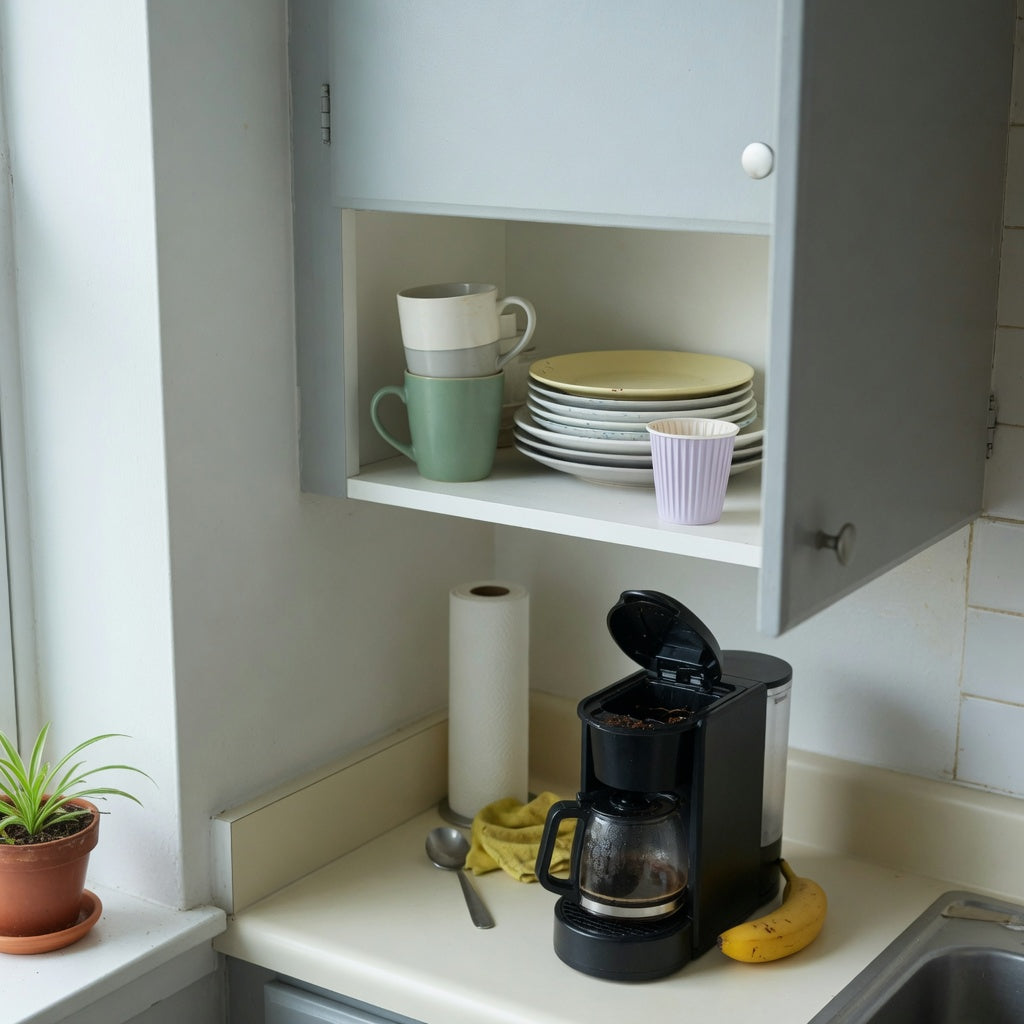
A rental kitchen rarely fails because the mug is ugly. It fails because the handle hits the cabinet door, the cup will not sit under a pod spout, or a half-finished coffee has nowhere to go except back in the microwave. In our store we see the same pattern: a shopper adds a fourth cup just in case, then asks which pieces a one-bedroom can actually keep. The best everyday mug for apartment kitchen use is the one that earns its footprint. A practical drink size. A grip you can manage one-handed. Care labels that match how you reheat and wash.
Shared shelves and a single sink make that job narrower than a gift-shop wish list. Color can wait until the cup clears the cabinet, the brewer, and the washing you will still do on a Tuesday night.
What the best everyday mug for apartment kitchen shelves has to survive
Daily use here is one or two hot drinks, not a brunch service. The piece lives near a sink that may have no dishwasher, rides in a microwave that also warms leftovers, and has to return to a shelf already holding bowls. You will look at it every morning, so shape still matters. Storage and care decide whether it stays.
Before glaze color, we walk shoppers through the jobs that show up in real apartments:
- Cabinet footprint: body width plus how far the handle sticks out
- Usable capacity, not only the brim-full number printed on the box
- Dishwasher-safe and microwave-safe wording that covers the glaze, any print, and any metal detail
- A lip you can sip from, and a handle that keeps fingers off a hot wall
- Food-contact use for hot coffee and tea, not a decorative piece pressed into service
A shaped cup can still be the daily one if those jobs check out. Shoppers who want something other than a plain cylinder often open our pleated coffee and tea cup. We do not treat the product name as a spec sheet. On the current listing, confirm capacity, material, handle shape, and any microwave, dishwasher, or food-contact wording before you decide it is the everyday mug. Also check whether the form nests, how wide the foot is, and whether a finger clears the handle. Missing lines are unanswered questions, not quiet yeses.
Unless that page says the pieces nest, do not buy a shaped cup as a stacking set. It can still earn a spot as the single mug you actually drink from, with the rest of the set kept small. To compare more forms the same way, start in our unique coffee mugs and judge each listing by the checks below, not by the photo alone.
Will stacking free a cupboard, or will the handles still collide?
Stacking saves a shelf only when the bodies nest and the handles do not fight each other. A straight side with a modest handle often stacks. A wide belly or a thick C-handle can sit fine alone and then become a tall, wobbly column. In a rental cabinet, that column tips the moment you reach for a plate.
We tell people to measure the empty shelf, not the mug in a lifestyle photo. Take three numbers with a tape:
- Interior cabinet depth, and the clear height between shelves.
- Mug diameter at the widest point, including any flare at the rim.
- How far the handle projects past the body.
Two mugs side by side, handles turned the same way, often take more width than a photo suggests. Stacking two high helps only if the lower rim can take the weight and the door still closes. If the handle hits the door or the next stack, the space-saving set becomes a counter pile.
Set size is the other leak. A one- or two-person apartment rarely needs more matching mugs than the people who live there, plus one spare for a guest. Extra gift mugs migrate to the counter, then crowd the drying rack beside a single sink. Shared kitchens get tense when one collection takes the whole drinkware shelf. Keep a small working set in the cabinet. Store sentimental cups somewhere else, or let them go.
Straight sides are usually the better storage bet when cabinet space is the hard limit. Buy a sculptural mug as one daily piece, not as a tower.
Is the listed capacity brim-full, or is there room for milk?
Listed capacity is often the volume filled to the rim. That is not the drink you can carry across the apartment without sloshing, and it is not the volume left after milk or a little foam. In our experience, shoppers who chase the biggest ounce number end up with a mug that misses a compact spout, plus a drink that cools before they finish it.
Match the mug to the drink you actually make:
- Black coffee or tea you finish in one sitting can live in a moderate cup, with headspace under the lip.
- Milk-heavy drinks need a wider bowl and more listed capacity, which usually means a bigger footprint.
- If you sip slowly, a lid or a mug warmer often beats upsizing. A larger open cup holds more liquid that goes lukewarm, and it steals shelf height.
Leave room under the rim. If the listing prints one number, plan to drink less than that once you stop short of the lip. The same question belongs on any candidate, including the pleated cup: does the ounce claim mean filled to the rim, and is there usable room for milk? Read the current page. Do not guess from the silhouette.
We go further on brim-full claims versus what you can finish in our piece on mug size for apartment coffee. Use it when two capacities are close and the cabinet is already tight.
Also check clearance under the brewer. Measure from the counter to the spout, then compare that gap with mug height, including any foot. A tall cup that looks right in a studio shot can hit a small pod machine. If it does not fit, you pour off to the side and lose the one-step morning the machine was meant to give you.
A wide mug can double as a soup or cereal bowl, which helps when you own fewer pieces. The trade-off is shelf width and a handle that may feel clumsy for a short tea. Do not force one giant bowl-mug to be your only cup if most mornings are a small coffee.
Stoneware, glass, or steel if the microwave is your reheater?
Material is a care decision, not a personality test. In the cups we handle, stoneware often feels heavier and more planted on a small counter. A thinner porcelain wall can feel easier in the hand, and a thin rim is easier to chip on tile. Neither name means microwave-safe or dishwasher-safe. The label decides, not the category.
Double-wall glass keeps the outside cooler and lets you see the drink. Thin glass is the piece we are least willing to call everyday on tile or concrete. If mugs get knocked off a narrow counter while you reach for the fridge, glass is usually the wrong daily piece.
Insulated steel holds heat longer and shrugs off drops better than ceramic. It fits a slow sip or a walk between rooms. It is the wrong call when you reheat a half-finished coffee, because metal does not belong in the microwave. With no dishwasher, steel can still be simple to rinse. You give up reheating entirely. That is a different purchase from the ceramic shapes on our shelves.
Do not warm coffee on melamine dinnerware. Heat drinks only in ceramic, glass, or other ware the maker marks as microwave-safe.
| Material | Microwave reheating | On a hard floor | Better apartment habit |
|---|---|---|---|
| Labeled ceramic | Only when marked microwave-safe | Can chip or crack | Daily coffee you reheat |
| Double-wall glass | Only when marked microwave-safe | Breaks more easily | Seeing the drink, if the counter is calm |
| Insulated steel | No | More forgiving of drops | Heat retention without a microwave |
| Melamine or unmarked plastic | Do not heat drinks on it | Varies | Not a reheating mug |
Choose labeled microwave-safe ceramic or glass when reheating is part of the morning. Choose steel when heat retention and drop resistance matter more than the microwave, and buy that piece for that job. For the ceramic checks we use before a cup stays on the working shelf, see our notes on a ceramic coffee mug for a small kitchen.
Which marks matter before hot coffee: microwave, metal, and lead?
Hot coffee every day is a food-contact job. Pretty and safe are not the same claim.
Use only ware made for microwave use. Suitable glass, ceramic, and plastic are usually labeled for the oven. China with metallic paint or trim is not. A gold rim, a silver logo, or a metallic decal stays on the counter while you reheat.
For an unlabeled cup you already own, set it beside a cup of water, not touching it, and run the oven for one minute. If the mug comes out warm or hot, it is not microwave-safe, because that result points to metal in the material or the glaze. A mug that stays cool still tells you nothing about lead.
Lead can sit in some glazes and printed decorations. When pottery is not made and fired properly, that lead can move into coffee or tea. Washing and boiling will not pull it out. If a piece says it is not for food, do not cook, serve, or store drinks in it. Ornamental ceramicware that looks usable is supposed to carry a not-for-food-use warning, or have a hole through the surface that would hold a drink. A hole or that warning means decor. Do not drink from it.
Factory-made everyday tableware is much less likely to have lead problems than rough handmade pieces, antiques, worn or damaged glaze, flea-market goods with no maker, and ware decorated in bright orange, red, or yellow. Less likely is not a promise. The FDA has reported traditional pottery labeled lead free that still released lead comparable to lead-glazed pottery, and in some cases above the action levels used for ceramic tableware. For cups and mugs, the FDA action level is 0.5 micrograms of lead per milliliter of leaching solution.
California public health guidance adds a kitchen warning. Heat can speed leaching, so do not microwave or cook in a dish that contains lead or might contain it. A dishwasher can damage the glaze on leaded ware, which can make later leaching more likely and can contaminate other dishes in the same load.
What we look for before a mug becomes the daily one:
- A clear food-use intention, not a decorative-only warning or a hole in the wall
- No metallic rim or paint in the microwave path
- Care marks that match how you actually reheat and wash
- Extra caution with antiques, damaged glaze, unknown imports, and vivid orange, red, or yellow decoration
- Retirement of any cup with a chipped rim or cracked glaze
We will not invent a lab result for the pleated cup if the current listing does not state one. If safety language is absent, that question is still open.
Can you carry it one-handed from the machine to the couch?
Apartment drinking is mobile. The mug goes from the machine to the table, sometimes to the couch. A handle that looks generous in a photo can still be too narrow for two fingers, or so wide that a full mug twists in the hand.
- Finger clearance between handle and wall, so skin stays off a hot body
- Enough thickness that the handle does not cut into a finger under a full pour
- Balance: a heavy base feels planted; a very wide bowl tugs on a one-handed carry
A slightly rounded lip is kinder for all-day coffee and tea than a sharp, thin rim. Weight is a trade-off. Heavier ceramic feels stable on a small counter and tires the wrist on a long carry. Very light ware feels easy until it chips. If the morning stays in one room, lip and handle comfort matter more than travel insulation. Drying space beside the kettle is its own fit, which we covered for a ceramic mug on an apartment counter.
What changes when the apartment has no dishwasher?
No dishwasher changes the buying math. A dishwasher-safe mark still helps, because it tells you the maker expects the glaze and decoration to face heat and detergent, even if the building has no machine. Hand washing has to be realistic on a weeknight, not only on move-in day.
Coffee and tea stain a crazed or worn surface faster than a smooth, intact glaze. A brown ring at the waterline shows up fast when every piece is on display. If the cup has ribs or pleats, ask whether residue sits in the texture and whether the listing says to hand-wash it. Use a non-scratch sponge. An abrasive pad dulls glaze.
Skip the microwave for steel and for any ceramic with metal. Do not put a chipped or cracked cup back into hot-drink service. Stains settle in the crack, and damaged glaze is a worse place for coffee. Washing will not remove lead from a suspect glaze, and a dishwasher can make damaged leaded ware a problem for the rest of the load.
An open kitchen mug is not a leakproof commute cup. Buy a lidded travel mug for the train. Buy a warmer if the problem is slow sipping, not volume. A bigger ceramic you will not finish does not fix a drink that goes cold.
The checks we run before another mug joins the shelf
Use this on the product page, including the pleated coffee and tea cup and any other shape you are comparing:
- Measure shelf depth, shelf height, and spout clearance. Compare them with diameter, height, and handle projection.
- Set the count at the people in the apartment, plus one spare. Stop there.
- Read capacity as brim-full unless the listing says otherwise. Leave headspace for milk.
- If you reheat, stay with labeled microwave-safe ceramic or glass. If you do not, steel is a separate buy.
- Keep metallic trim out of the microwave. Use the water check only for microwave behavior, not as a lead test.
- Prefer intact food-use ware. Skip decorative-only pieces and worn antiques for hot drinks.
- Check the handle against your grip, and the lip against daily sipping.
- If there is no dishwasher, pick a surface you will actually wash by hand, and retire chips early.
If the listing does not answer material, ounces, stacking, or appliance safety, leave that cup off the everyday shelf until you can confirm. Run that list and you will know whether a cup is the best everyday mug for apartment kitchen duty or just another object on the counter. Open the listing, or compare shapes in the collection, and keep only the piece that clears it.
Frequently asked questions
What should I compare to find the best everyday mug for apartment kitchen use?
Start with cabinet footprint, including how far the handle sticks out, then usable capacity rather than a brim-full ounce claim. Confirm microwave and dishwasher wording, keep metallic trim out of the microwave, and do not drink from decorative-only ware. A cup that fails the shelf or the safety label is not an everyday mug, no matter how the photo looks.
Will stacking mugs save space if the handles are large?
Only if the bodies nest and the handles do not block the stack or the cabinet door. Measure shelf depth and handle projection before you buy a set. A wide or sculptural cup usually works better as one daily piece than as a tall stack.
How can I tell whether an unlabeled mug is microwave-safe?
Prefer a piece labeled microwave-safe, and keep metal paint or trim out of the oven. For a cup you already own, heat it for one minute beside a cup of water, without letting the two touch. A mug that comes out warm or hot is not microwave-safe. That check does not tell you whether the glaze contains lead.
Does washing a ceramic mug remove lead from the glaze?
No. Washing, boiling, and other home cleaning do not remove lead from pottery. Do not serve drinks in pieces marked not for food use, and do not heat food in dishes that contain or might contain lead. Retire chipped or cracked glaze instead of scrubbing it harder.
How many everyday mugs does a one-bedroom kitchen need?
One per person plus a single spare covers daily coffee and a guest without taking the plate shelf. Extra gift mugs belong in storage or with someone who has the cabinet for them. If coffee goes cold because you sip slowly, a lid or a mug warmer is a better fix than a bigger set.
Ready to pick your mug? Two ways to save on today's order:
Ordering 1–3 mugs? Get an extra 10% off your 1st order with code 10_OFF Apply 10% Off & Shop Wooden-Handle Mugs →
Gifting 4+ mugs? Buy 3, Get the 4th Free applies automatically at checkout (no code needed; offers do not stack) · Free standard shipping (Nov pre-Christmas delivery: 15–20 calendar days US) · Free replacement if chipped in transit.
Popular mug buying guides: Wooden-Handle Tea Infuser Mugs Compared · Christmas & Secret Santa Mugs 2026 · Espresso & Cortado Cups Guide · Cup & Saucer Gift Sets · All 25 Mugs Spec Table · Mug Size Guide · Shipping & Promo FAQ
FIRST ORDER 10% OFF (CODE: 10_OFF) · OR BUY 3, GET THE 4TH FREE


Read more
Ceramic Mug Gift Tray: Capacity, Care, and Safety
Shoppers searching for a ceramic mug gift tray often land on a serving set, a boxed mug, or a snack carrier. Compare stated capacity, separate care rules, glaze wording, and whether the box is actu...
Read more
Planet Mug for Coffee Lovers: What Buyers Should Compare
A planet mug for coffee lovers is a different buy for a desk than for a shared kitchen. We sort heat-reveal cups from printed ones, then list the capacity, Pluto, care, and drinkware lines to verif...
Read more
Leave a comment
This site is protected by hCaptcha and the hCaptcha Privacy Policy and Terms of Service apply.