



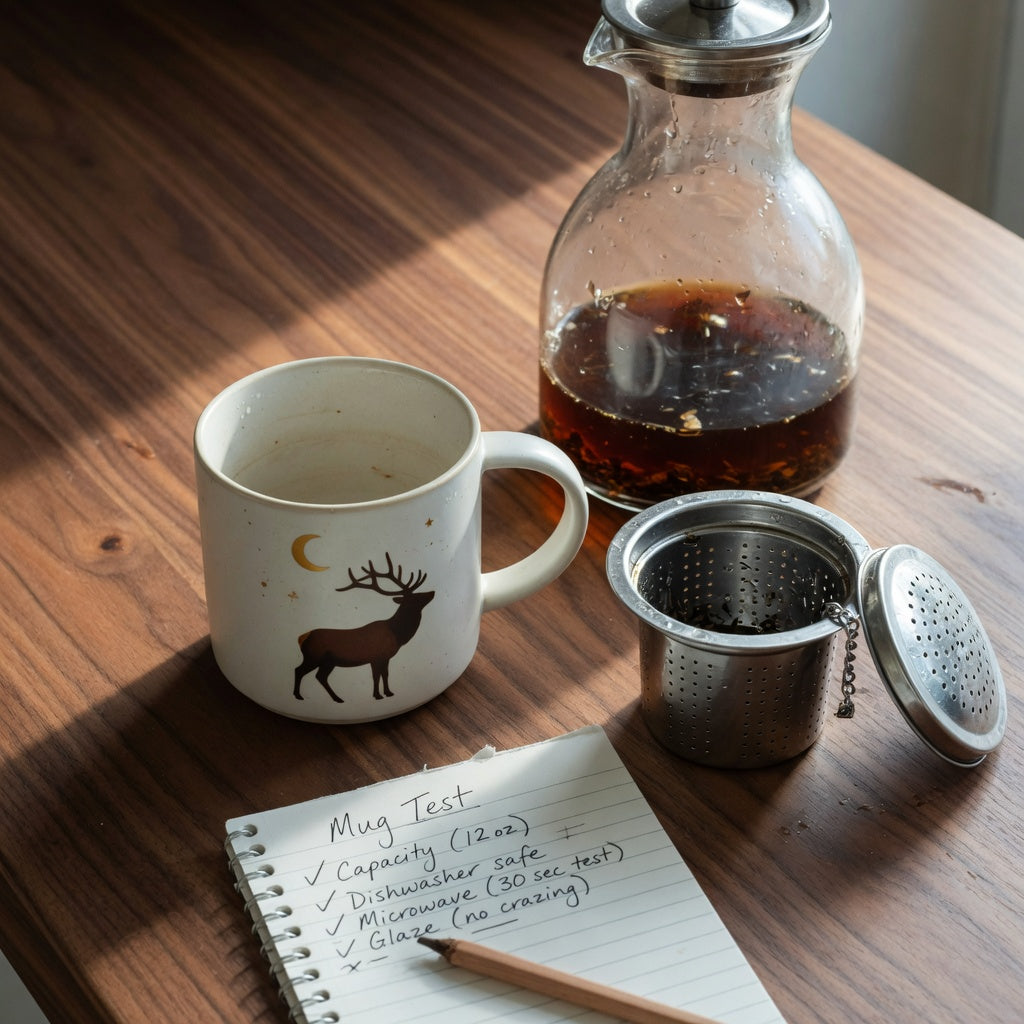
Elk and Moon Coffee Tea Mug Buying Checklist: What to Compare
Reading time: about 12 minutes
What we keep seeing after a month of office dishwashing is rarely a broken handle. It is a pale crescent where the moon used to be, with the elk still sharp. That miss is what an elk and moon coffee tea mug buying checklist is meant to catch. The wildlife picture looked finished. Nobody checked the wash.
We pack illustrated drinkware in our store, and the question on the bench is rarely about the elk in the listing shot. It is whether the cup is sold for hot coffee or tea, and whether the decoration can survive the sink that buyer actually uses. The search does not point to one factory line with a published spec sheet. Printed ceramic, hand-painted stoneware, and tea mugs that may or may not include a lid all carry a similar night-sky idea. Start on the Elk and Moon Nature Coffee Mug and read only the lines that page states today. If the picture fits and the build might not, set it beside other shapes in our unique coffee mugs. A shared motif does not copy capacity, glaze, or care.
What should an elk and moon coffee tea mug buying checklist settle first?
Settle the job before the artwork. A weekday desk coffee, one loose-leaf steep, and a shelf gift fail in different ways. Our team asks four questions before we talk about the print.
- Who drinks from it? An adult daily cup is a different risk call than a mug a child may grab.
- What goes in it? Black coffee, milky coffee, and a long tea steep do not want the same opening, lid, or basket.
- How will it be washed? A quiet hand wash at home and a shared office machine are not the same test.
- How exact must the photo be? Handmade lots can pool glaze and shift the moon. A production print usually matches the photo more closely, and it can also be the surface that scuffs first.
Run the elk and moon coffee tea mug buying checklist against the live page, not against a memory of a similar cup. If an answer is still a guess, leave the motif in the tab. Silence on the page stays silence. We do not fill a blank from another wildlife mug.
Which listing lines can you confirm, and which stay blank?
Read the current product page the way we tell customers to read it. Confirm what is written. Then stop.
| Check | What a listing can show | What it usually cannot prove |
|---|---|---|
| Body | Ceramic, stoneware, porcelain, or another named material | Firing temperature, or how much water the clay absorbs |
| Capacity | A stated ounce or milliliter figure | The comfortable pour once you leave space under the rim |
| Care | Dishwasher, microwave, or hand-wash wording | That a gold line or printed face was part of that test |
| Artwork | One photo, both sides, or a note that pieces vary | Whether the elk is underglaze, hand-painted, or a surface print |
| Food contact | A food-use claim, a test note, or a decorative warning | Lead or cadmium results for the exact piece shipping today |
| Tea parts | A lid or infuser listed as included | Basket volume and mesh size when those numbers are absent |
Regulators describe cups and mugs as small ceramic hollowware, commonly used for coffee or tea above room temperature. They usually, though not always, hold about 8 fluid ounces (about 240 milliliters) and have a handle. A listing that states 11, 15, or 16 ounces is describing a larger serving than that usual picture. Those figures are not the fill of this mug unless the Elk and Moon listing prints them. Do not borrow an ounce count from a moon mug you liked on another site.
Brim-full capacity is not the walk from the kitchen counter to a laptop. Leave about a finger of headspace, or the first step spills. If the page lists height and diameter, compare them with a mug you already reach for. If it does not, treat hand comfort as unconfirmed.
When does glaze color fail as a food-safety test?
A pretty glaze is not a safety test. Lead in a ceramic glaze, or in the decoration, can move into a drink when the piece was not made and fired properly. For ceramic cups and mugs, the FDA lead action level is 0.5 micrograms per milliliter of leaching solution, applied to any one of six units tested. Cadmium guidance for small hollowware uses that same 0.5 micrograms per milliliter figure, again on any one of six units. You will not taste either result.
FDA compliance guidance cites ASTM C738, a method that extracts lead and cadmium from glazed ceramic with acetic acid. The extraction is described as severe, and unlikely to be matched in ordinary use. A documented pass means something. A product photo does not.
Outside art is not automatically out of the question. Paint or glaze that crosses the lip meets the drink. We slow shoppers down, and sometimes send them away, when a piece matches the problem types regulators flag:
- Handmade ware that looks crude or irregular, sold without a named food-safe glaze
- Antiques and thrift finds with an unknown firing history
- Chips, a worn lip, or glaze that has already crazed into a fine crackle
- Bright orange, red, or yellow decoration, which deserves a harder look than a quiet clear glaze
- Sellers who cannot say where the mug was made, or whether it is meant for food
Everyday factory pottery, FDA notes, is much less likely to carry lead problems than the handmade, antique, damaged, uncertain-source, and brightly colored pieces it tells shoppers to watch. That is consumer guidance. It is not a certificate for every printed elk, and it is not a lab result for our listing.
A lead-free label on imported or traditional pottery is not a guarantee. FDA has reported traditional pottery labeled lead free that still had extractable lead at levels comparable to, or above, ceramic action levels. Ware labeled lead free that still shows extractable lead on the cited test may be considered misbranded. A badge in the title is not the test. On our page, trust only the food-contact language that is actually printed there.
One peer-reviewed pilot found that lead from ceramic mugs can leach into coffee and tea. Measured lead in that study ranged from 0.2 to 8.6 micrograms per liter in coffee, and from below 0.2 to 1.6 micrograms per liter in tea. Those ranges are not a score for our catalog. They are a reason the interior matters more than the elk on the outside.
CDC's position is that children have no identified safe level of lead in blood, and that smaller exposures are still linked to problems with development, learning, and behavior. If a child may drink from the mug, a missing food-contact statement is a reason to choose a different cup.
A positive home screen for leachable lead is a hard stop. Do not cook, serve, or store food or drinks in that piece. Washing and boiling leave the lead in the pottery. Retire it from the drink cupboard.
Ceramic that looks like a drinking mug is still treated as foodware unless it carries a visible warning such as "Not for Food Use. May Poison Food," plus a permanent statement on the base, or a hole is bored through the surface that would have held the drink.
See that warning, and do not pour coffee or tea. The artwork does not cancel it. This motif is also the wrong buy when you need a published lead-and-cadmium report and the page has none. Go to a maker who shows the test, or pick a plain commercial cup whose seller will stand behind food use.
Dishwasher cycles, microwave heat, and a metallic moon
Food-safe, dishwasher-safe, and microwave-safe are three different sentences. Shoppers often fold them into one sticker. A mug can be fine for hot coffee and still be hand-wash only.
In our experience, a print sitting on the glaze scuffs sooner in a busy dishwasher than decoration fired into the glaze. Most listings never name the process. If the product page does not name it, we will not guess from the illustration. Hand wash until the maker says the decorated surface can take the machine.
Metallic paint is a fast way to hurt both a microwave and a gold moon. Metal can spark. Detergent and abrasion dull luster, platinum, and gold trim. Unless the current listing explicitly says that decorated version is microwave-safe, keep metallic accents out of the microwave.
Other wear we see after a few weeks on a real kitchen counter:
- A chip at the lip or the foot ring. Stop drinking from it. A chip cuts, and it gives soil a place to sit.
- Crazing, the spiderweb of fine cracks in the glaze. Coffee and tea stain it. On an older piece with an unknown glaze, that crackle is a reason to stop using it for food.
- A handle that feels fine empty and bites when the mug is full. Clearance for two fingers on an empty cup can still pinch a full one. We look for room for three fingers without a knuckle jammed on the wall.
- An exterior that runs hot. A thicker wall often feels steadier in the hand and can slow heat loss next to a thin cup. We will not quote minutes. No fair published timing lines up elk art, moon art, stoneware, porcelain, and double-wall cups.
If hot hands are the problem, a single-wall illustrated mug may be the wrong tool. Browse other builds in that collection instead of hoping one wildlife print will also insulate.
What this purchase is not good for: microwave reheating when a metallic accent is present or simply unconfirmed, a dishwasher you will not baby when the page says hand wash, and anyone who wants a measured stay-hot time. We do not have that measurement for this motif.
Coffee headspace versus loose-leaf basket room
Coffee buyers and tea buyers misuse the same ounce number. A coffee drinker wants one comfortable pour for the hallway between the pot and a desk. A loose-leaf drinker needs leaf room, and often a lid, so the steep does not cool on the counter while the basket is still in.
Use a stated capacity only as a starting comparison. Then look for these gaps on the page:
- You will almost never drink the brim-full number. Leave headspace so the walk stays clean.
- A lid may be in the box, or it may be a separate piece. A photo of a lid is not enough if the parts list omits it.
- If the listing never mentions an infuser, treat the mug as a drinking cup. Do not expect a basket in the tissue.
- Basket size is its own number. Leaves need space to open. A tiny mesh ball in a large cup still makes a cramped steep, often a bitter one. Mug ounces are not infuser ounces.
- Art on one side leaves the back blank. A right-handed drinker sees the face held outward. A left-handed drinker may stare at a plain wall all morning. Look for a second image, or the words both sides.
This is a poor fit when you regularly brew for two or three people. It is not a teapot. It is also the wrong pick if you already know you want a wooden handle or a ball handle. Those grips fail in their own ways, and an elk does not repair a handle you dislike.
For daily coffee, put a stated food-contact surface first, then a handle you can hold at full weight, then a care label that matches your real sink. For tea, put basket room and a lid ahead of the moon. If those tea parts are absent, do not add them at checkout.
A gift unboxing or a weekday desk driver?
Gift buyers and daily drinkers should not run this list in the same order. We pack both. In our experience, the mismatches are about the job, not a bad elk.
If it is a gift, put photo match, hand dominance, and a care note the recipient can follow without texting you. Handmade pieces vary. Say so on the card when the listing says pieces differ. A production print is more predictable, and sometimes flatter up close. Either can be the right present. A decorative-only mug is not a gift for someone who asked for a coffee cup. Size cuts the same way: an oversized mug is clumsy for one small tea, and a dainty cup annoys someone who refills a large serving.
If it is your weekday driver, invert the order. Interior you trust, washing you will really do, handle comfort at full weight, then artwork. A moon that fades in the office machine becomes an expensive coaster. A moon that survives only because you hand wash it is a good tool only if Tuesday night still includes a hand wash.
Skip this motif when you need published insulation times, a lab sheet the page does not show, a cup for a small child, or a travel lid for a commute bag. A shelf piece with a food-use warning should stay on the shelf. Nothing in the artwork repairs a chipped lip.
Frequently asked questions
What belongs on an elk and moon coffee tea mug buying checklist before I pay?
Confirm who will drink from it, the material the page actually names, the stated capacity, dishwasher and microwave wording, food-contact or decorative-only language, handle clearance, and whether the elk or moon art is on one side or both. If the page is silent, leave that box unchecked. Do not copy specs from a different wildlife mug.
Does a lead-free label mean this mug is safe for hot coffee?
Not by itself. Regulators have found traditional pottery labeled lead free that still leached lead at or above ceramic action levels, and that labeling may be treated as misbranded when extractable lead is present. Look for a real food-use statement from the maker, and skip chipped, antique, or uncertain pieces. A home test that flags leachable lead means you stop using the mug for drinks.
Will the dishwasher fade a printed elk or a metallic moon?
It can. Assume it will unless the listing says the decorated surface is dishwasher-safe. Surface prints and gold or metallic accents are the first details we see dull after repeated cycles. Fired-in decoration usually holds up better, but only when the seller states that process. If the care line says hand wash, believe it.
Is the listed ounce size the amount I can actually drink?
Treat the number as a stated or brim-full capacity, then leave headspace so coffee does not slosh between the counter and the desk. The everyday regulatory picture of a cup or mug is often about 8 fluid ounces, while some listings advertise a larger serving. Neither figure is the volume inside a tea infuser. Check whether a basket is included before you count on one.
Can I drink from a mug marked Not for Food Use?
No. A visible warning such as "Not for Food Use. May Poison Food," or a hole through the food-contact surface, marks the piece as ornamental. An elk, a moon, or a gift box does not change that. Choose a mug sold for food, with care steps you can follow on an ordinary weekday.
Match capacity, care, and food-contact language on the live product page to the way you actually drink, and order only if those three agree. If they do not, compare handles and shapes in the unique coffee mugs collection before you keep a motif that cannot do the job.
More from our blog
Ready to pick your mug? Two ways to save on today's order:
Ordering 1–3 mugs? Get an extra 10% off your 1st order with code 10_OFF Apply 10% Off & Shop Wooden-Handle Mugs →
Gifting 4+ mugs? Buy 3, Get the 4th Free applies automatically at checkout (no code needed; offers do not stack) · Free standard shipping (Nov pre-Christmas delivery: 15–20 calendar days US) · Free replacement if chipped in transit.
Popular mug buying guides: Ceramic Tea Cups & Infuser Mugs · Ceramic Mugs with Lids Compared · Wooden-Handle Tea Infuser Mugs Compared · Christmas & Secret Santa Mugs 2026 · Espresso & Cortado Cups Guide · Cup & Saucer Gift Sets · All 25 Mugs Spec Table · Mug Size Guide · Shipping & Promo FAQ
FIRST ORDER 10% OFF (CODE: 10_OFF) · OR BUY 3, GET THE 4TH FREE


Read more
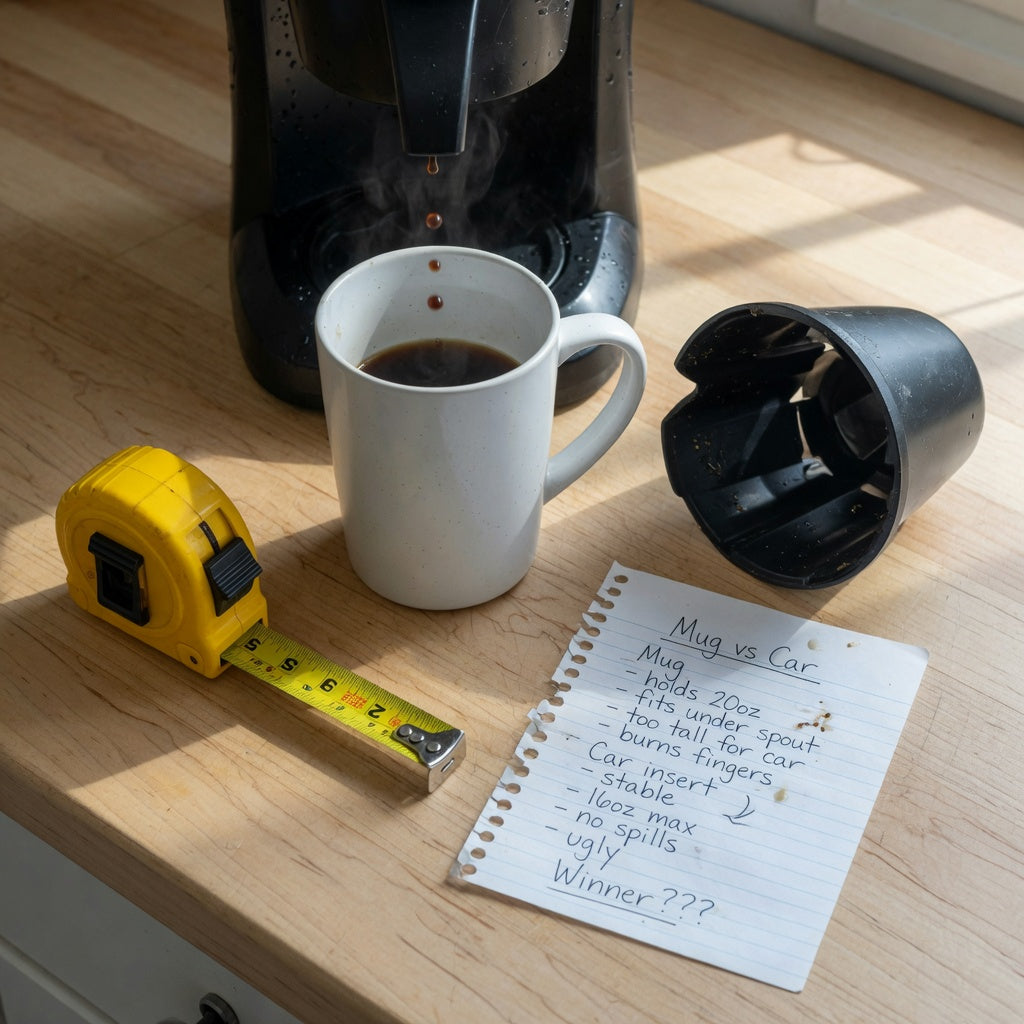
Tall Coffee Tea Mug Buying Checklist: Height, Base, Fill
A tall label can mean a higher shape or a bigger drink. Compare usable fill, external height, base, handle room, and care claims before the mug misses your machine or your pour.
Read more
Elk Moon Ceramic Mug Gift: What Buyers Should Compare
An elk moon ceramic mug gift fails when the moon is cropped, the cup drinks small, or the glaze story is missing. We compare photo match, ounces, weight, care, and ship timing before we recommend one.
Read more
Leave a comment
This site is protected by hCaptcha and the hCaptcha Privacy Policy and Terms of Service apply.