
Tall Coffee Tea Mug Buying Checklist: Height, Base, Fill
Reading time: about 12 minutes
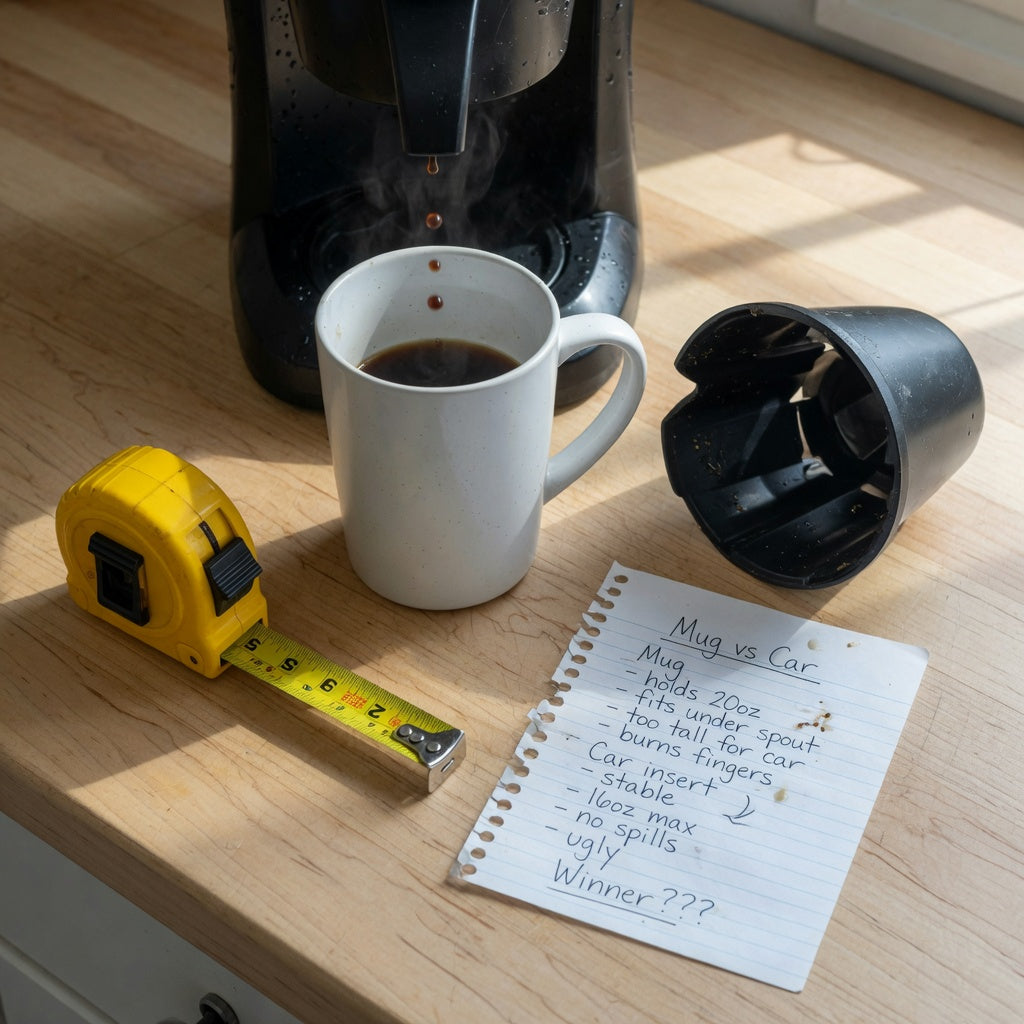
A customer set a new mug beside the short cup that already lives next to the kettle. The new one looked taller. Filled to a line they could carry, it held less coffee. We see that mix-up after unboxing more often than a chipped foot. The photo reads generous. Then the rim meets a single-serve spout, or the full cup wobbles on the way to a desk. In our store, tall is a shape word shoppers use before they measure. A tall coffee tea mug buying checklist is how we separate a higher, narrower silhouette from a bigger drink, and how we judge whether that silhouette clears the machine, the shelf, and the hand that has to carry it.
The Landscape Tall Coffee & Tea Mug is listed in our catalog as a 350 ml landscape tall coffee and tea mug. That title is a starting point, not a finished spec sheet. Before you treat 350 ml as the pour you will drink, confirm on the current listing whether the figure is brim capacity, then match every fit and care line to your own kitchen. Still comparing shapes? Look through the unique coffee mugs and put tall options next to shorter cups with a similar fill.
What a tall coffee tea mug buying checklist separates from the photo
There is no single legal or standards definition of a tall coffee or tea mug. Sellers use the word for a higher profile, a larger fill, or both, and those are different purchases. Two mugs can share a brim capacity and still drink differently: one short and wide, one tall and narrow. The wide cup is often steadier and easier to wipe out. The tall one can sit nicely beside a French press and still fail under a low shelf or in a car cup holder.
In our experience, weekday mugs were picked with measurements and care claims, not only artwork. Gift buyers skip this step. The print lands well at unboxing. A week later the mug lives on a high shelf because it will not clear the dishwasher door. Before a tall mug goes in the cart, we want these lines filled in:
- Listed capacity versus a comfortable pour. Brim fill is not the amount you can walk with.
- External height. This is what hits brewers, shelves, and racks.
- Rim diameter and base diameter. The rim changes the sip and the cleaning. The base decides stability and cup-holder fit.
- Overall width including the handle. A cropped photo hides this.
- Handle opening and weight when full. A tall body carries that weight higher.
- Care marks for that exact mug. Microwave and dishwasher symbols do not transfer from a similar cup.
- Food-use labeling. Hot coffee and tea do not belong in decorative ware.
If a number is missing, do not invent it from a lifestyle photo. Measure a mug you already like against the spout, the shelf, and the cup holder. That mug is your baseline.
Is 350 ml a bigger drink, or only a taller wall?
One U.S. fluid ounce equals 29.57353 milliliters. A catalog figure of 350 ml works out to about 11.8 U.S. fluid ounces, just under 12 fl oz. FDA describes cups and mugs as small ceramic hollowware commonly used for coffee or tea above room temperature. They normally, but not exclusively, hold about 240 ml, or 8 fl oz, and are manufactured with a handle. Sixteen U.S. fluid ounces converts to about 473 ml. So 350 ml sits above that usual cup and well short of an all-morning oversized mug.
Treat 350 ml as brim capacity unless the listing says otherwise. A comfortable pour stops below the rim. Milk, cream, or latte foam takes part of the volume. A milky drink with a thick foam cap can shrink the coffee dose or force a second trip to the machine. Black coffee or plain tea leaves more of that brim for the drink, once you subtract the headspace you actually keep. Lip shape changes the gap, so we do not pretend one empty-zone number fits every mug. Pour your current favorite to a carry-safe line, note that amount, and compare.
Height does not add ounces. For a long desk session with fewer refills, compare capacity first. A tall wall at 350 ml will not outlast a shorter mug with a larger brim fill.
Will the outside height clear the spout, shelf, and rack?
External height is the fit failure we hear about most, and many listings skip it. Measure the space you have, not the space the photo implies.
- Single-serve or drip spout. Measure from the tray up to the spout, then leave room to slide the mug in and out. A rim that cuts the stream splashes the counter and the handle.
- Espresso group head. The gap under the portafilter is often the tightest spot in the kitchen. A tall latte shape misses even when the ounces would have fit in a shorter cup. Measure that gap with a ruler before you order.
- Shelf or cabinet. Measure clear vertical space, including any rail above the shelf. Then check width with the handle if mugs stand in a row or hang from hooks.
- Dishwasher rack. Tall pieces catch the upper rack, the spray arm, or the door. A dishwasher-safe mark does not mean your rack has the clearance.
If the Landscape listing does not state external height, rim diameter, or base diameter, leave those as open questions. Do not copy dimensions from another tall mug, a marketplace photo, or an older screenshot. The live page is the only one that counts for this piece.
Does the base stay put once the mug is full?
Car cup holders are not one shared diameter, so we will not invent a number for every console. Measure the holder you use and compare it with the mug's base diameter. A narrow foot under a tall wall raises the center of gravity. Full, the mug can feel top-heavy even when it looked calm on the counter. If the base is wider than the holder, it perches on the rim and tips at the first turn.
A desk has the quieter version. A tall mug beside a laptop is easy to clip with a sleeve. We would rather see a broad foot and a handle you can get fingers through than a dramatic height you have to two-hand across the room.
Skip this shape for an open-cup commute, a leak-resistant lid, or a drop onto tile. Clay and glass break. A lidded travel bottle is the better car tool, even if a tall mug is what you want at the table. Nothing in the Landscape catalog title promises a lid or travel use. Read it as a table mug until the listing says otherwise.
Stoneware, porcelain, glass, or steel: what do you give up?
Material changes heat in the hand, empty weight, and how the piece fails. It does not prove food-contact, microwave, or dishwasher safety. Those claims have to be printed for the exact mug.
| Material | What shows up in daily use | Where it disappoints |
|---|---|---|
| Stoneware or everyday ceramic | Solid in the hand and familiar with hot coffee | Heavier once full, and it chips against a faucet |
| Porcelain | Often a thinner wall and a lighter clink | Thin rims chip, and thermal shock can still crack it |
| Glass | You can see tea color and the real fill line | Hot walls, and many glass mugs are clumsy in a rack |
| Stainless steel | Better drop resistance; double-wall styles protect fingers | Some tea drinkers notice a metallic note, and it is rarely a microwave piece |
A narrower opening can expose less liquid to room air than a wide bowl at the same fill. That is not a heat-retention warranty. Wall thickness, a preheated cup, and an open top all change how fast the drink cools. We would not buy a tall mug for insulation unless the listing describes a double wall or a lid. Confirm the Landscape material on the current page before you assume ceramic, porcelain, glass, or steel. The catalog title gives the form and the 350 ml figure. It does not lock the body, the glaze, or the handle.
Which glaze and care marks matter for a hot drink?
There is no known safe level of lead exposure, and lead used in some pottery may leach into food or drink. Washing and boiling do not remove it. If a lead-containing glaze is not fired at the proper temperature for the proper time, the lead may not fuse into the glaze. FDA's action level for lead in ceramic cups and mugs is 0.5 µg/ml of leaching solution under Compliance Policy Guide 545.450. For cadmium in ceramic small hollowware, the action level is 0.5 µg/mL under CPG 545.400. Those are enforcement thresholds for leach tests, not a personal exposure limit, and most product pages never link a lab report.
Some ceramic foodware leaches lead from the food-contact surface. With continued use, that can cause chronic lead poisoning. FDA action guidance uses ASTM C738 or a specified equivalent. Extractable cadmium can move into acid foods and, with continued food use, could cause chronic cadmium poisoning. Factory-made everyday pottery is described as much less likely to have lead problems than handmade pieces with a crude or irregular look, antiques, damaged or worn ware, flea-market finds, unknown makers, or ware brightly decorated in orange, red, or yellow. Ornamental ceramic that looks usable must carry a conspicuous not-for-food-use warning, including a permanent statement on the base, or have a hole through the food-contact surface. If a piece says it is not for food use and may poison food, do not put coffee or tea in it.
A lead-free line on a product page is not a food-use statement, and neither one is a posted leach test. ASTM C1607, the method for judging whether ceramicware is microwave safe for reheating, says ware with a metallic glaze, decoration, or paint should not go into that test or into a microwave unless it is specifically designed for that use and marked microwave safe. The method covers consumer reheating, not commercial microwaves, and microwave-intended ceramicware must also pass a thermal-shock criterion in ASTM C554. A gold or silver rim stays out of the microwave unless this exact listing says microwave safe. Dishwasher icons apply to the piece you are buying, not to every tall mug. Narrow wells are harder to scrub, and crazed glaze stains with tea. If you do not want a bottle brush in the routine, buy a wider bowl.
Can two or three fingers hold a full tall mug?
Handle room is why some tall mugs disappoint after the first hot pour. Two or three fingers need a clear opening, with knuckle space so you are not pressed against the wall. Large hands usually need more gap than a small loop gives. Listings seldom print that opening. If the loop looks tight for two fingers in the photo, it will feel tighter when the mug is full and hot.
A full clay or glass mug is not light, and a tall shape holds that weight higher than a short cup of the same fill. A weak grip, a sore wrist, or a long walk across a busy kitchen argues for a smaller cup or a deeper handle. Lip thickness matters for tea. A very thick rim feels clumsy. A paper-thin rim chips on a spoon. A wide foot resists a bump. A tiny foot under a high wall does not. We would not pick a very tall mug where kids reach across the table, the counter is crowded, or drinks get set on a sofa arm.
Match the live Landscape page to your kitchen
Use the current page for the Landscape tall coffee and tea mug listing, not a saved screenshot. Confirm the 350 ml figure, then fill in what the title leaves out.
- Name the drink: black coffee, tea, or a milky cup with foam. Compare it with about 11.8 fl oz at the brim, then subtract the headspace you really leave.
- Write down external height, rim diameter, base diameter, and width with the handle. If any number is missing, do not guess from the photo.
- Test those numbers against the brewer gap, the shelf, the dishwasher rack, and the car holder if you use one.
- Read the material, the handle description, and the microwave and dishwasher marks for this mug only.
- Confirm it is sold for food use. Be more cautious with handmade, antique, damaged, or brightly pigmented ceramic from a maker you cannot identify.
- Picture the full mug in your hand. If the handle looks tight or the base looks small, choose another shape from the rest of the mug collection instead of hoping the first week feels fine.
A tall mug earns the cupboard space when the height clears the machine and the fill matches the drink you already make. If either check fails, a shorter cup at a similar capacity will be the better weekday tool.
Frequently asked questions
What should a tall coffee tea mug buying checklist include before I order?
Compare a comfortable pour with the listed brim capacity, then check external height, rim diameter, base diameter, and width including the handle. Add handle clearance, how heavy that style feels once full, and the care marks printed for that mug. If the page skips a measurement, treat the fit as unknown rather than trusting the photo scale.
Is a 350 ml tall mug a large coffee mug?
At 29.57353 milliliters per U.S. fluid ounce, 350 ml is about 11.8 fl oz. That is larger than the roughly 240 ml, or 8 fl oz, FDA describes as a usual cup or mug, and smaller than 16 fl oz, which converts to about 473 ml. The amount you can drink is lower again after headspace, milk, or foam.
Will this tall mug fit under a coffee maker or espresso machine?
Only if the external height is shorter than the gap under the spout or group head, with room to slide the mug in. Measure that gap at home. If the listing does not print external height, neither we nor the product photo can promise clearance for the Landscape mug or any other tall cup.
Are tall ceramic mugs automatically microwave and dishwasher safe?
No. Ware with a metallic glaze, paint, or decorative rim should stay out of a consumer microwave unless that piece is marked microwave safe. Dishwasher use depends on the care label for the exact mug and on whether your rack has the physical clearance. The word tall does not settle either question.
Do tall narrow mugs tip more easily in a car or on a desk?
They can, once full, if the base is small relative to the height. A wider foot is steadier and less likely to perch on a cup-holder rim. If base diameter is not listed, do not assume the mug is steady in a car or safe from a casual bump on a desk.
More from our blog
Read more

Gift Checklist Coffee Tea Mug Christmas: What to Compare
A store-side Christmas mug checklist: match the drinker, coffee or tea, desk or commute, care labels, and food-use marks before the print. We tell you what to verify on the listing and when to skip...
Read more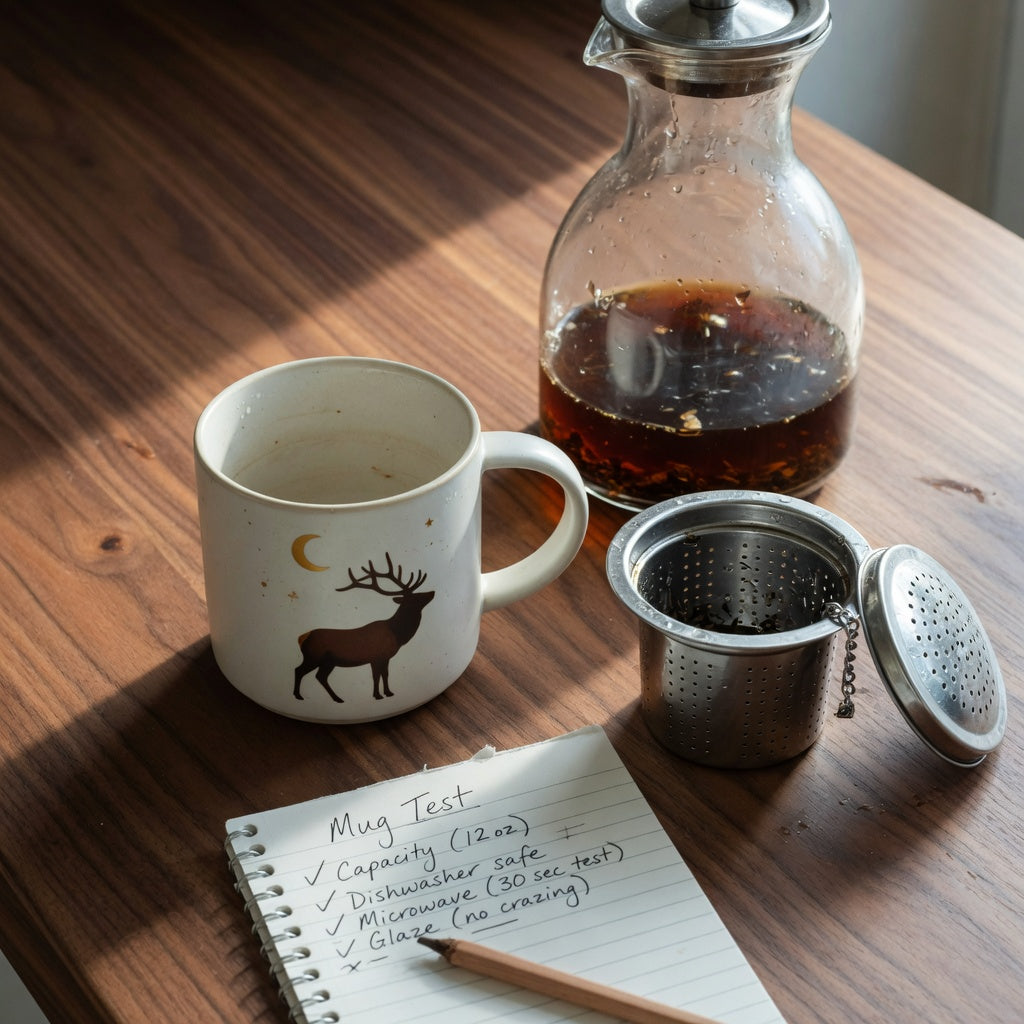
Elk and Moon Coffee Tea Mug Buying Checklist: What to Compare
A store-side elk and moon coffee tea mug buying checklist for comparing food-contact language, stated capacity, care labels, handle comfort, and whether elk or moon artwork will survive real washing.
Read more
Leave a comment
This site is protected by hCaptcha and the hCaptcha Privacy Policy and Terms of Service apply.