
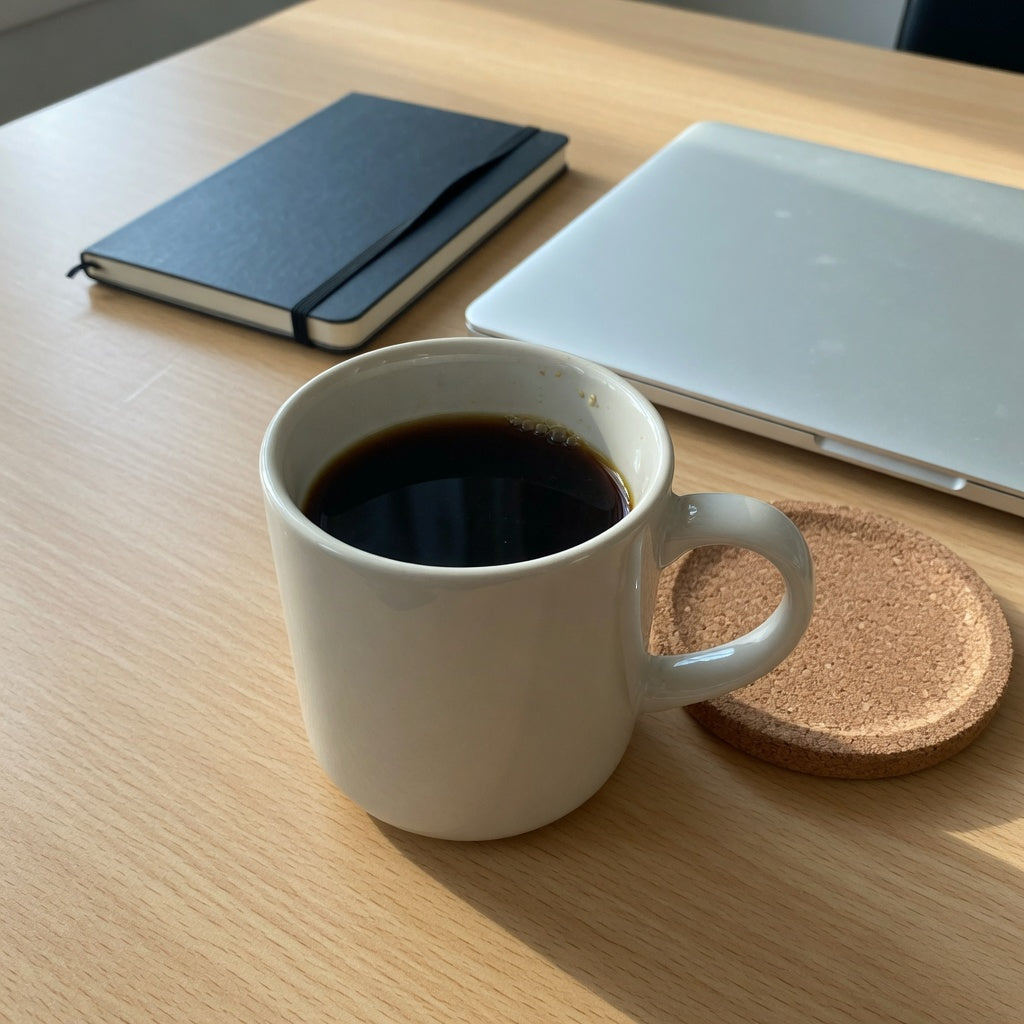
Desk Ceramic Mug for Workday Coffee: What to Compare
Reading time: about 12 minutes
Monday's first pour is the real product test. Cream goes in, the brew climbs the rim, and a knuckle hits the hot wall because the handle opening is tight. By late morning a pale ring sits in the desk finish. A desk ceramic mug for workday coffee is a tool you pick up between calls, not a spare cup for a guest. In our store, glaze color gets the first click. Capacity, heat, food-contact glaze, and the foot decide whether it stays.
How much room does a desk ceramic mug for workday coffee need?
There is no official office-mug size. Pod machines, drip brewers, and cream do not share one volume, and no standards body has published a workday target. FDA's lead guidance describes cups and mugs as small ceramic vessels normally about 240 mL (8 fl oz), usually with a handle. That is a regulatory description of the pieces the limit covers. It is not advice to buy an 8 oz cup if you add milk.
Pour a full single-serve brew, then cream, and a small cup is full before the drink is mixed. A larger mug can then crowd a keyboard tray or a notebook. Ounces and footprint are separate decisions. A tall narrow cup can clear a monitor arm. A lower, wider cup often feels steadier when your other hand stays on the keyboard. Measure both against the desk you have, not against a cropped photo.
On the live listing, check these before you trust the hero image:
- Stated capacity, and whether it is filled to the rim or to a drinkable line below it.
- Height and width, if the page prints them. A silhouette is not a dimension.
- Handle opening. You want daylight between your fingers and the outer wall. If a third finger has to press the hot wall, the opening is tight.
- Weight if you carry it from a kitchenette. A heavier cup sits still and gets tiring on a hallway walk.
Match the shape to the desk, then confirm the numbers. A shallow tray or a monitor arm leaves little depth, so start with the landscape tall coffee and tea mug and read capacity, height, and foot width on that page. The name points at a taller profile. It is not an ounce count, and it does not tell you how far the handle swings into a notebook. If the cup gets bumped while you type, a rounder body often feels steadier. Open the round coffee and tea mug and check base width, height, and handle clearance the same way. For a color or silhouette you can spot from a shared-kitchen doorway, browse our unique coffee mugs and keep the same checks. In our experience, the mismatches that come back are cream that would not fit, a handle that pinched, or a foot that marked the desktop.
Open ceramic, a splash lid, a cork foot, or a warmer?
Heat is the complaint we hear after the first week, not the first sip. Single-wall ceramic feels honest in the hand and gives warmth to the room. We will not quote a minute count. Independent timings for an ordinary desk mug across a long meeting are scarce, and retail lines that promise hours of heat are not measurements we can stand behind. If the drink must sit untouched through a long call, open ceramic is the wrong tool. An insulated bottle, or a tumbler with a ceramic-lined interior, is the honest swap. A desk mug is for sipping between tasks.
| Approach | What it helps | What it does not fix |
|---|---|---|
| Open ceramic mug | Easy sipping and a glaze you can see | Long heat, or a bag commute |
| Ceramic with a desk lid | Dust and a casual splash | A leak-proof seal, unless the listing says the lid holds when tipped |
| Cork or silicone foot | Bare ceramic off the desktop | Every veneer or soft coating; care rules can change |
| Mug warmer | A cup you set down during a call | A corked, domed, or uneven base that misses the plate |
| Insulated tumbler | Heat and travel | The open-cup smell many people want from ceramic |
Splash-resistant and leak-proof are different products. If the page never says the mug can lie on its side, do not test that claim in a laptop bag. A lid that pops off when you reach for the keyboard is a splash cover. It can keep dust off the coffee. It does not turn clay into a travel bottle.
Taste shows up in the same conversation. Shoppers tell us ceramic tastes cleaner than stainless, especially when a dark roast sits. That is repeated buyer talk, not a government or standards result. If your steel tumbler already tastes fine and heat is the priority, stay with steel. Choose ceramic when you want an open cup at the desk and you will reheat or pour a smaller second cup.
Can you see lead in the glaze, or do you need a leach test?
You cannot see lead in a glaze. The California Department of Public Health says looking at a dish does not tell you whether lead is present, and that lead is rarely found in plain white dishes. Coffee and tea are acidic, and acidic drinks leach lead from a contaminated surface faster than drinks that are not. Cooking or microwaving in lead-bearing tableware raises that chance. A white mug is not a clean bill, and a bright color is not a warning by itself.
FDA's action level for leachable lead from ceramic cups and mugs is 0.5 micrograms per milliliter of leaching solution. Enforcement may be considered if any one of six tested units exceeds that level. FDA states that lead leaving a ceramic food-contact surface can, with continued food use, cause chronic lead poisoning. Cadmium is a separate limit. For small hollowware under 1.1 liters, where an ordinary coffee mug sits, the cadmium action level is also 0.5 micrograms per milliliter if any one of six units exceeds it. Extractable cadmium can cause chronic cadmium poisoning with continued food use. Testing referenced with that guidance includes ASTM C738.
A lead-free line on the box is not those results. FDA has reported that some imported traditional pottery labeled lead free still contained extractable lead, in some cases at or above the ceramicware action levels. If weekday coffee will live in this mug, ask whether the food-contact surface was tested and to which method. We do not treat a lead-free badge on a listing as a substitute for that answer. If the leach story is missing, do not fill the gap from the glaze color.
Coffee touches the inside glaze and the lip. An outside print still matters if gold, platinum, or luster paint crosses the drinking edge. Bright novelty mugs make easy gifts and weak daily cups when nobody can describe how the lip was tested. We would rather see a glossy, undecorated interior for a workday pour, and keep a loud wrap for a mug that is not in your hand five days a week.
Microwave and dishwasher: body, rim, lid, and foot
FDA's microwave note is plain. Microwaves pass through ceramic, glass, and paper, and they reflect off metal. The oven does not heat the ceramic itself. The drink heats, then the cup feels hot from the liquid. Metal pans and aluminum foil can cook unevenly and may damage the oven because the energy bounces. A plain glazed mug and a mug with a metallic rim are not the same object in that appliance.
Split the listing into parts instead of trusting one icon:
- Ceramic body. Use the microwave only if the page says so and you see no metal.
- Gold, silver, luster, or metallic ink. Leave it out. Reflected microwaves are the reason.
- Lid. Plastic, silicone, and wood splash covers have their own heat limits.
- Cork or silicone foot. A hand-wash-only mark on the foot overrides a dishwasher symbol on the clay.
- Printed wrap. Some inks survive a dishwasher and some fade. Only that decoration's care note answers it.
Drop one reheating habit. FDA warns that water heated alone in a clean cup can superheat and erupt when the cup is moved or when instant coffee is added. Heat coffee that is already mixed, or let a too-hot pour cool in the mug.
Stain inside the cup is coffee oil and tannin, not a mystery defect. In our experience a smooth glossy glaze lets that film go with a real wash. A matte or crazed well holds a brown line a rinse will not lift. Crazing, the fine crack network in a glaze, can look intentional on a decorative piece and still makes a poor daily cup, because liquid sits in the lines. A chip that exposes clay at the lip is a reason to retire the mug.
Temperature is a separate issue, and it is not a verdict on ceramic as a material. IARC classified drinking very hot beverages, meaning drinks consumed above 65 degrees Celsius, as probably carcinogenic to humans (Group 2A) because of an association with oesophageal cancer. The concern IARC states is the temperature. Coffee itself was evaluated as not classifiable (Group 3). Let a roaring pour rest. A warmer set for comfortable sipping is a different habit from one that holds coffee near boiling.
Desk rings, a shared kitchen, and jobs this mug should refuse
Hot ceramic on a finished desktop leaves marks more often than people expect. The story is usually the same: coffee left in place, then a pale ring in the finish. A cork foot can interrupt contact between clay and desk. It is not a promise for every veneer, leather blotter, or soft coating. Standards guidance on cork feet and heat marks is thin, so we do not treat a cork pad as a certified coaster. If the listing shows a bare foot, use a coaster. An unglazed foot ring can also scratch a soft coating when the mug is only warm. Refinishing the desktop costs more than that habit.
Shared kitchens fail more simply. Four matching white mugs, and nobody knows which one was rinsed. A distinct color, a different silhouette, or an exterior print you can see from the doorway stops the mix-up, but only if the interior stays a glossy glaze and the decoration is not a metal band you cannot reheat. A weak decal that flakes in the dishwasher is not an ID system. Shapes and colors you can tell apart are grouped in our unique coffee mugs collection. Read each listing for interior glaze and care before a print becomes your office marker.
Say no when the job does not match the material:
- Not a commute bottle. Without a tested seal, the mug stays on the desk.
- Not an all-morning heat keeper with the top open. Use a warmer or an insulated cup, and skip unverified hour claims.
- Not a heavily decorated daily cup for acidic coffee if the seller cannot describe food-contact leach testing.
- Not a microwave candidate once metal, an unrated lid, or a keep-the-foot-dry note is part of the mug.
Eight listing checks before the mug stays on the desk
The photo is not the contract. The current listing is. Run this pass on the page you have open:
- Capacity versus your real pour plus cream, under a line you can carry without sloshing.
- Interior glaze: glossy and continuous, not a crackle surface you scrub every Friday.
- Handle clearance so knuckles stay off the hot wall, including the swing beside a notebook.
- A foot or a coaster plan that matches your desktop, not a photo of a stone slab.
- Lid type, if you want one. A splash cover is not a travel seal.
- Care, split by body, print, metal, lid, and foot.
- Lead and cadmium: a method such as ASTM C738, or equivalent leach results, not only the words lead free.
- In a shared office, a color or shape you can name without picking the mug up.
Use those lines on the taller landscape mug listing when a narrow footprint is what you need to verify, and on the rounder coffee and tea mug when stability matters more than height. Confirm height, capacity, handle, foot, and care on each live page. We are not pinning ounce counts or appliance icons here, because those details belong to the listing and can change. If neither shape fits, go back through the collection with the same eight checks. The mug that earns the spot beside the keyboard is the one whose page answers them without a shrug.
Frequently asked questions
What size desk ceramic mug for workday coffee fits a single-serve brew plus cream?
No standards body sets that size. FDA's description of a typical cup or mug in its lead guidance is about 240 mL (8 fl oz), which is tight once cream goes in. Read the stated capacity on the listing, including whether it is filled to the rim, and compare it with the pour your brewer makes. Then check height, foot width, and handle swing so extra volume does not crowd the desk.
Will plain ceramic stay hot through a meeting?
Do not count on it. Single-wall ceramic sheds heat, and we cannot cite a reliable minute count for a normal desk mug. A splash lid or a mug warmer can help if the foot sits flat on the plate and the listing allows that pairing. For a long meeting with the cup untouched, an insulated tumbler is the better tool.
Does a lead-free label mean the glaze meets FDA leach limits?
Not by itself. FDA has reported some imported traditional pottery labeled lead free that still released extractable lead, in some cases at or above ceramicware action levels. For cups and mugs the lead action level is 0.5 micrograms per milliliter if any one of six units exceeds it, and cadmium in small hollowware under 1.1 liters has its own 0.5 micrograms per milliliter action level. Ask for food-contact results such as ASTM C738, because color is not a test and lead is rarely found in plain white dishes.
Can I microwave and dishwasher a work mug with a lid, cork bottom, or metallic rim?
Only part by part. Microwaves pass through ceramic and reflect off metal, so keep a metallic rim or luster band out of the oven unless that decoration is cleared on the listing. A lid and a cork foot have their own care lines, and a hand-wash-only foot overrides a dishwasher mark on the clay. Do not heat plain water alone in a very clean cup and then move it or stir in instant coffee. FDA warns that the water can superheat and erupt.
Will a cork bottom stop rings on my desk?
It can reduce direct contact between hot ceramic and the finish. It does not replace a coaster on every veneer, leather pad, or soft coating, and it is not a certified fix. If the mug you are viewing has a bare foot, use a coaster. Confirm on the listing whether the foot changes microwave or dishwasher instructions before you treat the pad as a free upgrade.
More from our blog
Read more

Small Retro Coffee Cup Gift: Size, Safety, and Fit
Shoppers hunting a small retro coffee cup gift are often choosing between a true small cup and a standard mug with vintage art. We compare capacity, drink fit, food-use labeling, and care so the pr...
Read more
Christmas Ceramic Coffee Mug Gift: What to Compare
A christmas ceramic coffee mug gift has to work after the wrapping comes off. Compare usable ounces, glaze and metal-trim care, food-use labeling, and whether the box protects the mug.
Read more
Leave a comment
This site is protected by hCaptcha and the hCaptcha Privacy Policy and Terms of Service apply.