
Desk Size Ceramic Coffee Mug Emerald: Capacity, Fit and Care
Reading time: about 10 minutes
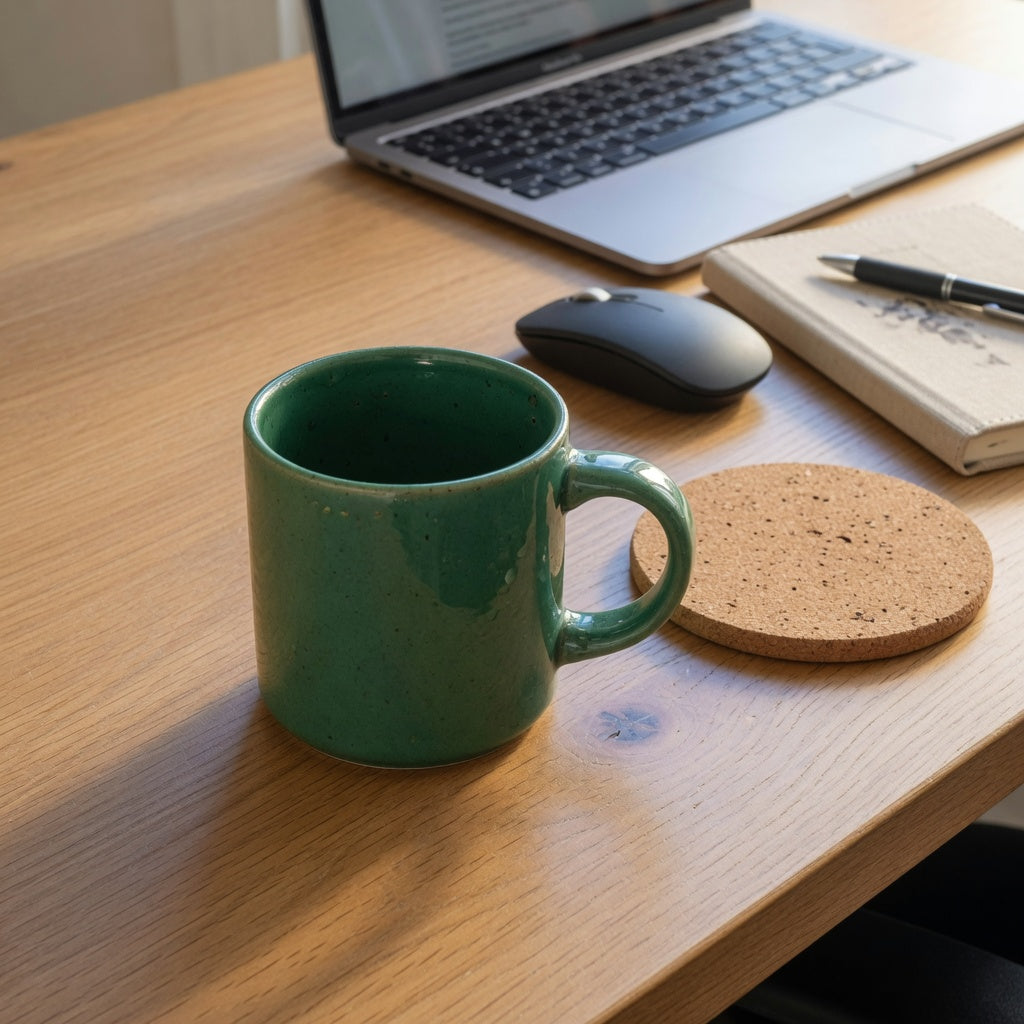
A mug can look “small” in a product photo and still be awkward at a workstation. The handle clips the mouse, the base blocks a notebook, or the cup sits close enough to a laptop that every reach feels risky. We evaluate a desk size ceramic coffee mug emerald by three things first: the space it occupies, the amount you actually pour, and how safely it handles daily desk use.
Our Emerald Small Ceramic Coffee Mug is listed at 270 ml—roughly 9.1 US fl oz—and is intended for tea, shorter coffee pours, desk use, and compact daily drinkware. In our store, that makes it a focused serving cup, not a large all-morning vessel. Capacity alone does not reveal outside dimensions, handle clearance, microwave or dishwasher suitability, glaze testing, or heat-retention performance. Those remain buyer checks, not promises.
Desk size ceramic coffee mug emerald: how much room will it use?
We have not found a universal industry measurement for “desk size.” Treat it as a use-case label rather than a fixed capacity or diameter. A mug only fits if its body, handle, lift path, and landing area work with your actual laptop, mouse, lamp base, notebook, and charging cables.
Before ordering, make a quick paper footprint:
- Measure the full silhouette. Use the distance from the far side of the mug body to the outermost edge of the handle. A body-only width understates the desk space required.
- Test your normal mouse movement. Put the paper template where you naturally reach for a drink, then move the mouse through its full working range.
- Open the notebook. A mug that fits beside a closed notebook may block the page once you start writing.
- Check overhead clearance. Monitor shelves and low desk cabinets can make a taller mug awkward to lift without tilting it.
- Plan the route from desk to mouth. You should not have to carry an open cup over the keyboard or thread the handle around a charging cable.
Start with the 270 ml Emerald Small Ceramic Coffee Mug. The live page is the place to check current dimensions and care wording; if a detail is not stated, treat it as unconfirmed. If silhouette and handle placement matter more than emerald color, compare the shapes in our unique coffee mug collection against the same paper test.
Is 270 ml enough for your coffee or tea routine?
A 270 ml capacity is useful only if it matches the drink you already make. Measure your normal finished serving once, including milk, creamer, or extra water. Also leave headspace. A cup filled to the rim may technically contain the drink, but it is not comfortable to carry from the kitchen to a desk.
| Buyer situation | 270 ml emerald ceramic | Larger open ceramic | Insulated lidded mug |
|---|---|---|---|
| Usual drink | Tea or a shorter coffee pour | A larger one-fill coffee | Slow sipping or portable use |
| Desk impact | Compact intent, but total width still needs checking | Requires more clear surface area | Footprint varies; lid and seal claims must be checked separately |
| Heat behavior | Open ceramic suited to a drink finished sooner | Open ceramic with more liquid to manage | Designed to slow heat loss |
| Main compromise | More frequent refills | More crowding and more liquid near electronics | More parts and a less traditional open-rim sip |
If your usual coffee is 16 US fl oz, that is about 473 ml. A 270 ml mug cannot hold that serving in one fill. The compact mug still makes sense if a refill gives you a useful reason to stand up, but it will frustrate anyone who wants one large brew with no return trip to the kitchen.
What should the handle, rim, and foot tell you during unboxing?
Product photos show color well; they rarely reveal the points that determine everyday durability. During our handling checks, we inspect the areas where ceramic mugs commonly become uncomfortable or show damage first:
- Rim: Look under bright side light and check for a smooth, continuous drinking edge. A chip, sharp point, or rough blister where your lip rests is a reason to contact the seller before use.
- Handle attachment points: Inspect both joints where the handle meets the body. Glaze variation can be cosmetic, but movement or a hairline fracture continuing into the ceramic body is not.
- Interior glaze: Check for open chips, sharp pits, raised blisters, or a new network of fine cracks. Do not confuse harmless color variation with physical damage, but ask about any break in the drinking surface.
- Base and foot ring: Set the empty mug on two known-flat surfaces and press lightly at several points around the rim. This separates a rocking mug from a warped desktop.
- Loaded grip: Before the first hot pour, fill the mug with cool water to your usual level and lift it several times. You will quickly notice if your fingers press against the mug body or if the handle creates awkward wrist strain.
There is a genuine footprint trade-off here. A broader base usually gives you more margin against an accidental bump, but it also occupies more desk area. A narrow or tall profile may save horizontal space while feeling less forgiving on a wobbly table. Appearance alone cannot settle that choice.
Does an emerald glaze prove the mug is safe for drinks?
Emerald is a color, not a safety certificate. The FDA guidance on lead-glazed traditional pottery explains that lead may be present in some glazes or decorations and can migrate into food or drink if the pottery was not manufactured and fired correctly.
The FDA identifies handmade or crude pottery, antiques, damaged pieces, flea-market finds, and certain brightly decorated traditional ware as categories that deserve added caution. It also notes that commercially manufactured everyday ware outside those categories is much less likely to present lead-related problems. “Less likely” is useful risk context, but it is not a product-specific laboratory report.
We do not describe a particular mug as independently tested, lead-free, or certified unless the current listing supplies that claim. Use these practical checks instead:
- Buy a vessel presented as coffee or tea drinkware, not an unmarked decorative container.
- Read the live product description for any material and safety statements.
- Do not drink from an antique, mystery-origin, or visibly damaged ceramic simply because its color looks suitable.
- Inspect the interior after delivery and stop using the mug if the drinking surface becomes chipped or materially damaged.
- If documented testing is essential to your purchase, ask for that documentation rather than inferring it from the glaze color.
Will open ceramic keep coffee hot through a long meeting?
An open ceramic mug is not designed to match a sealed, double-wall tumbler for heat retention. Heat escapes through the open rim and the ceramic body. We do not have an independent heat-retention test for this emerald mug, so we will not assign a number of minutes or imply that the dark color changes performance.
- Choose compact ceramic if you finish a shorter drink during one focused block of work and value an open ceramic rim.
- Choose an insulated, lidded mug if coffee regularly sits untouched through long calls or needs to travel between locations.
- Choose a larger open ceramic if you stay at one desk, prefer a single larger serving, and have enough clear surface area.
- Choose a sealed travel vessel if the cup will ride in a car, backpack, or hand while walking. A stationary desk mug is not a commuter bottle.
Pre-warming the mug with warm water can reduce the initial chill from cold ceramic, but it does not create insulation. A coaster is also worth using on wood or painted surfaces. Its main job is protecting the desk from moisture and heat marks, not keeping the drink hot.
Microwave, dishwasher, and thermal shock: which claims matter?
“Microwave safe” and “dishwasher safe” are separate claims. The word ceramic does not establish either one, and it does not tell you whether a mug is stoneware, porcelain, or another ceramic body. Do not assign a material subtype or appliance rating that the listing does not name.
Read the live care text before using either appliance. If the product page does not state a care method, treat it as unconfirmed and hand-wash until the seller or manufacturer provides an answer. A single home microwave test is not a substitute for care guidance, and a microwave-safe mug can still become hot enough to require cautious handling.
- Avoid sudden temperature changes. Do not move a mug directly from a refrigerator or cold windowsill to boiling liquid. Thermal shock can crack ceramic or weaken the handle joints.
- Use a soft sponge. Steel wool and aggressive abrasive pads can scratch or haze a colored finish.
- Separate it from other dishes. If dishwasher use is approved, position the mug so its rim and handle cannot knock against plates or another mug during the cycle.
- Check for metallic decoration. Any mug with metallic elements should stay out of the microwave unless the manufacturer explicitly states otherwise.
- Inspect after a drop or hard knock. Retire the mug from drink service if the rim chips, the handle moves, or a crack enters the interior.
We do not have independent repeated-cycle wear data for this emerald finish. Hand-washing is the more cautious approach for preserving appearance, but it is less convenient. Buyers who rely on a dishwasher every day should make a confirmed dishwasher-safe statement part of the purchase decision.
Who is the 270 ml Emerald Small Ceramic Coffee Mug actually for?
- Small stationary desk with tea or shorter coffee: The Emerald Small Ceramic Coffee Mug is the relevant option to review because its listed 270 ml capacity and intended uses match that serving routine.
- Gift for someone who likes saturated green drinkware: It can suit a home-office or study setup if the recipient uses open ceramic cups. During gift unboxing, inspect the rim, handle joints, interior, and base before removing all packaging.
- One large drip coffee with no refill: Skip the 270 ml size if the recipient normally pours 16 US fl oz or more. The capacity mismatch will matter more than the color.
- Long meetings or slow sipping: Choose an insulated or lidded vessel instead. Compact open ceramic will not solve extended heat-retention needs.
- Commuting or unstable surfaces: Use a sealed travel mug. A couch arm, bed tray, moving vehicle, or crowded shared desk is a poor match for open ceramic.
- Ice-heavy drinks: A 270 ml cup leaves limited room once ice is added. Buyers who make large iced coffees should choose more capacity.
Before ordering, answer five questions: Does your finished drink fit with headspace? Have you checked the widest dimension including the handle? Will the mug stay on a stable surface? Are you comfortable with open ceramic cooling? Do the stated care instructions match your routine? If capacity or silhouette fails that check, compare other options in the CoffeifyMug collection of unique coffee mugs rather than forcing a compact cup into the wrong job.
Frequently asked questions
Is a desk size ceramic coffee mug emerald large enough for daily coffee?
The listed 270 ml capacity is about 9.1 US fl oz, so it suits tea and shorter coffee pours. It is too small for a 16 US fl oz serving in one fill. Measure your normal finished drink, including milk or extra water, before deciding.
How do I check if a small ceramic mug will fit beside my laptop?
Check the full width from the far side of the mug body to the outer edge of the handle, not just the base. Make a paper template and place it beside your laptop while moving the mouse and opening your notebook. If dimensions are missing from a listing, ask rather than estimating from a styled photo.
Is an emerald ceramic mug automatically microwave and dishwasher safe?
No. Microwave and dishwasher suitability are separate product claims, and ceramic material alone does not confirm either one. Follow the live listing or manufacturer guidance; if a method is not stated, treat it as unconfirmed.
Can an emerald ceramic glaze contain lead?
Glaze color alone cannot answer that question. FDA guidance says lead may occur in some ceramic glazes or decorations and can migrate if pottery is not manufactured and fired correctly. Buy commercially produced drinkware, check documented claims, and do not use a mug with a damaged interior drinking surface.
How do I choose between the 270 ml emerald mug and another style?
Measure your usual finished drink and trace the clear mug area available on your desk. If 270 ml, open ceramic, and stationary use all match, review the current emerald mug listing. If capacity, shape, or care needs do not match, compare the unique coffee mugs collection before ordering.
More from our blog
Read more

Tall Ceramic Mug Home Office: Capacity, Grip, and Desk Fit
Height alone does not tell you serving size or desk stability. We compare the listed 350 ml option with larger mugs, then assess headroom, full weight, handle clearance, base geometry, care claims,...
Read more
What Size Cup for Flat White? 200, 250 and 270 ml Compared
Compare CoffeifyMug's 200, 250 and 270 ml options by usable headroom, drinking pace, machine fit, desk use and care checks. Includes a water-and-scale method for measuring the cup you already own.
Read more
Leave a comment
This site is protected by hCaptcha and the hCaptcha Privacy Policy and Terms of Service apply.