

Decaf coffee cup weekend coffee practical purchase checklist
Reading time: about 11 minutes
At 9:15 on a Saturday morning, a 170 ml pour can feel exactly right on a small kitchen counter - or frustrating if you planned to sit through a long breakfast without returning to the pot. We see that decision in our store when shoppers compare a cup in one hand with the amount they usually pour into it. This decaf coffee cup weekend coffee practical purchase checklist keeps the choice practical: published capacity first, handle comfort second, and serving location and care details before checkout.
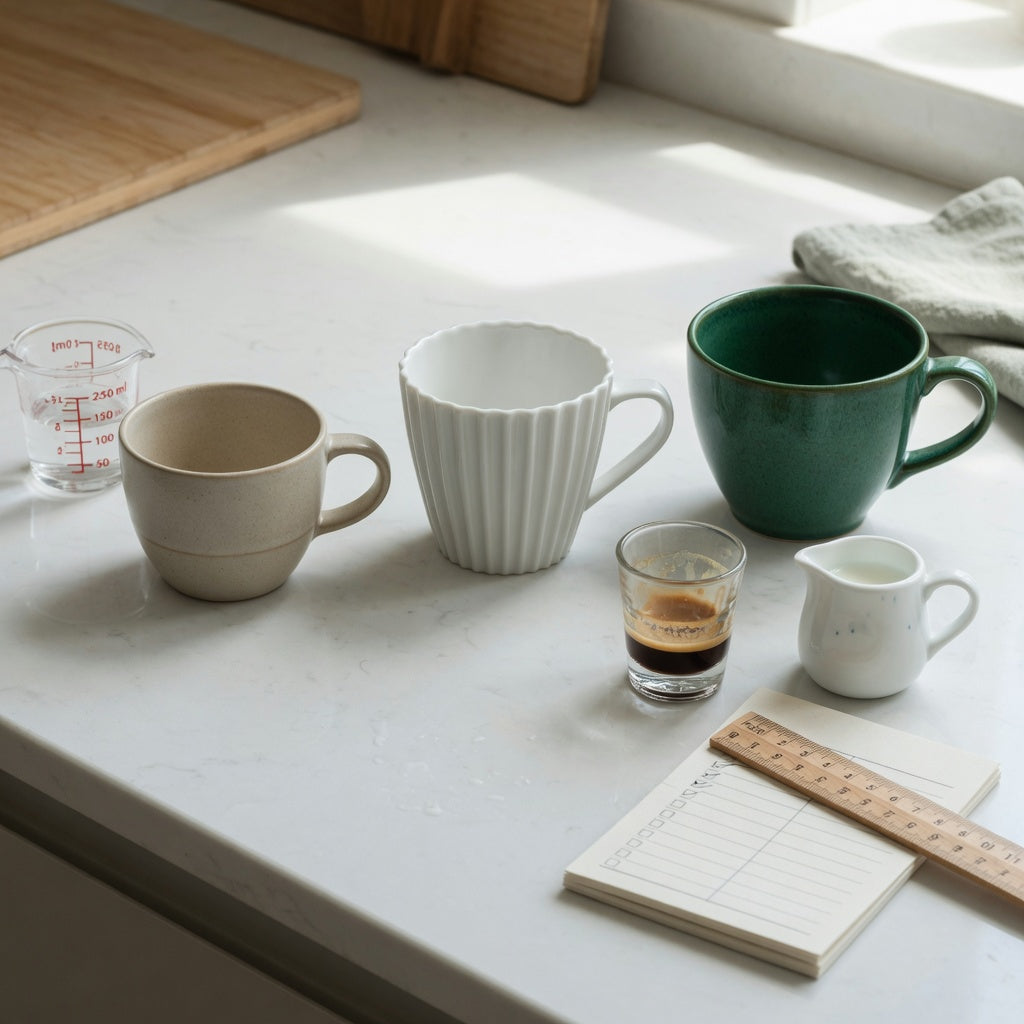
Our catalog comparison confirms three capacities: the Retro is 170 ml, the Pleated is 200 ml, and the Emerald is 270 ml. Those figures are the dependable starting point. The supplied product facts do not establish material, weight, outer dimensions, exact handle measurements, dishwasher rating, microwave rating, lid, or insulation, so we will flag those as checks rather than fill the gaps with assumptions.
What should a decaf coffee cup weekend coffee practical purchase checklist compare first?
Start with the amount and setting you can describe without looking at a product photo. A weekend cup may sit on a kitchen counter between pours, travel only as far as a home-office desk, or appear in a gift unboxing where the recipient's preferred serving is unknown. Those situations create different priorities before color or pattern enters the decision.
- Capacity: How much do you pour into one cup on a slow weekend, measured in milliliters rather than guessed as small or large?
- Handle comfort: Can your fingers fit without crowding, and does the cup stay balanced when partly full?
- Serving preference: Do you want one larger serving, a middle volume, or a smaller pour followed by another?
- Placement and care: Will it sit on a counter, home-office desk, table, or shelf, and are material and cleaning instructions stated?
In practice, the decaf coffee cup weekend coffee practical purchase checklist is a four-part decision: volume, grip, placement, and care. A pleasing shape cannot fix a volume mismatch, and a larger listed capacity cannot tell you how a handle will feel in your hand. If a product page leaves a detail blank, treat it as an open question rather than an implied feature.
Which 170 ml, 200 ml, or 270 ml capacity fits your Saturday pour?
Capacity is the cleanest way to narrow the three models, but compare it with your actual pour rather than a vague idea of a regular cup. A measuring jug used once on a quiet morning gives a better starting point than guessing from a photograph. It also shows the difference between wanting one larger serving and enjoying a smaller refill as part of the weekend routine.
| Model | Verified capacity | Reader situation | Why it fits | Next check |
|---|---|---|---|---|
| Retro coffee tea cup | 170 ml | Smaller pour or planned second serving | The smallest listed volume suits a measured serving and a deliberate return to the pot. | Confirm outside dimensions and handle clearance if the counter or shelf is tight. |
| Pleated coffee tea cup | 200 ml | Middle-size breakfast or home-office serving | The midpoint works when 170 ml feels restrictive and 270 ml feels more than you need. | Compare handle opening, base diameter, and care guidance. |
| Emerald coffee tea mug | 270 ml | Larger pour for a longer stationary breakfast | The largest listed volume gives more room before a refill during a table conversation. | Confirm filled weight, grip clearance, and storage dimensions. |
The three numbers are published catalog capacities, not a suggestion to fill any cup to its rim. Measure the amount you normally serve, then leave practical room for lifting and setting down without spilling. A higher capacity does not automatically reveal the cup's height, diameter, or weight, so those remain separate checks. For iced coffee, account for the space taken by ice and verify the opening if that is part of your weekend routine; capacity alone cannot answer that question.
Will the handle stay comfortable at a kitchen counter, desk, or sofa?
Handle comfort becomes noticeable during a slower hold, but capacity cannot predict it. Picture holding the cup through a 20-minute crossword, an email at the office desk, or a conversation at the table. The useful question is not simply if the handle looks large; it is if your usual grip has room and stays balanced when the cup is partly full.
When we handle drinkware in our store, we use an ordinary grip instead of pinching the top of the loop. Our check covers:
- Opening width and finger clearance at the narrowest point.
- Any sharp-feeling edge or uneven handle-to-body join.
- Whether the cup hangs level when lifted from the counter.
- Balance when partly full, including any wrist angle needed to keep it steady.
The supplied catalog facts do not include handle-opening width, handle thickness, cup-wall thickness, or filled weight for the Retro, Pleated, or Emerald. We therefore do not promise that one model suits every hand based on its name or a single product photograph. Use the product page for side views and listed measurements, and ask for any missing fit detail before ordering if handle comfort is decisive.
Which cup fits a counter ritual, home-office desk, or gift unboxing?
Once volume and grip are clear, let the place of use break the tie. The same cup can look right on an uncluttered counter and feel oversized beside a keyboard, while a gift recipient may care about the profile but have a very specific serving preference. These are the product paths we would suggest in our store:
- Small counter and a deliberate second pour: Start with the Retro listing because its verified 170 ml capacity matches a smaller serving. Use that product page next to confirm outside dimensions and handle views; 170 ml does not by itself prove a smaller physical footprint.
- Home-office desk and a middle-volume breakfast: Open the Pleated listing because its verified 200 ml capacity sits between the other two choices. Compare the base diameter, handle opening, and care details before assigning it a permanent place beside a keyboard.
- Longer table session and a larger stationary pour: Compare the Emerald model because its verified 270 ml capacity gives more volume before a refill. Check filled weight and shelf clearance as the next step, since a larger volume can change how a cup feels in the hand and where it fits.
- Gift unboxing with an unknown serving preference: Browse the unique coffee mugs collection and compare the listed capacities and silhouettes. If you can ask the recipient one question, ask how much they normally pour; that answer is more useful than guessing from a style name.
For coffee or tea served at a stationary counter, desk, or table, these links give you a focused comparison. They are less useful as a shortcut if the recipient needs a travel lid, a specific shelf dimension, or a known material rating that the listing does not provide.
What material and care details should you verify before the first dishwasher cycle?
Material and care deserve their own checkpoint because a product photo can show a finish but not the full care requirement. The verified facts for this comparison provide the three capacities; they do not state whether each item is ceramic, porcelain, stoneware, enamel, dishwasher-safe, microwave-safe, or approved for tight stacking. We do not infer material from color, texture, or a glossy surface. Look for explicit wording on the product page or ask our store before you order.
- Material and finish: Record the exact product wording instead of treating a photograph as proof of a particular material.
- Dishwasher and microwave care: Follow the stated instructions. If dishwasher compatibility is not listed, do not assume that a cup can go through the machine because it appears sturdy.
- Dimensions and weight: Compare outer height, widest diameter, base diameter, and filled weight with your shelf, saucer, desk, or hand.
- Storage guidance: Check handle clearance and stacking or nesting information if several cups will share one cupboard.
When a parcel reaches a kitchen counter or is opened as a gift, inspect it under bright light before the first wash. Common inspection points for handled drinkware include a chipped rim, a hairline crack, fine crazing or pinholes in the finish, a rough handle join, and a base that rocks. These are checks we recommend for any handled cup, not claims that the listed CoffeifyMug models have those conditions.
Run the first dishwasher cycle only according to the product-specific care direction. If the direction is missing or unclear, ask before using the machine. Photograph any visible issue before washing and contact the seller under the stated policy so the condition is documented.
When is a larger, travel, or different-style cup a better choice?
A useful comparison also tells you when to stop comparing these three. Their verified capacities run from 170 ml to 270 ml, so a shopper wanting a much larger single serving should move to a larger vessel instead of trying to overfill a smaller one. The supplied facts also do not confirm a lid, leak resistance, insulation, or car cup-holder fit for any model in this checklist.
- Car or bag transport: Choose a travel tumbler with an explicitly listed lid and transport design if the cup must move through a commute.
- Large table serving: Choose a larger handled vessel if one serving needs substantially more volume than 270 ml.
- Very tight cupboard storage: Choose a shape with published outside dimensions or nesting guidance; capacity does not predict shelf fit.
- Iced coffee with ice: Check opening width and usable room after ice, and verify a lid separately if the drink will leave the table.
That is a use-case boundary, not a defect. For stationary weekend coffee or tea, compare the three listed capacities and the handle details you can verify. For more shapes or another size, keep the same checklist beside you while browsing the collection.
What six checks should you complete before choosing your weekend cup?
Use this short pass on a quiet morning or while comparing product pages:
- Measure the pour: Use a measuring jug, record the milliliters, and decide if a second serving is part of the routine.
- Match the capacity: Shortlist 170 ml, 200 ml, or 270 ml based on that measurement, not on the assumption that larger is always better.
- Test the grip: Check opening width, finger clearance, the handle-to-body join, and balance when partly full.
- Measure the setting: Check the shelf, counter, desk, saucer, or table space using the product's outside dimensions.
- Verify care: Confirm material wording and dishwasher or microwave directions before the first cleaning cycle.
- Plan the use: Decide if the cup stays stationary, travels, or is a gift, then inspect the delivered piece before washing.
Our team uses this order because it keeps a style preference from hiding a practical mismatch. If two options still qualify, choose the one that matches your serving preference and storage reality; do not use an unlisted material, care rating, or handle measurement as a tie-breaker.
Frequently asked questions
What should I check in a decaf coffee cup weekend coffee practical purchase checklist?
Check your actual pour volume, handle fit, serving location, and stated material and care information. For this comparison, the verified capacity choices are 170 ml, 200 ml, and 270 ml. Treat unlisted dimensions, weight, dishwasher rating, lids, and insulation as questions for the product page rather than assumed features.
Is the 170 ml Retro cup too small for weekend coffee?
Not automatically. The Retro's verified 170 ml capacity suits a smaller serving or a planned second pour, but it is a poor fit if you want one large serving without a refill. Confirm handle fit and outside dimensions on the product page before ordering.
Which CoffeifyMug cup is the middle-size option?
The Pleated coffee tea cup is the middle listed option at 200 ml. It suits shoppers between the 170 ml Retro and the 270 ml Emerald, but capacity does not settle handle comfort or care. Compare those details on the product page before making it your desk or breakfast cup.
What should I verify before putting a new cup through a dishwasher cycle?
Check the product-specific care instructions for explicit dishwasher guidance and confirm the stated material if that information matters to you. The capacity figures alone do not establish dishwasher or microwave safety. If the instructions are missing, ask our store before the first cycle and inspect the rim, base, and handle join after delivery.
Can I use one of these cups in a car or for iced coffee?
Treat transport as a separate requirement. The comparison confirms capacity, not a lid, leak resistance, insulation, or cup-holder fit, so choose a travel style if the cup must ride in a car or bag. For iced coffee at a stationary table, check the opening and usable room after ice instead of relying on the capacity number alone.
Start with one measured Saturday pour, then open the Retro 170 ml coffee tea cup, Pleated 200 ml coffee tea cup, and Emerald 270 ml coffee tea mug pages. Compare the listed capacity with your grip, shelf or desk space, and care routine; if no single profile fits, continue through the unique coffee mugs collection with those measurements beside you.
More from our blog
Read more
Ceramic cortado cup gift choice practical purchase checklist
Choose a ceramic cortado cup as a gift by matching the recipient's finished drink, desired headroom, setting, and care expectations. Compare the verified Retro 170 ml, Pleated 200 ml, and Emerald 2...
Read more
12 oz ceramic coffee mugs first time buyer product shortlist guide
A practical first-purchase shortlist for 12 oz ceramic coffee mugs: verify the listing, compare tall and round silhouettes, and match the Landscape Tall, Round, or Mountain Tall Coffee Tea Mug to a...
Read more
Leave a comment
This site is protected by hCaptcha and the hCaptcha Privacy Policy and Terms of Service apply.