
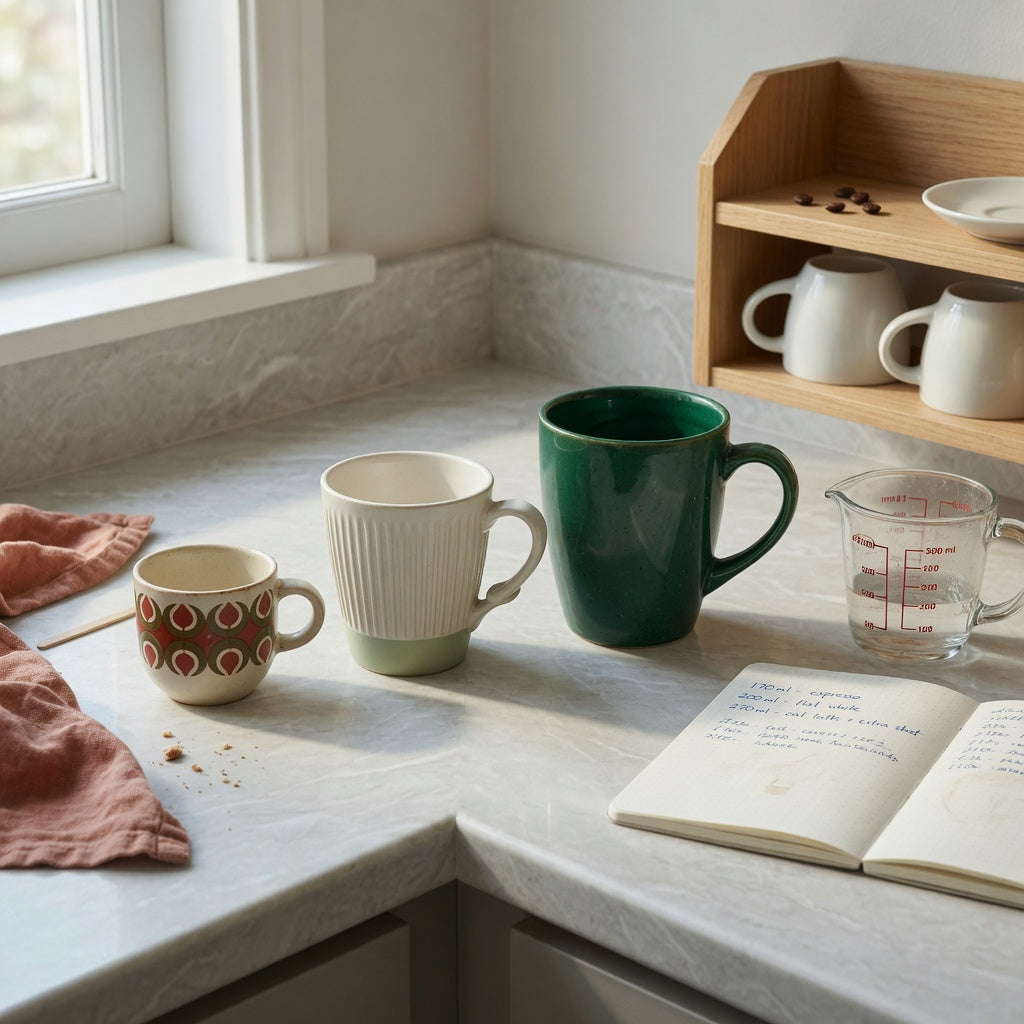
Decaf Coffee Cup Everyday Mug Rotation Product Shortlist Guide: 3 Picks
Reading time: about 8 minutes
At 10 a.m., one cup is on the drying rack, another is beside the keyboard, and the largest mug is still in the cabinet because it felt excessive for a short pour. That familiar mismatch is what this decaf coffee cup everyday mug rotation product shortlist guide is designed to solve. From handling cups in our store, we have found that the useful shortlist is rarely about collecting three similar designs. It is about giving each cup a clear job.
We are comparing three verified catalog capacities: Retro at 170 ml, Pleated at 200 ml, and Emerald at 270 ml. Capacity is the fixed starting point. Handle comfort, your preferred serving level, and the space available on a shelf or drying rack decide which option should actually enter the rotation.
How does the decaf coffee cup everyday mug rotation product shortlist guide assign each capacity?
Start by measuring the amount you normally pour, not the maximum amount your current mug can hold. Fill your usual cup with cool water to the level you actually use, then transfer that water to a marked measuring jug. This quick check gives the capacity figures a real reference point.
- 170 ml is the small-serving role. It suits someone whose measured pour is close to that amount and who does not mind returning for another serving later.
- 200 ml is the middle role. It gives a little more room than 170 ml without moving directly to the largest option in this shortlist.
- 270 ml is the fuller-serving role. It fits a routine built around fewer, larger pours rather than several small ones.
Listed capacity does not establish exterior width, height, stackability, or the amount of space a handle occupies. It also does not require you to fill a cup to its limit. Your normal fill can be lower, so use the numbers as comparison points rather than promises about physical footprint.
Which handle feels right between the kitchen, desk, and table?
A handle can look comfortable in a product image and still feel wrong for a particular hand. Finger clearance, thumb position, the distance between the handle and cup body, and balance at your normal fill level all affect the grip. We do not label one handle universally best because a two-finger hold and a full-hand grip are different preferences.
- Fill the cup with cool water to your normal serving level.
- Lift it using the number of fingers you naturally place through the handle.
- Notice whether your knuckles press against the cup body or your thumb has to pinch the top of the handle.
- Carry it along the real route from counter to desk or table, then set it on the surface you use most.
If a grip requires constant adjustment, that cup is a poor candidate for the highest-frequency slot, even if the capacity is right. For a gift, handle comfort is also the least certain variable. A known serving preference is useful, but do not assume the recipient holds a cup the same way you do.
Will three cups fit your shelf, drying rack, and care routine?
A capacity figure cannot tell you whether three cups will sit comfortably beside plates or clear the shelf above them. Before ordering a full rotation, measure the actual storage zone and compare it with the current product information. The relevant measurements are specific:
- Maximum width: measure from the far side of the cup body to the outer edge of the handle.
- Height: check the clearance between shelves rather than relying on a front-facing product photo.
- Depth: confirm that the cup will not prevent the cabinet door from closing or block items stored behind it.
- Rack clearance: if the current care instructions confirm dishwasher use, check that the handle will not interfere with the rack or spray arm.
We also recommend a basic inspection after unboxing. Look along the rim under direct light for chips or rough areas, examine both handle-to-body joins for visible cracks, and place the empty cup on a flat counter to check for rocking. Review the care instructions for each product before using a dishwasher or microwave; appearance alone does not confirm compatibility. These checks do not predict long-term durability, but they can identify an immediate fit or condition issue before the cup joins a daily routine.
Which Retro, Pleated, or Emerald cup should you choose or skip?
This shortlist maps each verified capacity to a serving scenario. The reasons to skip are just as useful as the reasons to buy.
| Option | Choose it when | Why it fits | Skip it when |
|---|---|---|---|
| Retro coffee tea cup, 170 ml | Your measured serving is small and you prefer several separate pours through the day. | It fills the smallest-capacity role in this three-cup comparison, so it does not make you choose a 200 ml or 270 ml cup for every short serving. | You dislike returning for another pour, your normal serving exceeds 170 ml, or you need exterior dimensions and handle clearance that have not yet been confirmed. |
| Pleated coffee tea cup, 200 ml | Your usual serving falls between the two extremes, or you want one capacity for both desk and table use. | At 200 ml, it is the numerical middle option: 30 ml above the Retro and 70 ml below the Emerald. | Your routine is consistently built around very small servings or you know that 200 ml will still lead to an immediate refill. |
| Emerald coffee tea mug, 270 ml | You prefer a fuller single serving and fewer trips back to the kitchen. | It provides the largest listed capacity in this shortlist, giving it a distinct role instead of duplicating the smaller cups. | You mainly pour small amounts, dislike carrying a larger filled serving, or have not confirmed that its exterior dimensions suit your desk and cabinet. |
If none of these capacities matches the amount you measured at home, do not force a choice just to complete a three-cup set. Browse our unique coffee mugs collection and apply the same filters: normal fill volume, handle preference, maximum exterior width, and current care instructions.
Do you need one cup, two cups, or a mixed three-cup rotation?
More cups do not automatically make a better rotation. Frequency of use should decide how many earn shelf space.
- One-cup setup: Choose the capacity closest to your measured everyday serving. The Pleated 200 ml can be a middle option, but it is not the automatic answer if your normal pour is clearly closer to 170 ml or 270 ml.
- Two-cup setup: Pair different capacities if your day has two distinct serving patterns. Retro plus Emerald covers the widest capacity difference; two cups of the same size may be more practical if your servings rarely change.
- Three-cup setup: Choose one of each only if small, medium, and fuller servings all occur often enough to justify separate roles. Otherwise, the least-used cup will occupy storage without solving a regular need.
For gift unboxings, one well-matched cup can be a better decision than a mixed set. Use a capacity the recipient already favors, and treat handle feel and cabinet fit as unknowns unless you have seen their current mugs.
Which five checks should you complete before ordering?
Use the decaf coffee cup everyday mug rotation product shortlist guide as a decision sequence, not a reason to buy all three options.
- Measure one normal serving. Use cool water and a marked jug rather than estimating from the cup's appearance.
- Count serving occasions. Note whether an ordinary workday involves several small pours or one or two fuller ones.
- Assign a role. Decide whether the new cup will be the small, middle, or fuller-serving option.
- Measure the storage zone. Record shelf height, usable depth, and maximum width including handle space.
- Review grip and care details. Inspect current product photos and specifications, then verify dishwasher or microwave compatibility instead of assuming it.
After those checks, open the product row that matches your serving role. Start with the cup you expect to use most often. A second or third option should solve a different daily scenario, not merely repeat the first purchase.
Frequently asked questions
Is a 170 ml cup too small for an everyday decaf coffee serving?
It is too small only if your normal measured pour exceeds 170 ml or you dislike making another serving. The Retro 170 ml is a practical candidate for intentionally small, repeated pours. Measure your current serving with water before deciding.
How should I build a mug rotation in a small kitchen?
The decaf coffee cup everyday mug rotation product shortlist guide works best in a small kitchen when you measure exterior storage space as well as serving volume. Start with one capacity that matches your most frequent pour, including the handle in your width calculation. Add another cup only if it serves a clearly different role.
How can I judge coffee cup handle comfort before ordering online?
Use product images to examine the handle opening, its distance from the cup body, and the likely thumb position, but recognize that photos cannot confirm personal comfort. Compare the design with a handle you already use comfortably. After arrival, test the grip with cool water before making it a high-frequency desk or kitchen cup.
Can I assume these cups are dishwasher or microwave safe?
No. Check the current product page and the care information supplied with the specific cup. If dishwasher or microwave compatibility is not stated, do not use that appliance until the correct care method is confirmed.
Should every cup in an everyday rotation have the same capacity?
Only if your serving preference stays consistent throughout the day. Mixed capacities are more useful when you regularly alternate between small and fuller pours. If one size already covers every occasion, repeating that size may be simpler than maintaining three different roles.
Write down three figures before your next step: your normal serving volume, maximum shelf width, and preferred grip style. Compare those notes with the linked 170 ml, 200 ml, and 270 ml options, then choose the cup with a specific job in your daily rotation.
More from our blog
Read more
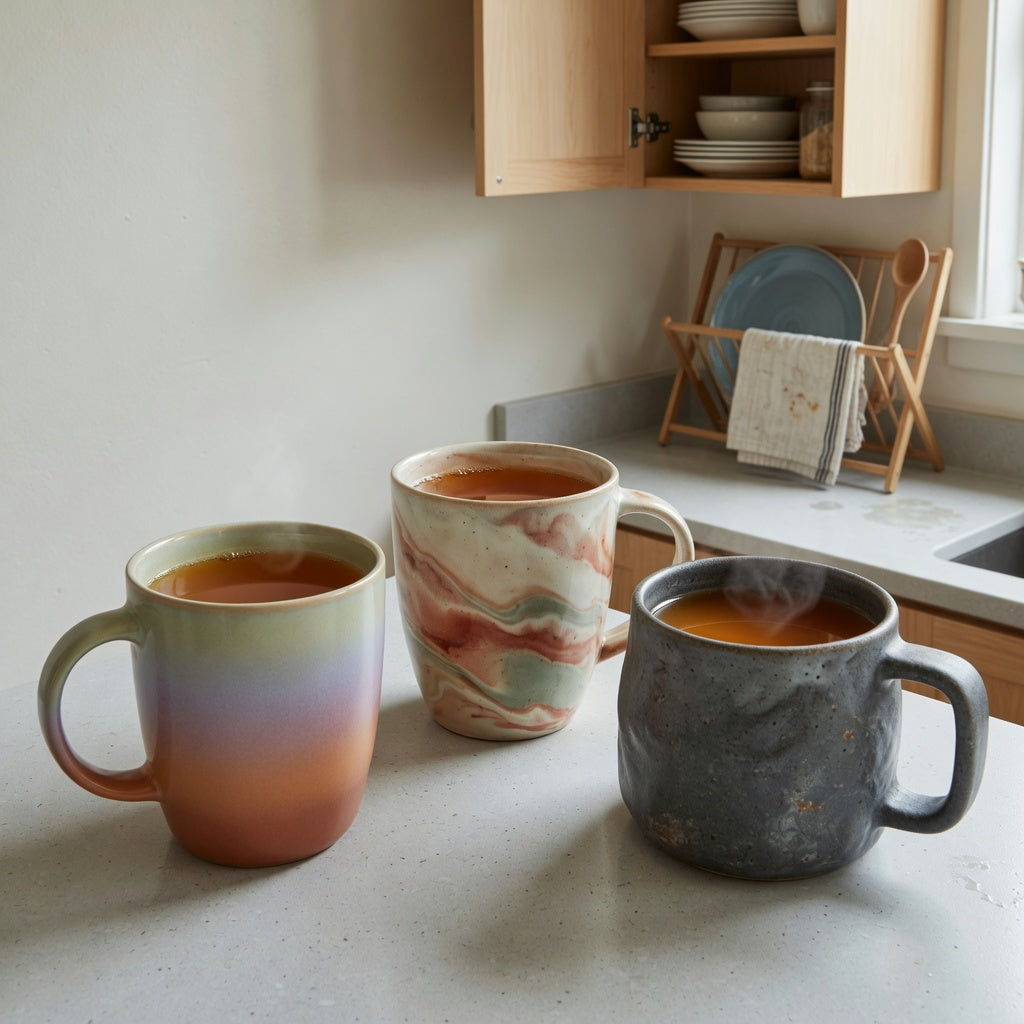
Apple Cider Mug Everyday Mug Rotation Product Shortlist Guide
Compare CoffeifyMug's 400 ml Gradient and Flow mugs with the 480 ml Rock using pour frequency, handle fit, cabinet space, and care habits. Each option has a clear reason to choose it or leave it of...
Read more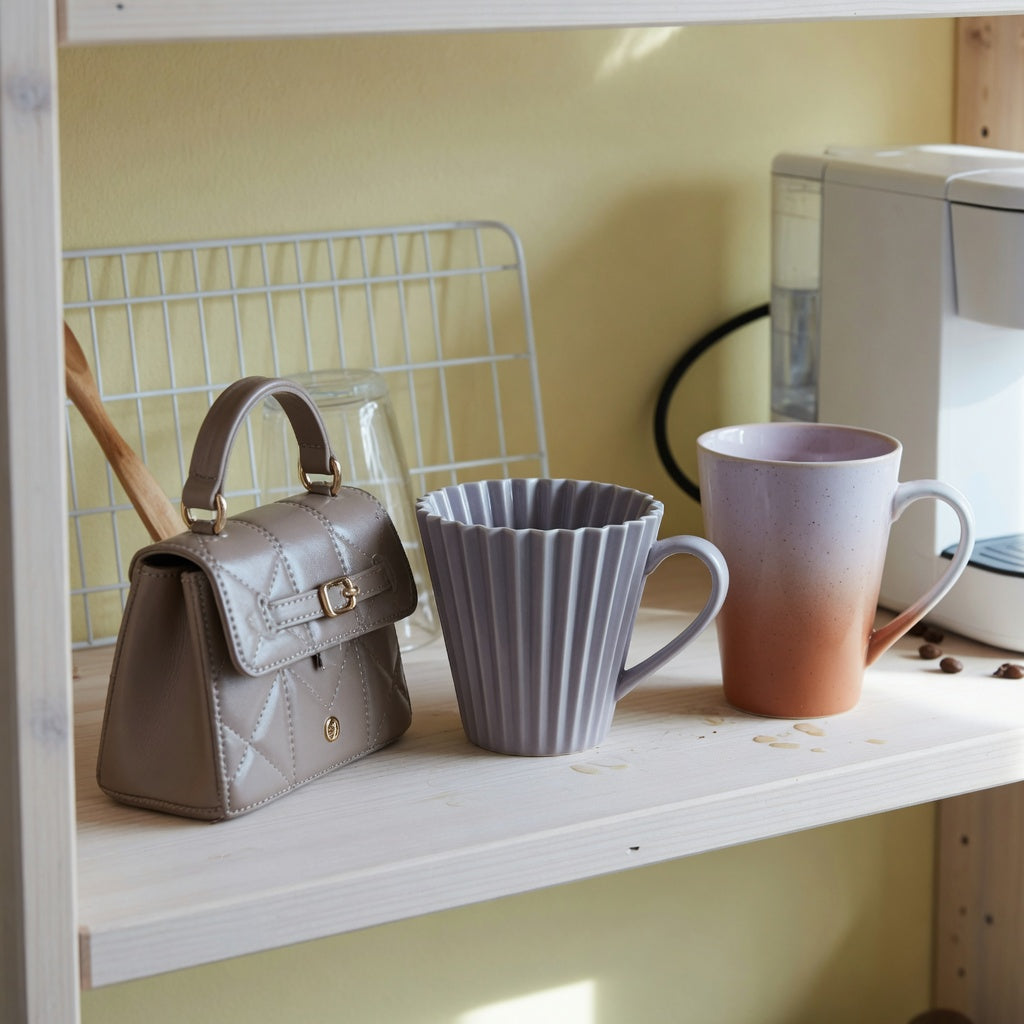
Cute Ceramic Coffee Mugs Everyday Mug Rotation Product Shortlist Guide
Build a small mug rotation around actual pours, cabinet space, and wash habits. Compare CoffeifyMug's Handbag, Pleated, and Gradient options with clear reasons to choose or skip each style.
Read more
Leave a comment
This site is protected by hCaptcha and the hCaptcha Privacy Policy and Terms of Service apply.