
Apple Cider Mug Everyday Mug Rotation Product Shortlist Guide
Reading time: about 11 minutes
A mug rotation usually breaks down at a very ordinary moment: one mug is still in the sink, another occupies too much of the cabinet's front row, and the remaining handle feels awkward when your fingers are damp from rinsing a spoon. This apple cider mug everyday mug rotation product shortlist guide is built around that moment. It narrows CoffeifyMug's ceramic options by the details that affect repeated use: the amount you actually pour, the way the handle meets your hand, and the space the mug must return to after washing.
We sell and handle this product category, and the practical questions we hear are rarely about owning the largest possible collection. Shoppers want two or three mugs they will reach for without thinking. A mug can look right on a product page and still be wrong for a shallow shelf, a smaller grip, or a routine that depends on quick dishwasher cycles. Our goal here is to identify those conflicts before checkout without making claims the product specifications do not support.
Use frequency in an apple cider mug everyday mug rotation product shortlist guide
Count uses before comparing designs. The right number of mugs depends on how often cider appears in your week and whether the same pieces also serve coffee or tea.
- Occasional cider: If you make cider a few times each season, one versatile ceramic mug may be enough. A dedicated three-piece cider rotation will probably spend more time taking up cabinet space than being used.
- One serving most days: Two mugs create a simple cycle. One can be in use or awaiting washing while the other is ready, without turning the shelf into a collection.
- Shared evening drinks: Start with the number of people served at the same time, then consider one backup. Do not assume everyone wants the same capacity or handle shape.
- Cider, coffee, and tea throughout the week: Give more weight to handle comfort and cleanup. A mug used for several drinks earns its place more easily than one reserved for a single seasonal pour.
In our experience, the best shortlist is often smaller than the shopper first expects. Frequency tells you how many mugs deserve space. Capacity and grip determine which ones make the cut.
400 ml or 480 ml: which capacity matches your real pour?
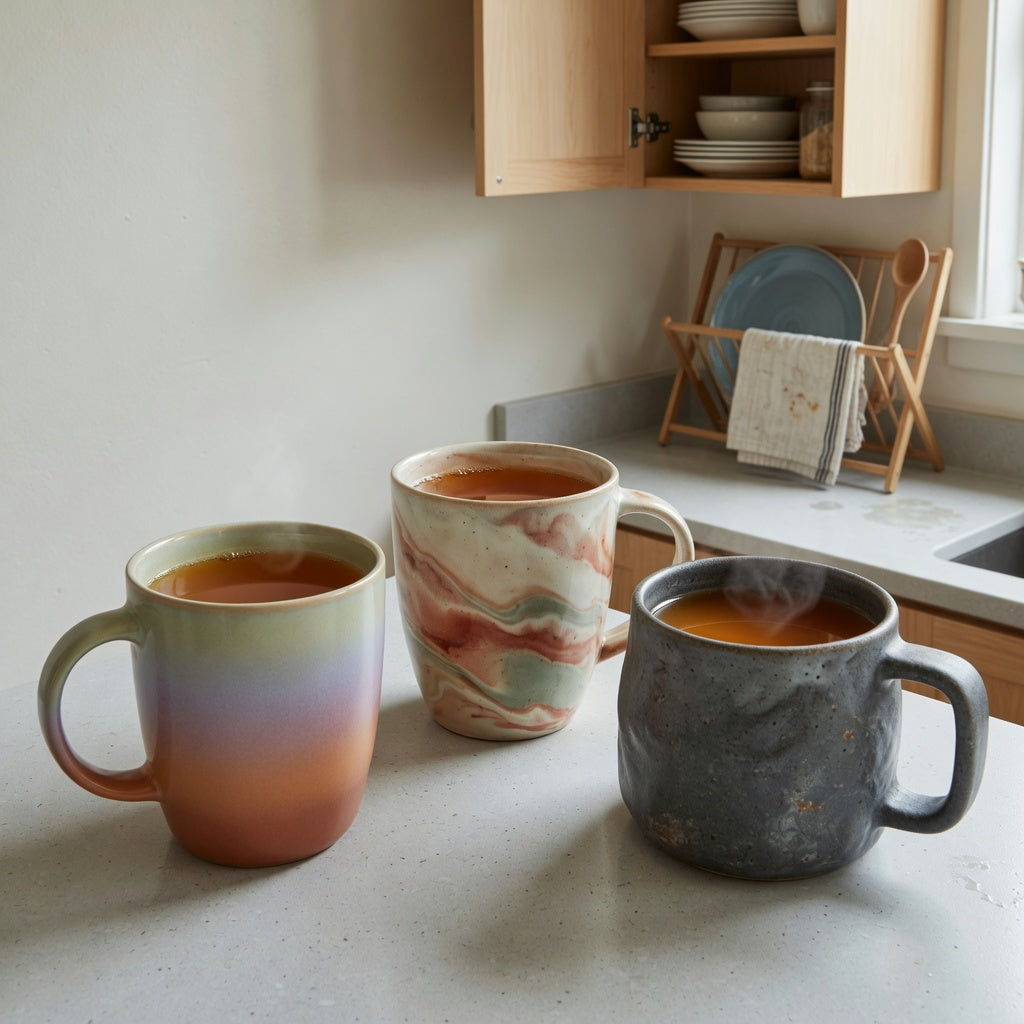
The Gradient and The Flow each have a verified 400 ml capacity. The Rock is 480 ml. That gives you two capacity groups rather than three, which makes the first decision straightforward.
Measure your usual serving instead of estimating it from memory. Fill your current mug with cool water to the level you normally consider comfortable, then pour that water into a measuring jug. Do not measure to the rim. A listed capacity does not mean hot cider should be carried at the very edge, especially if you add your own garnish or need walking room between the kitchen and desk.
- Shortlist 400 ml if your measured serving fits comfortably and you would rather avoid paying for capacity you seldom use.
- Shortlist 480 ml if your normal serving approaches 400 ml and you want more headspace or fewer trips back to the kitchen.
The difference is 80 ml. It matters only if you use it. A larger listed capacity can also mean more beverage weight in your hand when filled, but it does not automatically prove that the mug is taller, wider, or harder to store. External dimensions must be checked separately.
Handle opening, projection, and grip: what can an online shopper verify?
Handle comfort is personal, so we do not declare one shape universally better from a product name or capacity figure. Instead, compare each listing with the mug you already reach for most often.
- Check finger clearance. Notice whether you normally use one, two, or three fingers inside the handle. Compare the pictured opening with your current mug rather than assuming a larger-looking loop will suit your hand.
- Check handle projection. This is how far the handle extends beyond the body. Projection affects total cabinet width, drying-rack placement, and how easily the mug passes other items on a crowded counter.
- Look at the attachment points. The upper and lower handle joints influence grip position. Product photos can show the general orientation, but they cannot provide a universal comfort score.
- Think about the loaded grip. Test your current mug with cool water at your normal fill line. Never use hot cider for a grip experiment. A handle that feels fine on an empty mug may feel different once the cup is loaded.
Wet or slippery fingers are a real kitchen scenario, but the answer is not to conduct a risky hot-drink test. Look for enough clearance to grip without pinching, and keep one hand available to steady the mug if that is already your habit. If exact handle measurements are essential and are not stated, treat fit as unresolved rather than guessing.
Three ceramic candidates with a clear choose-or-skip reason
Open the CoffeifyMug unique coffee mugs collection to compare the designs, then use the verified capacity and the handle shown on each product page to reduce the field.
| Option | Verified capacity | Shortlist it when | Skip it when |
|---|---|---|---|
| The Gradient | 400 ml | Your measured serving fits 400 ml and its pictured form suits your grip | You regularly need more capacity or cannot confirm handle clearance |
| The Flow | 400 ml | You want 400 ml and prefer its pictured handle and design over The Gradient | You need a capacity advantage over another 400 ml option |
| The Rock | 480 ml | You use the extra 80 ml or want more room below the rim | You prefer smaller servings or have not confirmed storage fit |
The Gradient 400 ml for a measured 400 ml routine
Reader situation: Your comfortable pour falls within 400 ml, and you want an everyday ceramic mug that can also take a place in a coffee or tea rotation. Why it fits: The Gradient coffee and tea mug provides the verified 400 ml capacity without asking you to make room for volume you do not normally use. Compare the pictured handle opening and projection with your current favorite. Skip it: Leave it off the shortlist if your measured serving regularly pushes beyond 400 ml or the handle profile does not match your grip.
The Flow 400 ml when handle and design decide the tie
Reader situation: You have already settled on 400 ml but want to compare two designs before choosing a daily mug. Why it fits: The Flow coffee and tea mug matches The Gradient on verified capacity, so you can make the decision using the pictured handle shape and the design you would rather keep in regular view. There is no verified volume advantage between these two options. Skip it: Do not choose The Flow merely because the name suggests a specific ergonomic result. Skip it if the shown handle appears less compatible with your usual finger position or if 400 ml is already too close to your normal fill level.
The Rock 480 ml for the shopper who will use the extra space
Reader situation: Your measured pour approaches 400 ml, you dislike filling close to the rim, or you regularly return for a little more. Why it fits: The Rock coffee and tea mug has a verified 480 ml capacity, giving you 80 ml more than the other two candidates. Skip it: Remove it if you prefer smaller servings, find a fuller mug tiring to carry, or have not confirmed its external fit. Capacity alone does not establish cabinet width, height, base diameter, or overall weight.
A mixed rotation can make sense in a shared home: one 400 ml mug for the smaller pour and one 480 ml mug for the person who uses the extra capacity. A matched 400 ml rotation is simpler if serving habits are similar. If you drink cider only occasionally, shortlist one product rather than automatically buying several.
Cabinet, drying-rack, and care checks before checkout
Capacity gets the most attention online, but storage failures usually involve exterior measurements. Use a ruler on the mug that already fits your routine and record three numbers: overall height, widest width including the handle, and base diameter. Compare those measurements with any dimensions stated on the product page. If a dimension is not available, do not use capacity as a substitute.
- Closed cabinet: Check shelf height, depth, and door clearance. The handle is often the widest point and can catch neighboring mugs even when the body fits.
- Open shelf: Allow enough room to lift the mug without striking the shelf above. Do not assume any option is stackable unless the listing specifically says so.
- Drying rack: Compare handle projection with tine spacing. A mug that must lean against another piece can make an otherwise simple wash cycle awkward.
- Dishwasher routine: Confirm the current care instructions on the individual product page. This guide does not assert dishwasher or microwave compatibility that is not stated in the verified product facts.
At unboxing, place the empty ceramic mug on a level counter and inspect it under good light. Check the rim and foot ring for chips, look over the body for hairline cracks, and examine both handle joints. Confirm that the base sits steadily without rocking. These are sensible inspection points for any ceramic mug, not a claim that defects are common in these products.
After cider use, rinse visible residue before it dries and follow the product's stated care directions. If hand washing, a soft, non-abrasive sponge is a conservative choice for a glazed ceramic surface. Dry the mug before returning it to a closed cabinet. For a gift, complete the same inspection before wrapping so the recipient's first look is not also the quality-control step.
Which needs should remove these mugs from your shortlist?
These ceramic options are not good candidates for every drinking routine. Choose a different product category if any of the following is central to your purchase:
- You need a sealed vessel for commuting or carrying inside a bag.
- You expect specialized insulation or hours of stated temperature retention.
- You need a low-breakage material for a drop-prone outdoor setting.
- You are shopping for a bundle with cider ingredients, a lid, spoon, coaster, or other included items.
- You require confirmed stackability or exact handle dimensions that are not provided.
This shortlist evaluates The Gradient, The Flow, and The Rock as everyday ceramic mugs. It does not represent ingredients, accessories, specialized temperature performance, or bundled products as included. A travel tumbler, metal camping cup, or explicitly described gift set would suit those other needs better.
A five-minute comparison before opening the product pages
- Measure your comfortable pour with cool water and a measuring jug.
- Choose the 400 ml group or the 480 ml option based on that result.
- Compare the pictured handle opening and projection with your favorite mug.
- Measure cabinet height, total storage width, and drying-rack clearance.
- Verify care guidance instead of assuming dishwasher or microwave compatibility.
- Remove any option that requires you to guess about a must-have detail.
If the answers point to 400 ml, compare The Gradient and The Flow side by side and let handle fit and design settle the tie. If you will use the additional 80 ml, open The Rock next. If none of the three passes your grip or storage checks, do not force a purchase simply to complete a rotation.
Frequently asked questions
What should an apple cider mug everyday mug rotation product shortlist guide compare?
It should compare actual pour volume, handle opening and projection, exterior storage fit, and the care routine you are prepared to follow. It should also provide a clear reason to skip each option. Capacity alone is not enough to establish everyday fit.
Is a 400 ml or 480 ml mug better for apple cider?
Choose 400 ml if your measured serving fits with comfortable room below the rim. Choose 480 ml if you will use the additional 80 ml or want more headspace. The larger option is not automatically better if it adds beverage weight or unused capacity to your routine.
How can I judge an apple cider mug handle while shopping online?
Compare the product photos with a mug you already find comfortable. Focus on interior finger clearance, how far the handle projects from the body, and where its upper and lower joints sit. If handle fit is essential and measurements are unavailable, avoid treating a photo as an exact ergonomic guarantee.
Are The Gradient, The Flow, and The Rock dishwasher safe?
This article does not assert dishwasher or microwave compatibility. Check the current care instructions on each product page before putting a mug through a dishwasher cycle; if the guidance is unclear, use conservative hand washing until it is confirmed.
Which CoffeifyMug mug should I shortlist first?
Start with The Gradient and The Flow if your measured serving points to 400 ml, or The Rock if you will use 480 ml. Then visit the unique ceramic coffee mug collection and compare only the options that pass your capacity, handle, storage, and care checks. That leaves you with a rotation based on repeated use rather than unused shelf appeal.
More from our blog
Read more
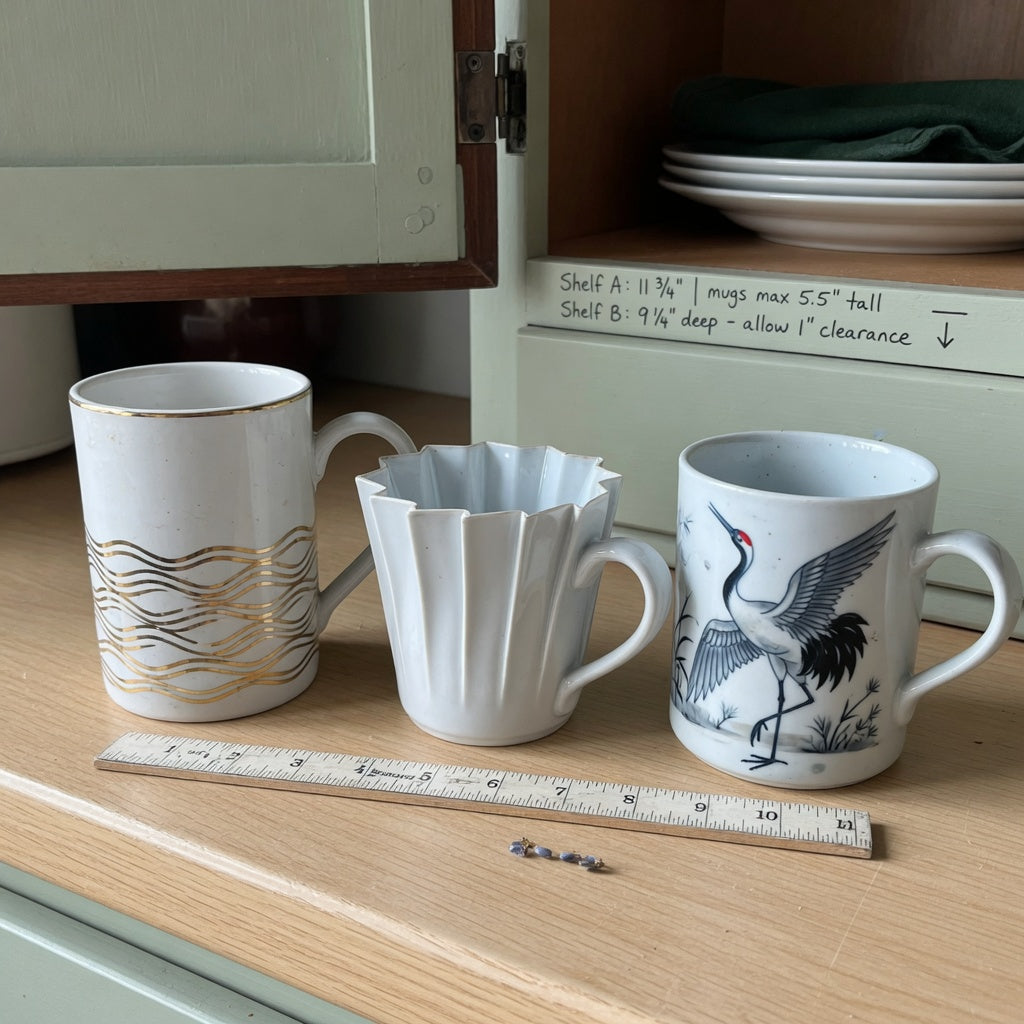
White Pottery Coffee Mugs Everyday Mug Rotation Product Shortlist Guide
Use cabinet measurements, cleaning habits, and design preferences to compare three white pottery mugs. Each pick includes a clear reason to choose it, skip it, or continue to the broader collection.
Read more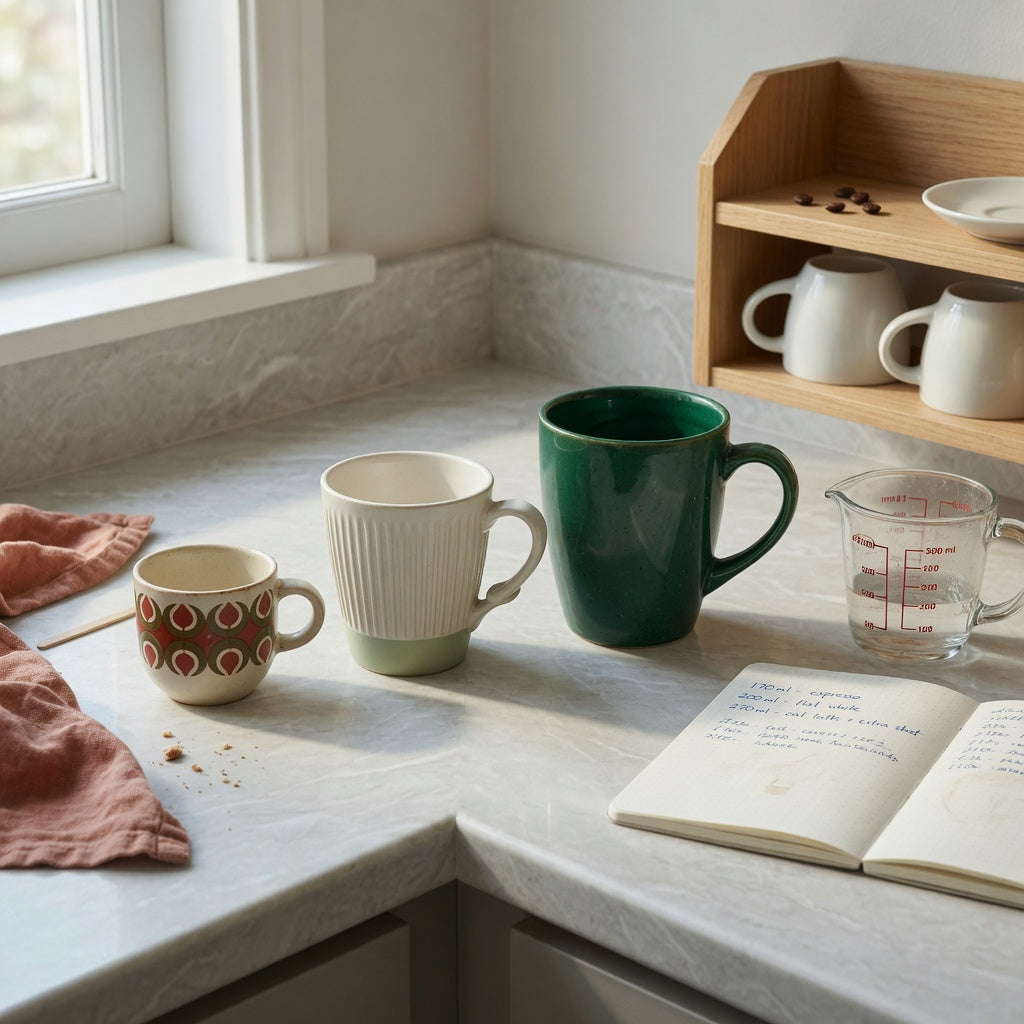
Decaf Coffee Cup Everyday Mug Rotation Product Shortlist Guide: 3 Picks
Compare the Retro 170 ml, Pleated 200 ml, and Emerald 270 ml by serving preference, handle comfort, and storage fit. Each option includes a practical reason to choose it and a clear reason to skip it.
Read more
Leave a comment
This site is protected by hCaptcha and the hCaptcha Privacy Policy and Terms of Service apply.