



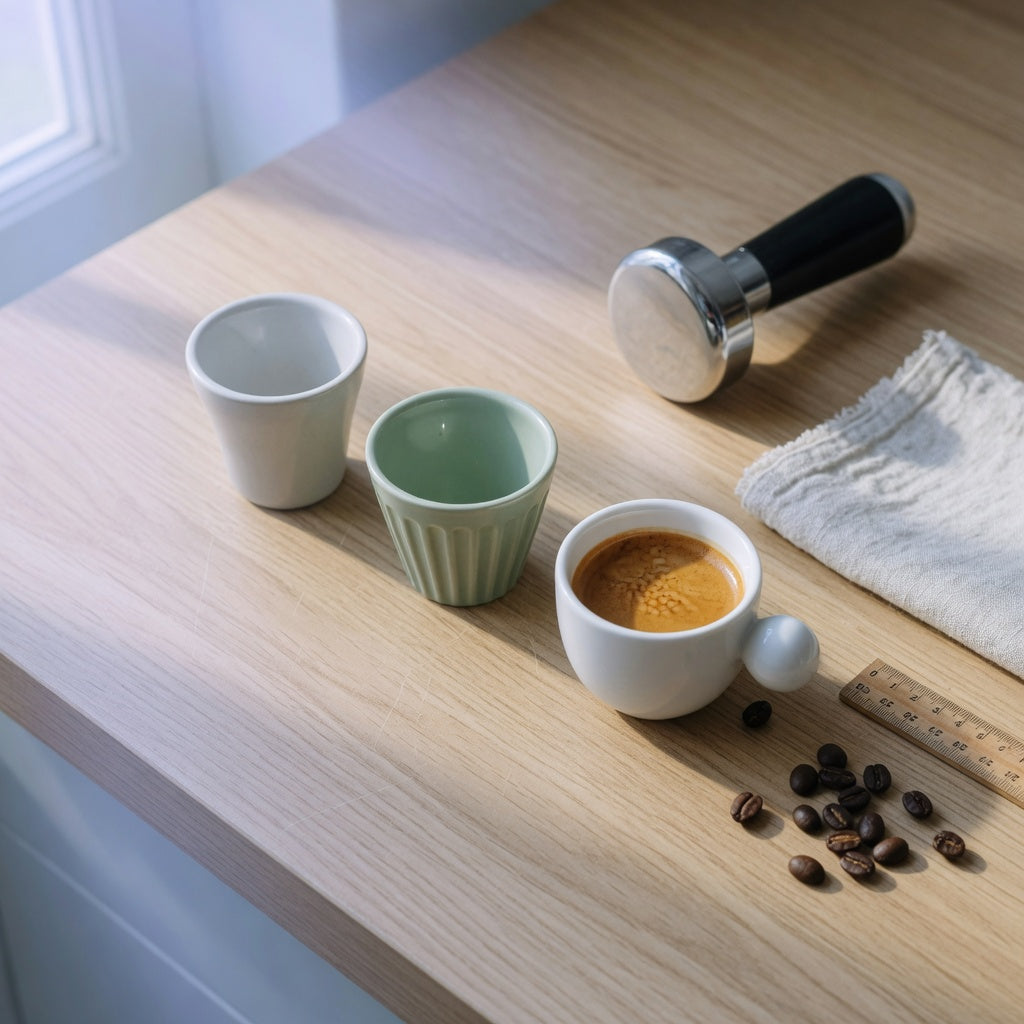
Cute Espresso Cups: First Time Buyer Practical Purchase Checklist
Reading time: about 9 minutes
The question we get most often about cute espresso cups isn't about pattern or colour. It's "will this actually work for espresso?" — usually sent to us with a screenshot of a listing. Most shoppers haven't read the capacity line. A 200 ml cup and a 50 ml demitasse photograph almost identically; only one of them makes a shot look like a shot. What follows is our cute espresso cups first time buyer practical purchase checklist — the listing details worth verifying, the ones nobody can settle for you from a photo, and the point at which a different cup is simply the better buy.
Why our cute cups hold three to five times a single shot
Espresso is a small drink, and the cup that serves it is small for a reason. A traditional Italian single is usually described at around 25 ml, modern specialty definitions commonly land between 25 and 35 ml, and the classic thick-walled china cup is about 50 ml — deliberately larger than the shot so the crema has room and doesn't slosh over the rim. Pull a 1:2 double from an 18 g dose and you have roughly 36 g of liquid. Still well under 100 ml.
Our ceramic cups sit outside that range, and we'd rather say so than let you discover it at the machine. The Retro Coffee & Tea Cup is listed at 170 ml, the Pleated Coffee & Tea Cup at 200 ml, and the Ball Handle Coffee & Tea Mug at 250 ml. All three are ceramic. All three are compact for mugs. All three are three to five times the volume of a 50 ml demitasse.
That's a category difference, not a defect. If your ritual is a straight single served in a traditional cup, buy a demitasse — ours won't do that job and we won't market them as though they will. If your morning is a double with a splash of steamed milk, a cortado, a small macchiato, an affogato, or tea at four in the afternoon, the 170–250 ml band is the more useful shape, and it's the range we stock.
Which of the three listed capacities matches your actual drink?
Same shelf, different habits. Here's how we'd match them at the counter, plus what to confirm before checkout because we can't confirm it for you from here.
| Cup | Listed capacity | Drink it suits | Confirm on the listing |
|---|---|---|---|
| Retro Coffee & Tea Cup | 170 ml | Double shot with a splash of milk, small cortado, tea for one, affogato | Interior colour, height and rim diameter, whether a saucer is included |
| Pleated Coffee & Tea Cup | 200 ml | Macchiato, small flat white, hot chocolate, a fuller cup of tea | Rim diameter, handle opening, care guidance |
| Ball Handle Coffee & Tea Mug | 250 ml | Small latte, longer black coffee, cocoa, evening tea | Handle loop size, weight when full, footprint on the drip tray |
The 170 ml cup is the one that keeps a double looking like a shot rather than a shallow bath. The 250 ml mug is the one that survives a milk-drink habit. To see the other shapes we carry before deciding, browse the unique coffee mugs collection — we publish a capacity on each product because that is the only way to compare them honestly.
Will the rim catch both spout streams? Measure before you order
No published standard governs the gap between a portafilter spout and a drip tray, so no product page — ours included — can promise a cup will fit your machine. A few measurements settle it, and none of them take more than a minute:
- Height. With the drip tray in place, measure from the tray grate up to the underside of the group head or spout. That's your hard ceiling.
- Rim diameter. Measure across the inside of the cup's rim and compare it to the spread between your two spout streams. A narrow rim catches one stream and lets the other run down the outside of the cup.
- Foot diameter. A base that overhangs a slatted tray can tip when you set the cup down one-handed.
- Weight when full. A 250 ml mug plus liquid is a different object to lift than a 50 ml demitasse, especially before the caffeine has kicked in.
If a listing doesn't publish height and rim diameter, treat both as unknown — not as "probably fine." Ask the seller for a real measurement and expect a number back.
Handles, interior colour and glaze: what a photo can't settle
- Handle opening. Miniature handles are common on cute cups and some are purely decorative. The rounded loop on the Ball Handle mug is visible in our photos; the usable finger clearance is not something a picture can prove. If you grip with two fingers or have larger hands, ask for the internal opening measurement.
- Rim thickness. A thick rim holds heat and feels solid against the lip; a thin rim reads more delicate. Neither is better, but more material takes longer to warm, which changes the first mouthful.
- Interior colour. A plain white interior shows crema — that contrast is how you spot a thin, pale shot before you taste it. Dark or heavily patterned interiors hide it. If you're still learning to judge your espresso, the inside of the cup matters more than the outside.
- Glaze and washing. Painted and hand-finished glazes vary in how they handle repeated hot cycles, and long-term dishwasher durability claims in this category are mostly anecdotal rather than tested to a standard. Read the care guidance on the listing you're buying; if it isn't there, ask.
On food contact, the U.S. FDA explains that lead in ceramic glaze is bound into the body when pottery is fired correctly, that improperly fired glaze can leave lead available for food, that some traditional pottery labelled "lead free" has still shown extractable lead, and that ceramicware intended only for decoration must be labelled so it isn't used with food. The practical version for a first-time buyer: if a cup has an unusual glaze or an unlabelled handmade finish, ask for food-contact confirmation before you commit.
Cute espresso cups first time buyer practical purchase checklist
Run this list against any cup you're considering, ours included. Anything you can't answer is a question for the seller, not an assumption to make at checkout.
- Capacity in millilitres, published. Under 90 ml is demitasse territory; 150–250 ml is a small coffee cup. Decide which one you're actually shopping for.
- Height and rim diameter, published. Both are needed for the machine-clearance check above.
- Handle opening you can grip. Two fingers, comfortably — not just a loop that looks neat in a photo.
- Interior colour. White if you want to read crema; patterned if the cup is mostly for looking at.
- Body material stated plainly. Ceramic, porcelain and stoneware aren't interchangeable words, and double-wall glass is a different product altogether.
- Saucer or stand included — yes or no. Sets that look complete in a photo are often sold cup-only.
- Care instructions in writing. Dishwasher and microwave guidance should be published, not inferred.
- Food-contact confirmation for unusual glazes. Especially hand-painted or novelty finishes.
- Breakage and returns. Ceramic ships heavy, and chips happen in transit.
- Whether it's drinkware at all. Search results mix real cups with plush and purely decorative espresso-cup objects. A soft toy is not a cup.
Where a cute ceramic cup is the wrong purchase
We'd rather you skip a sale than end up with a cup that irritates you every morning. Step away from this range if any of these describe you:
- You want a traditional single-shot cup. A 50 ml demitasse does that better; our smallest is more than three times that volume.
- Heat retention is your top priority for a slowly sipped shot. Double-wall glass is built for that job, though it's commonly reported as more fragile and its narrow bore suits espresso far better than milk drinks.
- Your usual drink is a 350 ml latte. A 250 ml mug holds a small latte; a full-size one needs a bigger vessel.
- You need formal food-contact documentation for a commercial setting or a gift with paperwork attached. Ask before ordering — a lifestyle photo can't supply it.
- You're buying a gift-ready boxed set with saucers. Confirm the contents. Cup-only listings are common across the category.
Cup-only or saucer set? Shelf space and gift logic
A saucer isn't decoration. It catches the drip between spout and table, gives you somewhere to rest a spoon, and makes a cup look intentional on an open shelf. It also adds diameter, which matters on a narrow drip tray or a tight cupboard shelf.
In a compact kitchen, cup-only designs earn their place because they stack and nest. Sets with saucers win as gifts because they look finished out of the box — provided the box actually contains the saucers. Match the gift to the recipient's machine rather than their personality: an espresso-only household will use a 170 ml cup daily and a 250 ml mug rarely, while a tea-and-cocoa household is the reverse. If you want to compare shapes side by side first, the small ceramic cups we stock are all listed with their capacities.
Frequently asked questions
Is 170 ml too big for a single espresso?
Yes, if you define espresso strictly. A single is roughly 25–35 ml and a classic demitasse about 50 ml, so 170 ml leaves a lot of empty space and the crema spreads thin. It's a good size for a double with a splash of milk, a cortado, or tea.
Will the Retro or Pleated cup fit under my espresso machine?
We can't promise that, and no listing honestly can — there's no standard spout-to-tray clearance. Measure from the drip tray grate to the spout, then compare that number with the cup height published on the product page. If height isn't published, ask us before you order.
Are these cups dishwasher safe?
Check the care guidance on the current listing rather than assuming. Glaze durability under repeated hot cycles varies, and long-term dishwasher claims in this category are usually anecdotal rather than tested to a standard.
Can I use a 200 ml cup for a macchiato or a flat white?
The Pleated cup's listed 200 ml is the closest match for milk drinks of that size — generous for a macchiato, about right for a small flat white. A standard 350 ml latte will be tight.
What's the most important step in this cute espresso cups first time buyer practical purchase checklist?
Write down your usual drink volume before you look at a single pattern. Handle size, saucer, interior colour and glaze care are all preferences you can trade off. Capacity is the one decision you can't fix after delivery.
Start with the number: if your daily drink lands between 150 and 250 ml, choose the capacity first and the pattern second, and use the unique coffee mugs collection to compare sizes without guessing. If your daily drink is a true single shot, buy a demitasse and keep these cups for everything else.
More from our blog
Ready to pick your mug? Two ways to save on today's order:
Ordering 1–3 mugs? Get an extra 10% off your 1st order with code 10_OFF Apply 10% Off & Shop Wooden-Handle Mugs →
Gifting 4+ mugs? Buy 3, Get the 4th Free applies automatically at checkout (no code needed; offers do not stack) · Free standard shipping (Nov pre-Christmas delivery: 15–20 calendar days US) · Free replacement if chipped in transit.
Popular mug buying guides: Wooden-Handle Tea Infuser Mugs Compared · Christmas & Secret Santa Mugs 2026 · Espresso & Cortado Cups Guide · Cup & Saucer Gift Sets · All 25 Mugs Spec Table · Mug Size Guide · Shipping & Promo FAQ
FIRST ORDER 10% OFF (CODE: 10_OFF) · OR BUY 3, GET THE 4TH FREE


Read more
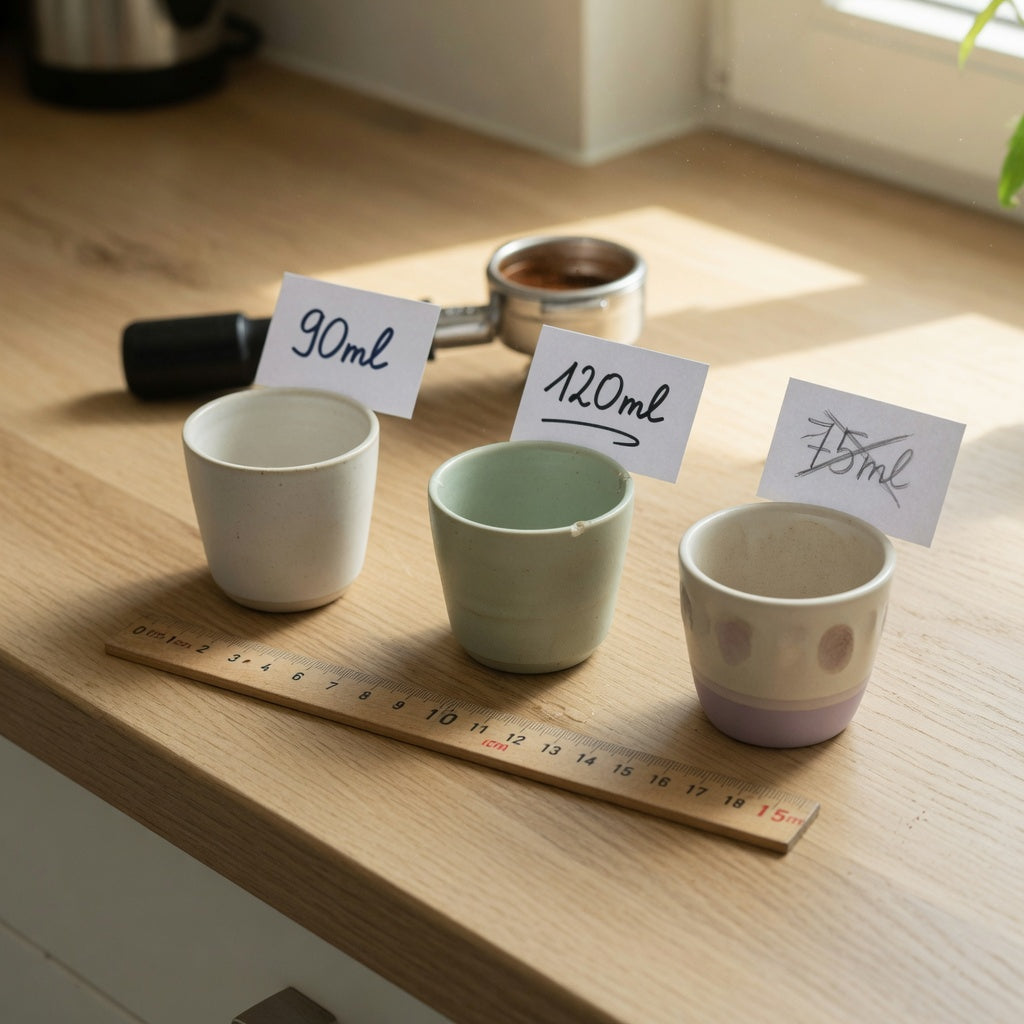
Cute Espresso Cups Gift Choice Practical Purchase Checklist
A gifted espresso cup fails when the pour is lost in too much volume, the rim splashes two streams, or the handle is only decorative. Use this checklist to match capacity, machine clearance, and ca...
Read more
Cute Espresso Cups Gift Choice Product Shortlist Guide: 3 Sizes
A scenario-based shortlist built on 170, 200, and 250 ml ceramic cups — with explicit reasons to choose or skip each one, plus the measurements to take before you pay.
Read more
Leave a comment
This site is protected by hCaptcha and the hCaptcha Privacy Policy and Terms of Service apply.