



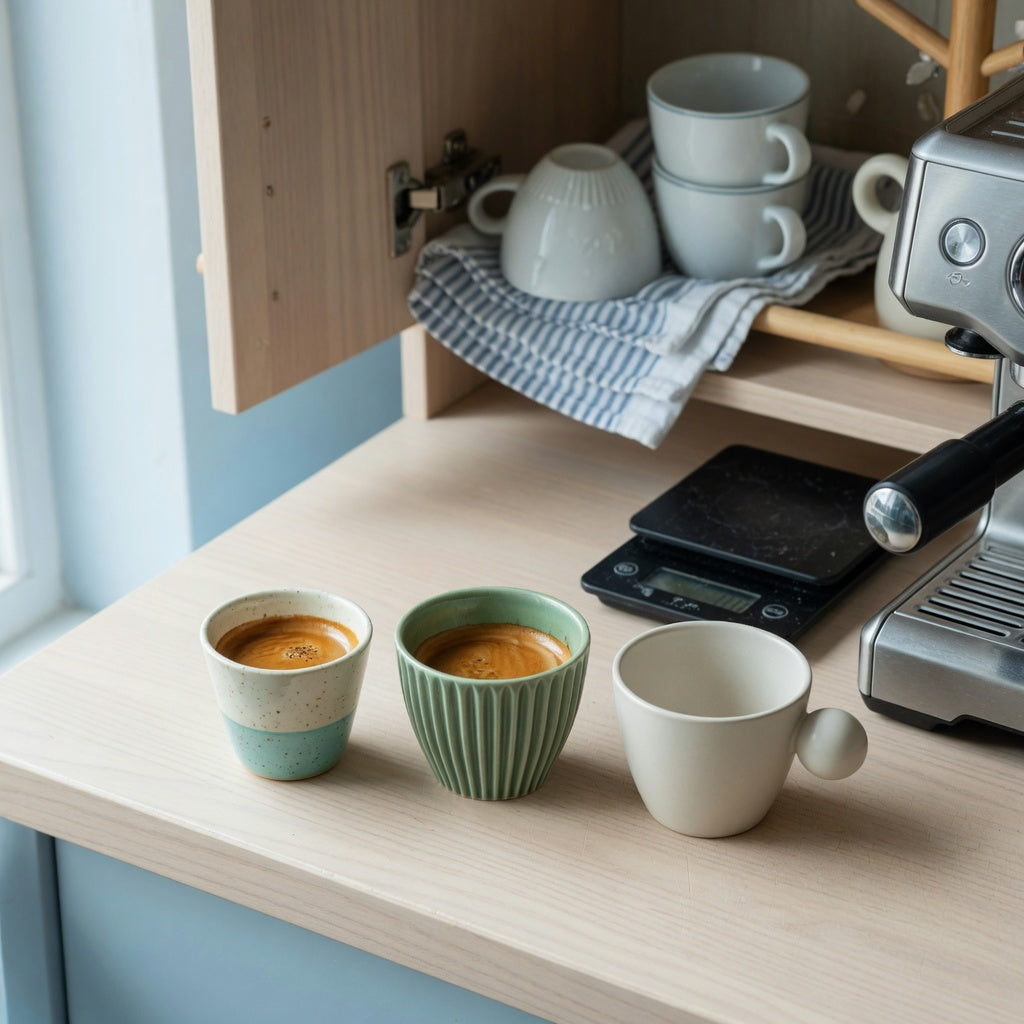
Cute Espresso Cups Everyday Mug Rotation Product Shortlist Guide
Reading time: about 10 minutes
Someone at our counter last week held up our smallest cup, turned it over, and asked whether it was a latte mug. It holds 170 ml. A traditional demitasse is commonly described at around 50 ml, so the question was fair — and that gap is exactly what a cute espresso cups everyday mug rotation product shortlist guide has to settle before anything else. Buy on looks alone and you end up with a cup that is either far larger than a demitasse or too small for the drink you actually make.
Here is the shortlist in one line: our three most compact ceramic cups are listed at 170 ml, 200 ml and 250 ml. Each one reads small next to a standard mug. Each one is still larger than a single-shot cup. We do not sell a true 50 ml demitasse, and we will not dress up a 170 ml cup as one.
Everything below stays inside what we can verify — listed capacity, a ceramic body, and the shape you can see. We are not going to hand you a heat-retention number or a chip-resistance rating, because those tests are not published for these cups.
Cute espresso cups everyday mug rotation product shortlist guide: three capacities, three habits
If you would rather judge the forms side by side than read descriptions, browse the unique coffee mugs collection first and come back to the table below.
| Cup | Listed capacity | Best fit | Skip it if |
|---|---|---|---|
| Retro Coffee & Tea Cup | 170 ml | A black double you drink standing at the counter | You want a true demitasse, or you take a generous milk cap |
| Pleated Coffee & Tea Cup | 200 ml | A daily double with a modest splash of steamed milk | Your cabinet shelf is shallow and rim diameter is tight |
| Ball Handled Coffee & Tea Mug | 250 ml | A cortado-sized drink you carry to a desk | You want the cup to read as espresso ware on the shelf |
170 ml Retro Coffee & Tea Cup — for the black double you drink standing up
The Retro is the smallest of the three and the one that sits closest to espresso ware in the hand. A double lands with visible headroom rather than at the rim; read that space as crema room, not as a fill line. In our store, buyers who pick it usually pull two shots back to back at the same counter and do not want to swap cups in between — 170 ml takes the second pour without a reset.
Skip it if your espresso is really a macchiato with a generous cap of milk, or if the tiny-cup ritual is the whole reason you are shopping. A 170 ml vessel will not feel like a demitasse, whatever the glaze does. Check the Retro cup's listed capacity and finish.
200 ml Pleated Coffee & Tea Cup — for the double plus a small pour of milk
Two hundred millilitres is the forgiving middle. It takes a double plus a modest splash without crowding the rim, which makes it the natural pick for anyone whose daily drink sits closer to a small flat white than a straight shot. The pleated exterior is the decorative half of the cup; the volume is the working half, and the two should be judged separately.
Two honest caveats. A ribbed outside gathers dust on open shelving faster than a smooth wall, so expect to rinse rims more often if the cups live out in the open. And a textured body does not automatically nest the way a plain cylinder does — if cabinet space is tight, treat stacking as something to verify rather than assume. See how the Pleated cup is described on its own page.
250 ml Ball Handled Coffee & Tea Mug — a small mug, honestly labelled
At 250 ml this is a compact coffee mug that happens to look good parked next to an espresso machine, and it is worth being blunt about that. The reason to choose it is capacity: a cortado or a small latte fits without a second cup entering the day, and the drink stays with you from kitchen to desk. The ball handle is the visible design difference here; whether the aperture suits your grip is your call, so check the measured handle opening on the listing rather than judging from a photo angle.
The reason to skip it is the same fact read backwards. A double shot in 250 ml looks like a puddle with a stain around it. If the small-cup-and-thick-crema ritual is what you are buying, this is the wrong geometry. Compare the Ball Handled mug's handle and rim.
How many cute espresso cups does a real rotation need?
Rotation is a washing-up problem before it is a style problem. Count the drinks you actually make in a week, then buy to that number instead of to whatever set size looks tidy on a product grid.
- One drinker, one or two shots a day. Two cups. One in use, one clean or drying. A four-piece set mostly occupies shelf.
- Two espresso drinkers in one kitchen. Four cups is the practical floor — two at breakfast, two in the wash.
- Weekend-only espresso. Buy for the weekend. Two cups you like beat six you never reach for.
- Guests once a month or more. The one case where a matched set earns its space, and where a saucer or stand starts to make sense.
- Milk drinks in half your rotation. Weight the shortlist toward 200–250 ml and keep a single 170 ml cup for straight shots.
- Cups that live at the office. Count the walk to the kitchen sink and the depth of your desk drawer, not just the number of colleagues who might want one.
Buy one cup first and live with it for a week. Capacity surprises show up on the first pour, not on the listing page — and returning a single cup is easier than reorganising a shelf of six.
Which measurement vetoes more cute espresso cups: shelf height or group-head clearance?
The emails we get after delivery are rarely about looks. They are about fit. A handful of measurements decide most of it, and none of them appear in a lifestyle photo.
- Drip tray to group head, with the portafilter locked in. If you weigh shots, add the height of the scale — cup plus scale is taller than cup alone, and this is the clearance miss we hear about most often.
- Rim diameter against spout spacing. A narrow rim can catch one stream and miss the other on a bottomless portafilter. If rim width is not stated, ask before ordering.
- Gap between cabinet shelves. Handle profile, not capacity, is usually what forces a cup onto its side. Measure the gap, then match it to the listed height.
- Handle aperture. Small loops hold two fingers at most. Check the number instead of estimating from an angle.
We do not publish a universal clearance figure, because it depends entirely on your machine and your scale. What we can do is help you compare heights and rim widths across the range before you commit.
Does a decorated cup make the crema harder to read?
A plain white interior is the traditional choice for a practical reason: it is the easiest background against which to judge crema colour and thickness. A dark interior or a busy pattern flattens that contrast. Our cups are bought for form and finish rather than as neutral tasting vessels, so if studying the shot is part of why you drink espresso, treat a decorated cup as the less informative option — not a faulty one.
The material question is narrower than it looks. These are ceramic cups; the comparison shoppers raise most often is ceramic against double-wall glass, and independent testing at true espresso volumes is thin — mostly magazine and retailer comparisons rather than anything a standards body enforces. We would rather leave that question open than invent a number for it.
Care, glaze safety and the one label worth reading twice
Two practical points, and neither is a durability promise.
First, care instructions are per product. Whether a decorated exterior is hand-wash only is a question for the listing on the day you buy, not something we will generalise across a range. Second, food-contact wording matters. FDA guidance on lead-glazed traditional pottery explains that lead in a glaze is bound when the piece is fired correctly, that improperly fired glaze may not fuse and can contaminate food, and that ceramicware intended only for decoration should be identified so it is not used with food. The practical version: buy items described as drinkware. Plush espresso-cup toys and purely ornamental objects turn up in the same search results as real cups, and they have no place in a rotation.
When we would talk you out of all three
There are situations where the honest answer is no, and it is worth saying so before you order.
- You want a genuine demitasse. None of these is it. 170 ml is our smallest, and that is a compact cup, not a 50 ml vessel with a handle. Source a true demitasse elsewhere and come back here for the everyday cup.
- You are gifting a serious espresso hobbyist. A pretty cup photographs well in a gift box, then gets shelved if it does not fit their machine. Gift access instead of a guess: send them to shop the full mug range themselves and let them choose a shape they will actually pull shots into.
- Your drink is dessert. Espresso over ice cream needs a wider, lower vessel, which our affogato cup shortlist covers separately. A narrow 170 ml cup is the wrong geometry for it.
- You want iced espresso in it. Ice displaces volume and drops the temperature quickly. A taller glass serves that better than a compact ceramic cup.
Frequently asked questions
Is 170 ml too big for a double espresso?
Not too big to use, but noticeably bigger than a demitasse. A modern double is a short measure of liquid — well under what a 170 ml cup holds — so the drink will look under-filled compared with a 50–60 ml cup. That headroom is useful for crema and a small splash of milk; it just is not a demitasse pour.
Do I need four cups or two for a daily espresso habit?
One drinker pulling one or two shots a day gets by on two: one in use, one clean. Two drinkers usually want four. Anything beyond that is a display decision, and the fastest way to crowd a cabinet shelf.
Can I make a macchiato or cortado in the 200 ml Pleated cup?
A small splash of steamed milk fits comfortably at 200 ml; a cortado-sized drink is a better match for the 250 ml Ball Handle. This cute espresso cups everyday mug rotation product shortlist guide splits the two by drink size rather than by looks, because drink size is the choice that goes wrong most often.
Are these cups dishwasher safe?
That is a per-product answer, and we will not generalise it across the range. Read the care section on the specific listing before the first cycle — a decorated exterior is often the line between hand-wash and dishwasher.
Will the Ball Handled mug fit under my espresso machine?
Measure drip-tray-to-group-head height with the portafilter locked in, then add your scale if you weigh shots. The listing height is the number to compare against. We do not publish a universal clearance figure because it depends entirely on your machine.
Start with one cup. Pick the capacity that matches the drink you make most mornings, live with it for a week, then add a second. If you are torn between 200 and 250 ml, the tie-breaker is milk: a splash belongs in the Pleated, a proper cortado belongs in the Ball Handle. See all three side by side in our unique coffee mugs collection and choose the one that matches your counter, your cabinet and your machine — not the one that photographs best.
More from our blog
Ready to pick your mug? Two ways to save on today's order:
Ordering 1–3 mugs? Get an extra 10% off your 1st order with code 10_OFF Apply 10% Off & Shop Wooden-Handle Mugs →
Gifting 4+ mugs? Buy 3, Get the 4th Free applies automatically at checkout (no code needed; offers do not stack) · Free standard shipping (Nov pre-Christmas delivery: 15–20 calendar days US) · Free replacement if chipped in transit.
Popular mug buying guides: Ceramic Tea Cups & Infuser Mugs · Ceramic Mugs with Lids Compared · Wooden-Handle Tea Infuser Mugs Compared · Christmas & Secret Santa Mugs 2026 · Espresso & Cortado Cups Guide · Cup & Saucer Gift Sets · All 25 Mugs Spec Table · Mug Size Guide · Shipping & Promo FAQ
FIRST ORDER 10% OFF (CODE: 10_OFF) · OR BUY 3, GET THE 4TH FREE


Read more
Ceramic Latte Cups Everyday Mug Rotation Product Shortlist Guide
A working shortlist of three ceramic latte cups at 250 ml, 400 ml, and 440 ml, each matched to a real morning routine, with the handle, footprint, glaze, and care checks to run before one earns cou...
Read more
Ceramic Latte Cups Storage Fit Guide: 250 ml vs 400 ml vs 440 ml
Three ceramic latte cups, one crowded shelf, and a cabinet door that won't close. We compare our 250 ml, 400 ml and 440 ml cups by listed capacity, handle geometry and realistic shelf footprint — p...
Read more
Leave a comment
This site is protected by hCaptcha and the hCaptcha Privacy Policy and Terms of Service apply.