
Abstract Coffee Mug Everyday Mug Rotation Product Shortlist Guide
Reading time: about 10 minutes
At 7:15 a.m., the mug at the front of the cupboard usually wins. A visually interesting mug may look right on a product page, but it can still end up behind the everyday cups if its capacity does not match your normal pour or its shape does not suit your storage. Our abstract coffee mug everyday mug rotation product shortlist guide starts with those ordinary decisions: what you drink, where the mug lives, and how often you are willing to refill it.
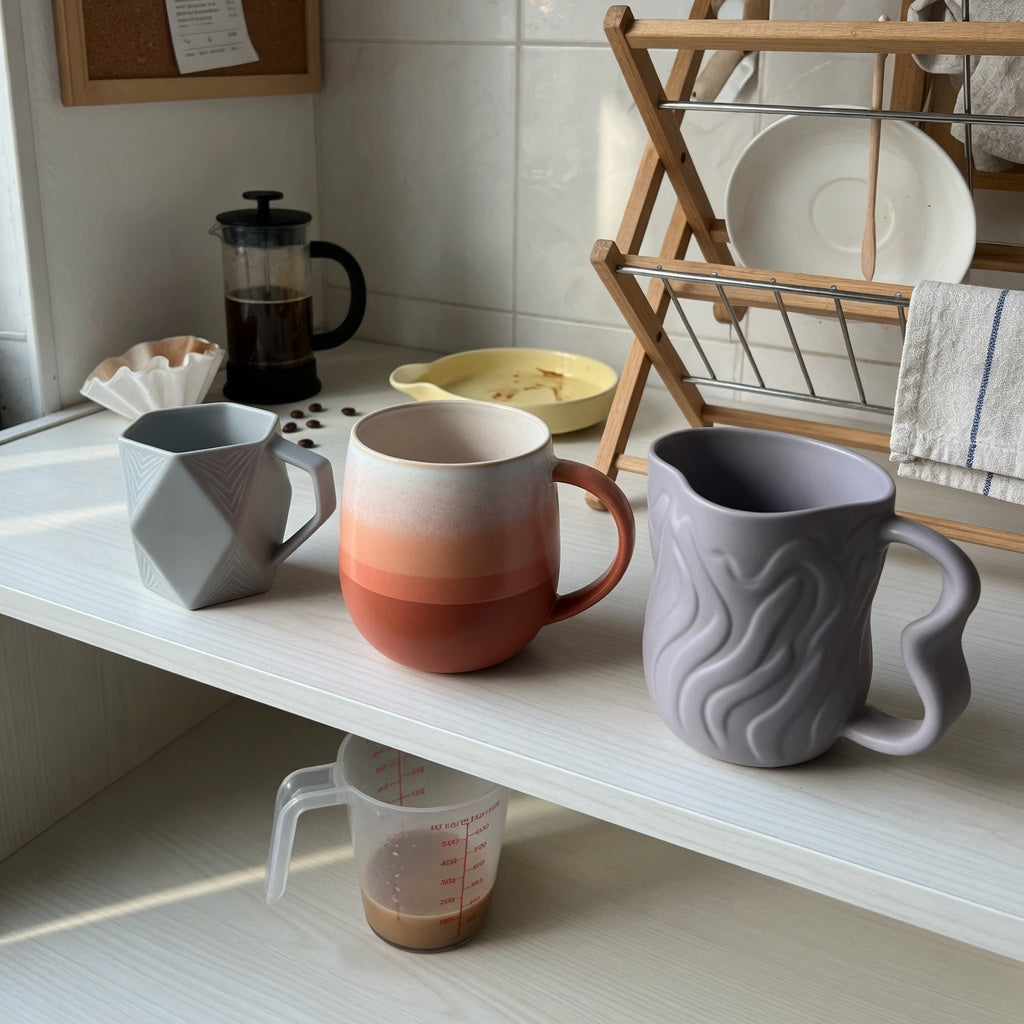
In our store, we treat abstract as a shopper's style lens for geometric forms, color transitions, and sculptural curves. It is not a claim about a designer, artistic provenance, production method, edition status, or named movement. The verified product differences used here are specific: Rhombus has a 250 ml capacity and geometric form, Gradient has a 400 ml capacity and color-transition finish, and The Flow has a 400 ml capacity with sculptural curves.
Which capacity matches the drink you make five days a week?
Measure the finished drink, not an idealized recipe. Fill your current mug to its usual weekday level, including milk or other additions, and pour it into a marked measuring jug. If you make iced coffee, account for the space taken by ice. A stated 400 ml capacity does not mean the mug can hold 400 ml of liquid plus a full serving of ice without approaching the rim.
- Choose the 250 ml capacity band if your normal drink is a short coffee, a modest tea, or a pour you are happy to refill. It can also give a smaller drink a defined role instead of leaving it in an oversized mug.
- Choose the 400 ml capacity band if your finished drink is regularly above 250 ml, you add milk or ice, or you want one mug to remain on an office desk through a longer work block.
Bigger is not automatically more practical. A 400 ml mug can be more volume than a short-pour drinker wants, while a 250 ml mug can create repeated refills for someone accustomed to a larger cup. Capacity mismatch is enough to push a good-looking mug out of a daily rotation, so settle this variable before comparing surface finish or silhouette.
Will the mug fit your shelf, mug tree, and drying rack?
Capacity and external dimensions are different measurements. A 250 ml label does not prove that a mug has the narrowest footprint, and sculptural curves do not tell you the exact width or height. Product photography can also make the widest point difficult to judge. We do not assume that any abstract form stacks, nests, or hangs securely unless the current product information confirms it.
- For a cupboard shelf: measure usable height, width, and front-to-back depth at the exact position where the mug will sit. Allow enough room to lift it without contacting the shelf above.
- For a mug tree: check branch spacing and hanging clearance using a mug you already own as a physical reference. Do not use capacity alone to predict fit.
- For a drying rack: identify a stable position where the mug will not press against plates or neighboring cups. Decorative forms deserve the same practical clearance check as any other drinkware.
- For open shelving: decide whether the visual difference matters enough to earn a visible slot. A color-transition finish has less influence on daily selection if the mug stays hidden at the back of a closed cupboard.
If exact exterior dimensions or hanging compatibility are essential to your setup, confirm them on the live product page before ordering. A geometric or sculptural label describes the visual form; it is not evidence of compact storage, stackability, or a particular grip.
Our abstract coffee mug everyday mug rotation product shortlist guide
This shortlist gives each mug one clear job. Start with the row that matches your real drink routine, then read the choose-or-skip details before opening the product page.
| Option | Verified catalog facts | Best rotation role | Main reason to skip |
|---|---|---|---|
| Rhombus | 250 ml, geometric form | Short weekday pours and refill-friendly routines | Your usual finished drink exceeds 250 ml |
| Gradient | 400 ml, color-transition finish | Longer drinks where surface color provides the visual change | You prefer short pours or care only about sculptural form |
| The Flow | 400 ml, sculptural curves | Longer drinks where silhouette provides the visual change | You want a conventional profile or cannot confirm storage fit |
Rhombus for a measured 250 ml drink
Reader situation: Your normal coffee or tea fits within 250 ml, you do not mind refilling, and your rotation lacks a smaller dedicated mug. Why it fits: The Rhombus 250 ml geometric coffee tea mug is the only smaller-capacity option in this three-product shortlist. Its geometric form also creates a clear visual difference from a plain cylindrical cup. Skip it: Do not choose Rhombus as your main weekday mug if your usual drink is closer to 400 ml or includes substantial room for milk and ice. Its geometric description does not guarantee a compact footprint, so storage still needs checking.
Gradient for a 400 ml drink and a finish-led change
Reader situation: You make a larger finished drink and want the abstract element to come primarily from color across the mug's surface. Why it fits: The Gradient 400 ml color-transition mug combines the larger capacity in this shortlist with a color-transition finish. That makes it a logical desk or open-shelf candidate for shoppers who notice surface treatment more than silhouette. Skip it: It is unnecessary capacity for consistently short drinks, and it is not the stronger choice if your priority is a visibly sculptural profile. Confirm current care guidance before ordering if automatic dishwasher use is a requirement.
The Flow for a 400 ml drink and a form-led change
Reader situation: You also need a 400 ml capacity, but the outline and curves of the mug matter more to you than a color transition. Why it fits: The The Flow 400 ml sculptural mug uses sculptural curves as its defining visual feature. It gives the larger-drink slot a different shape-led identity. Skip it: Choose a simpler style if you prefer a conventional profile, or pause if your mug tree and shelf have no tolerance for an unmeasured shape. Sculptural curves should not be treated as proof of better grip, balance, or durability.
Do two 400 ml mugs add variety or duplicate the same job?
Gradient and The Flow share the same verified 400 ml capacity, so many single-mug shoppers should treat them as alternatives rather than automatic companions. The useful distinction is where you want the abstract character to appear.
- Pick Rhombus plus Gradient if you need separate short-pour and long-pour roles, and you want the larger mug distinguished by its color-transition finish.
- Pick Rhombus plus The Flow if you need those same two capacity roles but want the larger mug distinguished by sculptural curves.
- Pick both 400 ml options only if your household regularly uses two larger mugs or if finish and form create genuinely separate use cases. Skip the pair if one person will use both for the same drink at the same desk.
A two-mug shortlist is often enough: one capacity for the drink you make most often and one clearly different option for another routine. If neither the geometric, color-transition, nor sculptural direction suits your kitchen, compare the broader unique coffee mugs collection using your measured pour and storage limits as filters.
What must you confirm before a dishwasher cycle?
The verified facts supplied for this comparison do not establish material, microwave compatibility, dishwasher suitability, or special care requirements. Do not infer ceramic, porcelain, stoneware, or another material from photography alone. A decorative finish is also not evidence that a mug is either fragile or unusually durable.
- Read the current product information and included instructions. Confirm the listed material and whether dishwasher or microwave use is explicitly allowed.
- Inspect the mug after unboxing. Check the rim, base, and visible surface for chips or hairline cracks that may have occurred in transit before the first wash or pour.
- Follow the stated wash method. If hand-washing is specified, use a soft, nonabrasive cleaning tool rather than assuming the finish tolerates an abrasive scrubber.
- Dry it before closed storage. Make sure the base and any recessed areas are dry before returning the mug to a cupboard.
A mug that requires a care routine you will not follow is a poor everyday candidate, even if its capacity and appearance are right. Shoppers who rely on a dishwasher every night should verify that requirement before choosing any of the three.
Can a one-week rotation test prevent cupboard clutter?
We recommend giving one new mug a defined job for a full week before adding a second abstract option. This is long enough to encounter a normal workday, a sink or dishwasher cycle, and the moment when the mug has to return to its storage position.
- Assign it one drink, such as weekday coffee, afternoon tea, or an office iced drink.
- Place it where your current everyday mug normally sits instead of creating a separate display position.
- Track practical friction: insufficient volume, unwanted leftover drink, extra refills, awkward drying placement, or a storage slot that is difficult to reach.
- Keep it in the active rotation only if both the drink volume and storage routine work. Otherwise, move it to occasional use and revise the shortlist before buying another.
This test separates visual interest from daily fit. In our experience selling this category, shoppers make a clearer second choice once they know whether the first mug solved a real capacity role or merely duplicated a cup they already owned.
Kitchen, office, and gift scenarios that change the pick
- For a compact kitchen: Start with your measured drink volume, then confirm exact exterior fit. Rhombus is the capacity match for pours within 250 ml, but its geometric form should not be assumed to fit a narrow shelf without checking.
- For an office desk: Gradient or The Flow may suit a drink that needs the 400 ml capacity. Choose Gradient for a finish-led difference and The Flow for a form-led difference, then confirm that your workplace care routine matches the product instructions.
- For a gift: Use the recipient's known mug habit, not the most dramatic photograph. Rhombus can disappoint someone who always makes a large drink, while either 400 ml option can be excessive for a short-tea routine. Include care and storage practicality in the decision before the gift unboxing.
The best shortlist is not the one with the most variety. It is the one where each mug has an obvious drink, storage position, and reason to be selected over the cups already in the cupboard.
Frequently asked questions
What does an abstract coffee mug everyday mug rotation product shortlist guide help me compare?
It compares mugs by repeat-use factors rather than appearance alone. For these three options, that means choosing between a 250 ml or 400 ml capacity, checking storage fit, and deciding whether you prefer a geometric form, color-transition finish, or sculptural curves.
Is the 250 ml Rhombus large enough for everyday coffee?
It is large enough only if your normal finished drink fits within 250 ml or you are comfortable refilling. Measure the coffee with any milk or additions included. Choose a 400 ml option if your usual drink consistently exceeds that amount.
Should I choose Gradient or The Flow if both are 400 ml?
Choose Gradient if the color-transition finish is the visual difference you want. Choose The Flow if sculptural curves and silhouette matter more. Since capacity does not separate them, storage fit, care instructions, and your preferred visual emphasis should decide the shortlist.
Are Rhombus, Gradient, and The Flow dishwasher and microwave safe?
Those care claims are not established by the verified facts used in this article. Check the current product page and the instructions supplied with the mug before using a dishwasher or microwave. Do not rely on appearance or assumed material.
Does abstract mean these mugs have verified artist or design provenance?
No. We use abstract only as a practical shopping description for geometric forms, color transitions, and sculptural curves. It does not assign a creator, production method, edition status, institutional connection, or named art movement.
Your next step: Measure your normal finished drink, identify the exact shelf or desk position the mug will use, and open the product page for the one matching capacity and visual direction. If none clears both checks, return to the unique mug collection and keep those two measurements beside you while comparing.
More from our blog
Read more
Green Ceramic Coffee Mugs Everyday Mug Rotation Product Shortlist Guide
Build a three-mug shortlist around wash frequency, cabinet clearance, and the role each design will play. This guide gives clear reasons to choose, verify, or skip Emerald, Green Waves, and Round o...
Read more
Black Tea Mug Everyday Mug Rotation Product Shortlist Guide: 3 Fits
Compare the Round 390 ml, Gradient 400 ml, and The Flow 400 ml by actual pour size, handle profile, storage space, and desk use. Each option has a clear reason to choose it, skip it, or test one be...
Read more
Leave a comment
This site is protected by hCaptcha and the hCaptcha Privacy Policy and Terms of Service apply.