



Ceramic Latte Cups Everyday Mug Rotation Product Shortlist Guide
Reading time: about 11 minutes
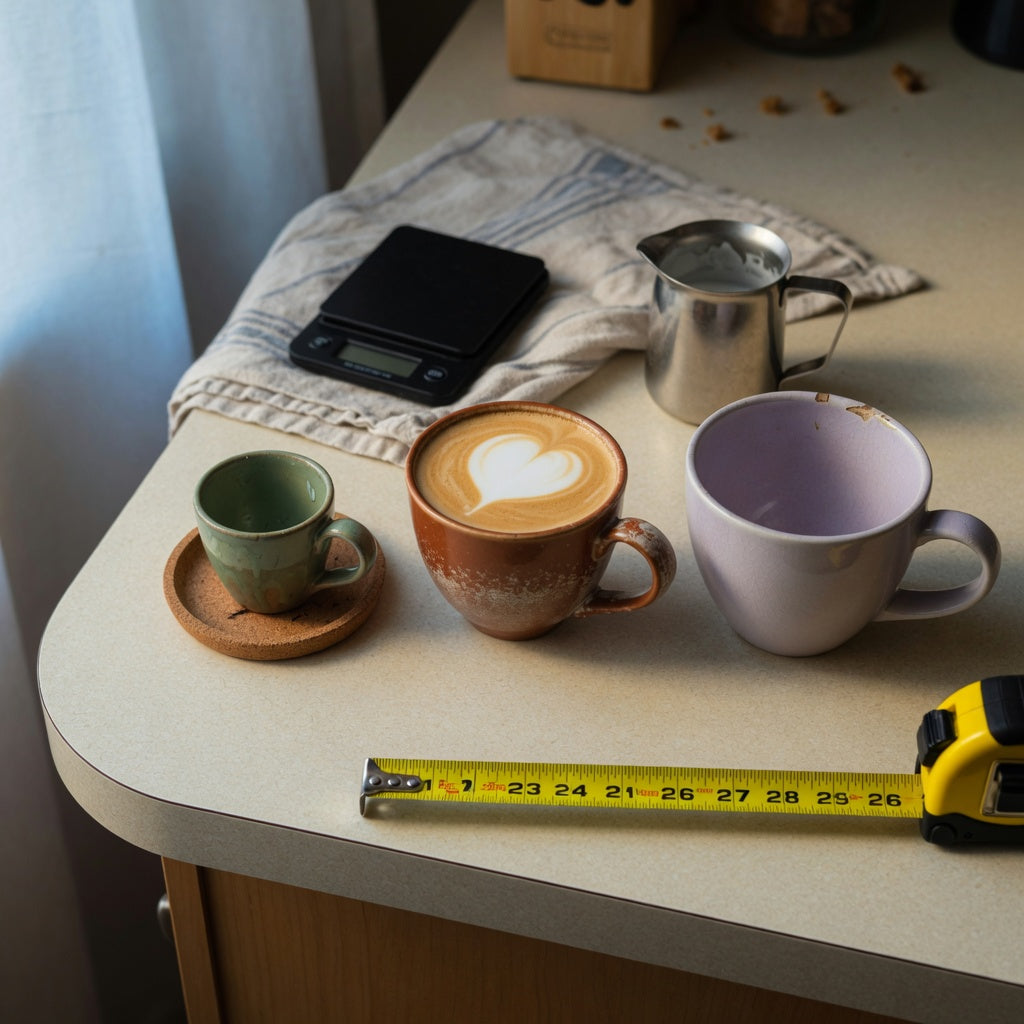
Three cups sit on our packing bench most mornings: the 250 ml Ball Handle, the 400 ml The Flow, and the 440 ml Morning and Night. The one that leaves the shelf first is usually the one whose fill line, handle, and footprint match the drink that person actually makes. This ceramic latte cups everyday mug rotation product shortlist guide is our working shortlist for that decision, not a broad buyer’s guide and not a promise that one size fixes every morning.
We pack and ship these cups every week, and the questions we answer are rarely about colour. They are about whether a cup will hold the drink someone makes before 8 a.m., fit the gap beside a keyboard, and survive the way that person actually loads a dishwasher.
What separates a ceramic latte cup from the mug already in your cabinet?
The FDA gives a useful baseline for the object most shoppers already picture. It describes cups and mugs as small ceramic hollowware for hot drinks, normally holding about 240 ml (8 fl oz) and made with a handle. Cups normally have a base and curved sides; mugs have cylindrical sides. That is a labelling convention rather than a style law, but it explains why latte cups often cluster around 200–300 ml while a diner mug runs larger and straighter.
Three buyer variables decide whether a cup keeps getting picked up:
- Listed capacity versus fill line. A 10 oz ceramic latte cup may hold 10 oz only when filled to the rim, which is not how anyone carries coffee across a room.
- Interior curve. A bowl-shaped or rounded-bottom cup can make a simple latte-art pour easier to control; a straight-sided mug gives a wider surface but can spread the pour.
- Handle geometry. The opening has to clear two or three fingers when the cup is full, not when it is empty on a shelf.
Why does a 10 oz ceramic latte cup pour like an 8 oz mug?
Because capacity is usually measured to the brim, and nobody pours to the brim. Three volumes stack up inside any ceramic latte cup: the espresso, the steamed milk you actually want, and the foam headspace you leave so the drink can be carried without a lap incident.
If your double shot is about 60 ml, a 250 ml cup leaves roughly 190 ml for milk and foam before you reach the rim, and you should not reach the rim. That is a short milk drink, closer to a flat white or cortado than the 12 oz latte many people mean by default. A 400 ml cup leaves roughly 340 ml, which is where a standard latte lives. At 440 ml you gain about 40 ml of extra headroom, which reads as a taller, foam-heavier pour or a generous tea.
This is the gap behind reviews that say a cup holds less than advertised. When a listing gives ounces and nothing else, ask whether that number is brim-full, a comfortable fill line, or includes foam headspace. If 12 oz is already your settled number, do the same arithmetic in reverse before you buy a smaller ceramic latte art cup.
Which interior shape helps latte art, and which shape just looks good in photos?
A rounded bottom is useful for control because milk collects in a narrower column as you pour. A wide, straight-sided mug gives you more surface area, which can suit a loose rosetta or a slow heart, but it also makes a small volume of milk spread thin. Neither shape is better for every drink. Capacity should come first, then rim width and interior curve.
Do not judge interior depth from a product photo taken at an angle. If latte art practice is the reason you are shopping, pick the capacity you will actually serve, then confirm the rim width and interior shape on the live listing. A 250 ml cup is a fine training vessel for control, but full-size pours belong in the 400 ml or 440 ml range so the surface area matches what you will serve guests.
Ceramic latte cups everyday mug rotation product shortlist guide: three sizes, three jobs
Here is the shortlist in one view, based on the listed capacities and the mornings each size tends to suit. We are stating capacity plainly; handle opening, base diameter, and footprint should be checked on each current listing because those measurements decide whether a cup fits your desk and shelf.
| Cup | Listed capacity | The morning it fits | Reasonable reason to skip |
|---|---|---|---|
| Ball Handle | 250 ml | One short milk drink, taken standing up or at a small desk | You default to a 12 oz latte or iced coffee |
| The Flow | 400 ml | The everyday latte, with room for a double shot and a foam cap | You pull single shots only, or your shelf gap is shallow |
| Morning and Night | 440 ml | Long morning lattes and a large evening tea | You drink short, strong drinks or have tight cabinet clearance |
Ball Handle, 250 ml: the short-drink cup
Listed at 250 ml, the Ball Handle coffee and tea mug is the size that suits a cortado, a flat white, or a single-shot cappuccino. It is the cup we reach for when the drink is short and the conversation is long.
Choose it if your daily drink is one small milk drink and you like the cup to feel nearly full at the end of the pour. Skip it if you routinely build 12 oz lattes, drink iced coffee, or want one vessel that also handles a large mug of tea; the volume simply is not there. Before ordering, check the handle opening and base diameter on the listing, because both decide whether it sits properly on the coaster you already own.
The Flow, 400 ml: the default latte
Listed at 400 ml, The Flow coffee and tea mug covers the middle ground most latte drinkers actually occupy. A double shot plus milk plus a modest foam cap lands inside 400 ml without pushing liquid to the rim.
Choose it if you want one cup that works for a standard latte, a large flat white, or a mug of strong tea. Skip it if your habit is a single shot with a splash of milk; you will be pouring a half-full cup every morning, and a half-full cup is exactly the kind of thing that quietly drops out of rotation. Confirm the footprint if your desk is narrow, since capacity alone does not tell you how much clear space the base needs.
Morning and Night, 440 ml: the long first drink
Listed at 440 ml, Morning and Night coffee and tea mug is the largest of the three and the one that can plausibly cover two different drinks. Forty millilitres over The Flow sounds trivial on paper; in the hand it reads as noticeably more headspace, which matters for a tall, foam-heavy latte or a big evening tea.
Choose it if your first drink of the day is large, or if you want one cup doing double duty between coffee and tea. Skip it if counter and shelf space is tight, or if your drinks are short and strong; a 440 ml cup filled a third of the way looks wrong in a way a smaller cup never does. Check the height against your shelf gap before you commit, not just the listed capacity.
Which cup survives a desk, a shelf gap, and a full-hand carry?
Two cups with similar capacity can live completely different lives. One gets used daily because it slides next to a keyboard without touching the mouse. The other gets demoted to the back of the shelf because its handle snags the monitor stand every time someone reaches past it.
When customers email us a photo of a crowded desk, the problem is rarely the glaze. It is clearance. Run these four checks before you commit to a desk cup:
- Measure the clear surface you actually have. A coaster, mouse pad, and laptop edge often leave less room than expected.
- Decide whether you want a loop you hook with two fingers or a sculpted form you grip with the whole hand. The second kind needs more side clearance.
- Check that the handle clears the base far enough that your knuckles do not scrape the desk when the cup is full and heavy.
- Measure your shelf gap, not your shelf width. Height is what disqualifies cups in most kitchens.
Handle opening and base diameter are the two numbers that decide this, and they are not always published. Ask before you buy rather than inferring from a product photo. If grip and clearance are your sticking point rather than capacity, compare silhouettes side by side in our unique coffee mugs collection.
What glaze and care checks matter before a cup joins the rotation?
Food-safe is not a mood. The FDA sets action levels for how much lead and cadmium may leach from ceramic food-contact surfaces, measured with an acetic-acid extraction test, ASTM C738, that the agency itself describes as far harsher than ordinary use.
- Lead: 0.5 micrograms per millilitre of leaching solution, applied to any one of six units tested, which covers cups and mugs as small hollowware.
- Cadmium: 0.5 micrograms per millilitre for small hollowware and 0.25 micrograms per millilitre for large hollowware.
- The label: ceramicware with extractable lead at or above those levels should not be marked Lead Free, and the FDA may treat that labelling as false or misleading.
Two consequences for a working rotation. First, a lead-free sticker is a claim, not a test report; if it matters to you, ask the seller for batch data instead of reading the badge. Second, the FDA flags handmade, antique, damaged, flea-market, and brightly orange, red, or yellow decorated pieces as higher concern, while describing everyday commercial factory pottery as much less likely to have a problem. Washing or boiling will not remove lead from a glaze that contains it, so retire any cup with a cracked or crazed surface rather than keeping it in daily service.
Microwave and dishwasher safety are piece-specific too. The FDA notes that microwaves are reflected by metal and pass through ceramic, so a plain glazed cup is the straightforward case; metallic trim, lusters, and cracked glaze are different questions. A general claim that ceramic is microwave safe does not automatically cover a decorated band or a repaired chip. Read the care note on the exact listing you are buying, and do not assume every cup in a shop behaves identically.
How many ceramic latte cups does one household actually rotate?
Three, in most households. One in use, one clean and dry, one in the dishwasher. That is enough to survive a skipped wash without buying a set of six you will never cycle through.
Storage maths decides the rest. Measure the gap between shelves before you fall for a tall cup, and decide in advance whether you are a stacker or a single-layer person. Stacking depends on handle clearance and rim shape, which is not something to guess from a photo. A small tape measure on the counter settles more arguments than any product description.
When are ceramic latte cups the wrong buy?
Three cases where we would genuinely point you elsewhere:
- Iced coffee and cold brew. Ice displaces volume, so a 250 ml cup becomes roughly a 150 ml drink once ice goes in. Start at 400 ml, or use glass.
- Commuting. None of these are travel vessels. A lidded tumbler wins on every metric that matters inside a bag.
- Shared office kitchens. Ceramic chips, and a crowded sink is where chips happen. If cups get handled roughly, buy fewer and expect to replace them.
Latte art practice is a softer case. A 250 ml cup is a fine training vessel for control, but if you are practising full-size pours you want the 400 ml or 440 ml so the surface area matches what you will serve.
Frequently asked questions
Is 250 ml enough for a latte?
It is enough for a short milk drink. With a 60 ml double shot you have roughly 190 ml left for milk and foam, which is flat-white and cortado territory rather than a standard latte. If your idea of a latte is 10 to 12 oz, go to the 400 ml cup.
Do these cups come with saucers?
Do not assume a saucer is included. The capacities in this ceramic latte cups everyday mug rotation product shortlist guide refer to the cups themselves. A saucer changes the footprint on a desk and the stacking height on a shelf, so check what the current listing says is in the box before ordering.
Can I microwave a ceramic latte cup?
Plain glazed ceramic is the straightforward case, because microwaves pass through it. Metal trim, metallic handles, and decorative lusters are a different question, and a crack or crazing is a reason to stop using a cup for hot drinks. Follow the care note on your specific cup.
What is the real difference between The Flow 400 ml and Morning and Night 440 ml?
Forty millilitres is roughly two and a half tablespoons, enough to notice as extra headspace for foam or a longer tea service, not enough to change which drink you can make. The bigger variable between those two is handle geometry and footprint, so verify those measurements on the live listings rather than treating them as near-duplicates.
How do I check a lead-free claim on a ceramic latte cup?
Ask the seller for leachable lead and cadmium test results instead of relying on the wording on the box. The FDA action level for lead in cups and mugs is 0.5 micrograms per millilitre, and the agency has found pottery labelled Lead Free that still tested at or above that level.
If you want the shortest path from here, measure your shelf gap and your clear desk space, pick the capacity that matches the drink you make most mornings, then compare shapes in the full mug collection. Two minutes with a tape measure beats another year of one overworked cup.
More from our blog
Ready to pick your mug? Two ways to save on today's order:
Ordering 1–3 mugs? Get an extra 10% off your 1st order with code 10_OFF Apply 10% Off & Shop Wooden-Handle Mugs →
Gifting 4+ mugs? Buy 3, Get the 4th Free applies automatically at checkout (no code needed; offers do not stack) · Free standard shipping (Nov pre-Christmas delivery: 15–20 calendar days US) · Free replacement if chipped in transit.
Popular mug buying guides: Ceramic Tea Cups & Infuser Mugs · Ceramic Mugs with Lids Compared · Wooden-Handle Tea Infuser Mugs Compared · Christmas & Secret Santa Mugs 2026 · Espresso & Cortado Cups Guide · Cup & Saucer Gift Sets · All 25 Mugs Spec Table · Mug Size Guide · Shipping & Promo FAQ
FIRST ORDER 10% OFF (CODE: 10_OFF) · OR BUY 3, GET THE 4TH FREE


Read more

Cute Espresso Cups Everyday Mug Rotation Practical Purchase Checklist
A practical checklist for choosing cute espresso cups that clear your machine, suit the shot you actually pull, and fit the shelf they'll live on. Compare our 170 ml, 200 ml, and 250 ml ceramic cup...
Read more
Cute Espresso Cups Everyday Mug Rotation Product Shortlist Guide
Three compact ceramic cups at 170 ml, 200 ml and 250 ml, matched to black doubles, small flat whites and cortado-sized drinks — plus an honest note on why none of them is a true demitasse and which...
Read more
Leave a comment
This site is protected by hCaptcha and the hCaptcha Privacy Policy and Terms of Service apply.