
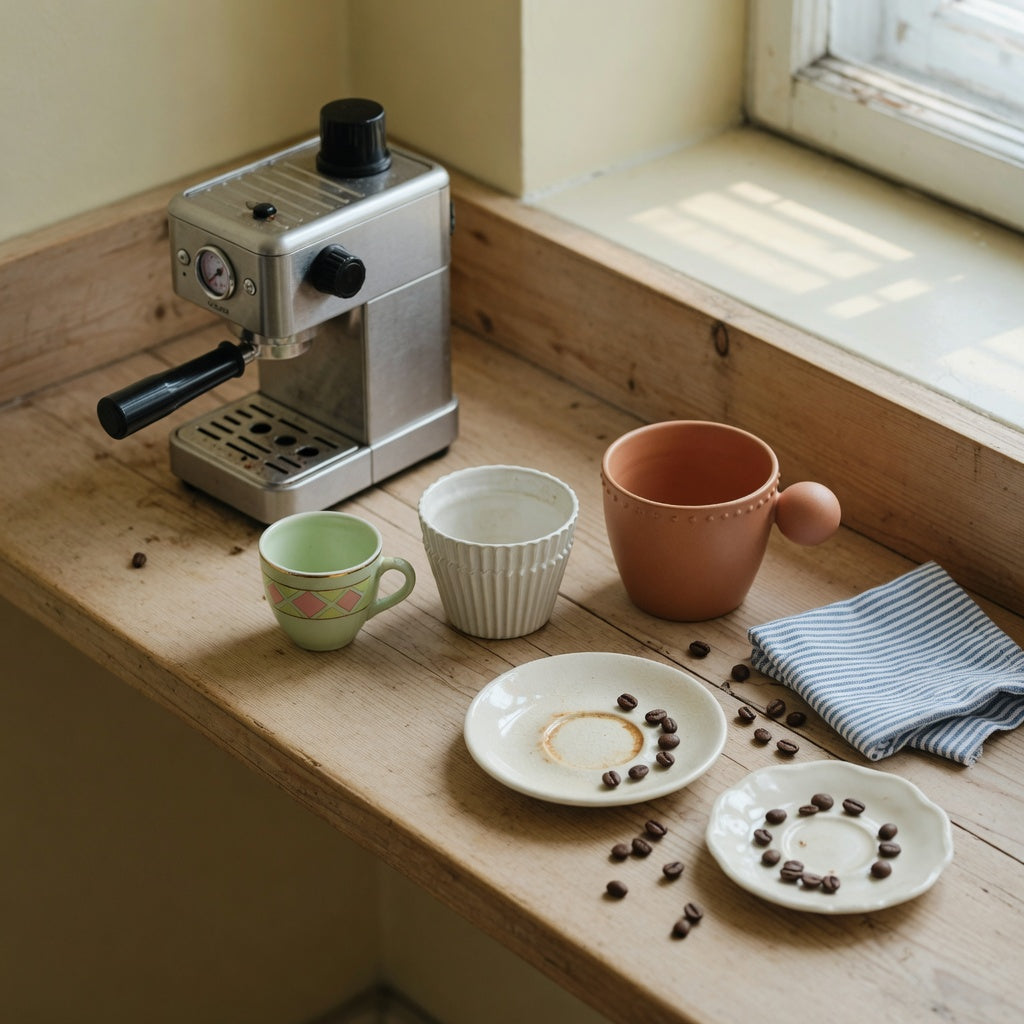
Cute Espresso Cups for Small Coffee Setup: 3 Sizes Compared
Reading time: about 10 minutes
A 170 ml cup is not a demitasse, and that is the first thing to get straight. When shoppers ask us for cute espresso cups for small coffee setup counters, the surprise is usually the same: the cup looks petite in photos, the shot sits low in the bottom, and the space it claims on the shelf is a measurement question, not a photo question.
None of that is a defect. It is a capacity decision. The three ceramic cups we stock in this range — 170 ml, 200 ml, and 250 ml — are compact drinkware, but they are larger than a traditional single-shot cup. That extra volume buys you milk room and tea duty; it costs you crema presentation and some heat. The useful question is not whether this is a real espresso cup, but which size fits the drink you actually make and the counter you actually have.
Why a 170 ml Cup Is Not a Demitasse
Espresso standards describe the drink, not the vessel. A traditional Italian demitasse is often described as holding around 50 ml. A single shot is usually discussed in the 25–35 ml range, and a modern double at a 1:2 brew ratio lands near 36 g of liquid. Put any of those into a 170 ml cup and you have a lot of headspace.
That headspace is where the practical differences show up:
- The shot sits low. Crema spreads across a wide surface and can thin into a film. If the look of the pour matters, a narrower cup reads better than a wide one.
- Empty volume cools a shot. More air above the liquid means more air to heat. Preheating with hot water for about twenty seconds is the habit that makes a larger cup behave more like a hot one.
- The cup earns its shelf space. At 170–250 ml, these cups move into macchiato, cortado, flat white, and tea duty. A 50 ml demitasse cannot do any of that.
That is the honest trade: you give up some crema presentation and heat retention, and you get one cup that does several jobs. If you want a true ristretto cup, none of these are it. You would be shopping in the 50–90 ml range, and that is a different purchase.
Which Size Fits Your Actual Drink: 170 ml, 200 ml, or 250 ml?
Capacity is the number that should drive the pick. All three are ceramic-bodied cups; beyond that, verify the form, any handle, and the care line on the current listing rather than assuming from a lifestyle photo.
| Cup | Listed capacity | What that capacity realistically suits |
|---|---|---|
| Retro coffee tea cup | 170 ml, about 5.7 oz | A double shot with room to spare; the smallest listed capacity of the three |
| Pleated coffee tea cup | 200 ml, about 6.8 oz | A double shot plus a small splash of steamed milk |
| Ball handled coffee tea mug | 250 ml, about 8.5 oz | Small milk drinks, longer blacks, or tea |
If you pull straight doubles and want the least cup here without dropping into true demitasse territory, the Retro coffee tea cup at 170 ml is the place to start. It leaves the shot visible rather than buried, and it is the smallest listed capacity of the three.
If espresso almost always gets milk, the Pleated coffee tea cup at 200 ml buys working room — enough to swirl a macchiato without reaching the rim — while still reading as a coffee cup rather than a mug.
The Ball handled coffee tea mug at 250 ml is the largest listed capacity and the one we point milk-drink and tea people toward. If grip comfort is the priority, the ball handle is the feature to inspect in the photos; confirm the opening size on the listing before you commit.
If you want to compare the silhouettes side by side, our unique coffee mugs collection groups the range in one place. If you specifically want to watch the pour through glass, these are ceramic, not glass — that is a different purchase.
Will It Fit Under Your Spout? Measure These Four Things
There is no published standard for spout-to-tray clearance, so fit stays a machine-by-machine question. In our store, the most common follow-up after a first espresso cup order is a fit question. Measure at home before ordering:
- Height with the saucer in place. Spout tip to drip tray, saucer included. A saucer adds height people forget to count.
- Rim opening versus the stream split. A double spout sends two streams. If the opening is narrow, one stream can land on the rim and run down the outside.
- Base diameter versus the drip tray. A wide base can overhang the tray and tip when you set the cup down one-handed.
- Handle clearance versus the machine housing. On compact machines the group head sits close to the body; a protruding handle can stop the cup from sliding back under the spout.
If the listing does not state cup height, ask before ordering. We would rather answer a measurement email than process a return.
Cute Espresso Cups for Small Coffee Setup Counters: Where the Space Actually Goes
Cute espresso cups for small coffee setup counters usually lose space in one place: the saucer. A cup on a saucer takes roughly twice the footprint of the same cup alone, and saucers do not stack as tightly as cups do. Before you buy a matched set, mark a 20 cm by 30 cm patch on the counter with tape. If the saucers fit inside that patch, you are fine.
Other space decisions worth making deliberately:
- Stacking beats matching. Three cups stacked take less room than two cups on saucers, and a stack survives being pushed into a corner.
- Open shelving beats closed cabinets when the counter is genuinely tiny — a single narrow shelf above the machine costs no counter at all.
- Skip the stand unless it is fixed. Freestanding metal cup stands need clearance on all sides and can wobble, which is the opposite of what a small setup wants.
If you are still choosing a shape, the collection link above is the fastest way to compare silhouettes. For the material side, our ceramic vs porcelain coffee mugs breakdown goes deeper than space allows here.
Handles and Saucers: The Two-Finger Test and the Footprint Trap
Handle comfort is a real variable, not a decorative detail. If the cup has a handle, look at the opening in the product photos and ask whether two fingers — index and middle — would pass through comfortably. If the listing does not make that clear, ask us.
There is a trade-off. A generous handle is easier for larger hands, for anyone with grip issues, and for lifting a full cup one-handed. It is also often the widest part of the cup and the part most likely to clash with the machine housing. On a counter with 8 cm of clearance behind the drip tray, handle width can matter more than rim diameter.
The Ball Handle model is the obvious pick if grip comfort outranks footprint. Buyers with smaller hands often prefer the lower-capacity Retro or Pleated because those cups weigh less when full — but verify the handle or handleless form on the listing first, since these are different shapes.
On saucers: whether a set includes them is a listing question, not a category assumption. If saucers are part of the purchase, count their footprint. If they are not, do not buy a stack of them for a tiny counter just because the photos looked styled.
Does a Pretty Interior Ruin Your Crema Read?
Partly, yes. Tasting guidance tends to favor a plain white interior because it shows crema color and texture clearly. A dark or heavily patterned interior hides the difference between a well-extracted shot and a thin, pale one. The exterior is where you can be as decorative as you like; the interior is the part doing diagnostic work.
So when you look at product photos, look inside the cup, not at it. A floral or speckled outside with a clean white inside gives you both. A saturated interior color is a genuine style choice, but it makes it harder to judge grind and ratio by eye — and if you are still dialing in a new machine, that matters more than it sounds.
This is also where a white ceramic cup has an advantage over dark stoneware or a colored interior. It is not about looking traditional; it is about seeing what you pulled.
Ceramic Care, Glaze Safety, and Dishwasher Reality
Ceramic holds heat well, which is why it is the default for espresso service. Thick walls also take longer to warm up, so the twenty-second preheat earns its keep twice over.
On glaze safety, the U.S. FDA guidance on lead-glazed pottery is worth knowing: lead in a properly fired glaze is bound into the finished surface, but improperly fired pottery can leave lead available to leach into food. The FDA also warns that some traditional pottery labeled lead free has still shown extractable lead, and that ceramicware meant only for decoration must be identified so it is not used with food. Any cup you actually drink from should be sold as food-use drinkware, not as an ornament. See the FDA guidance on lead-glazed pottery for the full wording.
On care, we do not assume a cup is dishwasher safe just because it is ceramic. Painted glazes, metallic rims, and hand-applied decoration are the usual casualties of a hot cycle, and the care line on the current product listing is the version to trust. If a listing is silent on care, hand wash it. Two defect modes to watch for over time are chipping along the rim — usually from stacking without a cloth between cups — and crazing, the fine hairline cracks in glaze that trap coffee oils and stain.
Gift Cup or Daily Driver: Which One Are You Buying?
Pretty sets sell as gifts, and that is fine — just be clear about which job you are buying for. A cup that gets used twice a day needs a comfortable handle, a care routine you will actually follow, and a size that fits your machine. A cup that sits on a shelf as a gift needs none of that.
If the recipient is a daily espresso drinker, buy the size that matches their machine and skip the stand. If the gift is for someone with a tiny counter, start with the machine-fit measurements above; among the three, the 170 ml Retro is the smallest listed capacity and the closest to a compact cup. If they drink milk drinks, the 200 ml Pleated is the more useful gift. The 250 ml Ball Handle is the pick for tea drinkers and larger hands.
For a broader look at the larger formats, our cute ceramic coffee mug guide covers the mug side of the same counter-space problem.
Frequently asked questions
Can I pull a single espresso shot into a 170 ml cup?
Yes, but the shot will look sparse and cool faster because of the headspace above it. Preheat the cup with hot water first, and the result is much closer to what you would get from a smaller vessel.
Do cute espresso cups for small coffee setup counters fit under a spout?
That depends on your machine, not the cup. Measure spout tip to drip tray with any saucer in place, then check the cup height on the listing or ask us. There is no industry standard for clearance, so no one can promise fit without that number.
Are these cups dishwasher safe?
Check the care line on the specific product listing rather than assuming. Ceramic alone does not guarantee dishwasher safety, and decorated or hand-finished glazes are usually the first thing to dull in a hot cycle. When in doubt, hand wash.
What is the difference between these and a traditional demitasse?
Capacity, mostly. A traditional demitasse is often described as holding around 50 ml, while ours are listed at 170 ml, 200 ml, and 250 ml. Ours hold a double shot with room left and can also take milk or tea; a demitasse cannot.
Can I use the same cup for tea?
Yes — these are sold as coffee and tea cups, and 200–250 ml is a sensible size for a small cup of tea. Rinse promptly if you switch between the two, since tea tannins can cling to the cup interior.
More from our blog
Read more

Ceramic Latte Cups Home Office Product Shortlist Guide: 3 Desk Picks
A desk-first shortlist of three ceramic latte cups — 250 ml, 400 ml, and 440 ml — with the home-office scenario each fits, the reasons to skip it, and the listing details that matter before checkout.
Read more
Cute Espresso Cups for Desk Use: Capacity, Footprint, Handle Fit
A desk cup usually fails on footprint, refill rhythm, or handle clearance before it fails on looks. We compare our 170 ml, 200 ml and 250 ml ceramic cups so you can match capacity to your machine, ...
Read more
Leave a comment
This site is protected by hCaptcha and the hCaptcha Privacy Policy and Terms of Service apply.