
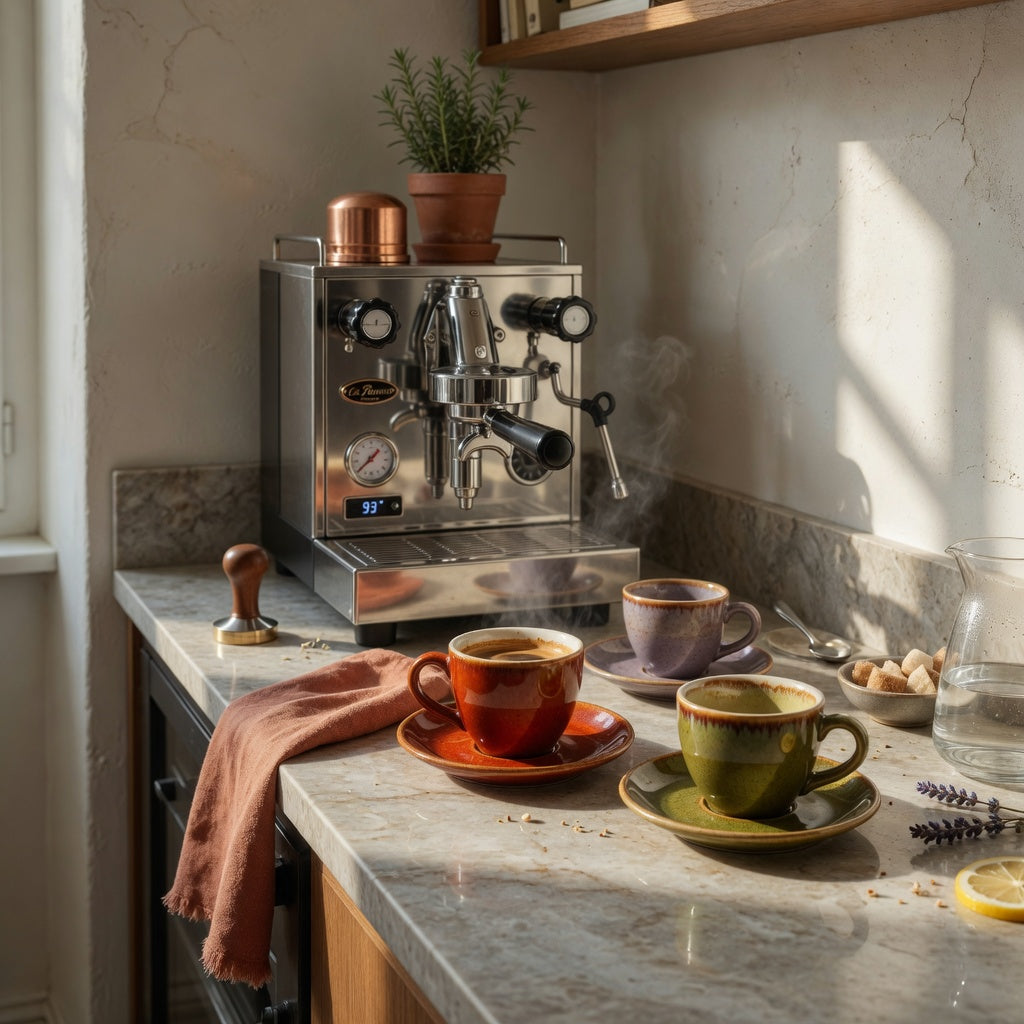
Cute Espresso Cups for Compact Corners: Sizing & Glaze Guide
Reading time: about 8 minutes
A 12-inch strip of butcher block between a grinder and a sink is often all the space a home coffee bar gets. In our store, we watch coffee lovers measure their espresso machines down to the millimeter, only to discover that their drinkware crowds the workspace. Selecting cute espresso cups brings personality and warmth to an otherwise utilitarian setup, but visual charm cannot compensate for an overflowing drip tray or a handle that bangs into your bean hopper. Making a smart purchase means looking past initial aesthetics to evaluate listed capacity, handle projection, and ceramic glaze durability.
Traditional Italian demitasse cups hold between 60 ml and 90 ml (roughly 2 to 3 fluid ounces), designed exclusively for a concentrated single or double shot of straight espresso. The compact ceramic vessels in our catalog—ranging from 170 ml to 250 ml—are deliberately larger. They bridge the gap between a miniature demitasse and a bulky 350 ml diner mug, giving you practical volume for cortados, flat whites, Americanos, and concentrated pour-overs without monopolizing your counter. This guide breaks down how three verified ceramic shapes in our collection perform in tight quarters so you can match the right cup to your daily coffee ritual.
Sizing cute espresso cups against tight coffee bar counter space
Countertop real estate vanishes quickly once you lay down a knock box, tamping mat, digital scale, and milk frothing pitcher. When shoppers evaluate compact drinkware, they usually check only the diameter of the base. The true functional footprint, however, includes the outward reach of the handle, vertical clearance under portafilter spouts, and the total diameter of any saucer you intend to slide underneath.
If you store drinkware directly on top of your espresso machine's warming tray, vertical clearance beneath overhead kitchen cabinets becomes your tightest bottleneck. A cup with excessive height forces you to tilt the rim forward every time you lift it, risking chips against upper cabinet molding. On the other hand, if you park your cups on narrow floating shelves beside your setup, lateral width dictates whether you can line up three vessels side by side or if you have to stagger them behind your bean canisters.
We always suggest taking a baseline counter measurement before ordering. Place your brewing scale on your machine's drip tray and measure the exact vertical distance between the scale's top plate and the lowest edge of your portafilter spouts. For compact home espresso setups, a wider, lower ceramic profile prevents awkward angled extractions, while a narrower, straighter profile preserves critical shelf space.
170 ml, 200 ml, or 250 ml: matching listed capacity to your daily drink
Because these compact vessels offer more volume than traditional Italian demitasse cups, verifying listed capacity protects you from surprises under the shower screen. In our catalog, three distinct compact ceramic silhouettes address different beverage recipes and spatial limitations:
| Cup Profile | Listed Capacity | Best Drink Ratios | Spatial Fit Trade-Off |
|---|---|---|---|
| 170 ml Retro ceramic cup | 170 ml (~5.7 oz) | Cortados, double macchiatos, small Americanos | Most compact base; holds more volume than a standard 60–90 ml single-shot demitasse. |
| Fluted Pleated Coffee & Tea Cup | 200 ml (~6.8 oz) | Traditional flat whites, 1:1 cappuccinos, loose-leaf tea | Textured outer ridges provide tactile grip but require slight extra lateral shelf clearance. |
| Ball-Handled Coffee & Tea Mug with its sculptural grip | 250 ml (~8.5 oz) | Small morning lattes, AeroPress brews, long black coffee | Largest volume in this compact tier; the spherical handle needs extra side clearance during storage. |
The 170 ml Retro ceramic cup provides the most modest physical presence in this lineup. It comfortably accepts a standard 36-gram double espresso shot accompanied by 100 to 120 ml of velvety steamed milk, leaving adequate headspace to carry the drink across the room without spilling. If you drink straight 30 ml single shots, keep in mind that a 170 ml ceramic body leaves substantial empty volume inside, which exposes the crema to cooler air and drops beverage temperature more quickly.
Stepping up to the 200 ml mark with the fluted Pleated Coffee & Tea Cup accommodates a balanced cappuccino or a double-shot flat white while keeping the base steady on narrow drip trays. If your morning routine rotates between espresso drinks and single-cup drip brews, the 250 ml Ball-Handled Coffee & Tea Mug with its sculptural grip acts as a versatile compromise vessel. It avoids the bulky footprint of an oversized 12-ounce mug while accommodating a wider variety of hot drinks. To explore other decorative ceramic silhouettes designed for cozy kitchen corners, take a look through our wider curated catalog of unique coffee mugs.
Evaluating ceramic glazes, rim geometry, and surface wear in compact spaces
In a small apartment or studio kitchen, your drinkware rarely hides behind closed pantry doors. It sits out on open shelves, display ledges, or machine warming grates. As a result, ceramic glaze selection is as much a functional consideration as a visual one. The surface finish governs how easily espresso oils wash out, how the cup feels against your lips, and how well the ceramic resists abrasion over months of daily use.
- Gloss vs. satin glaze behavior: Smooth high-gloss glazes rinse clean with minimal water pressure, an advantage if your espresso corner is located away from the kitchen sink. Matte and satin glazes offer an understated, tactile exterior, but aggressive metal stirring spoons can leave gray metal markings over time. We recommend wooden or silicone mini paddles if you stir sugar into satin-glazed interiors.
- Interior glaze contrast: A bright white or cream interior glaze gives you direct feedback on extraction quality, crema consistency, and roast color. Deeper interior glazes do not show fine crema nuances, but they conceal light coffee tinting if you cannot run a hot rinse immediately after drinking.
- Rim thickness and thermal retention: Dense ceramic bodies hold heat effectively when pre-warmed with hot water from your machine's steam wand. Thicker, rounded rims offer a comfortable mouthfeel that pairs naturally with microfoam milk drinks. In contrast, narrower rims deliver a sharp, concentrated sip profile suited for high-clarity light roasts.
- Reactive and speckled surfaces: Glazes featuring subtle organic speckles disguise faint water spots from mineral-heavy tap water, maintaining an intentional, tidy look on an open coffee cart without constant hand-polishing.
Handle geometry and storage clearance: open trays vs. vertical stacking
How you pick up and store a cup directly impacts daily workflow in a confined space. Generic mug handles often jut outward at wide angles, catching on machine power cords, snagging syrup pumps, or forcing you to space cups far apart on narrow display rails.
The spherical design feature on the 250 ml ball-handled mug creates an ergonomic thumb perch and a striking sculptural outline, but the ball projects directly outward. If you plan to park three mugs in a row on a shallow display ledge, you must allow for that side clearance. Cups with tighter, vertically oriented handles fit closer together on warming trays and allow for compact side-by-side parking.
Stacking is a common space-saving strategy, but glazed ceramics require careful handling. Most ceramic drinkware features an unglazed foot ring at the base where the vessel rested on the kiln shelf during firing. Placing an unglazed foot ring directly into the glazed interior of another cup can generate micro-abrasions over time. If your kitchen storage demands vertical nesting, place a thin disc of silicone or felt between the cups, or mount an open suspension rack that cradles each cup by its handle.
Buyer verification checklist before confirming your order
Because manufacturing batches evolve and specifications update, we advise checking active product listings against these criteria prior to placing an order:
- Check total vs. usable capacity: Stated catalog figures (170 ml, 200 ml, 250 ml) represent maximum brimful volume. Plan for a working capacity roughly 15 to 20 ml lower to prevent spills while moving the cup.
- Verify appliance tolerances: Clay body thickness and decorative glaze elements dictate microwave and dishwasher suitability. Review specific care notes on each active product page rather than assuming universal ceramic guidelines.
- Assess your grip preference: Decide whether your hand prefers a single-finger pinch grip, an open vertical loop, or a rounded geometric handle like the ball accent.
- Measure the drip tray grate: Ensure the flat base diameter of your chosen cup sits comfortably on your machine's drip tray ribs without tilting over drainage cutouts.
- Review your beverage profile: Choose 170 ml for cortados, 200 ml for cappuccinos and flat whites, and 250 ml for versatile coffee and tea infusions.
Frequently asked questions
Can cute espresso cups handle a standard cafe latte?
Commercial cafe lattes typically measure between 300 ml and 350 ml (10 to 12 ounces), which exceeds the capacity of these compact pieces. However, our 250 ml ball-handled vessel comfortably holds a classic 8-ounce latte, while the 170 ml and 200 ml options are tailored for cortados, macchiatos, and flat whites.
Why are these compact ceramic cups larger than traditional demitasse cups?
Traditional single-shot demitasse cups hold only 60 ml to 90 ml, which leaves no room for steamed milk or dilution. Our 170 ml to 250 ml compact ceramic cups give you sufficient volume for milk-based espresso drinks and concentrated filter brews while keeping your counter footprint minimal.
How should I care for specialized ceramic glazes on small drinkware?
Check the care instructions on each product page for dishwasher compatibility. For regular upkeep, cleaning with a soft sponge and mild detergent prevents surface abrasion on delicate matte or reactive glaze finishes.
Will these cups fit under a low portafilter with a coffee scale in place?
Compact ceramic cups generally feature lower vertical sidewalls than tall morning mugs, making them easier to position on a scaled drip tray. Measure the distance between your scale plate and the portafilter spouts to ensure at least 5 to 10 mm of clear working room before brewing.
More from our blog
Read more
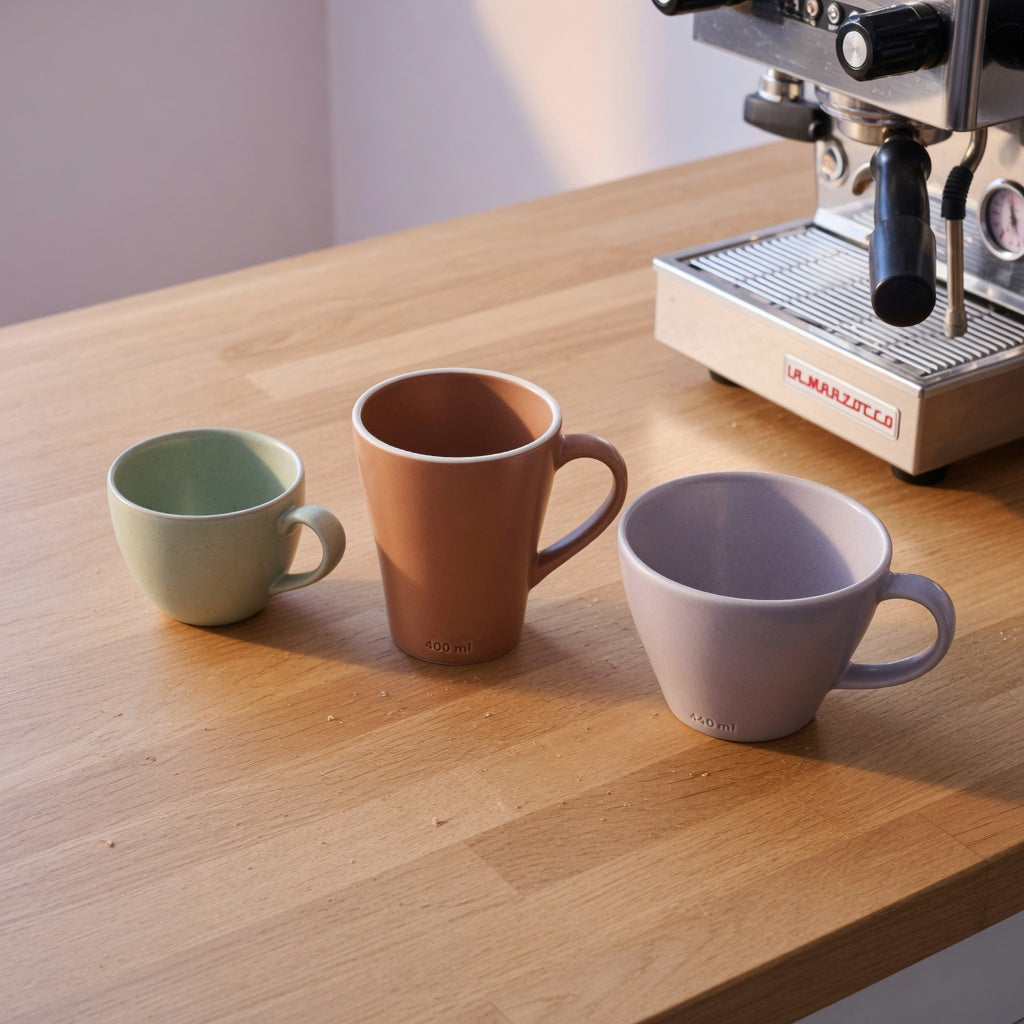
Ceramic Latte Cups Guide: 250 ml, 400 ml, and 440 ml Sizes
Compare ceramic latte cups across 250 ml, 400 ml, and 440 ml sizes. Learn how vessel shape, handle geometry, and desk footprint impact your daily coffee routine.
Read more
Ceramic Mugs Ideas for Desks and Shelves: A Practical Guide
Explore ceramic mugs ideas tailored for busy workstations and display shelving. Compare verified 170 ml, 400 ml, and 480 ml capacities to match your daily routine.
Read more
Leave a comment
This site is protected by hCaptcha and the hCaptcha Privacy Policy and Terms of Service apply.